


22,79 €
Mehr erfahren.
- Herausgeber: Independent Thinking Press
- Kategorie: Bildung
- Sprache: Englisch
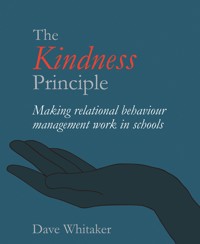
Written by Dave Whitaker, The Kindness Principle: Making relational behaviour management work in schools advocates a behaviour management approach rooted in values, acceptance and a genuine understanding of children's behaviour. In an education system that too often reaches for the carrot-and-stick approach to dealing with poor pupil behaviour, an approach built on kindness and compassion might just provide the cure. The Kindness Principle begins with the idea that relationships should be at the heart of behaviour management and culture, and sets out the ways in which the adoption of relational approaches can help create safer and happier schools. Schools where all staff and learners are valued and understood, where expectations and standards are high, and where kindness and acceptance matter. Dave Whitaker explores why it is so important to understand children - offering techniques and advice on how to work effectively with all children (even the most challenging and troubled ones) without resorting to zero-tolerance, no-excuses and consequence-driven practices. Dave also shares a wealth of real-life experiences from some of the most challenging schools in the country, along with research-informed insights that will help teachers understand children's behaviour in a new light. To this end he provides a wealth of guidance to help develop effective practice and learn from people who have actually walked the walk and don't just talk the talk. Furthermore, the topics covered in the book include: restorative approaches, unconditional positive regard, building personal resilience, structures and routines, and the ins and outs of rewards and sanctions. Suitable for teachers, school leaders and anyone working with children.
Das E-Book können Sie in Legimi-Apps oder einer beliebigen App lesen, die das folgende Format unterstützen:
Veröffentlichungsjahr: 2021
Ähnliche


















Praise for The Kindness Principle
This is a wonderful book, which anyone who cares about children and young people will find compelling. It challenges so much of the current orthodoxy about macho ‘no excuses’ school cultures and has lessons for us all about relationships and the impact of fear, humiliation and shame on young people.
Fiona Millar, education journalist, The Guardian
Dave Whitaker’s book is a game changer. It’s a behaviour management book for teachers, support staff and school leaders written by someone who actually does it for a living whilst carrying themselves with credibility and integrity. This is no self-help book. It’s a call to loving arms.
Hywel Roberts, teacher, writer, speaker and humorist
The Kindness Principle captures decades of Dave Whitaker’s thinking and experience in an inclusive and practical book.
Stephen Tierney, Chair, Headteachers’ Roundtable, and author of Educating with Purpose
How can anyone object to kindness? Particularly when it comes to children. There are so many elements of this book that resonate: the need for adults to be their authentic selves with lived values, the power of recognition and intrinsic motivation, the value of play and co-constructed rules, the rigour of flexible consistency, the effect of seeing attention-seeking behaviour as attention-needing behaviour, and the fundamental problems of using fear and sanctions to control children and demand respect.
Fran Morgan, founder of Square Peg
Dave’s work is so much more than kindness: it is relational, successful and replicable. And what he shares in The Kindness Principle is unconditionally excellent and seriously useful.
Paul Dix, behaviour specialist, WhenTheAdultsChange.com
The Kindness Principle is a book I want to read again and again. Since reading the book, my interactions with dysregulated pupils have improved – and my belief that kindness and relationships should be at the heart of every school has been strengthened.
Simon Kidwell, Head Teacher, Hartford Manor Primary School and Nursery B
Dave Whitaker’s The Kindness Principle is a book that speaks up for children – and it is a really good read. It sheds light on the rituals, routines and habits of the school system and shares current research findings and practical advice to enable teachers and others in school to consider how best to give children every opportunity to succeed and to enjoy their education.
Mick Waters, Professor of Education, University of Wolverhampton
The Kindness Principle is a wonderfully crafted book that reminds us of the value and impact of kindness and authentic leadership in schools. Dave poses a series of provocations, encouraging the reader to consider the systems and leadership behaviours evident in their schools – and challenges them to rethink them. A must-read for anyone who works with children and young people.
Kate Davies, CEO, White Woods Primary Academy Trust
In The Kindness Principle Dave takes us on a ‘25-year learning walk’ with a coherent philosophy of education, a characteristic humility and a sound grounding in neuroscience. Whether it’s practical insight into micro-structures and de-escalation, new knowledge on neurochemicals needed for learning, or the emotional resonances of tricky situations recounted with students and staff, the book shares a lot of powerful learning for educators and leaders at all levels.
Kiran Gill, CEO, The Difference
The Kindness Principle is a must-read book for enlightened educators which provides a practical guide to relationships-led practice. Between these covers, you’ll find everything you need in order to become a school where teachers love to teach, learners love to learn and where curiosity and empathy turn adversity into opportunity.
Dr Pooky Knightsmith, expert on child and adolescent mental health
In The Kindness Principle, Dave provides invaluable insights into the essential ingredients that shape successful behaviour management strategies in schools. I have known Dave for a decade and I believe that he is one of the wisest and most highly respected voices in this field.
Jon Chaloner, CEO, GLF Schools, Vice Chair, Headteachers’ Roundtable
Perhaps one of the greatest mistakes we can make in education is to see the virtue of kindness as somehow irrelevant or, worse still, weak. What Dave Whitaker’s beautiful book shows us is that the opposite is true.
Ben Walden, Director, Contender Charlie
This is for Josie – she was a principal, she had strong principles and she was kind. I wish she were here to read this book.
Foreword
I feel very privileged to have been invited to write this foreword. Dave’s book is one of those rare gems: a really useful education book. It is a book that will take courage to read – and even more courage to apply the approaches advocated within it.
I am not a teacher but, having talked to schools as a neurobiologist and paediatric neurologist for over three decades, it is my experience that almost all of the hundreds of teachers whom I have had the privilege to meet are motivated by a single desire: to do their best for the children and young people under their care. It is to that high ideal that this book gives fuel and substance. We sit at a time when education is being split into two halves: old-style Victorian teaching methods and modern methodologies based on compassion and understanding. As an observer it is hard, at the moment, to see how any commonality can be found between the two. This book lays out ways of thinking about education which any teacher can engage with and then apply to themselves and the children and young people in their care.
To each and every teacher reading this I would ask you to think carefully about the principles and discussions in this book. Ask yourself, are the premises sensible? Do they contain that one essential: common sense? I think that you will likely say, ‘Well, yes. This all seems very sensible.’ I would agree. There is a depth of understanding in this book of how to successfully lead children and young people into that most important of things: self-motivated learning. It has always been my belief that an excellent education is one that produces exactly this.
The deeper principle that is also explicit in this book is probably the most significant one – if you, as a teacher, can develop and own the core principles that are set out here, then you will experience that most wonderful of things: a really enjoyable and often profound life. If you are experiencing that then your pupils will experience the wonder of having a great teacher.
Andrew Curran
Acknowledgements
I have to say thanks to many people who have helped me to be in a position where I can say that I have actually written a book. That probably needs to begin with my ‘persuader’, Ian Gilbert. The encouragement was subtle but effective, even if it did take years. Thanks also to Dr Andrew Curran for not only providing scientific inspiration but for being kind enough to write the book’s foreword.
It goes without saying that this would not have happened without the support of my family – Mum, Dad, Zoe and Ben – but especially my youngest son, Joe, who was my own personal editor and checker. He spent hours by my side explaining sentence structure and grammar – something that was missing from my own education in the 1980s. He certainly is a credit to modern education but also to his own teachers at Hall Cross Academy in Doncaster.
I have to say a huge thank you to the friends and colleagues who have motivated and inspired me over the years – those teachers who champion the most vulnerable children every day. Verity Watts for keeping me thinking, Hywel Roberts for his enthusiasm and support, Danny Ross and Luke Mitchell for being relational experts and gurus in their own right. The staff, past and present, at Springwell in Barnsley, who are the most committed and passionate educators I could have ever wished to work with. And all those who work in Wellspring schools now, carrying the commitment, resilience and passion of unconditional positive regard with them every day.
More recently, I have reason to thank Kiran Gill and Fran Morgan for their eagerness to make a difference to children’s life chances and for their help with the data. Also, Louise Penny from Independent Thinking Press for making my work look good.
Contents
Introduction: It must start with kindness
There can be no keener revelation of a society’s soul than the way in which it treats its children.
Nelson Mandela1
Kindness is defined as the quality of being friendly, generous, and considerate. Affection, gentleness, warmth, concern, and care are words that are associated with kindness. While kindness has a connotation of meaning someone is naive or weak, that is not the case. Being kind often requires courage and strength.
Karyn Hall2
Kindness can sometimes be perceived as weakness and, when associated with behaviour management in schools, can be a real conundrum. Is it possible to use kindness in a way that leads to successful behaviour management? How is it possible for a school to have kindness as its basis for relational behaviour management and still have children who show respect, follow the rules and achieve success? It is hard to believe that kindness, as a foundation for behaviour management, could be questioned or doubted – but it is. If we aspire to be relational in our approach to behaviour management, then we must start with kindness. Kindness can mean being tough and fair – exposing frailties and weaknesses but doing it with warmth and compassion. To remain kind in difficult and challenging environments takes courage and strength.
2 We are living in an era of polarised views on managing behaviour. Fast-track school improvement is based on creating compliance at all costs. High levels of strict conformity are seen as a strength in many schools, even if the collateral damage is high exclusions and cohort change. Many schools across the country employ a system based on strict consequences and sanctions. They use this compliance, along with the threat of punishment, to successfully ‘control’ the behaviour of most of the children in their care. But what do we mean by ‘successfully’?
Exclusion3 is viewed as an acceptable and inevitable consequence of a system in which, without compliance, there is no other option. It is regarded as an unavoidable and tolerable side effect of what are perceived as successful behaviour policies. Strict compliance at all costs is even viewed by some proponents as a positive life lesson that prepares children for adulthood and the ‘real world’.
However, surely a behaviour policy should only be viewed as successful if exclusion is not needed? Arguably, if a behaviour policy must rely on the cliff-edge sanction of exclusion, then it is not successfully changing behaviour for the better. If a school permanently excludes a child, then perhaps they are admitting defeat – that they aren’t able to manage their behaviour. This is inevitably going to provoke controversy, but the idea should at least be explored and debated. As educators, we should all ask ourselves the question about what successful behaviour management actually is. Permanent exclusion essentially means passing the problem onto someone else. It certainly is not a cure.
Should we, as education professionals, regard schools as successful if they do not do their very best to work with the most challenging and vulnerable children in society? Some children need additional support, guidance and flexibility in their educational journey. Some pupils have specific additional needs that cannot be met in a mainstream environment. Some need to move to specialist settings because it is in their best interests to do so. However, some are excluded because the system is failing them; they are moved from school to school because nobody is repairing the damage and making the adjustments that they need in order to be successful. Schools too often focus on dealing with the symptoms of challenging behaviour, 3 not the causes. There is a small but seemingly ever-increasing cohort of children – if my experience is anything to go by – who are either excluded from education or trapped in a cycle of punishment, which seems to be considered an acceptable consequence of a widely used and highly regarded behaviour strategy. We must ask ourselves whether this is OK.
Behaviour management in schools begins with our choices as adults and our behaviour as professionals. Yes, we can write out our behaviour policy and have the rules, rewards and sanctions clearly displayed on classroom walls, but it is our understanding of, and ability to deal with, relationships that really influences behaviour. We all need to be careful with our choices as education professionals. We can, and do, choose where to work, who to work for and who to work with. This book will explore how kindness, strong relationships and an understanding of behaviours (of both adults and children) can lead to successful and happy schools in which children and adults thrive, struggle, laugh and cry together.
We are constantly influenced by those with whom we work, live and socialise. We all work with, or have worked with, leaders and colleagues who either inspire us or frustrate and infuriate us. We must always be willing to learn and develop by exposing ourselves to new ways of working and thinking. We must be led by our core values but also willing to adapt and change throughout our careers as we gain more experience, knowledge and understanding. In the modern world of fake news and social media, we are exposed to strong opinion and polarised views, more so than ever before. Educational debate, particularly on social media, can be both enlightening and utterly frustrating. We must be willing to listen to and learn from the wise. Wisdom is powerful, but it comes from genuine experience and not just from research and books. Books help, as does data, but there is no substitute for wisdom gained through experience.
After starting my career as a secondary school geography teacher – leading inclusion and special needs – and then moving into headship, executive headship and becoming a National Leader of Education (NLE), I found myself in academy trust leadership. This book is a twenty-five-year ‘learning walk’ through challenging, urban, disadvantaged primary and secondary schools, pupil referral units (PRUs) and social, emotional and mental health (SEMH) – previously known as behaviour, emotional and social difficulties (BESD) – special schools, as well as academies and free schools, and the teaching, training, outreach, support and leadership that goes 4 with it. It may help you to make those challenging choices and find contentment in your job and organisation. But, whether content or not, behaviour management is never easy. It is a roller coaster of emotions and stress, which causes us to suffer constant highs and lows. It changes from class to class, week to week and year to year. You think you have got it sorted and then an hour later you think you are a failure. It definitely does not become easy – it just gets easier than it was. Working in challenging schools with complex children is both truly rewarding and exceedingly hard work. It relies heavily on your personal resilience, your ability to accept getting things wrong, and your understanding that when it does go wrong, it is not necessarily anyone’s fault. It is about trying to do your very best for the children who need you – and never underestimating how powerful that need may be.
In 2018 The Guardian published an article about the school where I was lucky enough to be the then executive principal and the way in which we used kindness at the heart of our values and philosophy.4 Looking back, it seems incredible to think that being kind to children was worthy of making the national news – or any news at all. It is also amazing to think that the article received criticism from some for a style of behaviour management that was considered soft, and that I, as the head, was even considered a danger to the teaching profession because of my relational approach. It did, however, open up a debate which allows us to explore the values associated with managing behaviour. It allows us to consider in detail how we treat children in our care and to ponder what it is we are trying to achieve in our schools.
Although this book draws on some thinking from the worlds of therapy and neuroscience, I must be clear that I am neither a therapist nor a neuroscientist – I am a ‘schoolist’. This book is written about schools and for the people who work in them – whoever you may be and whatever role you have.
1 Address by President Nelson Mandela at the launch of the Nelson Mandela Children’s Fund, Pretoria, 8 May 1995. Available at: http://www.mandela.gov.za/mandela_speeches/1995/950508_nmcf.htm.
2 Karyn Hall, The Importance of Kindness, Psychology Today (4 December 2017). Available at: https://www.psychologytoday.com/gb/blog/pieces-mind/201712/the-importance-kindness.
3 At the time of writing, the Department for Education are looking determined to change the term ‘exclusion’ back to the old and antiquated term ‘expulsion’. They are also likely to bring back the term ‘suspension’ to replace fixed-term exclusion too. This seems like a backwards step and a totally unnecessary change, but one I would like you to note. Either way, all these terms still have an extremely negative connotation that we could do without.
4 Josh Halliday, ‘We Batter Them with Kindness’: Schools That Reject Super-Strict Values, The Guardian (27 February 2018). Available at: https://www.theguardian.com/education/2018/feb/27/schools-discipline-unconditional-positive-regard.
Chapter One
Unconditional positive regard
Don’t smile until Christmas?
Before we delve deeper into the behaviour of children in school – the challenges it brings, the emotions it generates and the solutions we need – we should first reflect on the work of Carl Rogers, the author of numerous books focused on the humanistic approach to psychotherapy. Rogers believed that:
For a person to ‘grow’, they need an environment that provides them with genuineness (openness and self-disclosure), acceptance (being seen with unconditional positive regard), and empathy (being listened to and understood). Without these, relationships and healthy personalities will not develop as they should, much like a tree will not grow without sunlight and water.1
Rogers was an American psychologist who pioneered a person-centred approach to understanding human relationships. His work is widely used in the fields of psychotherapy and counselling but less so in modern education. However, if we look at the following quote, I think you might be able to see why it may be applicable for us:




