


20,39 €
Mehr erfahren.
- Herausgeber: Independent Thinking Press
- Kategorie: Bildung
- Sprache: Englisch
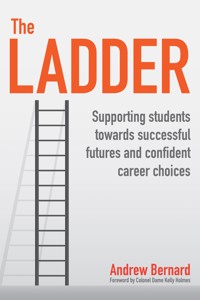
Foreword by Colonel Dame Kelly Holmes. Regardless of one's plans for the future, many people's careers are founded on a series of chance encounters, experiences and serendipity. School, college, university, jobs, family, sports, hobbies, friends, relationships - these are all fertile grounds for career-related conversations and explorations.What if we teachers, guides, mentors, parents and peers started to notice these seemingly unconnected happenings and, indeed, started to engineer and encourage them to happen? Using the mantra 'every adult is a careers teacher', The Ladder will inspire teachers to explicitly link their subject area to students' futures, both in school and outside its walls, and support them in doing so. Bernie draws upon his 30-year career in education and business development to bring clarity, focus and ideas to educators as to how they can best start students on their own ladders to success. Ultimately, in writing this book, Bernie's aim is to bring young people's futures to life with some personal skills reflection and forward planning designed to help them as they embark on their fulfilling futures - regardless of their upbringing, academic achievements or ethnic background.
Das E-Book können Sie in Legimi-Apps oder einer beliebigen App lesen, die das folgende Format unterstützen:
Veröffentlichungsjahr: 2021
Ähnliche








PRAISE FOR THE LADDER
Enriched with references to an Aladdin’s cave of qualifications, educational experiences and institutions, The Ladder encourages parents, teachers and trainers to think widely and laterally. It is the least we owe our children – and, for that, we owe Bernie a debt of gratitude.
Alastair Stewart, OBE, journalist
Not only will this book support those working in education, but it will ultimately transform the career journeys and experiences of young people everywhere. Packed full of information, tried-and-tested ideas, reflective tasks and case studies, The Ladder is a fantastic resource that I wish my teachers had read when I was in school!
Gavin Oattes, bestselling author and international keynote speaker
Comprehensive and up to date, The Ladder is packed with practical and achievable suggestions for enhancing careers education from primary age upwards. Bernie has compiled a wealth of thorough research and draws on his years of experience working with young people across the UK. He provides a clear vision for how teachers can provide effective careers education for their pupils and shares his passionate belief that all young people should be encouraged – and enabled – to achieve their potential.
Gemma Hay, Principal Teacher of Citizenship, George Heriot’s School
I’ve known and worked with Andrew ‘Bernie’ Bernard for years. He always delivers practical, real-world and down-to-earth advice on employability and success for students. His new book The Ladder is no exception. A great read full of practical tips for both students and their teachers.
Lee Jackson, award-winning motivational speaker and author of How to Enjoy and Succeed at School and College
Bernie is an amazing man whose passion has helped develop and encourage young people to aspire and to be successful, whatever their background or level of education. His very readable and useful new book continues this tradition – as Bernie’s passion and enthusiasm to help anyone, and not just young people, is clear throughout The Ladder. B
If you are a school head, a teacher, a careers lead, a parent or a businessperson, then parts, if not all, of this book are for you. It can be used over many years to encourage you and to provide advice, guidance and sources of information. The Ladder will help anyone who, like me, believes that we must help encourage and support all young people to develop and then achieve their dreams.
Professor Nigel Adams, Director, Buckingham Enterprise & Innovation Unit (BEIU), University of Buckingham
Life is like a game of snakes and ladders – this book helps students not only to find their ladders but to climb them too. Crammed with research, reflections and insights, The Ladder will be an invaluable resource for people helping students to fulfil their potential.
Professor Paul McGee, motivational speaker and Sunday Times bestselling author
The Ladder is a brilliant user guide for educators and employers invested in providing young people with opportunities to succeed. Brimming with self-reflection tools and practical and thought-provoking exercises, this is a great book for those of us who have been helped on our own path when we were younger, and are now looking for ideas and support to pay it forward.
Sharon Davies, CEO, Young Enterprise
The Ladder is a must-have manual for all who wish to help students make confident career choices. It is useful, practical, concise and, above all, encouraging and inspiring. It will be loved by career teachers, indeed all teachers, but it is also a valuable ‘dip in and dip out’ resource full of tools and ideas for every adult wanting to help children and young people to enjoy a successful future. I read The Ladder as an employer, a business owner, the chair of an enterprise agency and a patron of a youth enterprise support organisation – and I will be recommending this excellent handbook to all of my colleagues. C
I recommend Chapter 2 on the continuum for the acquisition of skills and knowledge (CASK) for every reader, but after that you choose the chapter of tools and ideas relevant to the student you are helping. The book features a number of tools – like the 7 Skills Assessment Sheet (7SAS) and the STAR and GROW models – and they are all clearly and helpfully explained. Most of the tools, ideas and recommendations are new to me, even though I’ve been interested in employability skills and enterprise education for nearly 30 years. Chapter 10 on ‘careers questions’ is my favourite and I’ll be recommending it to all of my colleagues, ranging from primary school teachers to educators at colleges and universities, especially in the run-up to Global Entrepreneurship Week.
Tony Robinson, OBE, author of The Happipreneur: Why #MicroBizMatters?
PREFACE
I started writing this book in July 2019 and now it is September 2020. The majority of the global population has been affected by the COVID-19 pandemic in 2020 and the consequences are sure to be far-reaching and long-term.
In June 2020 the World Bank issued a stark set of forecasts and warnings for the future economic prosperity of the majority of the globe, saying, ‘While the ultimate outcome is still uncertain, the pandemic will result in contractions across the vast majority of emerging market and developing economies.’1 The bank predicts that ‘global coordination and cooperation will be critical’ to recovery. Their base-line forecast suggests the likelihood of a ‘5.2 percent contraction in global GDP’, which they confirm is the ‘deepest global recession in decades’.
This book was written to support schools in giving their young people the best possible future by helping them create their ladder to success. That ladder is based on understanding, developing and sharing their skills alongside more formal learning and qualifications.
It looks as though this book has been written at just the right time.
As my final edits are completed, the Careers and Enterprise Company have released some topical research into teachers’ thoughts about the future, post-COVID-19. Gathering the views of nearly 5,000 teachers using a Teacher Tapp survey, they found that 74% of teachers believe that employability skills will be the most important way to improve students’ career prospects in the near future.2 Additionally, the survey found that almost half (49%) fear there will be ‘far fewer jobs and opportunities for their students in the coming years’.
It’s true to say that no one can predict exactly what the long-term effects of the COVID-19 pandemic will be, but one thing seems certain: it’s going to be much harder to find work as companies reduce their workforces or are forced to close. It seems that it has never iibeen more important to highlight all the options that are open to young people and the various ways in which they can get there.
With the creativity and adaptability apparent in young people, I foresee a generation of people who will rethink the way they look at their skills and abilities and how they relate to employment, self-employment and entrepreneurship.
I truly hope this book helps you to help them.
1 See https://www.worldbank.org/en/publication/global-economic-prospects.
2 Careers and Enterprise Company, Workplace skills now more important than exam results in post-Covid jobs market say teachers (7 July 2020). Available at: https://www.careersandenterprise.co.uk/news/workplace-skills-now-more-important-exam-results-post-covid-jobs-market-say-teachers.
FOREWORD BY COLONEL DAME KELLY HOLMES
I wouldn’t be who I am unless my PE teacher gave me the opportunity to change, by telling me that I could be good at something – running – and encouraging me to pursue that as a sport.
My teacher really supported me and continued to push me to focus on my sporting goals during my school years. I wasn’t really academic at all and being in athletics gave me a sense of identity and purpose. This helped me to set my dreams and formed the basis of my career.
I always believe that if you can help someone to change by giving them an opportunity to see for themselves that they can succeed, then that will never be forgotten by them, or by you. This, I suppose, is the essence of what every teacher and adult can do to support young people to develop their vision of themselves in the future.
I know that sport has a wonderful ability to unite and bring people together, especially if they believe their only avenue to self-expression is sport. This gives people the opportunity to develop a variety of skills: interacting and socialising, communicating with others and taking part allows you to learn life lessons. Failure isn’t the end, it’s the chance to translate a negative into wanting to change, improve and better yourself.
Whatever it is you go through in life and whatever it is you want to achieve, I believe you should try to find your diamond – the skills or quality that sets you apart - then you can go all the way. Sometimes it’s harder to find that diamond within yourself, but those who do will find they are able to push through to another level.
Whatever you do in life, we all need a champion – someone to help us try to find our diamond. Will you join me and Bernie to help young people find their diamonds?
Kelly x
ACKNOWLEDGEMENTS
This book would not be in your hands without the support, friendship and kindness of the following people.
My family: Val, my wife, the strongest of women, who raises my sights, holds me to account and us all together; Millie and Ruby, the most incredible women, who I’m lucky enough to call my daughters. x
Friends who have played parts in my journey in many ways and at different times: Paul Wilson, Ian Clarkson, David and Debs Hurst, Joe McLoughlin, Tony Burrows, Jules Walker, Gema Ensenat, the Leaf family, Zak Croft, Matt Kerslake, Heather Heaton Gallagher, the Mousley family, Nicola Hall and Gemma Hay.
Clients and colleagues who’ve become friends: Steph Boyle and Nicola Crowther at the Manufacturing Institute, Amy Leonard and the team at The Talent Foundry; Jane Rawnsley, Taslima Khatun and Alison Westhead at the Prudential; Colonel Dame Kelly Holmes; Sarah Glass and the team at the Centre for Leadership Performance.
Nick Newman, Stephen Logan, Ken McCall, Ross Bennett and the ambassadors and partners at National Careers Week (NCW): every year you amaze me with what we achieve. Teamwork.
Fellow speakers at the Professional Speaking Association of the UK and Ireland, especially Sarah Fox and Lee Jackson.
Our school clients – some of whom have been with Innovative Enterprise for over a decade – who continue to have faith in our ability to inspire and support students.
Ian Gilbert at Independent Thinking and David Bowman, Louise Penny, Bev Randell and the team at Crown House Publishing for having the faith in me to write this book.
My friends on Twitter, many of whom I’ve never met, who daily make me laugh, and to think and debate education, well-being, politics, careers and kindness. Join me: @EnterpriseSBox.
Young people who continue to impress, surprise and amaze me … and often really, really, really make me laugh.
Thank you all, you’ve all played a part in making this book what it is. vi
CONTENTS
GLOSSARY
1 During the 2020 Black Lives Matter protests, sparked by the unlawful killing of George Floyd in Minnesota, USA, there has been much debate on this side of the Atlantic about the catch-all/shorthand term ‘BAME’. Many people who could be described as such feel it is a demeaning term, a term that ‘others’ people of colour. My use of the acronym in this book reflects its use in many pieces of research or projects from organisations which support people of colour. It is not for me to challenge or debate the use of this label in the course of this book. I have also reflected on changing the descriptor to ‘people of colour’ or ‘non-white’, but again these are problematic terms – especially non-white, which I feel is even more ‘othering’. The slightly uncomfortable compromise I have reached, therefore, is to maintain the use of BAME where relevant but to acknowledge that it will jar with some readers. For this I apologise.
NOTE FOR TEACHERS, MENTORS AND ADVISORS
Life is short and moves quickly. Decisions (or the lack thereof) can affect you for many years, and in the context of careers we often don’t realise what we ‘should have been’ until it feels like it’s too late. When reflecting on the life paths we’ve chosen, we will often realise that random opportunities lead to interesting journeys and, in the end, make us who we are. But what if we had had help in making better decisions earlier on?
Using the mantra that ‘every adult is a careers teacher’, this book aims to inspire and support educators and education leaders to explicitly link their subject area(s) to students’ futures in and outside school. There are plenty of free, effective and easy-to-use ideas to help you to support them in this book and referred to or signposted throughout it.
Who should read this book?
Adults who were helped by someone when they were younger, whatever their position now. (So, everyone then.)
More specifically:
Teachers: secondary heads of year and subject leaders.Secondary school head teachers and members of the senior leadership team (SLT).Careers leaders and guidance professionals.Employees, managers and directors in businesses and other organisations.Further education (FE) and higher education (HE) lecturers and tutors.Governors.Parents.This book supports educators to empower students in another crucial dimension: attitude. I want to help you to support children 4through changes in their beliefs about themselves and what they’re capable of. The journey looks something like:
It’s important that teachers support students’ aspirations and help them with future thinking (tempered with, but not crushed by, realism). Do you know anyone who won’t sing in public because ‘someone said I was tone deaf’, or someone who gave up on their ideal career because a teacher said ‘you’ll never make the grades for that’, or someone who didn’t go to university because a parent or family member said ‘that’s not for people like us’?
So, here’s what we can do instead: help them to bring the future to life. This book contains all you need to know in order to be an advocate for young people and their future aspirations, pathways and career aims.
Chapter 1
YOU ARE HERE
The longer I live, the more convinced I become that life is 10% what happens to us and 90% how we react to it.
Charles R. Swindoll1
How did you get to where you are today?
Did you have a clear plan for your schooling, work, career, family and relationships?
Did everything go to plan?
Did life take a few turns you weren’t expecting?
Perhaps there were a couple of ‘random occurrences’ you couldn’t have planned?
Did you do it all on your own?
I’m willing to bet that your life has been defined by a series of decisions (some more considered than others), a few periods of comfort, a couple of sparks of pure chance and some drifting, as well as some support from others when you needed it, even if that was unsolicited because you didn’t realise you needed it. Sound familiar?
This book is an exploration of the positive effects of random occurrences and how they can shape and change the direction of our lives. More importantly, it’s an exploration of how we can use our positions and experiences to create more, seemingly random, such occurrences to support young people as they explore and progress their education, careers and lives.
6My journey
Officially my name is Andrew David Bernard, but to be honest I don’t really like the name Andrew. At school, where all my friends had a nickname, I was called Bernie. Seeing as everyone who knows me calls me this, and I reckon it suits me, I call myself Bernie. Hello.
I was brought up in Buckinghamshire, England, where I lived with my dad, David, mum, Jean, and sister, Sarah Jane. I went to a grammar school where I was one of only two boys from my primary school to get a place. (My parents moved to a new house to be in the catchment area.) They said I was ‘lucky’; however, it didn’t feel like it. I wasn’t particularly happy there – especially as all my close friends had gone to the secondary modern nearby. I grinned (mostly) and bore it.
During my early teens I was becoming an accomplished cyclist, winning the chance to compete in a national competition. I did not, however, end up riding in the nationals, because my bike was stolen. Well, that’s the reason I gave to anyone who asked; on reflection, I think I was looking for an excuse not to be humiliated on the national stage, so used this one. It has always been a huge regret.
Alongside my sporting endeavours, my O-level (as they were in those days) results were OK – 9 in total, all Bs and Cs – but then at 16 there was another choice: sixth form, college or work? By this point I’d made some good friends at school and they were pretty much all going to the local college to study A levels. Me? Well, my parents decided that I would ‘do better’ if I stayed at the grammar to do mine. As you can imagine, this wasn’t what I’d hoped for, but there was no winning mum and dad round to my way of thinking. Unfortunately, like many teenagers who don’t get their way, I decided that life was not fair and embarked on a full-blown two-year tantrum fuelled by machismo, anger, testosterone and entitlement.
It did not go well and after two years of coasting, arguing, showing off2 and generally being angry, results day arrived. Many of my schoolmates were jumping around shouting happily about how they’d got into Oxford, Cambridge, Durham or LSE. I slunk off home with the unopened envelope containing the results for the two A levels I had completed. When I opened it, after a minute of disbelief, I experienced 7the first genuine emotion I’d felt for years, maybe ever. I started bawling my eyes out as I realised that I’d wasted the past two years, with only an E in sociology and a U in business studies to my name. Well, despite thinking I knew it all, I honestly had no idea what to do.




