


19,19 €
Mehr erfahren.
- Herausgeber: Carcanet Classics
- Kategorie: Poesie und Drama
- Sprache: Englisch
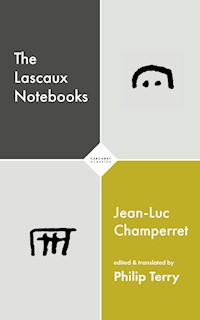
This newest Carcanet Classic collects the oldest poetry yet discovered, as written down or runed in the Ice Age in Lascaux and other caves in the Dordogne, and now translated – tentatively – into English for the first time. The translation is at two removes, from French versions by the mysterious linguistic genius Jean-Luc Champerret, and then from the striking originals that retain such a sense of early human presence. Philip Terry mediates between the French and those hitherto inscrutable originals.Jean-Luc Champerret's unique contribution to world literature is in his interpretation of the cave signs. And Philip Terry's contribution is to have discovered and rendered this seminal, hitherto unsuspected work into English. The translated poems are experiments, as the drawings may have been to the original cave poets composing them as image and sound. While archaeologists maintain that these signs are uninterpretable, Champerret assigns them meanings by analogy, then – in an inspired act of creative reading – inserts them into the frequent 3 x 3 grids to be found at Lascaux. The results – revelation of Ice-Age poetry – are startling.
Das E-Book können Sie in Legimi-Apps oder einer beliebigen App lesen, die das folgende Format unterstützen:
Veröffentlichungsjahr: 2022
Ähnliche

















3
The Lascaux Notebooks
JEAN-LUC CHAMPERRET
EDITED & TRANSLATED BY PHILIP TERRY
CARCANET CLASSICS
5
‘Quantity over quality.’
– Jean-Luc Champerret, Carnet Gris6
CONTENTS
INTRODUCTION
In August 2006 I was on holiday in Charentes with my family, trying to finish off a translation of a novel by Catherine Axelrad on Victor Hugo, L’Enfant d’Aurigny. When our holiday let expired, towards the end of August, as we still had a few days free, we decided to prolong our vacation, as was our custom, by spending a couple of nights with an architect friend, David Martin, who lived near Montignac in the village of La Bachellerie. We saw very little of our friend, as it happened – as usual, he was burning the candle at both ends, and he was in the middle of a complicated job converting the interior of a nearby château, which had been acquired by a wealthy Japanese client whose enormous wealth was matched only by his stringency. He talked at length about the project, which had been taking up his time for some months, even showing us his architect’s drawing plans. Essentially, he was leaving the exterior intact, as he had to, for it was an immeuble classé, but was remodelling the interior à la japonaise – which, as far as I can remember, consisted in knocking down a lot of walls, inserting new supports, installing a zen-like courtyard garden with a fountain constructed according to principles derived from the I Ching, and erecting a large number of white silk partitions supported by bamboo in place of the walls. He was discussing this with us on the terrace on the last evening over a bottle of Margaux when, just before he went to bed, he suddenly said ‘I have somethiing for you’. At which point he rushed down to his cellar and came back, minutes later, not with the bottle of vintage wine we had been anticipating, but with a large and rather dirty wooden crate. ‘This,’ he said, ‘is yours. I found it tucked away at the back of a cupboard in the château. They’re the papers of a local poet who used to live there, Jean-Luc Champerret. They might interest you 10– and they’re of no use to me. Have you heard of him?’ I had not – but I willingly disburdened him of the crate, which we squeezed into our already packed car in the morning.
When we got home, I put the box in the garage without opening it, for in truth I was not much interested in French regional poets that neither I nor anyone else had heard of, and thought no more about it. Over the next four years I was preoccupied with administrative duties back home as the university sector, where I earned my living, became increasingly corporate. There were the usual cuts and closures – ‘rationalisation’ was the word they used – the usual cull of senior staff, the usual restructurings, and then, as a certain satirical poem drawing comparisons between the vice-chancellor and Stalin was leaked on Facebook, I was forced to adopt a low profile for a period, busying myself with visiting lectureships and secondments.1 It wasn’t until June 2009 that I looked at the crate again. After returning from a teaching 11stint in Berlin, where I had been helping them set up a Creative Writing programme at the Freie Universität, we were preparing to move house – we’d decided to downsize as our son would soon be going off to university – and sorting through some junk in the garage I came across the Champerret box again. This time, I opened it – partly out of curiosity, partly to determine whether or not I should throw it in the skip that was taking up the drive. It wasn’t all that easy to open – the lid had been nailed down with some veritable clous paysans – but once I got it off I examined the contents. It contained papers, some loose, some tied in bundles, covered all over with thick brown dust, a few rusty ink pens, some pieces of charcoal, several bundles of letters, three small notebooks – one black, one grey, and one blue – and six copies of a volume of poems by Champerret, Chants de la Dordogne, published by a small press in Perigueux in 1941, Éditions du Noir (presumably a reference to Perigord Noir, the old pays name, still in use, for the region which lies to the south of Perigueux, and which takes its name from the black oaks which grow there). The volume contained a collection of rather sonorous poems – reminiscent of Swinburne in this respect – written in rhyming alexandrines, seemingly based on, or attempting to recreate, peasant songs from the region, celebrating robust country life and a now vanished mode of smallholder farming, where a single farm would produce its own foie gras, confit d’oie, truffes, goat’s cheese, wine, and a regional version of eau de vie distilled from acorns called eau de chêne. The papers themselves, or some of them at least, were in a fragile state, and some of the loose leaves collapsed when you picked them up, turning to dust – it looked, too, like a family of mice had at one time made their home in the crate, using the paper to make a nest. The papers that had survived included notes, and more poems, written in much shorter lines, accompanied by diagrams reminiscent of Chinese calligraphy, and a number of abstract drawings in charcoal done on standard issue Bureau de Poste blank postcards, a little like some of the graphic work of Henri Michaux. There were also a number of visual poems where the words and letters were distributed sparsely across the page in various font sizes, perhaps indebted to Apollinaire, certainly influenced by Mallarmé’s Un Coup de dés, of which they seemed to be a somewhat belated imitation. The Carnet Gris, the first I opened, bore the title ‘Notes sur Lascaux’, and was written in pencil. The first 36 pages were filled with writing and diagrams in a diminutive and impenetrable script. The rest of the notebook was blank. I closed the crate, sure of one thing – it was not going in the skip.212
Subsequently, I tried to find out more about Jean-Luc Champerret, but it was not easy. There was little on public record – no trace of his Chants de la Dordogne remained, and the Bibliothèque Nationale did not hold a single copy. Nor did he appear to have written any other published works. And when I asked my few contacts in French Departments – David Bellos, John Sturrock, Cécile de Bary – none of them had heard of him. I did, however, track down his birth certificate via the Mairie in Montignac. He was born in the village of Le Moustier, on the road from Les Eyzies to Montignac, on 11 September 1910, to Alice Rose Champerret and Gaston Yves Champerret. But there was nothing more. Clutching at straws, I rang David Martin, to see if he had any more information on Champerret, and he was able to put me in touch with 13one Isabelle Dupois, who had worked as a housemaid at the château where the crate had been found. At once I travelled down to the Dordogne to meet her. She was a little lady, now of an advanced age, who was hard of hearing but who had no faith in modern hearing aids, so that you had to raise your voice to get through to her, and could only ask the simplest of questions. However, she was able to furnish me with the following information. Champerret had been living in Paris at the outbreak of the war where, she believed, he had briefly worked in the Resistance, working with a cell that included a tall wiry Irishman, before being forced to flee from the capital, at which point he had returned to his native region. Here, he had taken up residence at the château, which at that point had been requisitioned by the local Resistance. He was a quiet man, who didn’t give much away, but she knew from what she had gathered at the time that he had worked, among other things, as a code breaker. When Lascaux was discovered by five schoolboys and their dog Robot, on 12 September 1940, Champerret had been sent in secret by his cell to survey the caves, in case they offered a possible hideout for Resistance members. But nothing came of this plan, as within days everyone in the area knew about the discovery of a new and remarkable set of cave paintings in the hills to the south of Montignac. Then in February 1942 the château was raided by the Gestapo. Champerret got away, but Dupois knew nothing of his subsequent movements. ‘Did he ever marry?’ I asked her. ‘Non,’ she replied emphatically, ‘ce n’était pas sons genre.’
It was the notebooks, I soon learnt, that supplied the key to Champerret’s work. What is certain, is that during his clandestine excursion to Lascaux, made before any archaeologists had set foot there, Champerret had not only evaluated the potential of the network of caves for Resistance operations, but had looked very closely at the paintings, and had looked particularly at the signs and marks, seeing in their 14ancient forms a hidden code. During his long, lonely, nervous nights at the château, Champerret must have ruminated on what he had seen in the cave, bringing his skills as a codebreaker to bear on the ancient drawings and signs, and the notebooks contained the rich fruit of these ruminations. The notebooks are not always easy to decipher. At the best of times they are difficult to read, then some of the pages are missing, many are blank, and at apparently crucial points the pages seem to have been chewed up by rodents. And then, they are notebooks. The arguments are not made or advanced at all systematically. Nevertheless, putting it all together, Champerret’s propositions relating to what he saw in the caves of Lascaux, seem to be along the following lines. Focussing primarily on the signs that he found there – signs that subsequent generations have almost unanimously defined as uninterpretable – Champerret at once proposes that they are to be read as script, as a primitive form of writing, and in the last pages of the Carnet Bleu he proposes meanings that should be attached to each sign. A row of vertical lines, he proposes, might represent spears, or a forest, or even rain. An upturned ‘v’ sign (or, rather, two such signs, one on top of the other) might represent mountains, or huts. A line of dots might represent people, or a journey, or faces, or stars. A row of horizontal lines might represent mist or night. A sign resembling an upturned question mark might represent a club, a sign resembling a three-quarters circle with a dot in the middle, an eye, a meandering line or group of lines a river, and so on. ‘Le signe,’ he remarks at one point – suggesting that the ideas of Saussure, which were to influence a subsequent generation writing on Lascaux3, had already crossed the 15Swiss border by word of mouth – ‘n’est jamais arbitraire’. Such signs, he argues, could be linked together in sequence to form primitive sentences or to carry or pass on messages, were they to be scratched on a stone or a piece of bark, or even scratched in the earth with a stick. Or they might just make a record of a transaction between tribes. So, the sign for mountains in conjunction with the sign for journey would convey, for example, that a hunting party had crossed the mountains. A group of signs representing antlers might record the goods handed over in an exchange.4
This, in itself, amounts to a revolutionary breakthrough in interpreting the signs found in the caves at Lascaux, when we think that in 1986, 46 years after Champerret composed his notes, Mario Ruspoli, in his book The Cave of Lascaux, could write ‘the signs are unfathomably mysterious’.5 And yet, Champerret’s imagination by no means stops here. In what is no doubt his most radical step, he draws our attention to the curious, but frequent, three by three grids of squares that decorate the walls of the cave, most notably in the polychrome 16blazon below the Black Cow in the Nave of Lascaux. Taking a leap of the imagination, a leap in the dark – and is this not quite literally what the bounding Chinese horses lining the ceiling of Lascaux’s Axial Gallery ask us to do by example? – Champerret proposes that these grids, in themselves empty of meaning, act as frameworks for the insertion of signs, thereby acquiring and multiplying meanings. Just as the signs for mountain and journey, placed in conjunction, acquire meanings, so the grid filled with signs, and scratched, for example, on a stone, might carry messages. So, the grid filled with antlers might represent a large consignment of antlers, the grid filled with signs representing the forest and signs for fire might warn of a forest fire. But Champerret goes further than this, proposing that whereas these grids might have originally been used for practical purposes, that they evolved to form the basis of the first written poetry. Of course, this is an astonishing, almost unbelievable proposition, in effect announcing the discovery of Ice Age poetry. But if Homo sapiens fossilis could create visual art, both parietal and mobiliary, that would inspire some of the greatest painters and sculptors of the twentieth century – from Picasso and Dubuffet to Pierre Soulanges, Marcel Duchamp and Louise Bourgeois – and if such people could, as has recently been argued, create the origins of cinema in the thaumatrope, who is to say that they could not create poetry? Champerret, however, is not content with abstract propositions. Just as Wittgenstein argues that one does not learn a game by reading a book of rules, but by playing it, so, for Champerret, it can be inferred that he believed that practice would prove or disprove the validity of his ideas, which is the point at which he stopped theorizing and began to write poetry using the signs and grids he inherited. Whether he decided on possible meanings for individual signs before embarking on his poetic project, or whether the process of composition itself suggested what these meanings might be, we will never know, but the latter seems the most likely. His notes attaching to each sign show every indication that they were not written all at once, but added to and developed as he worked on the poems. One imagines that in the process of composition, Champerret discovered what the signs needed to be, needed to mean.17
Which leads us, finally, to the poems themselves, which begin to come into clear focus viewed through the lens of the notebooks. The technique is simple, the results startling. Beginning with the proposition that nine signs taken from the cave network, and inserted into the three by three grid, will make a poem, Champerret puts his theory to the test, not by writing one poem, but by writing (if we include his variants) in excess of six hundred. If his hunch is right, he says, then placing signs in the grid will render poems. They are not all great poems, but that is beside the point. Not all poems written in English or French in the seventeenth century are great poems, though this is generally considered a rich period for poetic development. That they are poems is indisputable, and Champerret makes his argument by sheer force of numbers. His typical method can be broken into five stages: (i) he fills the grid with signs; (ii) he ‘translates’ this minimally into French; (iii) he writes through the first translation, adding connector words, so that the poem reads more easily in modern French, translating the three by three structure into stanzaic form, three stanzas of three lines each; (iv) he writes the first variation on the poem, elaborating some of the lines, and embellishing the detail, as a shaman or an oral poet might vary the bare outline of an inherited story; (v) he repeats (iv) continuing to elaborate and embellish the original, as if a different poet were performing the text, all the while maintaining the stanzaic pattern of three stanzas of three lines each, though here the lines are progressively indented to 18echo the original three by three structure as it is distributed laterally as well as vertically across the page.6 There is a sixth and final stage sometimes employed, but we will return to that in a moment. Firstly, here is one of Champerret’s poems, in its variant translated forms, beginning with stage (i) and proceeding with stages (iii), (iv) and (v) (the signs represent, in order: eye, bison, sun, horns, bison, spears, legs, bison, club):
*
The eye
of the bison
is the sun
the horns
of the bison
are spears19
the legs
of the bison
are clubs
*
The eye
of the bison
is like the bright sun
the horns
of the bison
are like sharp spears
the legs
of the bison
are like heavy clubs
*
The white eye
of the black bison
is like a star at night7
the curved horns
of the black bison
are like sharp spears
the thick legs
of the black bison
are like heavy clubs
20For most poets, this would be enough. More than enough. But Champerret, in what is perhaps his greatest single stroke, revisions the poem one more time by focusing separately on each stanza of his third stanzaic transformation, which he then deconstructs into nine single or multiple word units, then distributes the words across the page, playing freely with line spacing and font size, into three lines of three word units each. These poems are not, as I had first thought on rifling through the Champerret crate, a belated imitation of Mallarmé’s poetics as represented in his Un Coup de dés of 1896, rather they represent perhaps, in their purity, the only poetry of its time to have understood Mallarmé, and to have taken the tradition that he inaugurated forwards, anticipating, in this respect, the spatialism of Pierre Garnier. In a way that is almost alchemical, Champerret, via the Mallarméan breakthrough, succeeds in refracting his multiply-performed poem through the poetic technology of modernity, and returning it, paradoxically, to its original three by three grid-like structure. Scientifically, this proves nothing, poetically it is a tour de force. The work, like Mallarmé’s Un Coup de dés, is to be read simultaneously across two pages, which cannot be reproduced here, but I refer the reader to the latter pages of this volume where a selection of these poems have been translated into English.
Finally, a further word should be said about Champerret’s Carnet Bleu, where he begins to experiment with the other grids which he found at Lascaux, realising, perhaps late in the day, that these too could be the basis of poetic composition. As well as the ubiquitous three by three grids, here Champerret draws our attention to other forms of grid structure: single squares, where a single sign could be inserted; squares divided by a vertical line where two signs could be inserted; squares divided by two vertical lines and one horizontal line, where six signs could be inserted; and four by four grids, where sixteen signs could be inserted, 21among others. Experimenting with these grids, Champerret was able to compose both shorter works – departing from a single sign – and longer narrative structures, taking him to the heart of Ice Age myths. The monostichs, narrative poems, and formally experimental poems that Champerret composed in the Carnet Bleu, as well as related compositions on loose leaves (Feuilles Détachées as they are called in the archives of the Pôle de la Préhistoire) are here represented in selections from the Boîte Rouge where the Carnet Bleu and the related Feuilles Détachées are archived.
Whether my reading of the jumbled notes in Champerret’s notebooks is correct in every detail I cannot say. But in its broad outline it is certainly what Champerret recorded and advanced. Unfortunately, Champerret himself has not left us a lengthy and closely argued dissertation advancing his theories, the thoughts that underpin them, the details and times of his access to the cave network, and how his thoughts might have been refined and taken forward. In one of the letters contained in the crate there is a tantalising indication that Champerret did indeed compose such a document but, alas, it is now almost certainly lost. The letter is from the Directeur du Musée de L’Homme, Paul Rivet, and dated June 1941. It is short, so I quote it in its entirety, in the translation by Yves Christophe Lécroart of the Pôle de la Préhistoire:
Dear Sir,
Thank you for your essay on the caves at Lascaux and the mysterious signs therein. We have received a great deal of correspondence regarding Lascaux since its discovery in September 1940, and unfortunately it is not possible to respond to every enquiry in detail. The study of Upper Paleolithic parietal art is a science, and should be left in the hands of specialists, as 22interference by amateurs can only cause damage to this sacred national inheritance in the long term. Your work is pure fantasy. The signs you describe bear no resemblance to those that have been discovered at Lascaux, and meticulously recorded in tracings and documented in detail by the Abbé Breuil, as outlined in his report presented to the Académie des Inscriptions et des Belles Lettres in October 1940.
I sincerely discourage you from pursuing your speculations, and advise you at this moment of national turpitude, to direct your not inconsiderable energies elsewhere.
Yours sincerely
Paul Rivet
Whether or not Rivet read Champerret’s essay closely, or at all, we will never know, though his perception of discrepancies between Champerret’s collection of signs and those at Lascaux is not without foundation.8 What is certain is that 23Rivet had other things on his mind, for in June 1940, along with librarian Yvonne Oddon and the Russian ethnologist Anatole Lewitsky, Rivet was establishing a Resistance network operating out of the Musée de L’Homme, to oppose the Vichy regime and Nazism. Indeed, the subtext to his letter clearly urges Champerret to get involved with the Resistance himself (Rivet was not to know that he was already deeply embroiled in Resistance activity, and that, ironically, the Lascaux essay and the Resistance work were always already intertwined on more than one level).9 Whatever Rivet had on his mind, the rebuttal must have hit Champerret hard. And yet, this was not the first time in the chequered history of Upper Paleolithic art that major discoveries had been dismissed out of hand. When Marcelino de Sautuola and his daughter, Maria, discovered the polychrome paintings at Altamira in 1879, members of the archaeological establishment, including the prominent French prehistorian, Émile Cartailhac, were quick to denounce Altamira as a fraud. De Sautuola died in 1888, embittered, bankrupt, and discredited.24
It is my hope that this volume, introducing Champerret’s work to the general reader – it has been known in specialist circles for some time – will go some way towards setting the record straight. David Lewis-Williams, in his study The Mind in the Cave, bemoans the advent of the New Archaeologists, whose striving to make archaeology a strictly scientific discipline based solely on empirical evidence – carbon and pollen dating, for example – closes the door on more speculative methods of enquiry, and thus is unable to tackle many of the most urgent questions surrounding the sociological meanings, resonances and significations of cave 25art in its more esoteric and ritualistic dimensions.10 While Lewis-Williams is not directly concerned with the signs in the caves, and their specific significations, his arguments indirectly suggest why Champerret’s poetic approach might be valid. Only by bringing the poetic imagination to bear on the mysterious signs and marks left by our ancestors on the walls of the cavern at Lascaux, is Champerret able to restore to us the lost archive of Ice Age poetry. Champerret’s solving of this great puzzle, like the cracking of a Gestapo code, is achieved only in and through the poetic imagination. His work, in this sense, represents a threefold victory for poetry: it is poetry, here utilised as sacred methodology, that cracks the code; it is the poetic corpus of Homo sapiens fossilis that is thereby restored to us; and in his own poems, Champerret presents us with some of the most revolutionary post-Mallarméan poetry to have been written in the twentieth century. Taken in its entirety, Champerret’s work amounts to no less than the greatest modern ‘defence’ of poetry that we have.
Philip Terry, Wivenhoe, 12 September 2021
26
1 Now that the storm has blown over, it is perhaps the right moment to print the poem in full, not least because various, and much more scatological, versions of the verses were circulated at the time without my knowledge or approval. The verses, it goes without saying, are in imitation of Mandelstam’s unpropitious poem on Stalin, which led to his imprisonment and exile. I am indebted to Professor Angela Livingstone for clarifying Mandelstam’s Russian. The correct title of the poem is ‘Five Year Plan’: ‘We are alive but no longer feel the campus under our feet,/you can’t hear what we say from ten steps away//but when anyone half-starts a conversation/they mention the military man from Durham.//His thick fingers are like worms,/his words bark at you like hounds.//His cockroach brows laugh,/and the top-knot of his tie shines.//He is surrounded by his bald-headed henchmen,/and clowns with his large spotted handkerchief.//Someone nods, someone smiles, another pie chart is projected,/he alone points at us and thunders.//He forges order after order like hand grenades,/hurling them at the cleaners, the administrators, the professors.//The broad-breasted boss from the north/savours each early retirement like an exquisite sweet.’
2 The contents of the Champerret box are now held in the archives of the Pôle de la Préhistoire in Les Eyzies, where they are stored in three box files, the Boîte Noire (B.N.), the Boîte Rouge (B.R.), and the Boîte Jaune (B.J.).
3 Among the best-known examples of a structuralist approach to cave art is André Leroi-Gourhan’s monumental Treasures of Prehistoric Art, translated by Norbert Guterman (New York: Abrams, 1967). Here, in what now seems like an example of the reductive tendency in structuralism, which led to the movement towards post-sructuralism, Leroi-Gourhan, in an act of interpretation that Derrida would subsequently come to term phallocentric, reads all the cave drawings and all the accompanying signs as examples of either the masculine (the phallus) or the feminine (the vulva).
4 When I gave a paper on Champerret at the University of Essex conference ‘Translation: A Walk on the Wild Side’ in June 2017, Simon Everett, a CHASE-funded PhD student who was giving a paper on untranslatability in Mandarin poetry, remarked that several of the signs in Champerret, such as that for mountain, closely resembled the symbols in oracle bone script (the origin of Chinese pictographic script).
5 Mario Ruspoli The Cave of Lascaux: The Final Photographs transl. Sebastian Wormell (London: Thames and Hudson, 1987), p. 160.
6 Champerret left no notes regarding the poetic forms he employed, but in the vast majority of cases (we will look at others later), he employed a form of three stanzas of three lines each. The line is syllabic, and varies from between one and fourteen syllables, tending to increase progressively towards the final stanzaic elaboration.
7 Signs for ‘sun’ and ‘star’ are interchangeable in Champerret’s sign table.
8 That there are discrepancies between Champerret’s signs and those at Lascaux today is beyond question. These are twofold: some signs present in Lascaux are missing from Champerret; while some signs in Champerret do not appear to be present at Lascaux. This said, the overall consonance, given what must have been the brevity of Champerret’s visit, or visits, is remarkable. There are several possible explanations for the apparent disparities: (i) that some of the signs noted down by Champerret (those not visible in Lascaux today) rapidly deteriorated as the cave was exposed to air and light and carbon dioxide; (ii) that the light source used by Champerret in the cave created shadow effects which caused Champerret to see signs where there were none; (iii) that Champerret’s overactive and overstimulated imagination itself caused him to see signs in the cave’s rock surface where they were not; (iv) that Champerret made some of the signs up, speculating, not without reason, that there were likely to be other signs buried beneath the parietal art and the layer of calcite which covered the cave walls in places; and (v) which would account for the signs present in Lascaux but not in Champerret, that Champerret, inevitably, missed some of the signs. This being said, in the history of cave art, there have always been disagreements concerning what is there and what is not. To take the example of Cresswell Crags, the only example of parietal engraving in Britain, whereas Spanish archaeologists Sergio Ripoll, an experienced expert in Ice Age art, and Francisco Muñoz, claimed to have identified upwards of 215 engravings in the Church Hole cave, Paul Pettitt, from the University of Sheffield, and Paul Bahn, have argued that there are only 25 indisputable engraved figures. What Champerret saw, and recorded in his notes and drawings, may well differ from what can be seen today under modern lighting and in well-lit photographs, and yet, many have testified that what we see when in a cave, and what we see in a photograph, are ontologically different. It is a tantalizing thought, that what we have preserved in Champerret’s notebooks and drawings is actually much closer to what Paleolithic people themselves might have seen.
9 In reference to the Nazi occupation of France, it might be added that in this context Champerret’s apparently nostalgic verse of Chants de la Dordogne could be seen as a mode of resistance in itself, in that it records traditional aspects of French rural life that were under threat of extinction from the Nazis. At a similar period in Britain, when invasion was still a very real possibility, the Recording Britain project, involving artists such as John Piper, Michael Rothenstein, Barbara Jones and Stanley Badmin, was established to record in watercolour and drawing a visual record of people, buildings, landscapes and livelihoods similarly under threat.
10 See David Lewis-Williams The Mind in the Cave (London: Thames and Hudson, 2002), p. 65.
FROM BOÎTE NOIRE: CARNET NOIR (1-33)
(BN. CN. 01)
*
The watchman
by the hut
holds his spear
one eye
on the
trees
one eye
on the mist
the mountains
*
The watchman sits
by the hut
holding his spear erect28
he keeps one eye
on the
trees
one eye
on the mist covered
mountains
*
The watchman sits
motionless by the hut
clutching [?] his spear tight
he keeps one eye trained
on the swaying trees
at the forest’s edge
the other eye watches
the mist as it rises
over the [mountains]
(BN. CN. 02)
*
Paw prints at
the crossing by
the waterfall
the paw prints
lead the hunters
to a [cave]
they set the trap
watch
spears ready
*
A line of paw prints
sunk in mud at the crossing
by the waterfall
the hunters
follow the marks
to the [mouth] of a cave30
outside they set a trap
and watch
spears at the ready
*
By the crossing
that leads to the waterfall
fresh animal prints sunk in mud
following the trail [?]
hunters trace the paw prints
to the mouth of a cave
outside they set a trap
they sit back and watch
[spears at the ready]
(BN. CN. 03)
*
Bison
from the mountains
come to the crossing
bison from
over [?] the mountains
smashing our huts
the huts crushed
beneath the bison
[from the mountains]
*
Bison came
from the mountains
stampeding over the river crossing
a herd of bison
from over the mountains
smashing our huts32
our huts crushed
one after the other by the herd
who fell on them like mountains
*
A herd of bison
came down from the mountains
leaping and dancing over the crossing
they charged down from the mountains
a herd of black bison
smashing our huts beneath heavy hooves
our huts were flattened our mothers
crushed by the herd of bison
who fell on us like mountains
(BN. CN. 04)
*
Faces
in the trees
not birdsong
the birds
have flown
[to the] mountains
at night
faces
dance
*
Faces move
among the trees
there is no birdsong
winter is coming
the birds are flying
to the mountains34
at night singing
the faces dance
in the moonlight
*
Faces silhouetted
among tall trees
there is no birdsong to be heard
winter is coming
the birds are leaving their nests
flying off over the mountains
at night singing
the strange faces of the tree spirits [?] dance
silhouetted in the moonlight
(BN. CN. 05)
*
The woman
holds a needle
in her hand
she takes the needle
and pushes it through
the beads’ eyes
the woman makes
a knot
holds up a necklace
*
The woman is holding
a needle carefully
in her hand
moving the needle slowly
she threads it through the eyes
of a row of beads36
holding them up
she ties a knot in the gut string
tries on the new necklace
*
The woman is holding
a bone needle carefully
between her finger and thumb
moving the needle swiftly
she threads it through the eyes
of a line of amber beads
she holds them up
and ties a knot in the gut string
shows her new necklace to her companions [?]
(BN. CN. 06)
*
Footprints
of strangers
by the river
out of the mist
their silhouettes appear
carrying spears
we watch them
from behind the trees
fire in our hearts
*
Footprints in the mud
of others
by the bank of the river
we see their silhouettes
emerge from mist
carrying long spears38
we crouch behind the trees
watching them
burning inside
*
By the bank of the river
there are footprints in the mud
footprints of tribesmen from beyond the mountains
suddenly we see their forms
appear out of the grey mist
carrying their long bone tipped spears
we crouch behind the cover of the trees
watching their every step
burning inside with fear
(BN. CN. 07)
*
The mammoths
have
arrived
people
gather
outside the huts
with axes and
spears we make our way
down river
*
A herd of mammoth
have arrived
in the plain
the people of the tribe
muster
outside the huts40
armed with axes and
tall spears we make
our way down the river valley
*
A herd of woolly mammoth
have arrived
crashing into the open plain
the people of the tribe
muster hurriedly
outside the hide covered huts
armed with heavy [?] axes
and tall bone tipped [spears] we tread
the track down the river valley
(BN. CN. 08)
*
A single mammoth
by the crossing
at night
we surround it
holding our axes
our spears
when we throw a single spear
the mammoth runs off
into the forest
*
A lone mammoth
is grazing by the crossing
as night falls
we surround it
waving our axes
and spears shouting42
when the first spear is thrown
the mammoth cries out
running off into the forest
*
An isolated mammoth
is grazing by the river crossing
as night begins to fall
we run swiftly towards it
from all sides waving our axes
brandishing our spears and shouting
when the first spear is launched
the mammoth bellows
charging off into the depths of the forest




