


Erhalten Sie Zugang zu diesem und mehr als 300000 Büchern ab EUR 5,99 monatlich.
- Herausgeber: Nick Hern Books
- Kategorie: Poesie und Drama
- Serie: NHB Modern Plays
- Sprache: Englisch
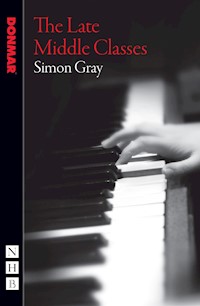
A funny yet melancholic look at the frustrations, secrets and guilt of middle-class respectability in 1950s England. England in the 1950s. Celia, bored to distraction, fills her time with tennis and gin; Charles, a pathologist, is buried in his work among the living and the dead; and their gifted son, Holly, is having his first lessons in both music and in life. Simon Gray's play The Late Middle Classes was first performed at the Palace Theatre, Watford, in March 1999, and produced on tour by the Ambassadors Theatre Group/Turnstile Group Limited. It was the winner of the Barclays Stage Award for Best New Play of 1999. The play was revived at the Donmar Warehouse, London, in June 2010.
Sie lesen das E-Book in den Legimi-Apps auf:
Seitenzahl: 123
Veröffentlichungsjahr: 2019
Das E-Book (TTS) können Sie hören im Abo „Legimi Premium” in Legimi-Apps auf:
Ähnliche









Simon Gray
THE LATE MIDDLE CLASSES
NICK HERN BOOKS
London
www.nickhernbooks.co.uk
Contents
Dedication
Original Production
Characters
The Late Middle Classes
About the Author
Copyright and Performing Rights Information
For Victoria
The Late Middle Classes was first presented by the Palace Theatre, Watford, on 23 March 1999 (previews from 19 March), and produced on tour by the Ambassadors Theatre Group/Turnstile Group Limited. The production then played at Brighton, Plymouth, Bath, Woking and Richmond. The cast was as follows:
BROWNLOW
Nicholas Woodeson
HOLLY in his forties
James Fleet
HOLLY aged twelve
Sam Bedi
CELIA
Harriet Walter
CHARLES
James Fleet
ELLIE
Angela Pleasence
Director
Harold Pinter
Designer
Eileen Diss
Lighting Designer
Mick Hughes
Sound Designer
Dominic Muldowney
The Late Middle Classes was revived at the Donmar Warehouse, London, on 1 June 2010 (previews from 27 May), with the following cast (in order of speaking):
BROWNLOW
Robert Glenister
HOLLY in his forties
Peter Sullivan
HOLLY aged twelve
Harvey Allpress / Laurence Belcher / Felix Zadek-Ewing
CELIA
Helen McCrory
CHARLES
Peter Sullivan
ELLIE
Eleanor Bron
Director
David Leveaux
Designer
Mike Britton
Lighting Designer
Hugh Vanstone
Composer
Corin Buckeridge
Sound Designer
Simon Baker for Autograph
Characters
THOMAS BROWNLOW
HOLLIDAY ‘HOLLY’ SMITHERS in his forties
HOLLIDAY ‘HOLLY’ SMITHERS aged twelve
CELIA SMITHERS
CHARLES SMITHERS
ELLIE BROWNLOW
ACT ONE
Scene One
BROWNLOW’s study/sitting room. Autumn. Early evening. The present.
A baby grand piano, a sofa, desk, table, an armchair.
BROWNLOW, in his seventies, is sitting in armchair, dozing, muttering.
Doorbell rings.
BROWNLOW (mutters in his sleep, gradually wakes up, listens). No, I couldn’t have heard it – must be a dream –
Doorbell rings again.
BROWNLOW goes to window, peers out. Knocks on window.
Is there anybody there? Who’s there? Mrs Jameson, is that you? Mr Jameson? Surely you know not to disturb me at this hour, I’m very busy –
Doorbell rings again.
Who is it? (Agitated. Attempts to compose himself, goes out of room.)
Voices off, indistinct.
(Off.) Yes? Can I help you?
HOLLY (off). I don’t know if you remember me. I’m Holliday Smithers.
BROWNLOW. Smithers – Holliday Smithers – yes, yes, of course I remember you.
HOLLY. I was just passing and couldn’t help wondering if you were still here.
BROWNLOW. Yes, yes, still here. Well, please come in.
HOLLY enters the sitting room, followed by BROWNLOW. HOLLY is in his mid-forties. He looks around.
And, um, where have you come from?
HOLLY. Well, from Australia in fact. Melbourne.
BROWNLOW. And you’re staying on the island?
HOLLY. No, I’m staying in London. But I had to come down to Portsmouth for a few days.
BROWNLOW. And so you decided to pay us a visit, after all these years.
HOLLY. Well, I had the afternoon off, couldn’t resist driving over – odd that, being able to drive over, all the way by road. I still imagined having to take the ferry. I’d have preferred that on such a beautiful day. Especially when everything turned out to be so familiar. (Looks around again.) As it is here. Except that it’s all older, of course.
BROWNLOW. Yes, yes, like myself.
HOLLY. Like myself. Do you mind if I sit down?
BROWNLOW. Oh – oh, yes, of course, I’m sorry – please. Where would you like? (Gesturing around room.)
HOLLY walks over to armchair, sits down, watched by BROWNLOW.
HOLLY. There is a change, though. No, not a change, an absence. Yes, something’s missing. Oh yes, a cat. There was always a cat called Kitty-Cat. Kitty-Cat Number Seven. You explained to me that your mother always called her cats Kitty-Cat so it was always the same cat to her. When one died she’d go straight on to the next Kitty-Cat almost without noticing the pain of loss or the treachery of replacement. But you numbered them in your head. So I knew Kitty-Cat Number Seven.
BROWNLOW. They were called Catty-Kit, not Kitty-Cat.
HOLLY. Oh yes, sorry. I must have let the chocolate bar get in the way. Well, what number did it get up to, Catty-Kit, before its sequence ended?
BROWNLOW. Eleven. Number Eleven I had put down the day after I buried my mother.
HOLLY. Ah. The end of the line then.
BROWNLOW. It felt like the end of an era.
HOLLY. Yes, I suppose it must have done. (Little pause.) But have you gone on keeping the same hours?
BROWNLOW. Well, I keep the hours, yes. Yes, I do that.
HOLLY. Every morning from ten to twelve and every evening from nine, was it? Until midnight.
BROWNLOW. Nine thirty until midnight. Back then. Now of course my time’s my own and I start earlier. Whenever I feel like it.
HOLLY. You and your beloved talking to each other. (Glancing towards piano.)
BROWNLOW. Yes.
HOLLY. And what do the two of you talk about these days? Anything in particular?
BROWNLOW. A concerto. We’re working on a concerto. We’ve been at it for a long time. A long, long time. I hope to complete it before I die.
HOLLY. Oh yes, you must. You’d want to hear it, after all. You used to say that you couldn’t compose the opening until you knew how the piece would close. So first close, then open, and then on into the middle, which would look after itself.
BROWNLOW. Well, of course one has these theories at different times of one’s life. One’s creative life. Perhaps it’s to do with memories. The more memories you have, the more difficult it all becomes.
HOLLY. You mean the memories teem about and get in the way?
BROWNLOW. Well, no, not teem about. Not quite as lively as that. They bob up.
HOLLY. What sort of memories?
BROWNLOW. Well, just memories. Of days gone by. (Little pause.) You, for instance. You bob up now and then. Quite often in fact.
HOLLY. Do I?
BROWNLOW. Do I ever bob up for you?
HOLLY. Oh, yes. This afternoon when I was walking about the island. I went to see the old house, well, the family house, and one thought led to another and that led to another and then finally up you bobbed again.
BROWNLOW. Like a jack-in-the-box.
HOLLY. No, not really like a jack-in-the-box. The thoughts were quite logically connected, I think. Though there was a bit missing – something I tried to remember and couldn’t. The music. The music that seemed to run through it all. It wouldn’t come back. It won’t come back.
BROWNLOW. Really? Can I offer you something? Tea? Coffee? And I do believe there’s some sherry somewhere – but very, very old. From my mother’s day. Quite a few bottles of it there should be in the larder, Mrs Jameson helps herself to it from time to time but – she’s my cleaning woman, you know, she came long after your time – after my mother’s too – in fact she’s only been here about ten years, I think it must be, and her husband does the gardening. Sometimes I hear them down in the kitchen, laughing and talking, and it occurs to me that they’re at the sherry, especially when they’re being rather loud. May I ask a question?
HOLLY gestures.
There is a pause.
HOLLY (gently). A question. You’re going to ask a question.
BROWNLOW. Are you real?
HOLLY. Yes, quite real. Well, at least I think I am. One can never be completely sure on that point, can one? (Gets up, goes over to BROWNLOW.) But here, feel this. (Holds out his hand.)
BROWNLOW tentatively moves his hand, touches HOLLY’s sleeve. As he withdraws his hand, HOLLY catches it in his.
There, you see. Not just the garments but flesh and blood.
They stand, hands clasped for a second. HOLLY removes his hand.
BROWNLOW. Did you say yes? To the sherry, that is?
HOLLY. A glass of your mother’s sherry, yes, I’d love to try it at last. Thank you.
BROWNLOW. Well, I’ll see what I can find. (Goes out.)
HOLLY goes over to piano, picks along keyboard as if trying to work out a tune. Shakes his head in exasperation, goes back, sits in armchair, takes out cigarette, lights it. Sits back meditatively. As he does so:
Piano music, over, as:
Lights going down as lights coming up on SMITHERS’ sitting room.
Scene Two
Spring. Evening. Early 1950s.
SMITHERS’ sitting room.
HOLLY, as a child of twelve, playing the piano.
HOLLY continues to play for a second, stops. He gets up, goes over to sofa, sits down. Takes out exercise book from satchel, extracts a loose sheet of paper, reads it very intensely, then reaches urgently into satchel, fumbles deeply, takes out magazine, begins to go through it, studying pictures, occasionally reading to himself aloud but inaudibly from sheet of paper.
Sound of front door opening and closing.
HOLLY scrambles to his feet, stuffs magazine and exercise book back into satchel, hurries over to piano, starts playing.
CELIA SMITHERS, HOLLY’s mother, enters, dressed in tennis shorts, top, carrying tennis racquet and tennis balls.
CELIA. She’s chucked! That bloody Moira woman has actually chucked! She couldn’t phone me before I left so I could have got somebody else, no, she just stepped out as I was cycling past, with her hand raised like a policeman – I nearly pedalled straight into her and I wish I had – she honked out some nonsense about coughs and sore throats, running eyes, her cheeks were like apples, my dear, great shiny apples, by far the healthiest thing I’ve seen all week – oh, I could kill her! Kill, kill, kill! (Serves viciously with imaginary ball.)
HOLLY. It’s because you keep beating her.
CELIA. Oh, don’t be so silly.
HOLLY. It’s true. Every time you come back from playing against her you crow about beating her six love, six love. You do the same with me, so I know how she feels.
CELIA. She wouldn’t be so petty. Yes, she would. Everyone on this bloody island is petty. That’s why you’ve got to win a scholarship. To get us off it.
HOLLY. That makes complete sense. That’s perfectly logical. I understand that.
CELIA. You sound just like your father. (Banging her racquet gently on his head.) I. Won’t. Have. You. Making. Fun. Of. Your. Father.
HOLLY. I wasn’t making fun of him. I just don’t see why my getting a scholarship would get you off the island.
CELIA. Because if you win a scholarship to St Paul’s or Westminster we won’t have to pay the fees and we can all move to London where we belong. And if you don’t win a scholarship you’ll end up going somewhere local where you’ll have to be a day-boy so we can afford your fees. We’ve been over and over it.
HOLLY. You haven’t been over and over it with me.
CELIA. No. I meant your father and I have been over and over it.
HOLLY. What’s wrong with Portsmouth Grammar School? A lot of boys from around here go there – all my friends – and they say it’s jolly good.
CELIA. It may be jolly good for them but it’s not jolly good enough for us.
HOLLY. Well, I don’t think it’s fair that everything you want comes down to me getting a scholarship. I probably haven’t got a chance. We don’t know anybody around here who’s –
CELIA. Edwin Tomkins.
HOLLY. Oh, him.
CELIA. ‘Oh, him’ won a full scholarship to St Paul’s, as his wretched parents never stop boasting. And as you despise him so much you could surely do just as well. Now, do get on with your practice, and what about your prep, have you done that yet?
HOLLY. Almost. I’ve just got a bit of French left.
CELIA. Then finish your practice and on with your French. I want it done before Mr Thing-me-bob comes. You’re always too tired to do any prep after your piano lessons.
HOLLY starts playing piano.
(Watches him.) Oh, you do remind me of someone, you know, whenever you play.
HOLLY. Do I? Who?
CELIA. One of the young chaps in the war, one of the fighter pilots. He had the same – same intensity – as if there was nothing else in the world but the music, even though everybody was singing around him.
HOLLY (plays for a little). What happened to him?
CELIA. He went for a Burton, poor young devil, like so many of the rest of them.
HOLLY. Oh. (Playing on.)
CELIA. Tell me something. Something very important.
HOLLY. Oh, Mummy, I’m trying to concentrate.
CELIA. You have to answer this. Do you love me?
HOLLY (sighs). Of course I love you.
CELIA. Why?
HOLLY. Oh, Mummy, you know why. Because you’re my mother.
CELIA. I do wish you’d once, just once, come up with a more flattering answer. What is that piece anyway, it’s been driving me mad trying to remember – Beethoven, isn’t it?
HOLLY. Very nearly. It’s Brownlow. Mr Brownlow.
CELIA. Golly, really, you mean he writes it too? (Staring over HOLLY’s shoulder.)
HOLLY. Oh, yes. Thomas Ambrose Brownlow.
CELIA. Ambrose? Thomas Ambrose Brownlow? Is that hyphenated? Thomas Ambrose-Brownlow?
HOLLY. No, that’s his middle name I think.
CELIA. Rather precious to use your middle name. Especially when it’s Ambrose. But I suppose if your name is Brownlow, Thomas Brownlow, and you want to add a little splash, if you’re a composer – what’s it called? (Reading.) Mio – ‘A Bagatelle for Mio’.
HOLLY. It’s ‘miaow’. It’s about their cat when it miaows.
CELIA. Doesn’t sound at all like a miaow to me. Except it’s soft and velvety so I suppose that’s a bit like a cat. What does he do with them when he’s composed them? Does he have them played by people – concerts, that sort of thing?
HOLLY. He says they’re doing this on the Third Programme.
CELIA. The Third Programme, golly. Well, perhaps they’ll let you play it.
HOLLY. Actually, Mummy, I don’t want to do the piano any more.
CELIA. What on earth do you mean?
HOLLY. I mean I don’t like it. And I’m not very good at it.
CELIA. Nonsense! Your Mr Ambrose says you’re the best student he’s ever had. By far and away the best on the island anyway.
HOLLY. Yes, well, he doesn’t really mean it, he’s just being polite.
CELIA. You need your music, you know you do. You put it down on your scholarship form that you played the piano as one of your main interests.
HOLLY. No, I didn’t. I put down music. And so if I change to the violin –




