


0,49 €
Mehr erfahren.
- Herausgeber: Quickie Classics
- Kategorie: Religion und Spiritualität
- Sprache: Englisch
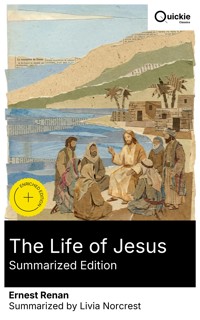
Published in 1863, The Life of Jesus offers a rigorously historicized portrait of the Nazarene within the Galilean world under Herodian rule. Reconstructing the ministry from the Synoptics with philological tact, Renan treats miracles as later legends while foregrounding the moral force and eschatological tone of Jesus's preaching. His lucid, gently lyrical prose sets villages and the Lake of Gennesaret before the reader even as it applies higher criticism. The book belongs to the nineteenth-century quest for the historical Jesus, in dialogue with German methods yet insistently vivid. Renan, a former seminarian turned philologist, drew on mastery of Semitic languages, a chair at the Collège de France, and observations from Levantine travel. Seeking to unite moral reverence with scientific inquiry, he composed a human-centered portrait that provoked ecclesiastical censure yet established him as a founder of modern religious historiography. Essential for students of theology, history, and literature, this classic models how faith's origins can be examined without scorn and piety without credulity. Read it as a landmark of historical criticism and as an elegant, provocative narrative of Christian beginnings. Quickie Classics summarizes timeless works with precision, preserving the author's voice and keeping the prose clear, fast, and readable—distilled, never diluted. Enriched Edition extras: Introduction · Synopsis · Historical Context · Brief Analysis · 4 Reflection Q&As · Editorial Footnotes.
Das E-Book können Sie in Legimi-Apps oder einer beliebigen App lesen, die das folgende Format unterstützen:
Veröffentlichungsjahr: 2026
Ähnliche













The Life of Jesus (Summarized Edition)
Table of Contents
Introduction
Ernest Renan’s The Life of Jesus pivots on the creative friction between spiritual reverence and historical scrutiny, proposing that the most influential life in Western memory can be approached with the tools of philology, comparative texts, and sober observation without extinguishing its moral radiance, and in so doing it invites readers to consider how tradition, landscape, and testimony shape a figure at once intimate and elusive, whose human presence is traced not to diminish faith but to test how a narrative grounded in sources, probabilities, and cultural context might illuminate, rather than eclipse, the power of belief.
First published in 1863 in French, and later translated widely, The Life of Jesus belongs to Renan’s multivolume History of the Origins of Christianity, a genre-defining work of nineteenth-century historical criticism that treats the Gospels as documents to be weighed rather than harmonized. Set principally in first-century Galilee and Judea, it reconstructs scenes from village life, itinerant teaching, and religious controversy within the broader environment of Roman-era Palestine. Renan writes as a scholar of languages and religion shaped by the intellectual currents of his century, offering a biography that merges disciplined inquiry with a cultivated, often lyrical, sensibility.
The book follows the rise of a teacher whose words gather a circle of followers and stir hope among ordinary people, while encountering resistance from authorities and rival expectations about sacred destiny. Readers meet a succession of episodes rendered in lucid, poised prose that alternates between elegant description and analytical commentary, creating a narrative that is at once accessible and meditative. Renan compares overlapping sources, identifies patterns and seams, and carefully marks uncertainty, inviting readers to consider degrees of likelihood rather than certainties, all while sustaining a tone that privileges humane sympathy over polemic.
Throughout, Renan treats the problem of historical memory, asking how stories formed in communities become records for later ages, and how a compelling personality can generate meanings exceeding any single testimony. The tension between the human and the ideal runs through his portrait, as does attention to landscape, which he uses to suggest how environment shapes sensibility. He explores the genesis of a moral vision centered on compassion and justice as a living force within a movement, while examining authority, charisma, and hope as social energies that resonate beyond doctrinal frames without foreclosing personal belief.
Methodologically, the book exemplifies nineteenth-century critical practice: philological comparison of texts, cautious use of conjecture when sources are silent, and synthesis of cultural background drawn from history and archaeology available at the time. Renan distinguishes between layers of tradition, notes editorial tendencies, and evaluates the plausibility of episodes in light of context, making room for the reader’s judgment. His pages dwell on names, places, and customs to anchor scenes, and his reflective voice acknowledges limits of proof, shaping a study that aims for probability rather than demonstration, yet remains animated by literary grace and disciplined restraint.
Upon publication, the work attracted wide readership and sustained controversy for its decision to approach a sacred subject with secular tools, a watershed in public debates about religion and modern knowledge. Its legacy includes a durable influence on historical studies of early Christianity and on the idea that rigorous scholarship can coexist with respect for the ethical force of religious narratives. For contemporary readers navigating polarized discussions of faith, history, and identity, Renan’s volume models a patient, source-based inquiry that neither demands credulity nor scoffs at meaning, opening space for thoughtful engagement across convictions.
Approached today, The Life of Jesus rewards attention to how arguments are built from evidence, how narrative cadence affects interpretation, and how the language of admiration can coexist with methodological reserve. It offers a point of entry into historical Jesus research, yet it is equally a window onto nineteenth-century scholarship, with all its ambitions and constraints. Its continuing value lies in the way it equips readers to ask better questions about sources, context, and the uses of biography in shaping cultural memory, while inviting reflection on how enduring ideals take root in ordinary lives.
Synopsis
Published in 1863 as the opening volume of Histoire des origines du christianisme, Ernest Renan’s The Life of Jesus presents a historical portrait of Jesus grounded in philology, textual criticism, and Mediterranean geography. Renan aims to separate what he deems recoverable history from theological interpretation, treating the Gospels as layered documents to be weighed rather than harmonized. Drawing on his knowledge of Semitic languages and travels in the Levant, he emphasizes setting and chronology while refusing supernatural explanations. The book proposes to trace Jesus’ development within First‑Century Judaism, following the arc from rural beginnings to public ministry and the formation of a movement.
Renan opens by situating Palestine under Roman rule, sketching Galilee’s countryside, towns, and customs as the cradle of Jesus’ outlook. He surveys the religious landscape—Pharisees, Sadducees, Essenes, and popular apocalyptic hope—to establish the intellectual climate. Jesus of Nazareth appears as a pious Galilean shaped by village life and the moral rigor of his tradition. The encounter with John the Baptist serves as a historical starting point, anchoring Jesus within contemporary reform movements. From this matrix, Renan argues, emerged a personal vocation centered on proclaiming God’s reign as an ethical and spiritual horizon rather than a political program.
In Renan’s account, the early ministry unfolds in Galilean villages and along the lake, where parables, aphoristic teaching, and acts of compassion attract followers. He characterizes Jesus’ authority as moral and persuasive, not coercive, and describes the formation of a close circle of disciples drawn from artisan and fishing communities. Reports of wonders are treated critically: Renan views them as legendary accretions or symbolic narratives reflecting the enthusiasm of crowds, not violations of natural law. What remains central is a distinctive ethic of mercy, purity of intention, and trust in divine providence, articulated in memorable sayings and communal practice.
As the movement grows, Renan traces mounting friction with religious specialists and guardians of ritual exactitude. Debates over purity, Sabbath observance, and social boundaries sharpen the contrast between Jesus’ inclusive ethos and prevailing norms. Popular acclaim raises expectations of a messianic liberator, which Renan argues Jesus declines in favor of a spiritual mission. The narrative highlights periods of withdrawal and return, suggesting an evolution from village teacher to prophetic figure conscious of a unique role. Support from women and itinerant adherents sustains the mission materially and socially, while opposition crystallizes among those invested in legal authority and institutional stability.
Renan presents the decision to go to Jerusalem as a pivotal turn with unavoidable political implications. In the capital, symbolic gestures and public teaching bring Jesus into direct conflict with priestly leadership under Roman oversight. The Passion sequence is reconstructed with cautious attention to sources: preliminary surveillance, arrest, interrogation, and execution by crucifixion. Renan differentiates between what he takes as the historical core and later theological shaping, aiming to preserve the human drama without importing dogmatic claims. The emphasis falls on resolve, integrity, and the consequences of challenging entrenched powers at the center of Judea’s religious and civic life.
After the execution, Renan follows the first community’s disorientation and gradual reinvigoration. He interprets the emergence of conviction among disciples as a spiritual and psychological process, grounded in memory, hope, and shared experience rather than physical prodigies. Placing special weight on Galilee and the initiative of certain women and close companions, he describes how the message was recast into a durable mission. The book closes by tracing the outlines of a faith organized around the person and teaching of Jesus, setting the stage for the institutional and doctrinal developments addressed in subsequent volumes of his history.
Beyond its narrative, The Life of Jesus is significant as a landmark of nineteenth‑century historical criticism. First published in 1863 and widely read, it stirred controversy by treating sacred texts with the same critical methods applied to secular sources and by portraying Jesus as a consummate human personality. Renan’s synthesis—philological, geographical, and comparative—helped normalize a scholarly approach that separates history from theology while acknowledging their entanglement. The book’s enduring resonance lies in its questions: how to read ancient testimony, how belief arises in communities, and how a life lived in a specific place and time can radiate lasting moral influence.
Historical Context
In 1863, under France’s Second Empire, Ernest Renan published The Life of Jesus, the first volume of his History of the Origins of Christianity. Renan, trained in ecclesiastical studies at Saint-Sulpice before leaving the seminary, had become a leading philologist of Semitic languages at state institutions like the Bibliothèque nationale and the Collège de France. Parisian scholarly culture and centralized ministries shaped his career, situating his work at the intersection of university research and public debate. The book emerged from a milieu where the French state regulated higher education, the Catholic Church wielded considerable cultural authority, and learned societies promoted historical and linguistic inquiry.
Renan’s approach drew on nineteenth‑century historical criticism, especially German scholarship associated with David Friedrich Strauss and the Tübingen school of Ferdinand Christian Baur. Philology, comparative religion, and emerging positivist ideals encouraged treating sacred texts as historical documents subject to source analysis and contextual reconstruction. French Oriental studies, anchored in institutions such as the École des langues orientales and the Académie des inscriptions et belles‑lettres, fostered rigorous study of Semitic languages and antiquities. This intellectual climate privileged chronology, manuscript comparison, and linguistic nuance, equipping Renan to situate early Christian writings within Mediterranean Judaism and Hellenistic culture rather than within confessional dogma.
The political-religious landscape of 1860s France sharpened the stakes. Ultramontane Catholicism, strengthened under Pius IX, promoted centralized papal authority, while liberal Catholics and secular intellectuals defended critical scholarship and institutional autonomy. The Second Empire managed but gradually liberalized the press, allowing theological controversy to reach mass audiences. In 1864, the Syllabus of Errors condemned rationalism and modern biblical criticism, signaling a tightening Catholic response. French universities and the Collège de France, though state‑run, harbored currents of independent inquiry that sometimes clashed with clerical influence. Renan’s project unfolded amid these contested boundaries between church doctrine, state oversight, and scientific history.
Field experience shaped Renan’s historical imagination. In 1860–61 he led the Mission de Phénicie, a state‑sponsored archaeological and epigraphic survey in present‑day Lebanon and Syria, during which his sister and collaborator Henriette died near Byblos. The expedition deepened his acquaintance with Semitic epigraphy, Levantine geography, and local traditions, informing the topographical sensibility of his later writing. Back in Paris, he delivered his 1862 Collège de France inaugural lecture, calling Jesus an incomparable man, a remark that triggered public outcry. Government authorities suspended him from the chair, dramatizing tensions between scholarly historicism and confessional expectations on the eve of the book’s publication.
The Life of Jesus appeared in 1863 with Michel Lévy Frères and immediately reached a broad readership through multiple editions and translations. Newspapers and journals amplified reactions: Louis Veuillot’s ultramontane daily L’Univers attacked the book, while liberal periodicals debated its methods. Catholic authorities denounced it, and the Congregation of the Index soon prohibited the work. The Collège de France chair remained closed to Renan until the fall of the Second Empire in 1870. The controversy revealed how print culture, state institutions, and ecclesiastical censure intersected, turning a scholarly reconstruction into a national event at the heart of French cultural politics.
Renan built his narrative on textual criticism of the Gospels, privileging the Synoptics and treating the Fourth Gospel as later and theologically shaped. He interwove philological analysis with observations about Galilean settings gathered during his Levant travels. The result adopted the tone of historical biography rather than dogmatic exposition, presenting Jesus within first‑century Judaea’s social and religious milieu. His reliance on linguistic nuance, geographic plausibility, and comparative custom sought to craft a rational, humanly intelligible portrait, a choice that underpinned both the book’s wide appeal and the charge, from opponents, that he subordinated revelation to modern historical method.
Across Europe, contemporaneous controversies framed the reception. In Britain, Essays and Reviews (1860) and Bishop John William Colenso’s critical work on the Pentateuch provoked ecclesiastical trials. In Germany, Strauss’s Leben Jesu had already unsettled Protestant theology. Translations and reviews circulated Renan’s book into these debates, linking French philology with broader disputes over biblical inspiration, historical reliability, and the authority of emerging sciences. Expanding literacy, railways, and commercial publishing accelerated circulation, while salons and learned societies hosted disputations. The work thus belonged to a transnational quest for the historical Jesus that recast faith narratives as subjects for critical historiography.




