


Erhalten Sie Zugang zu diesem und mehr als 300000 Büchern ab EUR 5,99 monatlich.
- Herausgeber: Nick Hern Books
- Kategorie: Poesie und Drama
- Serie: NHB Modern Plays
- Sprache: Englisch
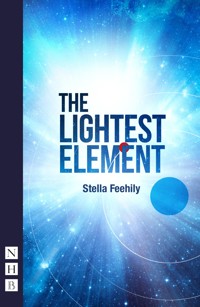
'Nothing compares with being the first person in the history of the world to see something, but timing is everything. The world has to be ready for you.' Boston, 1956. Cecilia Payne-Gaposchkin, one of the most eminent astronomers of the twentieth century, is about to be appointed Chair of Astronomy and the first woman to head a department at Harvard University. Only two things stand in her way: a covert investigation aimed at exposing her as a Communist sympathiser, and the entrenched conservatism of her male colleagues. When a student journalist asks to profile her, it feels like an opportunity to control her own narrative – assuming, of course, that the invitation is actually what it seems… Stella Feehily's play The Lightest Element is a taut drama exploring how a challenge to social norms can be almost as difficult as overturning scientific orthodoxy. It premiered at Hampstead Theatre, London, in 2024, directed by Alice Hamilton.
Sie lesen das E-Book in den Legimi-Apps auf:
Seitenzahl: 84
Veröffentlichungsjahr: 2024
Das E-Book (TTS) können Sie hören im Abo „Legimi Premium” in Legimi-Apps auf:






Stella Feehily
THE LIGHTEST ELEMENT
NICK HERN BOOKS
London
www.nickhernbooks.co.uk
Contents
Original Production Details
Acknowledgements
Epigraph
Dedication
Characters
The Lightest Element
Source Material
About the Author
Copyright and Performing Rights Information
The Lightest Element was first performed at Hampstead Theatre, London, on 5 September 2024. The cast was as follows:
CECILIA PAYNE-GAPOSCHKIN
Maureen Beattie
NORMAN/PROFESSOR VARNEY
Steffan Cennydd
PROFESSOR FRED WHIPPLE
Simon Chandler
BUDD PHILIPS/ PROFESSOR RICHARDSON/ ENSEMBLE
Hari Kang
SALLY KANE
Annie Kingsnorth
RONA STEWART
Rina Mahoney
PROFESSOR SCHWENGER/ENSEMBLE
Simon Markey
PROFESSOR HENRY NORRIS RUSSELL/ PROFESSOR FRANK CABOT
Julian Wadham
Director
Alice Hamilton
Designer
Sarah Beaton
Lighting Designer
Johanna Town
Sound Designer
Harry Blake
Video Designer
Zakk Hein
Movement Director
Michela Meazza
Casting Director
Gabrielle Dawes CDG
Acknowledgements
Writing a play involving astronomy and astrophysics sometimes seemed impossible, and I needed some help.
Advisers include friends, family, valued colleagues, and professionals who graciously responded to a random email.
Thank you to Thom Burns, Curator of Astronomical Photographs, Harvard Plate Stacks Collection at the Center for Astrophysics ǀ Harvard & Smithsonian. Thanks to the Harvard Archive and staff.
Thanks to the Royal Astronomical Society: Dr Sue Bowler (Editor of A&G), Philip Diamond (Executive Director), and Sian Prosser (Librarian and Archivist).
Thanks to The Harvard Crimson: Vivienne Germain and Sage Lattman showed me around and talked me through the history of the Crimson.
Thank you to Meg Weston-Smith and Dame Jocelyn Bell Burnell for taking the time to speak with me.
Thank you to Julia Smeliansky from the American Academy of Dramatic Arts for arranging my interviews at the Harvard Observatory.
Thank you to Chris Campbell and Jack Doulin for providing me with valuable feedback.
Special thanks to Professor Cecilia Gaposchkin, Chair of the Department of History at Dartmouth College, who allowed me to use some of her grandmother’s most famous lines.
Thank you to Greg Ripley-Duggan, who programmed the play and introduced me to Alice Hamilton. Alice was so encouraging and made great suggestions. Also thanks so much to the wonderful team at Hampstead and casting director, Gabrielle Dawes.
Love and thanks to the gorgeous cast and crew of The Lightest Element. I was amazed to discover that Maureen Beattie (CPG) was born in Bundoran, County Donegal – the very town in Donegal I grew up in. It was meant to be.
Thank you to Mel Kenyon for never giving up on Cecilia. Mel organised a crucial earlier reading, so thanks to: Zephy Losey, Harriet Walter, Guy Paul, David Rintoul, Archie Redford, Thea Mayeux and Iona Champain.
Thanks to NHB editor, Sarah Liisa Wilkinson, Deborah Halsey, Nick Hern and the team at NHB.
Thanks to Max Stafford-Clark who read endless drafts, gave invaluable advice for improvements and supplied abiding support. Thanks to Kitty Stafford-Clark for her warmth and encouragement.
Finally thanks so much to my long-suffering researcher; astrophysicist and actor, Victoria Porter. She guided me patiently through the kindergarten stage of astrophysics without rolling her eyes – too much.
S.F.
‘I ofen looked up at the sky an’ assed meself the question – what is the stars, what is the stars?’
Captain Boyle, Juno and the Paycock, Seán O’Casey
‘Life can only be understood by looking backward; but it must be lived looking forward.’
Søren Kierkegaard
For my mother
Characters
PROFESSOR CECILIA PAYNE-GAPOSCHKIN, British, playing twenty-five, fifty-six, seventy-six. Professor of Astronomy, Harvard
RONA STEWART, American, playing thirty, fifty. Harvard research assistant and assistant to Cecilia Payne-Gaposchkin
SALLY KANE, American, twenties. A student at Radcliffe
HENRY NORRIS RUSSELL*, American, fifties. Director of the Princeton University Observatory
NORMAN MATTISSON*, American, twenties. A student at Harvard and an ‘Editor’ at The Harvard Crimson
PROFESSOR FRED WHIPPLE, American, Chairman of Astronomy, Harvard, and Director of the Smithsonian Observatory
BUDD PHILIPS, a reporter for The New York Times
MEMBERS OF THE ASTRONOMY DEPARTMENT
PROFESSOR FRANK CABOT*
PROFESSOR DAVID RICHARDSON
PROFESSOR GERHARD SCHWENGER
PROFESSOR JAMES VARNEY*
(* Doubling)
Note on Text
A forward slash (/) indicates when the following line is spoken.
Time Frame
The action takes place in 1925 and 1956, with the opening and closing scenes set in 1977.
Note on Play
Cecilia Payne-Gaposchkin (1900–1979) was a pioneer in astronomy and one of the most eminent astronomers of the twentieth century. She was the first to apply atomic physics to the study of the temperature and density of stellar bodies, and to conclude that hydrogen and helium – the two lightest elements – were also the two most common elements in the universe.
This ebook was created before the end of rehearsals and so may differ slightly from the play as performed.
Scene One
17th January 1977. Two hours before an awards ceremony. A stage. American Astronomical Society.
CECILIA PAYNE-GAPOSCHKIN walks onstage and surveys the auditorium. She has a manuscript in one hand and an unlit cigarette in another.
CECILIA. Will there be more light than this?
RONA STEWART (assistant to CECILIA) dressed in 1970s style, follows from the wings.
RONA. We’re early. I understand these are ‘working lights’.
CECILIA takes off her coat – revealing a suit that has a timeless quality.
CECILIA (muttering as she looks around). Shouldn’t one be able to work in ‘working lights’?
RONA. Is that what you’re wearing?
CECILIA. What’s wrong with it?
RONA. Do you want the truth or an argument?
Beat.
CECILIA. An argument?
RONA (scolds). Why didn’t you buy something new like I told you?!
CECILIA (defies). I like this.
RONA. So did I – thirty years ago.
CECILIA hands the coat to RONA.
CECILIA. Is there an itinerary?
RONA (checking a list). Soundcheck at five p.m. Welcome drinks in the lobby at six p.m. The guests will take their seats just before seven.
CECILIA. Just before seven, I take a Valium.
RONA (handing her a little pill box). You take half a Valium. We don’t want you asleep. Margaret Burbidge will make her address at seven-fifteen – she will invite you to the podium – which I imagine will be – (Pointing centre stage.) somewhere here. Mrs Burbidge will hand you the illuminated scroll. Applause. You knock their socks off with your lecture. Applause, applause.
CECILIA. Thank you for the vivid picture, Rona.
(Trying to find light.) Oh for goodness’ sake! I can’t see a thing.
RONA. The technical staff will be here shortly. Try further downstage perhaps?
CECILIA – sticking the unlit cigarette in her teeth and trying to read in the half-light – begins her speech.
CECILIA (loudly). ‘The reward of the young scientist is the emotional thrill of being the first person in the world to understand something. Nothing can compare with that experience.’
RONA. You don’t have to kill yourself. There will be a microphone.
More light comes on the stage.
CECILIA (calls out). Thank you!
RONA pulls out an ashtray from her bag and hands it to CECILIA.
Thank you.
A projection or a board becomes visible with a picture of Henry Norris Russell alongside the words: ‘Henry Norris Russell Prize Lecture. The American Astronomical Society – Cecilia Payne-Gaposchkin. 50 years of Novae’.
RONA. Well, Mrs G – it’s there in black and white. The Henry Norris Russell Prize. A lifetime-achievement award. What say you to that?!
CECILIA. I say God or the American Astronomical Society has a sense of humour. And I’ve been dreaming of him recently. I am as I am now and he is as he was.
RONA. Interesting.
CECILIA. And I still don’t like him.
RONA. I have recurring dreams about playing field hockey at Bryn Mawr and am in a constant state of anxiety in case anyone notices that I am nearly fifty.
CECILIA. And do they?
RONA. No! No one even bats an eyelid at this sweating middle-aged woman running with teenagers. Probably some message in that.
CECILIA. When I first met Russell he had mislaid his gloves on the New Haven train. I lent him a pair belonging to my father.
History does not record if he found his gloves but he never returned mine.
RONA. Ain’t that just like a man?! Do you want a cup of tea or something stronger?
CECILIA. I want a few moments to gather my thoughts. Maybe a tea. If you don’t mind?
RONA. Not at all. I left Serena in the lobby. She is thrilled to be invited to such a grown-up event. She’s talking about becoming a scientist…
RONA starts to leave the stage.
You’ll be an inspiration to her.
CECILIA (lighting her cigarette). I hope I’ll be an inspiration to me.
CECILIA finds the spot from which she will deliver her lecture. CECILIA looks back at her notes.
(With the cigarette between her teeth.) ‘The reward of the older scientist is the sense of having seen a vague sketch grow into a masterly landscape.’
From the lighting box:
TECHNICIAN. Professor Gaposchkin?
CECILIA. Yes?
TECHNICIAN. Just stay there, Professor Gaposchkin. Going dark for a few seconds. Lighting check in five.
She closes her eyes. Darkness and the night sky. The stars appear to pulse in the heavens.
Scene Two
January 1925. The Harvard College Observatory. Cambridge, Massachusetts. A classroom.
It’s cold outside and not so warm inside either.
Numbers, words and equations on a large blackboard. Director of the Princeton University Observatory, PROFESSOR HENRY NORRIS RUSSELL, fifties, shrewd and charismatic, dressed in a suit and high-neck shirt of an earlier era, is looking at the work with some interest – disbelief even.
CECILIA has a tray of tea things.
RUSSELL backs away from the board; his expression is inscrutable.
CECILIA. Professor Russell, I’m sorry to have taken so long. The yard is treacherously icy and, there’s not much light this late.
RUSSELL. No matter, Miss Payne. It gave me another chance to peruse the current draft of your thesis. In the main, it is a beautiful piece of work. Professor Shapley is keen to have it published.
CECILIA places the tray on a desk.
CECILIA. Thank you. I understand that you have noted a problem in the chapter on ‘The Relative Abundance of the Elements’.
RUSSELL (gesturing towards the board




