


0,99 €
Mehr erfahren.
- Herausgeber: via tolino media
- Kategorie: Gesellschafts- und Liebesromane
- Sprache: Englisch
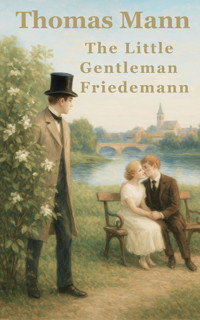
Diese 1897 veröffentlichte Novelle markiert das literarische Debüt von Thomas Mann. Sie enthält bereits die ersten Ansätze der großen Themen, die sein gesamtes Werk durchziehen werden: die selbstgewählte Einsamkeit, den Konflikt zwischen Begehren und Verzicht und die Verletzlichkeit der Seele angesichts der Leidenschaft. Es ist die Geschichte eines jungen, verwaisten, zerbrechlichen und behinderten Mannes, der sich aus der Welt zurückgezogen hat und in der Isolation ein prekäres Gleichgewicht findet. Die Ankunft einer jungen verheirateten Frau, schön, unnahbar, einsam und souverän, bringt seinen Rückzug aus der Welt durcheinander und offenbart die Schwächen eines Lebens, das von Gefühlen ferngehalten wird. Dieses Werk, das dem französischsprachigen Publikum noch wenig bekannt ist, verdient es, wegen seiner Ausdruckskraft und der erstaunlichen Reife seines damals 22-jährigen Autors wiederentdeckt zu werden. Es zeugt bereits von der psychologischen Tiefe und der sorgfältigen Erzählstruktur, die Thomas Mann zu einem der großen Namen der Weltliteratur machen werden.
Das E-Book können Sie in Legimi-Apps oder einer beliebigen App lesen, die das folgende Format unterstützen:
Veröffentlichungsjahr: 2026
Ähnliche














Title Page
The Little Gentleman Friedemann
A short story byThomas Mann
Original title:
Der Kleine Herr Friedemann
Translated from German byAdèle Liechtenstein
With :
An original preface
By Adèle Liechtenstein
An original biography
By Adèle Liechtenstein
Preface
Published in 1897, this short story marks the literary beginnings of Thomas Mann. It already contains the seeds of the major themes that would run through his entire body of work: chosen solitude, the conflict between desire and renunciation, and the vulnerability of the soul in the face of passion.
It is the tale of a fragile man, withdrawn from the world, who finds in isolation a precarious balance. The arrival of a young married woman - beautiful, unattainable, solitary, and sovereign - shatters his retreat and exposes the flaws of a life kept at a distance from emotion.
Still little known to the French-speaking public, this work deserves to be rediscovered for its evocative power and the astonishing maturity of its author, then only twenty-two years old. It already reveals the psychological depth and meticulous narrative construction that would make Thomas Mann one of the great names in world literature.
Biography of Thomas Mann
Thomas Mann, born on June 6, 1875 in Lübeck, is one of the most significant writers of the twentieth century. Coming from a prosperous bourgeois family, his destiny was shaken by the premature death of his father in 1891, an event that led him to abandon the world of commerce and devote himself to writing. His literary beginnings were marked by the novella The Little Herr Friedemann (Der kleine Herr Friedemann), published in 1896, which tells the tragic story of a deformed and solitary man, humiliated by a passionate love. Already in this work, we find the themes that would permeate his entire oeuvre: solitude, the fragility of the individual, and the tension between desire and renunciation.
Success came in 1901 with Buddenbrooks, a vast family saga depicting the decline of a bourgeois dynasty in Lübeck. This novel, which earned him the Nobel Prize in Literature in 1929 (awarded for his entire body of work, but largely thanks to this book), established Mann as one of the major writers of his time. Other landmark works followed, such as Tonio Kröger, Death in Venice, and The Magic Mountain - meditations on beauty, illness, time, and the crisis of European ideals. Mann became an essential intellectual figure, able to combine psychological introspection with political reflection.
Confronted with the rise of Nazism, Thomas Mann, who was traveling in Switzerland at the time of Hitler’s seizure of power in early 1933, chose not to return to Germany. He settled in Küsnacht, in the canton of Zurich, and later went into exile again in the United States in 1938.
His essays and speeches denounced totalitarianism and defended European culture. He authored several major radio addresses to Germany beginning in 1940, in which he openly condemned Nazism and urged his compatriots to resist barbarism. In Doktor Faustus, published in 1947, he transposed the tragedy of twentieth‑century Germany into the life of a fictional composer, Adrian Leverkühn, whose cursed fate symbolized the spiritual corruption of an entire nation. Until the end of his life, he remained a respected moral voice throughout the world.
Thomas Mann died on August 12, 1955 in Zurich, at the age of 80, in a clinic where he had been hospitalized. He was buried in the Kilchberg cemetery on the shores of Lake Zurich. His grave, sober and elegant, has become a place of literary remembrance. Mann had chosen to remain tied to Switzerland, the country that had welcomed him in the 1930s and where he had found refuge from Nazism.
His legacy is immense. His works have been translated into dozens of languages and continue to influence writers, philosophers, and readers. His style is characterized by intellectual rigor, psychological depth, and a critical humanism. He succeeded in uniting classical narration with modern philosophical reflection, and his great novels such as Buddenbrooks, The Magic Mountain, or Doktor Faustus, as well as his novellas like The Little Herr Friedemann and Death in Venice, embody the tension between the individual and history, between beauty and decay, between art and politics.
Major Novels and Tetralogy
Buddenbrooks. The Decline of a Family (Buddenbrooks. Verfall einer Familie): 1901
Royal Highness (Königliche Hoheit): 1909
The Magic Mountain (Der Zauberberg): 1924
Joseph and His Brothers (Joseph und seine Brüder): 1933–1943 (Tetralogy in four volumes)
Lotte in Weimar (Charlotte à Weimar): 1939
Doktor Faustus: 1947
The Holy Sinner (Der Erwählte): 1951
Confessions of Felix Krull, Confidence Man (Bekenntnisse des Hochstaplers Felix Krull): 1954 (unfinished)
Famous Novellas and Short Stories
The Little Gentleman Friedemann (Der kleine Herr Friedemann): 1896
The Clown (Der Bajazzo): 1897
Tonio Kröger: 1903
Tristan: 1903
The Prodigy (Das Wunderkind): 1904
Death in Venice (Der Tod in Venedig): 1912
Disorder and Early Sorrow (Unordnung und frühes Leid): 1926
Mario and the Magician (Mario und der Zauberer): 1930
The LittleGentleman Friedemann
A short story byThomas Mann
Original title:
Der Kleine Herr Friedemann
Translated from German byAdèle Liechtenstein




