


1,99 €
Niedrigster Preis in 30 Tagen: 1,99 €
Niedrigster Preis in 30 Tagen: 1,99 €
Mehr erfahren.
- Herausgeber: DigiCat
- Kategorie: Geisteswissenschaft
- Sprache: Englisch
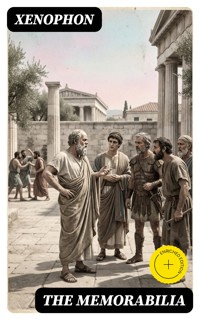
Xenophon's 'The Memorabilia' is a profound work that intricately outlines the teachings and philosophies of Socrates, while simultaneously serving as a defense of his character amidst the political turmoil of Athens. Written in a Socratic dialogue style, the text captures the essence of Socratic thought through carefully crafted conversations, inviting the reader to engage with profound moral and ethical issues. The literary context of the work is crucial, as it emerges from a period where Socratic ideals were being questioned, making Xenophon's portrayal not only a testament to Socrates' enduring influence but also a critical commentary on Athenian society. Xenophon, a renowned historian, soldier, and student of Socrates, draws from his experiences within the socio-political landscape of ancient Greece. His dual role as both a participant in and an observer of the events surrounding Socrates' life and death lends unique authenticity to 'The Memorabilia.' Xenophon's close association with Socrates and his philosophical inquiries illuminate his motivations for preserving the teachings of his mentor, as he sought to provide a counter-narrative to the dominant criticisms of Socratic philosophy. 'The Memorabilia' is essential reading for anyone interested in ethical philosophy, Socratic teachings, or the history of classical thought. Its engaging dialogue and rich context offer readers not only a glimpse into the mind of Socrates but also a reflection on the values that continue to resonate today. This work serves as a bridge between ancient wisdom and contemporary moral questions, making it a timeless treasure for scholars and casual readers alike. In this enriched edition, we have carefully created added value for your reading experience: - A succinct Introduction situates the work's timeless appeal and themes. - The Synopsis outlines the central plot, highlighting key developments without spoiling critical twists. - A detailed Historical Context immerses you in the era's events and influences that shaped the writing. - An Author Biography reveals milestones in the author's life, illuminating the personal insights behind the text. - A thorough Analysis dissects symbols, motifs, and character arcs to unearth underlying meanings. - Reflection questions prompt you to engage personally with the work's messages, connecting them to modern life. - Hand‐picked Memorable Quotes shine a spotlight on moments of literary brilliance. - Interactive footnotes clarify unusual references, historical allusions, and archaic phrases for an effortless, more informed read.
Das E-Book können Sie in Legimi-Apps oder einer beliebigen App lesen, die das folgende Format unterstützen:
Veröffentlichungsjahr: 2022
Ähnliche








The Memorabilia
Table of Contents
Introduction
Against the din of public outrage and the chill of a courtroom’s verdict, Xenophon’s Memorabilia advances a steady claim that reasoned conversation, disciplined conduct, and the daily practice of virtue form a rampart stronger than rhetoric, and that a life examined among friends and fellow citizens can answer accusations not by flourish but by example, showing how moral inquiry, prudence in action, and reverence for what is due give a soul its poise, align judgment with purpose, and make instruction persuasive because it is tested, so that philosophy appears not as escape or ornament, but as the craft of living well in common.
The author is Xenophon of Athens, an accomplished soldier, historian, and man of letters who lived roughly from the late fifth to the mid-fourth century BCE and was an associate of Socrates. Composed in the early fourth century BCE, after the execution of Socrates in 399, the Memorabilia is written in lucid Attic Greek and arranged in four books. Its form is that of recollection: assembled episodes that present Socrates in conversation, situated within a broader intention to vindicate his character and influence by portraying habits of thought, speech, and daily discipline rather than by theoretical treatise.
The central premise is straightforward and compelling: by gathering remembered encounters, Xenophon aims to show what kind of person Socrates was and what kind of effect he had on those around him. The book presents varied conversations—brief, pointed, often practical—through which Socrates examines claims, encourages self-scrutiny, and urges a life ordered toward virtue and usefulness. Without staging elaborate argument for its own sake, it places readers in the company of a teacher whose questions and examples turn familiar tasks and relationships into occasions for ethical reflection, thereby countering the charges that made his death a civic trauma.
Literarily, the Memorabilia exemplifies clarity and economy. Xenophon’s style favors concrete situations, apt analogies, and an unadorned cadence that leaves the weight on action and character. The Greek title, Apomnemoneumata, signals its method: recollections, not a systematic philosophy. Yet the arrangement is artful. Episodes are selected to build a composite portrait—temperate, pious, fair-minded, and demanding of himself and others—so that the reader learns as much from the pattern of scenes as from any single exchange. The result is a narrative mosaic that makes ethics intelligible through recognizable experiences rather than through technical vocabulary.
The work holds classic status because it is one of our principal sources for Socrates alongside Plato, Aristophanes, and later testimonies, and because it shaped the literary form by which philosophers could be known through remembered conversations. Xenophon’s Socrates, attentive to daily affairs and civic obligations, complements the more speculative horizons often associated with Plato. That complementarity gave antiquity and later ages a richer, more dimensional figure of Socrates. The book thus stands at the headwaters of a tradition in which character, talk, and example teach as effectively as syllogism, and moral philosophy is inseparable from lived practice.
The enduring themes are capacious yet grounded: moderation in desires, steadiness under fortune, justice in dealings, reverence for gods and laws as the framework of communal life, and the conviction that knowledge is measured by what it enables one to do responsibly. Friendship and mentorship receive sustained attention, as do household management, work, and the training of the self. A through-line is usefulness—how speech and action serve the good. Under Xenophon’s hand these are not abstractions; they appear as habits cultivated in time, through counsel and correction, in settings where real choices shape character.
The pedagogical approach is practical and dialogic. Socrates poses short questions, tests assumptions with examples drawn from crafts, athletics, or civic duties, and appeals to standards his interlocutors already recognize. The method is diagnostic rather than adversarial: it seeks clarity about ends and means, urging coherence between profession and practice. Xenophon’s portrait highlights how inquiry can be at once demanding and friendly, frank yet considerate. The aim is not victory over an opponent, but the formation of a reliable agent—someone who can steward resources, honor obligations, and guide others by reasoned persuasion rather than compulsion.
Historical context sharpens the book’s purpose. Athens had been convulsed by war, regime change, and recrimination. Accusations against Socrates—centered on impiety and the corruption of youth—were forged in a charged civic climate. Writing afterward, Xenophon responds not with a counter-speech alone, but with a sustained demonstration of character under ordinary pressures. His own life beyond Athens, including long service and travel, lends him a seasoned eye for leadership and accountability. That experience anchors a portrayal of philosophy as compatible with duty, piety, and competence, offering a corrective to images of intellectuals detached from common responsibilities.
The Memorabilia influenced ancient readers across genres. Philosophers found in it a model of ethical seriousness rooted in daily practice; historians and biographers drew on it for a sober, humane portrait of Socrates. Later compilers, such as Diogenes Laertius, used Xenophon among their sources, and Plutarch engaged Xenophon’s writings in his moral essays and Lives. Roman admirers valued Xenophon’s clarity and poise; his pages became part of a broader classical education in which style and character converged. The work helped sustain a Socratic legacy that informed Cynic and Stoic ethics, where self-mastery and public responsibility are joined.
Transmission continued through late antiquity and into the Renaissance, when humanists prized Xenophon’s elegant simplicity and moral instruction. The Memorabilia, alongside other works by Xenophon, entered curricula that trained readers to see in Greek prose an ideal of clarity yoked to ethical purpose. Modern translations have kept the book close to students of philosophy, classics, and political thought. Its scenes are immediately approachable, yet they reward careful, repeated reading. Because it proceeds by example rather than by formal system, it can be entered from many angles—literary, historical, ethical—without presuming technical preparation.
Readers approaching the text might attend to how defense and instruction intertwine. The arrangement of the four books moves from general exoneration to particular demonstrations of counsel and conduct, inviting us to weigh the credibility of a life as evidence. Watch how interlocutors change as questions sharpen, how analogies from crafts recalibrate pride, and how piety frames deliberation without stifling inquiry. Above all, notice the consistency between Socrates’ recommendations and his own bearing. The cumulative effect is an education in seeing: distinguishing what is useful from what is vain, what is disciplined from what is merely fashionable.
For contemporary audiences, the book’s appeal lies in its union of ethical clarity with civic concern. It affirms that rigorous questioning can be courteous, that character grows through shared speech, and that responsibilities in work, friendship, and community are the proving grounds of wisdom. In an era anxious about leadership, information, and trust, the Memorabilia offers a portrait of authority grounded not in status but in coherence of life. Its pages remind us that integrity persuades, that counsel requires patience, and that the measured pursuit of the good—day by day—remains the most durable answer to fear, fashion, and accusation.
Synopsis
Xenophon’s Memorabilia, often translated as Recollections of Socrates, is a four-book compendium designed to defend Socrates’ character and way of life. Composed in the early fourth century BCE in the aftermath of Socrates’ trial and death in 399 BCE, it arranges brief scenes and argumentative passages rather than a continuous narrative. Xenophon presents Socrates as a teacher who sought practical wisdom, moral self-discipline, and reverence for the gods. The overall purpose is apologetic and instructional: to counter public accusations of impiety and corruption while illustrating how Socrates conversed with companions about conduct, utility, and virtue. The work’s sequence moves from rebuttal to exemplar-filled exploration of ethical topics.
Book I opens with a direct rebuttal of the charges. Xenophon portrays Socrates as scrupulously pious, respectful of Athenian law, and committed to customary worship. The much-discussed personal sign is presented as a divine warning that discouraged ill-timed actions rather than as an impious innovation. Socrates is shown steering companions away from idle speculation about the cosmos and toward the practical question of how to live well. The initial chapters establish his moderation, endurance, and temperance, positioning him as a guide who elevates others through conversation and example, not as a sophist selling instruction or a subversive undermining civic order.
The defense also addresses the allegation that Socrates corrupted the young through associations with controversial figures. Xenophon counters by recounting how Socrates tried to improve ambitious companions, admonishing arrogance and urging obedience to law. Dialogues in Book I exhibit his method: he probes definitions, asks for evidence, and tests claims by reference to usefulness and consequences. In exchanges with critics, including professional intellectuals, he insists that wisdom must serve life’s needs. Discussions on piety argue from observation and purpose, encouraging gratitude for benefits received. Across these episodes, the portrait is consistent: Socrates seeks to cultivate good judgment, self-control, and civic responsibility.
Book II develops a positive account of virtue as the product of choice, training, and steady practice. Xenophon has Socrates emphasize that good habits formed through daily discipline shape character more reliably than abstract theorizing. A notable centerpiece is the moral tale attributed to Prodicus about Heracles confronted by two paths, which Socrates uses to dramatize the attraction of ease and the claims of effort. The conversations repeatedly commend industry, restraint, and conscientious stewardship of one’s abilities. Socrates’ examples are concrete and accessible, highlighting how prudent planning, measured desires, and consistent labor advance personal excellence and make one genuinely useful to others.
Another persistent theme in Book II is friendship. Socrates urges careful selection and testing of companions, defining genuine friendship as a bond of mutual goodwill grounded in virtue and proven reliability. He recommends observing how people handle obligations, wealth, and pleasure to assess character, and he warns against one-sided arrangements that invite disappointment. Practical counsel on reciprocity, trust, and loyalty frames friendship as a cooperative pursuit of the good rather than a source of convenience. Throughout, Xenophon’s Socrates treats moral improvement as a shared enterprise that flourishes through honest counsel, measured criticism, and a willingness to learn from failure.
Book III turns outward to public life, examining leadership, command, and statesmanship through particular cases. Socrates engages men with political or military ambitions, pressing them to clarify aims, reckon with their limitations, and acquire the skills their roles require. He argues that effective leadership depends on knowledge, discipline, and the ability to manage resources and people, and he draws parallels between civic administration and other forms of organization. Conversations with would-be leaders stress preparation, attention to detail, and accountability to laws. The result is a portrait of civic excellence as an extension of personal excellence, grounded in competence, justice, and care for those one leads.
Xenophon also shows Socrates using everyday situations to teach. An encounter with the courtesan Theodote explores persuasion, attraction, and the ethics of exchange, redirecting talk of charm toward questions of mutual benefit and commitment. Other episodes consider the management of desires, the dangers of complacency, and the importance of consistency between words and deeds. Socrates repeatedly reframes immediate concerns—pleasure, reputation, profit—by asking what truly improves a life. The teaching style remains practical: he disarms vanity with questions, invites scrutiny of motives, and proposes exercises in moderation. The portraits emphasize tact, irony, and a steady focus on what is helpful and just.
Book IV concentrates on knowledge and piety as foundations for reliable action. A sustained sequence with the eager youth Euthydemus illustrates the difference between possessing information and understanding its application. Socrates exposes the hazards of overconfidence, guiding his interlocutor toward the kind of self-knowledge that motivates study and reform. Elsewhere he discusses prayer and divine favor, urging requests that align with wisdom rather than fortune alone, and he underscores the use of his sign as a caution against rashness. The book closes by reaffirming that disciplined habits, clear aims, and reverent attention to the gods shape prudent, courageous conduct.
Across its four books, Memorabilia offers a systematic, example-driven defense of Socrates that doubles as a primer in practical ethics. Xenophon’s portrait emphasizes usefulness, moderation, and piety, presenting philosophy as a craft for living rather than speculative theory. Without relying on technical argument, the work poses durable questions: how to test character, how to align desire with reason, and how to prepare for private and public responsibilities. Its enduring significance lies in its clear, orderly image of Socrates as moral educator and civic benefactor—a complementary witness to the Socratic legacy that invites readers to measure ideals by their fruits in action.
Historical Context
Xenophon’s Memorabilia is set against the civic world of late fifth- and early fourth-century BCE Athens, a polis defined by direct democracy, public litigation, and dense religious activity. Citizens met in the Assembly to decide policy, a Council prepared business, and large juries adjudicated disputes. Ritual festivals, sacrifices, and processions organized communal life and helped legitimize institutions. Within this frame, Socrates moved through streets, gymnasia, and workshops conversing with fellow Athenians. Xenophon writes to defend Socrates’ character and practice within these institutions, presenting a figure whose ethics and piety he believed had been misunderstood amid the era’s volatile politics and intellectual contests.
The Peloponnesian War (431–404 BCE) profoundly shaped the generation portrayed in the Memorabilia. Athens suffered plague, fiscal strain, factionalism, and finally defeat by Sparta, leading to the demolition of its long walls and the collapse of its maritime empire. The trauma of war fostered suspicion of unconventional figures and ideas, a mood that later framed the accusations against Socrates. Xenophon’s depiction of Socratic moderation and self-sufficiency echoes a reaction to this breakdown, emphasizing character over rhetoric and steady judgment over volatility—qualities Athenians found in short supply during the long war and its immediate aftermath.
Athenian democracy empowered ordinary citizens to deliberate and judge, but it also made public reputation a civic resource and a liability. Orators swayed the Assembly; litigants appealed to large juries; and lawcourts heard wide-ranging charges, including those concerning public morality and piety. Socrates—visible, provocative, and relentlessly questioning—operated within this environment. The Memorabilia underscores that his inquiries remained within legal and religious norms as Xenophon understood them. By presenting conversations about justice, law, and civic duty, Xenophon aligns Socrates with responsible citizenship while implicitly critiquing the democratic tendency to confuse notoriety with guilt or philosophical examination with subversion.
The intellectual marketplace of late fifth-century Greece was crowded with sophists who taught rhetoric and civic success for fees. Their itinerant instruction in argument and persuasion found eager Athenian audiences. Socrates was often lumped with this movement by contemporaries who saw all “clever talkers” as one group. Xenophon’s work makes a careful distinction: Socrates charged no fees, pursued moral improvement rather than courtroom victories, and challenged interlocutors to define virtues rather than to win debates. The Memorabilia thus responds to a well-known conflation, differentiating Socratic inquiry from sophistic display and defending the social utility of philosophical examination.
Religion permeated Athenian public life. The city maintained ancestral cults, consulted oracles, and policed impiety (asebeia) through legal procedures. In 415 BCE, scandals over the mutilation of the Herms and profanation of the Mysteries heightened anxieties about religious respect, linking sacrilege to political disloyalty. Such precedents shaped jurors’ sensitivities decades later. Xenophon highlights Socrates’ scrupulous sacrifices and his deference to divine signs, portraying him as a model of piety within traditional practice. The Memorabilia stresses consultation of seers and adherence to customary rites, countering the charge that Socratic inquiry undermined religion by arguing that true understanding fortifies, rather than erodes, civic cult.
Political upheavals sharpened suspicion of intellectuals. Oligarchic coups in 411 BCE and in 404–403 BCE (the regime of the Thirty) destabilized Athens. Socrates had acquaintances who later became prominent oligarchs—figures like Critias and Charmides—facts that complicated his public image after democracy’s restoration. Xenophon confronts this context by showing Socrates advising moderation, justice, and respect for law, not violence or faction. By separating personal association from endorsement, the Memorabilia insists that Socrates neither trained conspirators nor encouraged anti-democratic plots, challenging the narrative that philosophical circles served as incubators for political extremism.
After the restoration of democracy in 403 BCE, Athens declared a general amnesty for most political offenses to reduce cycles of vengeance. The legal possibility of prosecuting impiety remained, however, and in 399 BCE Socrates was tried and condemned. Xenophon was not present—he later says he learned details from others—yet he responds to the trial’s core claims. The Memorabilia offers sustained evidence of Socrates’ lawful conduct: reverence for gods, care for youth, and serviceable advice to citizens. By situating Socrates within the amnesty’s spirit of civic healing, Xenophon implies that the conviction reflected lingering anxieties more than demonstrable harm.
Economic changes also frame the work. The loss of imperial tribute after 404 BCE forced Athens to rely more on local revenues, silver mining at Laurion, and private wealth. Citizens shouldered “liturgies,” public service expenses such as the trierarchy, which strained fortunes during recovery. Xenophon’s wider corpus addresses practical management, and in the Memorabilia he presents Socrates advising craftsmen and householders on competence, thrift, and honest dealing. The focus on self-mastery and utility reflects a city reassessing prosperity without empire. By stressing productive labor and prudent stewardship, the book connects moral excellence to economic resilience in a humbled polis.
Athenian society rested on households (oikoi) managed by men with the assistance of women, dependents, and enslaved persons; metics contributed significantly to commerce and craft. Formal political rights were restricted to male citizens, yet daily life intertwined many statuses. Socrates’ conversations, as Xenophon records them, often cross these social boundaries—speaking with artisans, household heads, and ambitious youths—probing what competence, justice, and friendship require in practice. The presence of enslaved labor and the legal limitations on women formed the backdrop to discussions of responsibility and authority, shaping how Athenians understood virtue and usefulness within the home and the city.
Military experience defined citizenship ideals. Hoplite service and naval campaigns during the fifth century forged expectations of discipline, endurance, and command. Xenophon himself had extensive military experience, and in the Memorabilia he shows Socrates engaging questions of generalship and leadership, arguing that effective command depends on knowledge, self-control, and care for subordinates. This emphasis mirrors Athenian scrutiny of generals in the Assembly and courts, where failures were publicly judged. In a city exhausted by war, Socrates’ model of rational authority offered a corrective to impulsive decision-making and to the pursuit of command for prestige rather than for competence.
Greek geopolitics after 404 BCE remained fluid. Sparta’s ascendancy faced persistent Persian influence, especially in Asia Minor. Xenophon’s participation in the expedition of Cyrus the Younger (401 BCE) and the Ten Thousand, and his later writings, exposed him to Persian power and practical problems of marching, supply, and negotiation. Although the Memorabilia does not recount that campaign, its stress on practical wisdom, piety in decision-making, and adaptive leadership resonates with lessons learned amid wider Greek-Persian entanglements. Socrates, as presented here, teaches skills for civic and military life that remain applicable beyond Athens, throughout a fragmented Greek world.
Spartan hegemony framed Xenophon’s adult years. He associated with King Agesilaus II and fought alongside Spartan forces; as a result, Athens exiled him, and Sparta granted him an estate at Scillus near Olympia. He likely wrote or revised parts of his works while living under Spartan protection. The Memorabilia, however, remains focused on Athens and Socrates. Its admiration for discipline and moderation harmonizes with Xenophon’s praise of Spartan virtues elsewhere, yet the book presents these as classically Athenian, rooted in careful deliberation and lawful piety, suggesting that civic excellence is not the monopoly of any single polis.
The political order altered again with the so‑called King’s Peace (387/6 BCE), brokered under Persian auspices, and later the rise of Thebes. After the Theban victory at Leuctra (371 BCE), Spartan power waned, and Xenophon’s residence at Scillus ended when regional dynamics shifted. Many scholars place the composition or revision of the Memorabilia in the early to mid-fourth century BCE, within this unsettled landscape. The work’s backward glance to Socrates can be read as a response to contemporary disappointments: when hegemonies faltered and alliances shifted, a stable measure of civic worth was sought in character and practical wisdom.
Urban culture shaped the form of Socratic inquiry. Athenians mixed in the agora, gymnasia, workshops, and at symposia; questions of honor, profit, and reputation were negotiated in conversation. The Memorabilia captures this texture by representing informal, situational exchanges rather than formal lectures. Social occasions—banquets, training grounds, and neighborhood encounters—become stages for ethical reflection. Such settings mattered for persuasion: in a society where many learned by seeing and hearing, the image of Socrates walking, questioning, and exemplifying moderation functioned as pedagogy rooted in ordinary civic life rather than in institutional classrooms.
The literary context is the flourishing of Socratic writings in the fourth century BCE. Alongside Plato, authors such as Antisthenes and Aeschines of Sphettus composed dialogues or memoirs about Socrates. Xenophon’s contribution is distinctive for its sober, practical tone and its explicit apologetic purpose. He begins by rejecting the charges against Socrates and offering episodes to prove his piety and beneficence. The work also answers earlier popular portrayals, especially Aristophanes’ Clouds (423 BCE), which satirized Socrates by blending him with sophists. By documenting concrete advice on householding, friendship, and civic duties, the Memorabilia counters caricature with usefulness.
Communication technologies and habits shaped how such defenses could be mounted. Athens was an intensely oral society, but writing on papyrus rolls increasingly preserved arguments for wider circulation. Xenophon frames his text as a record of reliable memories—his own and those of credible witnesses—reflecting both oral recollection and emerging literary documentation. The Memorabilia’s plain style and episodic structure suit compilation from remembered conversations, aligning with contemporary practices of assembling apomnemoneumata (recollections) to instruct and vindicate. The book thus sits at the junction of lived conversation and crafted text, aiming to stabilize Socrates’ reputation in durable form.
Xenophon’s Socrates emphasizes enkrateia (self-control), eusebeia (piety), and chresimotēs (usefulness), virtues that spoke to postwar Athens. In a city taxed by litigation, faction, and poverty, the idea that good judgment begins with self-mastery and respect for the gods served as social medicine. The Memorabilia does not advance a constitutional program; rather, it seeks to repair civic life by improving the character of individuals who deliberate, command, trade, and parent. This micro-political strategy mirrors the limits and possibilities of a polis rebuilt after defeat: reform the citizen, and the city may steady itself without coercion or utopian schemes. The Memorabilia functions as a mirror to its era’s anxieties and a critique of superficial success.
Author Biography
Xenophon of Athens (c. 430–354 BCE) was a soldier, historian, and author whose works bridge memoir, history, and practical philosophy in the classical Greek world. Active during the late Peloponnesian War and its aftermath, he combined firsthand military experience with an accessible prose style that made him a key witness to his era. He is best known for Anabasis, the account of the “Ten Thousand,” and for Hellenica, a continuation of Greek history after Thucydides. His Socratic writings preserve a distinctive portrait of Socrates. Across genres, Xenophon’s themes include leadership, education, piety, and the organization of civic and domestic life.
Raised in an elite Athenian milieu, Xenophon was associated with the cavalry and developed lifelong expertise in horsemanship. As a young man he became a student and admirer of Socrates, whose practical ethics and emphasis on self-mastery profoundly shaped his outlook and later dialogues. Intellectually, Xenophon wrote in the shadow of Herodotus and Thucydides, adapting historiographic models to his own experiences and didactic aims. He also engaged closely with Spartan institutions, observing their training and discipline at first hand. These formative influences—Socratic inquiry, equestrian practice, and Spartan example—inform his characteristic interest in leadership and the moral education of citizens.
Xenophon’s military reputation rests above all on the Anabasis, his narrative of the Greek mercenary army that marched into the Persian Empire to support Cyrus the Younger and then retreated after the battle of Cunaxa (401 BCE). Writing in a restrained third person, he reconstructs how the Greeks elected new leaders, preserved cohesion, and navigated hostile terrain back to the Black Sea. The work blends operational detail with reflections on morale, discipline, and religious consultation. Because Xenophon himself became a prominent leader during the retreat, Anabasis is both a strategic case study and a personal testament to pragmatic command under extreme conditions.
Following the expedition, Xenophon’s close ties with Sparta deepened, particularly his association with King Agesilaus II. He campaigned with Spartan forces and fought at Coronea (394 BCE) on their side. Ancient tradition reports that Athens exiled him, likely for this alignment, after which he resided for years at Scillus near Olympia, a property granted by Spartan authorities. In this rural setting he hunted, managed an estate, and wrote widely. The country life and cavalry expertise evident in treatises such as On Hunting (Cynegeticus), On Horsemanship, and The Cavalry Commander (Hipparchicus) reflect practical experience as well as a didactic impulse.
Xenophon’s historical works include Hellenica, covering Greek affairs from the final years of the Peloponnesian War through the early fourth century BCE. Intended as a continuation of Thucydides, it remains an indispensable—if sometimes partisan—source for the period, especially regarding Sparta and its diplomacy. His Agesilaus offers a laudatory biographical portrait of the Spartan king, while the Constitution of the Lacedaemonians analyzes Spartan institutions, praising their discipline and explaining their social order. Read alongside Thucydides and other sources, these works illuminate Xenophon’s strengths as a clear observer and his limitations where political sympathies color interpretation.
Xenophon also produced influential Socratic and political-philosophical writings. Memorabilia, Apology of Socrates, Symposium, and Oeconomicus present Socrates as a teacher of virtue, practical reason, and household management, complementing Plato’s more metaphysical treatments. The dialogue Hiero probes the psychology of tyranny, while Ways and Means proposes revenue reforms for Athens. Cyropaedia (Education of Cyrus) blends history and fiction to depict an idealized ruler’s training and statecraft; as a “mirror for princes,” it shaped later debates on leadership and empire. Across these texts, Xenophon advances a vision of prudent governance grounded in character, discipline, and useful knowledge.
After Sparta’s defeat at Leuctra (371 BCE), Spartan power in his region waned, and the Eleans reportedly reclaimed Scillus; Xenophon subsequently lived for a time near Corinth. He died around 354 BCE. His lucid Attic style made his works staples of Greek education and, much later, of modern classrooms—Anabasis in particular served generations of students as an entry to Greek prose. Historians value his eyewitness testimony and institutional analyses; philosophers and political theorists engage his portraits of Socrates and reflections on rulership. Xenophon’s blend of practicality and moral inquiry ensures a lasting place in discussions of strategy, leadership, and civic life.




