


1,99 €
Mehr erfahren.
- Herausgeber: Quickie Classics
- Kategorie: Sachliteratur, Reportagen, Biografien
- Sprache: Englisch
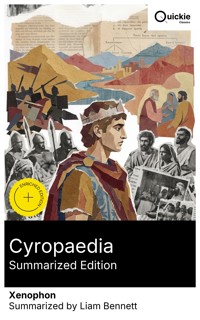
The Cyropaedia is Xenophon's fourth-century "education of Cyrus," a hybrid of biography, political theory, and historical romance that charts the formation and rule of Cyrus the Great. In lucid Attic prose and episodic scenes, Xenophon combines set speeches, tactical vignettes, and ethnographic asides to model imperial leadership. Its idealizing arc—from Cyrus's training through conquest and administration—ends with a sombre epilogue on Persian decline, inviting readers to test exemplar against experience and to weigh virtue, persuasion, and institutions in sustaining power. An Athenian gentleman-soldier and student of Socrates, Xenophon campaigned with Cyrus the Younger and led the Ten Thousand out of Persia—an ordeal recorded in his Anabasis. Exiled from Athens and resident among Spartans, he blended practical command with philosophical inquiry. These experiences, and his curiosity about Persian customs, shaped his vision of a ruler whose self-mastery, prudent delegation, and attention to ritual bind disparate peoples. Students of political thought, leadership, and empire will find in this mirror-for-princes a rigorous manual—one that influenced Machiavelli and still provokes debate about ideals versus institutions. Read it alongside Herodotus and Plato to triangulate Greek views of Persia and power; read it on its own for the pleasure of clear storytelling yoked to practical wisdom. Quickie Classics summarizes timeless works with precision, preserving the author's voice and keeping the prose clear, fast, and readable—distilled, never diluted. Enriched Edition extras: Introduction · Synopsis · Historical Context · Author Biography · Brief Analysis · 4 Reflection Q&As · Editorial Footnotes.
Das E-Book können Sie in Legimi-Apps oder einer beliebigen App lesen, die das folgende Format unterstützen:
Veröffentlichungsjahr: 2026
Ähnliche










Cyropaedia (Summarized Edition)
Table of Contents
Introduction
Centered on the lifelong schooling of a conqueror, Xenophon’s Cyropaedia explores the tension between command that coerces and leadership that persuades, arguing through example that lasting rule is secured less by arms than by the disciplined shaping of one’s own character, the careful cultivation of allies, and the intelligent use of customs, rewards, and institutions that make obedience feel voluntary even as it binds communities together across distance, language, and ambition, while testing whether virtue can survive success and whether education can tame the contingencies of chance and desire in men and cities alike today.
Composed in the fourth century BCE by Xenophon, an Athenian soldier and writer associated with Socrates, Cyropaedia is a didactic prose narrative that blends historical material with imaginative reconstruction to examine leadership through the figure of Cyrus the Great of Persia. The setting ranges across the Persian and wider Near Eastern world, with courts, camps, and frontier spaces serving as stages for testing character and policy. Not a strict chronicle, the work uses history as a framework for ethical and political reflection. Ancient and modern readers have recognized its exemplary, instructive aim rather than documentary completeness.
Beginning with the hero’s upbringing and early training, Xenophon presents a sequence of scenes in which education, decision, and example shape the capacity to command. The narrator’s voice is measured and lucid, alternating concise description with speeches, counsel, and small observational details about manners, camp life, and ceremony. The tone is reflective and pragmatic rather than triumphalist, inviting readers to evaluate choices and outcomes without insisting on a single doctrine. The experience is episodic yet cumulative: episodes of negotiation, drill, and encounter are arranged to show how habits become policies and how policies, in turn, build institutions and trust.
Education is the organizing principle of the book, not only in tutors and lessons but in how customs, laws, and rituals educate whole communities. Xenophon repeatedly considers self-control, justice, and practical wisdom as sources of authority that make persuasion more effective than compulsion. He asks how a leader refines desire into ambition that serves a common good, and how rules can be adapted without dissolving the loyalties they sustain. The work also probes the optics of rule: reputation, display, and reward create expectations that become instruments of policy. These themes remain central to any inquiry into power and responsibility.
Alongside institutions, Xenophon studies relationships: friendship, loyalty, and affection are treated as political resources that must be nurtured without sliding into favoritism. Scenes of camaraderie and rivalry test how honors, punishments, and shared hardships bind a mixed company of peoples and interests. The narrative pays close attention to recruitment, logistics, and the organization of work, showing how technical competence supports moral influence. Cultural difference is approached pragmatically: practices are weighed for their utility in stabilizing cooperation across boundaries. By tracing how a leader listens, delegates, and rewards, the book models a style of authority grounded in reciprocal obligation and earned trust.
Because it offers cases rather than maxims, Cyropaedia continues to invite argument from historians, philosophers, and students of leadership. It has been read across centuries as a meditation on how rulers are made and unmade, and as a challenging counterpoint to theories that reduce politics to force alone. Contemporary readers will find in it early explorations of soft power, institutional design, and the management of diverse teams. Its focus on character as public infrastructure, and on culture as a form of technology, gives it an unexpectedly modern feel without erasing its ancient distance, allowing dialogue across time without anachronism.
Approaching Cyropaedia as a thought experiment clarifies its method: Xenophon constructs an idealized education and then tests it against changing circumstances, not to predict every outcome but to frame better questions. The history is selective and stylized, so it rewards a reading that distinguishes between factual reportage and argumentative example. Pay attention to small, procedural choices—who speaks, who eats where, how rewards are timed—as they carry the work’s hypotheses about power. Read with patience and skepticism, and the book yields a durable conversation partner on leadership, ethics, and statecraft that does not depend on foreknowledge of its final turns.
Synopsis
Xenophon’s Cyropaedia, composed in the fourth century BCE, is a prose narrative that blends historical recollection with didactic reflection. Framed as an inquiry into how one person secures willing obedience from many, it follows the rise of Cyrus the Great as a study in leadership, education, and statecraft. Rather than a strict chronicle, the work offers a carefully shaped portrait that uses episodes to explore prudence, courage, and practical wisdom. Xenophon presents Cyrus as the exemplar of a ruler who unites moral training with strategic insight, inviting readers to consider the sources of authority, the psychology of command, and the organization of power.
The opening presents Persian institutions of education, where boys learn justice, self-control, and endurance under a communal regimen. Cyrus excels within this framework while remaining respectful of law and elders. A visit to Media exposes him to courtly splendor and horsemanship, widening his experience beyond Persian austerity. Xenophon emphasizes the tension between moderation and luxury, portraying the young prince as alert, curious, and adaptable. This early formation—partly severe, partly polished—sets the foundation for how Cyrus combines discipline with charm, and principle with flexibility, traits that later enable him to attract followers and to persuade allies without relying solely on compulsion.
As the narrative turns outward, regional conflict draws Cyrus into command alongside the Medes. He serves under the Median king, receives responsibility over Persian forces, and begins to shape an army fit for extended campaigning. Training intensifies; cavalry grows in importance; and Cyrus enforces order through clear routines, visible fairness, and measured rewards. Xenophon registers his interest in logistics, intelligence, and morale, showing how practical details—from rations to reconnaissance—support strategic aims. The emphasis on persuasion continues: Cyrus wins cooperation in counsel, fosters competitive excellence among companions, and uses public recognition to anchor discipline more reliably than fear alone.
Alliance-building becomes central. Neighboring peoples—some wavering, others oppressed by a stronger empire—are courted or subdued with a mix of firmness and clemency. Cyrus integrates varied contingents, assigning roles that respect their strengths while standardizing command. He encourages frank advice yet keeps strategic intentions close, balancing openness with secrecy. Xenophon underscores how promises, oaths, and shared hardships bind diverse groups more effectively than coercion. Through successes and setbacks, Cyrus learns to make magnanimity a calculated tool, turning former rivals into loyal supporters. The army’s cohesion rests not only on material rewards but also on the sense that justice and honor govern distribution and promotion.
Campaign episodes illustrate the practical art of generalship. Cyrus alternates audacity with caution, exploiting terrain, timing, and surprise while maintaining secure lines and vigilant outposts. He enforces discipline in camp, regulates plunder, and keeps spirits high by assigning merit-based honors. Tactical scenes—raids, feints, and counter-marches—serve Xenophon’s broader argument that dependable habits, clear commands, and intelligent reconnaissance outweigh brute strength. The leader’s character remains central: Cyrus consults experienced advisers, tests proposals against changing conditions, and adapts plans without losing momentum. These passages present warfare as an extension of education, where order, restraint, and rational deliberation produce lasting advantages.
Xenophon interweaves moral exempla that probe loyalty and virtue. The story of Panthea and Abradatas, treated with unusual delicacy, highlights Cyrus’s respect for personal bonds and his effort to inspire rather than compel devotion. Their choices and fates model a chivalric ideal that links private honor to public commitment. Episodes involving prominent defectors—welcomed and proven through deeds—show how trust can be built across former enmities when justice is visibly practiced. In each case, Cyrus’s measured clemency becomes strategic capital: he binds followers by safeguarding dignity, rewarding courage, and demonstrating that steadfast service will be acknowledged in proportion to merit.
As victories accumulate, the narrative shifts from campaigning to the architecture of empire. Cyrus advances against a dominant Mesopotamian power and undertakes operations against a major city, combining coordinated assaults with diplomatic overtures. The transition from field command to governance becomes Xenophon’s focus: garrisons are positioned, satraps appointed, and tribute arranged to support a stable order. Administrative measures aim to convert conquest into consent, institutionalizing security and justice so allies remain allies. The court begins to take shape as an instrument of rule, projecting splendor that impresses without dissolving the older Persian commitment to frugality and disciplined public service.
The mature ruler refines procedures that manage access, reward competence, and sustain vigilance. Ceremonial display, carefully controlled, serves as pedagogy for subjects and as a constant reminder to officials of their duties. Cyrus cultivates a corps of close companions trained for both counsel and action, relying on clear chains of command tempered by personal trust. Xenophon examines the persistent danger of luxury’s softening effects and the challenges of succession and continuity. Throughout, the narrative probes how laws, customs, and daily routines can preserve the founder’s intentions, ensuring that loyalty flows from perceived fairness and that fear, when used, does not corrode willing obedience.
Cyropaedia closes as a meditation on the conditions that enable good rule and the fragility of those conditions over time. Without insisting on strict historical exactitude, Xenophon offers a mirror for rulers and citizens, asking how character formation, institutional design, and prudent management of incentives can harmonize. The work’s enduring significance lies in its exploration of authority grounded in consent, its caution about unbalanced luxury, and its belief that education shapes political outcomes. Read as political theory cast as biography, it invites reflection on leadership that unites justice with effectiveness, while remaining wary of the drift that can follow initial success.




