


2,99 €
Mehr erfahren.
- Herausgeber: Skyline
- Kategorie: Fantasy und Science-Fiction
- Sprache: Englisch
In the year 2126, England enjoyed peace and tranquillity under the absolute dominion of a female sovereign. Numerous changes had taken place for some centuries in the political state of the country, and several forms of government had been successively adopted and destroyed, till, as is generally the case after violent revolutions, they all settled down into an absolute monarchy. In the meantime, the religion of the country had been mutable as its government; and in the end, by adopting Catholicism, it seemed to have arrived at nearly the same result: despotism in the state, indeed, naturally produces despotism in religion; the implicit faith and passive obedience required in the one case, being the best of all possible preparatives for the absolute submission of both mind and body necessary in the other. In former times, England had been blessed with a mixed government and a tolerant religion, under which the people had enjoyed as much freedom as they perhaps ever can do, consistently with their prosperity and happiness. It is not in the nature of the human mind, however, to be contented: we must always either hope or fear; and things at a distance appear so much more beautiful than they do when we approach them, that we always fancy what we have not, infinitely superior to any thing we have; and neglect enjoyments within our reach, to pursue others, which, like ignes fatui , elude our grasp at the very moment when we hope we have attained them.
Das E-Book können Sie in Legimi-Apps oder einer beliebigen App lesen, die das folgende Format unterstützen:
Veröffentlichungsjahr: 2018
Ähnliche
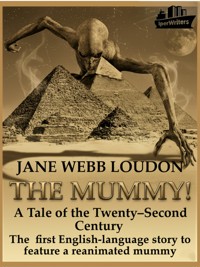


















Jane Webb Loudon
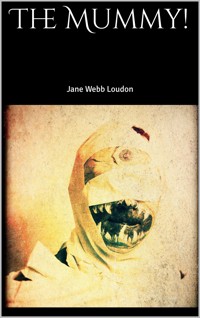
The Mummy!
Table of contents
INTRODUCTION.
CHAPTER I.
CHAPTER II.
CHAPTER III.
CHAPTER IV.
CHAPTER V.
CHAPTER VI.
CHAPTER VII.
CHAPTER VIII.
CHAPTER IX.
CHAPTER X.
CHAPTER XI.
CHAPTER XII.
CHAPTER XIII.
CHAPTER XIV.
CHAPTER XV.
CHAPTER XVI.
CHAPTER XVII.
CHAPTER XVIII.
CHAPTER XIX.
CHAPTER XX.
CHAPTER XXI.
CHAPTER XXII.
CHAPTER XXIII.
CHAPTER XXIV.
CHAPTER XXV.
CHAPTER XXVI.
CHAPTER XXVII.
CHAPTER XXVIII.
CHAPTER XXIX.
CHAPTER XXX.
CHAPTER XXXI.
CHAPTER XXXII.
INTRODUCTION.
CHAPTER I.
CHAPTER II.
High and distinguished as was the favour shown to Edmund Montagu, it was by no means greater than he deserved. His face and figure were such as the imagination delights to picture as a hero of antiquity; and his character accorded well with the majestic graces of his person. Haughty and commanding in his temper—ambition was his God, and love of glory his strongest passion; yet his very pride had a nobleness in it, and his soldiers loved though they feared him.
Very different was the character of his younger brother Edric, whose romantic disposition and contemplative turn of mind often excited the ridicule of his friends. As usual, however, in similar cases, the persecutions he endured upon the subject, only wedded him more firmly to his own peculiar opinions; which, indeed, he seemed determined to sustain with the constancy of a martyr; whilst he put on such a countenance of resolution and magnanimity whenever they were assailed by jests or raillery, as might have been imagined suitable to an expiring Indian at the stake. Unfortunately, however, his friends did not always properly estimate this dignified silence; and their repeated bursts of laughter grated so harshly in the ears of the youthful Diogenes, that he became gradually disgusted with mankind. He secluded himself from society; despised the opinion of the world, because he found it was against him; and supposed himself capable of resisting every species of temptation, simply because, as yet, he had met with nothing adequate to tempt him. Older and more experienced persons have made the same mistake.
The education of these two young men had been entrusted to tutors of characters as essentially different as those of their pupils.—Father Morris, who had had the care of the elder, was an intelligent Catholic priest, the confessor of the family. Whilst Doctor Entwerfen, who took charge of the younger, was a worthy inoffensive man, whose passion for trying experiments was his leading foible; but whose good-nature caused him to be beloved, even by those to whom his follies made him appear ridiculous.
Sir Ambrose Montagu, the father of Edmund and Edric, was a widower, and these two sons constituted his whole family. The worthy Baronet was no bad representative of what an old English country gentleman always has been, and of what it still continued, even in that age of refinement. He was as warm in his feelings as hasty in his temper, and as violent in his prejudices, as any of his predecessors. In fact, the same causes must always lead to the same results; and there is something in a country life that never fails to produce certain peculiar effects upon the mind.
Sir Ambrose, however, was far superior to the generality of his class, and amongst innumerable other good qualities, he was an indulgent master and an affectionate father. His foible, however,—for alas! where shall we find character without one,—was a desire to show occasionally how implicitly he could be obeyed. In general, he was easy to a fault; and it was only when roused by opposition, that the natural obstinacy of his disposition displayed itself. Edmund was his favourite son; the early military glory of the youthful hero was flattering to his parental pride, and his eyes would glisten with delight at the bare mention of his darling's name.
It was one fine evening in the summer of the year 2126, when Sir Ambrose Montagu, such as we have described him, was sitting in his library, anxiously expecting intelligence from the army. To divert his impatience, he had ordered the attendance of his steward Mr. Davis, and endeavoured to amuse himself by hearing a report of the affairs of his farm; whilst Abelard, an old butler, who had been in the Baronet's service more than forty years, stood behind his master's chair holding a small tray, on which was placed an elegant apparatus for smoking, and a magnificent service of malleable glass, made to fold up to a pocket size, when not in use, containing the baronet's evening refreshment.
Sir Ambrose was above seventy; and his long white hair hung in waving curls upon his shoulders, as he now sat in his comfortable elastic arm-chair, leaning one elbow upon the table before him. His features had been very handsome, and his complexion still retained that look of health and cleanness, which, in a green old age, is the sure indication of a well-spent life. His countenance, though intelligent, was unmarked by the traces of any stormy passions; the cares and troubles of life seemed to have passed gently over him, and content had smoothed the wrinkles age might have made upon his brow; whilst the tall thin figure of Mr. Davis, as he stood reverentially bending forward, his hat in his hand, and his whole demeanour expressing a singular mixture of preciseness and habitual respect, contrasted strongly with the dignified appearance of his master.
The windows of the library opened to the ground, and looked out upon a fine terrace, shaded by a verandah, supported by trellis-work, round which, twined roses mingled with vines. Below, stretched a smiling valley, beautifully wooded, and watered by a majestic river winding slowly along; now lost amidst the spreading foliage of the trees that hung over its banks, and then shining forth again in the sun like a lake of liquid silver. Beyond, rose hills majestically towering to the skies, their clear outline now distinctly marked by the setting sun, as it slowly sunk behind them, shedding its glowing tints of purple and gold upon their heathy sides; whilst some of its brilliant rays even penetrated through the leafy shade of the verandah, and danced like summer lightning upon the surface of a mirror of polished steel which hung directly in face of Sir Ambrose.
"What a lovely evening!" exclaimed the worthy baronet, gazing with a delighted eye upon the rich landscape before him; "often as I have looked upon this scene, methinks every time I see it I discover some new beauty. How finely that golden tint which the sun throws upon the tops of those trees is relieved by the deep masses of shadow below!"
"It is a fine evening," said Davis, bowing low, "and if your honour pleases, I think we had better get the patent steam-mowing apparatus in motion to-morrow. If the sun should be as hot to-morrow as it has been to-day, I am sure the hay will make without using the burning glass at all."
"Do as you like, Davis," returned his master, taking his pipe, "you know I leave these matters entirely to you."
"And does not your honour think I had better give the barley a little rain? It will be all burnt up, if this weather continues; and if your honour approves, it may be done immediately, for I saw a nice black heavy-looking cloud sailing by just now, and I can get the electrical machine out in five minutes to draw it down, if your honour thinks fit."
"I have already told you I leave these things entirely to you, Davis," returned the baronet, puffing out volumes of smoke from his hookah. "Inundate the fields if you will; you have my full permission to do whatever you please with them, so that you don't trouble me any more about the matter."
"But I would not wish to act without your honour's full conviction," resumed the persevering steward. "Your honour must be aware of the aridity of the soil, and of the impossibility that exists of a proper development of the incipient heads, unless they be supplied with an adequate quantity of moisture."
"You are very unreasonable, Davis," aid Sir Ambrose; "most of your fraternity would be satisfied by being permitted to have their own way; but you——"
"Excuse my interrupting your honour," cried Davis, bowing profoundly; "but I cannot bear it to be thought that I was capable of persuading your honour to take any steps, your honour might not thoroughly approve. Now as to the germinization and ripening——"
"My good fellow!" exclaimed Sir Ambrose, smiling at the energy with which Davis spoke—his thin figure waving backwards and forwards in the sunshine, and his earnest wish to convince his master, almost depriving his voice of its usual solemn and sententious tone. "As I said before, I give you full and free liberty to burn, dry, or drown my fields, as you may think fit; empowering you to take any steps you judge proper, either to germinate or ripen corn upon any part of my estate whatever, only premising, that in future you never trouble me upon the subject; and so good night."
This being spoken in a tone of voice Davis did not dare to disobey, he slowly retired, apparently as much annoyed at having his own way, as some people are at being contradicted; when suddenly a brilliant flash of light gleamed on the baronet's polished mirror. "Ah! what was that?" exclaimed Sir Ambrose, starting up, and dashing his pipe upon the ground.
He gazed eagerly upon the mirror for a few seconds in breathless anxiety, bending forwards in a listening attitude, and not daring to stir, as though he feared the slightest movement might destroy the pleasing illusion. The flash was repeated again and again in rapid succession, whilst a peal of silver bells began to ring their rounds in liquid melody. "Thank God! thank God!" exclaimed the aged baronet, sinking upon his knees, and clasping his hands together, whilst the big tears rolled rapidly down his face, "My Edmund has conquered! my Edmund is safe!"
The faithful servants of Sir Ambrose followed the example of their master, and for some minutes the whole party appeared lost in silent thanksgiving; the silver bells still continuing their harmonious sweetness, though in softer and softer strains, till at last they gradually died away upon the ear. Sir Ambrose started from his knees as the melody ceased, and desiring Abelard to summon Edric and Father Morris, he rushed upon the terrace, followed by Davis, to examine a telegraph placed upon a mount at little distance, so as to be seen from one end of it: the light and music just mentioned, being a signal always given, when some important information was about to be transmitted.
The sun had now sunk behind the hills, and the shades of evening were rapidly closing in as the baronet, with streaming eyes, watched, the various movements of the machine. "One, two, and six!" said he; "yes, that signifies he has won the battle, and is safe. My heart told me so, when I saw the signal flash. My darling Edmund!—two, four, and eight—he has subdued the Germans, and taken the whole of the fine province of France. Six, six, and four—alas! my failing eyes are too weak to see distinctly. Davis, look I implore you! The signal is changing before we have discovered its meaning! For mercy's sake, look before it be too late! Alas! alas! I had forgotten your eyes are as feeble as mine own. Oh, Davis! where is Edric? Why is not he here to assist his poor old father at such a moment as this?"
In the meantime, Edric was, as usual, engaged in those abstract speculations with Dr. Entwerfen, which now formed the only pleasure of his existence, and which he pursued with an eagerness that made all the ordinary affairs of life appear tasteless and insipid. His imagination had become heated by long dwelling upon the same theme; and a strange, wild, indefinable craving to hold converse with a disembodied spirit haunted him incessantly. He had long buried this feverish anxiety in his own breast, and tried in vain to subdue it; but it seemed to hang upon his steps, to present itself before him wherever he went, and, in short, to pursue him with the malignancy of a demon.
"What is the matter with you, Edric?" said Dr. Entwerfen to his pupil, the day we have already mentioned. "You are so changed, I scarcely know you, and your eyes have a wild expression, absolutely terrific."
"I am, indeed, half mad," returned Edric, with a melancholy smile; "and yet, perhaps, you will laugh when I tell you the reason of my uneasiness. I am tormented by an earnest desire to communicate with one who has been an inhabitant of the tomb. I would fain know the secrets of the grave, and ascertain whether the spirit be chained after death to its earthly covering of clay, condemned till the day of final resurrection to hover over the rotting mass of corruption that once contained it; or whether the last agonies of death free it from its mortal ties, and leave it floating, free as air, in the bright regions of ethereal space?"
"You know my opinion," said the doctor.
"I do," replied the pupil; "but forgive me if I add—I do not feel satisfied with it: in fact mine is not a character to be satisfied with building my faith upon that of any other man. I would see, and judge for myself."
"I do not blame you," resumed the doctor; "a reasonable being should believe nothing he cannot prove;—however, to remove your doubts, I am convinced we have only occasion to step into the adjoining church-yard, and try my galvanic battery of fifty surgeon power, (which you must allow is surely enough to re-animate the dead,) upon a body, and then——"
"Hold! hold!" cried Edric, shuddering. "My blood freezes in my veins, at the thought of a church-yard:—your words recall a horrible dream that I had last night, which, even now, dwells upon my mind, and resists all the efforts I can make to shake it off."
"Tell it to me, then," resumed the doctor; "for when the imagination is possessed by horrible fantasies, it is often relieved by speaking of them to another person."
"I thought," said Edric, "that I was wandering in a thick gloomy wood, through which I had the utmost difficulty to make my way. The black trees, frowning in awful majesty above my head, twined together in masses, so as almost to obstruct my path. Suddenly, a fearful light flashed upon me, and I saw at my feet a horrid charnel house, where the dying mingled terrifically with the dead. The miserable living wretches turned and writhed with pain, striving in vain to escape from the mass of putrescence heaped upon them. I saw their eye-balls roll in agony—I watched the distortion of their features, and, making a violent effort to relieve one who had almost crawled to my feet, I shrank back with horror as I found the arm I grasped give way to my touch, and a disgusting mass of corruption crumble beneath my fingers!—Shuddering I awoke—a cold sweat hanging upon my brows, and every nerve thrilling with convulsive agony."
"Mere visionary terrors," said the doctor. "You have suffered your imagination to dwell upon one subject, till it is become morbid.—However, though I do not see any reason why your dream should make you decline my offer, I will not urge it if it give you pain."
"Is it not strange," continued Edric, apparently pursuing the current of his own thoughts, "that the mind should crave so earnestly what the body shudders at; and yet, how can a mass of mere matter, which we see sink into corruption the moment the spirit is withdrawn from it, shudder? How can it even feel? I can scarcely analyse my own sensations; but it appears to me that two separate and distinct spirits animate the mass of clay that composes the human frame. The one, the merely vital spark which gives it life and motion, and which we share in common with brutes, and even vegetables; and the other, the divine ethereal spirit, which we may properly term the soul, and which is a direct emanation from God himself, only bestowed upon man."
"You know my sentiments upon the subject," replied the doctor, "therefore I need not repeat them."
"I know," resumed Edric, "you think the organs of thought, reflection, imagination, reason, and, in short, all that mysterious faculty which we call the mind, material; and that as long as the body remains uncorrupted they may be restored, provided circulation can be renewed: for that you think the only principle necessary to set the animal machine in motion."
"Can any thing be more clear?" said the doctor. "We all know that circulation and the action of the lungs are inseparably connected, and that if the latter be arrested, death must ensue. How frequently are apparently dead bodies recovered by friction, which produces circulation; and inflation of the lungs with air, which restores their action. If your idea be correct, that the soul leaves the body the instant what we call death takes place, how do you account for these instances of resuscitation? Think you that the soul can be recalled to the body after it has once quitted it? Or that it hovers over it in air, attached to it by invisible ligatures, ready to be drawn back to its former situation, when the body shall resume its vital functions? You cannot surely suppose it remains in a dormant state, and is reawakened with the body; for this would be inconsistent with the very idea of an incorporeal spirit."
"Certainly," resumed Edric, "the spirit must be capable of existing perfectly distinct from the body; though how, I own candidly my imperfect reason cannot enable me to comprehend."
"I wish you would overcome your childish reluctance to trying an experiment upon a corpse, as that must set your doubts at rest. For if we could succeed in re-animating a dead body that has been long entombed, so that it might enjoy its reasoning faculties, or, as you call it, its soul in full perfection, my opinion would be completely established."
"But where shall we find a perfect body, which has been dead a sufficient time to prevent the possibility of its being only in a trance?—For even if I could conquer the repugnance I feel at the thought of touching such a mass of cold mortality, as that presented in my dream last night, according to your own theory, the organs must be perfect, or the experiment will not be complete."
"What think you of trying to operate upon a mummy? You know a chamber has been lately discovered in the great pyramid, which is supposed to be the real tomb of Cheops; and where, it is said, the mummies of that great king and the principal personages of his household have been found in a state of wonderful preservation."
"But mummies are so swathed up."
"Not those of kings and princes. You know all travellers, both ancient and modern, who have seen them, agree, that they are wrapped merely in folds of red and white linen, every finger and even every toe distinct; thus, if we could succeed in resuscitating Cheops, we need not even touch the body; as the clothing it is wrapped in will not at all encumber its movements."
"The idea is feasible, and, as you rightly say, if it can be put into execution, it will set the matter at rest for ever. I should also like to visit the pyramids, those celebrated monuments of antiquity, whose origin is lost in the obscurity of the darker ages, and which seem to have been spared by the devastating hand of time, purposely to perplex the learned."
"You say right," cried the doctor with enthusiasm. "And who can tell but that we may be the favoured happy mortals, destined to raise the mystic veil that has so long covered them? we may be destined to explore these wonderful monuments—to revive their mummies, and force them to reveal the secrets of their prison-house. Cheops is said to have built the great pyramid, and it is Cheops whom we shall endeavour to re-animate! what then can be more palpable, than that it should be he who is destined at length to reveal the mystery."
"Every word you utter, doctor, increases my ardent desire to put our scheme into immediate execution: but how can we accomplish it? How obtain my father's consent? You know it has long been his intention to marry me to the niece of his friend the Duke of Cornwall, and you know how obstinate both he and the duke are."
"Then if you remain in England, it is your intention to marry Rosabella?"
"I would perish first."
"If that be the case, I confess I do not see the force of your objection."
"True; for as long as I refuse to marry her, their anger will be the same, whether I travel or remain in England. In fact, I shall be happier at a distance than here, where I shall be annoyed by having the subject constantly recurred to. Yet it pains me to speak upon it to my father. He has so long cherished the idea of my marriage, and dwelt upon it so fondly—"
"Then you had better stay,—relinquish all thoughts of scientific discoveries, and settle contentedly on an estate in the country; employing your time in regulating your farm, settling the disputes of your neighbours, and bringing up your children, if you should happen to have any."
"How can you torment me so?—If you could imagine the struggle in my bosom, between inclination and duty, you would pity me."
"Do you think your presence necessary to your father's happiness?"
"No—if Edmund be with him, he will never think of me."
"And do you not think—nay, are you not certain, that an union with Rosabella would make you miserable?"
"It is impossible to doubt it. Her violent temper, and the mystery which hangs over the fate of her father, which she cannot bear to have even alluded to, forbid the thought of happiness as connected with her."
"It is strange, so little should be known of her father. I never heard the particulars of his story."
"No human being knows the whole, I believe, but the duke and my father. However, I remember to have heard it rumoured when I was a child, that he had committed some fearful crime, and that he was either executed, or had destroyed himself."
"Then it is not surprising that it should pain Rosabella to hear him spoken of. But to return to our subject: your answers have removed the only doubts that can arise; and after what you have confessed yourself, I cannot imagine what further hesitation you can feel—"
At this moment they were both startled; and the words were arrested on the doctor's lips by a gentle tap at the door. It was old Abelard the butler. Half ashamed of the unphilosophic terror he had evinced, the doctor felt glad to be able to hide his emotion under the appearance of anger, and demanded peevishly, what was the matter. "Have I not told you a hundred times," continued he, "that I do not like to be interrupted at my studies! and that nothing is more disagreeable than to have one's attention distracted, when it has been fixed upon an affair of importance!"
"I do not attempt to controvert the axiom you have just propounded," returned Abelard, speaking in a slow precise manner, as though he weighed every syllable before he drawled it forth: "for undeniable facts do not admit of contradiction. However, as the message with which I stand charged at the present moment relates to master Edric, instead of yourself, I humbly opine, no blame can attach itself to me, on account of the unpremeditated interruption of which you allege me culpable."
"And what have you to say to me?" demanded Edric.
"That the worthy gentleman, your respectable progenitor, requests you instantly to put in exercise your locomotive powers to join him on the terrace, to the end, that there your superior visual faculties may afford soulagement to the mental anxiety under which he at present labours, by aiding him to develop the intelligence conveyed to him by the telegraphic machine."
"What!" exclaimed Edric, eagerly, and then, without waiting a reply, he darted forward, and in a few seconds was by the side of his father.
Abelard gazed after him with amazement: "There is something very astonishing," said he, addressing Dr. Entwerfen, "in the effervescence of the animal spirits during youth. I labour under a complete acatalepsy upon the subject; I should think it must arise from the excessive elasticity of the nerves. Ideas strike—" but here, happening unfortunately to look up, he too was struck to find Dr. Entwerfen had vanished with his pupil, and unwilling to waste his eloquence upon the empty air, he also departed; slowly and solemnly, however, according to his custom, to join the party assembled on the terrace.
CHAPTER III.
When Edric and Dr. Entwerfen reached Sir Ambrose, they found Father Morris at his side, explaining with his usual promptness and clearness the meaning of the different signs of the telegraph.
"My dear Edric," exclaimed Sir Ambrose, throwing himself into the arms of his son, "my dear, dear Edric! your brother has gained the battle! The Germans are completely overthrown. He has taken their king, and several of their princes prisoners; and the fine province of France is ceded to us entirely!"
"I am rejoiced to hear it," cried Edric, returning his father's embrace with emotion, "and he, I hope, is safe?"
"I hope so too," replied Sir Ambrose; "though he says nothing of himself: but you know Edmund: 'Our troops won this,' 'our army gained that!'—'the soldiers fought bravely!'—he never speaks of himself. To hear him relate a battle, nobody would imagine he had ever had any thing to do with it."
"It is too dark to see any more," said Father Morris, who had been for some time watching the telegraph, and now turned from it in despair; "the machine is still in motion, but it is too dark for me to decipher what it means."
The attention of all present was directed to the sky as he spoke. It was indeed become of pitchy blackness, a general gloom seemed to hang over the face of nature; the birds flew twittering for shelter, a low wind moaned through the trees, and, in short, every thing seemed to portend a storm.
"Had we not better return to the house?" said Dr. Entwerfen, looking round with something like fear at these alarming indications, for his heated imagination had not yet quite recovered the effect of the awful speculations he had so lately been indulging in. "What is that black spot there? I declare it moves! Good heavens, what can it be?"
"Really, doctor!" returned Abelard, "you provoke the action of my risible faculties. That opaque body which you perceive at a little distance, and which seems to have occasioned such a fearful excitement of your nervous system, is only a living specimen of the corvus genus, who has probably descended upon earth to search for his vermicular repast."
"I beg your pardon, Mr. Abelard," rejoined Mr. Davis, speaking with his usual precision, "but, according to my humble apprehension, you labour under a slight mistake as to that particular. The feathered biped that has so forcibly attracted your attention, appears to me, not one of the corvi, but rather one of the graculi; a variety of extremely rare occurrence in this vicinity, and which are sometimes called incendriæ aves, from their unfortunate propensity to put habitations in combustion, by picking up small pieces of phlogisticated carbon, and carrying them in their beaks to the combination of straw and other materials, sometimes piled upon the apex of a house, to defend it from the inroads of pluviosity."
"It is of no use," sighed Sir Ambrose, still straining his eyes to endeavour to decipher the movements of the telegraph, the outlines of which only now appeared, stamped as if in jet, and strongly relieved by the dark grey sky beyond.
"It is of no use," reiterated Father Morris, and the whole party were preparing to retire, when suddenly a vivid light flashed upon them from the hill, and instantly a long line of torches seemed to stream along the horizon. "He is coming home, but will write more to-morrow," exclaimed the whole party simultaneously; for all knew well by experience, the meaning of that signal. "He is coming home, thank God!" repeated Sir Ambrose, his pallid lips quivering, and every limb trembling with agitation.
"Look to my father," cried Edric, "he will faint."
"Oh no, no!" repeated Sir Ambrose: "thank God! thank God!"
"Lean upon me, at least," said Edric, affectionately.
Sir Ambrose complied; and, supported by his son, still gazed anxiously on the torches, their red glare shedding an unnatural light around them, and making the surrounding darkness only appear still more intense. Thunder now growled in the distance, and rain began to fall in large drops; yet still Sir Ambrose gazed upon the torches, and could not be persuaded to leave the terrace. These wild, fearful looking lights, gleaming through the tempest, seemed a connecting link between him and his darling son; and it was not till they were obscured by the thick heavy rain, and even the outline of the telegraph vanished in the gathering clouds around, that he could be induced to seek for shelter.
Sir Ambrose slept little that night: the sleep of age is easily broken, and perhaps the joyful agitation of his spirits had produced a slight access of fever. He rose with the dawn; and, long before the rest of his family had descended, summoned Abelard, that he might dispatch him to inform his most intimate friend the Duke of Cornwall of the news.
"Go," said he, as soon as the drowsy butler made his appearance. "I am sure the duke feels nearly as great an interest in the success of Edmund as myself, and will not be displeased if he be disturbed a little earlier than usual upon such an occasion."
"I obey," replied Abelard. "I will shake off my somnolent propensities, and speed with the velocity of the electric fluid to the castle of the noble chieftain."
"Take heed you do not forget your message by the way," repeated Sir Ambrose, smiling.
"Not all the waters of Lethe could wash such somnifugous tidings from my memory," replied the butler. "Your honour's words are imprinted upon the mnemonic organ of my brain; and my sensorium must be divided from my cerebellum ere they can be effaced."
The Duke of Cornwall had been the intimate friend of Sir Ambrose almost from infancy. They had been companions at school and at college; besides which, peculiar circumstances which had happened in their youth, had linked them together in indissoluble ties. What these circumstances were, however, no one exactly knew, except the parties concerned, and they always avoided alluding to them. All that was generally understood upon the subject, being, that Sir Ambrose had, in some manner, been instrumental in saving the duke's life; but how, when, or where, was never clearly explained.
The Duke of Cornwall was of the Royal family of England, and closely allied to the throne. His father had been brother to that prince who had so stedfastly refused the crown when it was offered to him by the ambassadors from the people; and as that prince had left no male descendants, the duke might be considered as legitimately entitled to reign. The thought of disturbing by his claims the female dynasty now established, had, however, never entered into the mind of the duke; who, with half the sense of his friend Sir Ambrose, possessed, at least, ten times the obstinacy; and having taken it into his head that he would marry his daughter Elvira to Edmund Montagu, and his niece Rosabella to Edric, he turned all his thoughts, plans, and wishes to the accomplishment of this object, and suffered no other idea to interfere with it.
Those, however, who were acquainted with the characters of the young people, thought the duke had quite reversed the natural order of things by this arrangement; and that the strong mind and haughty spirit of Rosabella would have suited better with the ambitious Edmund; whilst the soft yielding disposition and feminine graces of Elvira seemed to harmonize exactly with the taste of the philosophic Edric. No persuasions, however, could induce the duke to deviate in the slightest degree from his design. Like many of the higher classes of society in those days of universal education, he affected an excessive plainness and simplicity in his language; so much so, indeed, as sometimes almost to degenerate into rudeness, in order that it might be clearly distinguished from the elaborate and scientific expressions of the vulgar; and when urged upon the subject of these intended marriages, he would roughly say, "Don't talk to me; there is nothing like a little contradiction in the married life. If two people were to agree to live together, who were always of the same opinion, they would die of ennui in six months. No, no, I'm right, and so they'll find it in the end."
He would then shake his head, and put on such a look of positive determination, that his friends would generally retire in silence, feeling it perfectly in vain to attempt to alter his resolution. As to consulting the inclinations of the young people themselves, the idea never entered his imagination. "Children don't know what is good for them," he would reply sharply, if any one presumed to suggest such a thought, "and it is the duty of parents and guardians to decide in such matters."
Sir Ambrose, wishing the connection for his sons, and respecting even the whims of his friend, had as yet never interfered, and the young people had also appeared silently to acquiesce. Rebellious spirits, however, were hidden under this apparent calm; and the duke was soon to learn from experience, that human beings were rather more difficult to manage than a drove of turkeys, or a flock of sheep; a fact, of which before he did not seem to have the slightest suspicion.
The duke had already risen, and was in his garden, when the messenger of Sir Ambrose arrived panting for breath, and quite exhausted by the velocity which, as he expressed it, he had employed in endeavouring to execute with the utmost expedition, the implied wishes of his master. The duke was surprised to see him.—"What brings you out so early, Abelard?" demanded he.
"Oh, your grace," replied the butler, gasping for utterance, "the haste I have made has impeded my respiration; and the blood, finding the pulmonary artery free, rushes with such force along the arterial canal to the aorta, that—that—I am in imminent danger of being suffocated."
"Pshaw!" said the duke.
"Besides," continued Abelard, "a saline secretion distils from every pore of my skin, in a serous transudation, from the excessive exertions I have made use of."
"And what has occasioned these violent exertions?"
"The earnest desire experienced by Sir Ambrose to transmit with all the expedition possible, to your grace, the intelligence he has just received of the acquisition of a victory by Master Edmund, in the hostile territory of Germany."
"Victory!" shouted the duke, "Victory—Rosabella! Elvira! where are you, girls? Here's tidings to rouse you from your slumbers.—And how is he, Abelard? Is the brave boy safe himself? God bless him! victory will be nothing to us, if we are to lose him."
"It occasions me excessive chagrin," replied Abelard, "that I am totally unable to resolve that interrogatory to your grace's complete satisfaction. Taciturnity, however, upon some subjects, is, I believe, generally considered synonymous with prosperity; and, as Master Edmund, to the best of my credence, conveyed no information relative to his sanity in the communication made by him to his paternal ancestor, I humbly opine that there are no reasonable grounds for supposing it has suffered any material deterioration in consequence of the late sanguinary encounter in which he has been engaged."
The duke had not patience to wait the conclusion of this speech; but hobbled away as fast as his infirmities would permit, vociferating for Elvira and Rosabella, in a voice that might have silenced Stentor; and Abelard, finding himself alone, was fain to follow his example, marvelling as he went along, however, at the excessive impatience of the fiery spirits of the age, which would not permit people to remain stationary, even to hear, what he called, a compendious replication to the very questions which they themselves had propounded.
Whatever faults might fall to the share of the Duke of Cornwall, that of a cold heart was certainly not amongst the number, and the delight he felt on hearing of Edmund's triumph could not have been greater if the youthful hero had been his own son. His eyes, indeed, absolutely sparkled with transport, when he communicated the intelligence to his niece and daughter; and his tidings were not bestowed upon insensible ears, for the breasts of both his youthful auditors throbbed with pleasure at the news, though the causes of their emotions were different. Elvira had been the idol of Edmund's homage from her childhood; and she fancied she returned his passion with equal fervour; but she deceived herself, and love was as yet a stranger to her heart. Endowed with great beauty and superior talents; accustomed from her earliest infancy to be worshipped by all around her; surrounded by flatterers, till even flattery itself had lost its charm, Elvira was as yet insensible to love; why she was so, we leave to philosophers to explain; we merely state facts and leave others to draw conclusions.
Rosabella's character was essentially different from that of her cousin. Passion was the essence of her existence; and her dark eyes flashed a fire that bespoke the intensity of her feelings. She loved Edmund, but though she loved him with all that overwhelming violence, that only a soul like hers could feel, yet she would not have scrupled to sacrifice even him to her revenge, if she had thought he treated her with negligence or contempt. She scorned the opinion of the world, and regarded mankind in general but as slaves, whom she should honour by trampling beneath her feet. Ambition, however, was her leading passion, and even her love for Edmund struggled in vain for mastery against it. This feeling was now highly gratified by the tidings of Edmund's victory. She triumphed in his glory; and a deeper glow burnt upon her cheek, from the proud consciousness she felt that she had not placed her affections upon an unworthy object.
"We have no time to lose, girls," said the duke. "I would not miss being with Sir Ambrose when he receives his letter, for kingdoms. Here, Hyppolite! Augustus! get a balloon ready, and let us be off directly. How tedious these fellows are! They might have removed a church steeple in the time they have wasted about that balloon."
"If your grace would have a moment's patience," said Hyppolite, holding the cords of the balloon. But his Grace had no patience; it was an ingredient Nature had quite forgotten to put into his composition; and, without waiting for the ascending ladder to be put down, he sprang into the car in such haste the moment the balloon was brought to the door, that he was in imminent danger of oversetting it. "So! so!" said he, "very well! that will do,—and now girls, that you are safely embarked, we will be off. Hyppolite! you will steer us:—and, Abelard, go you into the buttery, and let my fellows give you something to eat; you will want something after your fatigues. There! there, that will do; don't let us hinder a moment——;" and the rest of his speech was lost in air, as the balloon floated majestically away.
"It has often appeared very astonishing to me," said Abelard, after watching the balloon till it was out of sight, "to observe how partial great people are generally to an aërial mode of travelling; for my part, I think the pedestrian manner infinitely more agreeable."
"De gustibus non est disputandum," replied Augustus, the duke's footman, to whom this observation was addressed:—"But I think I observe symptoms of lassitude about you, Mr. Abelard. Will you not adjourn to the apartment of Mrs. Russel, our housekeeper, to repair by some alimentary refreshment, the excessive exhaustion you have sustained in the course of your morning's exertions?"
"Willingly, Mr. Augustus.—I own candidly, I feel the want of a little wholesome nutrition. I shall, besides, be extremely happy to avail myself of the opportunity fortune so benignantly presents, of paying my respects to Mrs. Russel, whom I have not seen these three days."
The worthy housekeeper was equally rejoiced with Abelard at this instance of fortune's benignity; a sort of sentimental flirtation having been going on between them for the last thirty years. She accordingly stroked down her snow-white apron, re-adjusted her mob cap, and smoothed her grey hairs, which were divided upon her forehead, with the most scrupulous exactness, before she advanced to welcome her visitors. "What will you take, my dear Mr. Abelard?" said she, as soon as he was within hearing; "what can you fancy? I have a delicious corner of a cold venison pasty in my pantry."
"Words are altogether too feeble to express the transports of my gratitude at receiving so gracious an accolade, beauteous Eloisa," replied the romantic butler; for thus, in allusion to his own name, was he wont to call her. "But though you had only the rigours of the Paraclete to invite me to, instead of the comforts of your well-stored pantry, still would words be wanting to express the feeling of my bosom on thus again beholding you."
"Spare my blushes!" said Mrs. Russel, casting her eyes upon the ground, and playing with a corner of her apron. "I feel a roseate suffusion glow upon my cheeks, as your flattering accents strike upon the tympanum of my auricular organs."
"Oh, Mrs. Russel!" sighed Abelard, gazing upon her tenderly;—then, after a short pause, he continued: "As to the aliments with which your provident kindness would soulage my appetite—though venison be a wholesome viand, and was reckoned by the ancients efficacious in preventing fevers, and though the very mention of the savoury pasty makes the eryptæ, usually employed in secreting the mucus of my tongue, erect themselves, thereby occasioning an overflow of the saliva, yet will I deny myself the indulgence, and content myself simply with a boiled egg, as being more likely to agree with the present enfeebled state of the digestive organs of my stomach."
"You shall have it instantly," cried Mrs. Russel.
"And will you have the kindness to superintend the culinary arrangement of it yourself?" rejoined Abelard. "I do not like the albumen too much coagulated; and I prefer it without any butyraceous oil, simply flavoured by the addition of a small quantity of common muriate of soda."
The egg was soon prepared and devoured. "Thank you, thank you! dear Mrs. Russel," said Abelard; "this refection was most acceptable. I had felt for some time the gastric juice corroding the coats of my stomach; and still, though I have now given it some solid substance to act upon, I think it would not be amiss to dilute its virulence by the addition of a little fluid. Have you any thing cool and refreshing?"
"I have some bottled beer," replied Mrs. Russel; "but I am afraid the carbonic acid gas has not been sufficiently disengaged during the process of the vinous fermentation to render it wholesome; and there is scarcely any alcohol in the whole composition——"
"That is exactly what I want," said Abelard; "for my physicians have expressly forbidden stimulants. Provided the gluten that forms the germ was properly separated in the preparation of the malt, and the seed sufficiently germinated to convert the fecula into sugar, I shall be perfectly satisfied."
"I can guarantee the accuracy of its preparation both with regard to the malt and the beer," repeated Mrs. Russel; and the frothing fluid soon sparkled in a goblet, to the infinite satisfaction of the thirsty butler, who, after a hearty draught, vowed nectar itself was never half so delicious; and that all the gods on Olympus would envy him, if they could but taste his fare, and see the blooming Hebe that was his cup-bearer.
CHAPTER IV.
When the balloon of the duke approached the habitation of Sir Ambrose, its occupiers perceived the worthy baronet walking with hasty strides towards the mount of the telegraph, which commanded an extensive view of the surrounding country, followed by Edric and Dr. Entwerfen, who appeared vainly endeavouring to persuade him to relax a speed so little suited to his advanced years.
"Talk not to me of going slowly, when I expect news of my darling Edmund!" exclaimed Sir Ambrose, continuing his rapid pace—his heart beating with paternal pride, and his countenance beaming with exultation.
"I am also anxious to hear of my brother," said Edric, "but after the information we have already received by the telegraphic dispatch, it appears to me that we have little more to learn of importance."




