


0,49 €
Mehr erfahren.
- Herausgeber: Booksell-Verlag
- Kategorie: Abenteuer, Thriller, Horror
- Sprache: Englisch
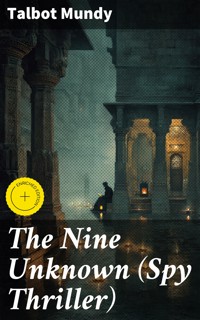
In "The Nine Unknown," Talbot Mundy weaves a gripping spy thriller that intricately blends adventure with the espionage genre. Set in the backdrop of early 20th century India, the narrative follows a clandestine society formed by the ancient Indian Emperor Ashoka, which guards secrets that could potentially alter the course of civilization. Mundy's prose is rich and evocative, drawing on historical elements and a deep understanding of Eastern philosophies and mysticism. The novel's tightly woven plot, combined with its philosophical undercurrents, delineates the tension between knowledge and power in a world rife with intrigue and deception. Talbot Mundy, an adventurer and writer known for his vivid portrayals of the East, draws upon his own extensive travels and experiences in India, which shaped his worldview and storytelling approach. Mundy's exposure to diverse cultures, coupled with his journalistic background, enabled him to create a narrative that celebrates the depth of historical wisdom while simultaneously critiquing colonial attitudes. His understanding of espionage intricacies adds layers of realism to the story that have captivated readers for generations. For readers seeking a thrilling ride through a world filled with hidden truths, betrayal, and the battle for knowledge, "The Nine Unknown" is a must-read. Mundy's ability to intertwine adventure with intellect offers profound insights into the human condition, making this novel a timeless exploration of the quest for power and wisdom. In this enriched edition, we have carefully created added value for your reading experience: - A succinct Introduction situates the work's timeless appeal and themes. - The Synopsis outlines the central plot, highlighting key developments without spoiling critical twists. - A detailed Historical Context immerses you in the era's events and influences that shaped the writing. - A thorough Analysis dissects symbols, motifs, and character arcs to unearth underlying meanings. - Reflection questions prompt you to engage personally with the work's messages, connecting them to modern life. - Hand‐picked Memorable Quotes shine a spotlight on moments of literary brilliance. - Interactive footnotes clarify unusual references, historical allusions, and archaic phrases for an effortless, more informed read.
Das E-Book können Sie in Legimi-Apps oder einer beliebigen App lesen, die das folgende Format unterstützen:
Veröffentlichungsjahr: 2023
Ähnliche












The Nine Unknown (Spy Thriller)
Table of Contents
Introduction
At the frontier where empire, myth, and espionage converge, The Nine Unknown explores how secret knowledge can become the most coveted, volatile weapon in a ruthless contest of wills.
The Nine Unknown is a spy thriller by Talbot Mundy, a prominent author of early twentieth-century adventure fiction, first published in the 1920s amid the heyday of pulp magazines and globe-spanning intrigue. Rooted in the long-circulating South Asian legend of a clandestine brotherhood safeguarding potent knowledge, the novel channels the anxieties and appetite for discovery that shaped its era. Set against the shifting currents of colonial geopolitics, it combines cloak-and-dagger suspense with the suggestive atmosphere of far-reaching conspiracies, inviting readers into a world where the line between the visible and the hidden—between public power and private influence—can be perilously thin.
Without venturing beyond its opening premise, the story sets agents and adventurers on the trail of rumors that the Nine Unknown still exist and that fragments of their guarded knowledge may be surfacing. Competing interests—official and unofficial—maneuver for advantage, turning borders, bazaars, and back rooms into stages for coded messages, double bluffs, and uneasy alliances. The pace is brisk and measured in alternating surges: reconnaissance gives way to pursuit, inference to action. Mundy’s narrative voice privileges atmosphere and momentum, favoring clear stakes and a steadily tightening net of suspicion that makes every meeting a test and every scrap of information a potential lever.
At its core, the novel weighs the ethics of secrecy: Who should decide what knowledge is too dangerous to share, and what happens when the guardians, the ambitious, and the merely curious collide? It probes the allure of hidden wisdom, the hunger for mastery, and the temptation to treat ideas as instruments of control. The legend’s aura lends an almost metaphysical pressure to very practical questions of loyalty and duty. In this light, espionage is not only a contest of resources or nerve but also a moral calculus about ends and means, where restraint can be as consequential as revelation.
Mundy crafts his intrigue from the small mechanics of spycraft—observation, patience, the reading of faces and silences—as much as from chases and standoffs. Rumor meets verification in a steady duel, and the narrative mines the space between plausible guess and hard proof. Locales are sketched with an eye for telling detail rather than exhaustive description, keeping the story in forward motion while giving the action a tactile edge. The legend functions as catalyst, not encyclopedia, and the book’s tension grows from the friction between ancient stories and modern expediencies, allowing myth and method to coexist in a single, tightly wound thread.
For contemporary readers, the novel’s questions about knowledge—who owns it, who profits by it, and how it should be used—remain strikingly relevant. In an age of information asymmetry and high-stakes secrecy, the tale’s preoccupation with curation, disclosure, and the costs of control resonates beyond its period setting. The book invites reflection on power that operates out of sight, the appeal and danger of conspiracy-thinking, and the responsibilities that come with expertise. It also offers a view of cross-cultural encounter that, while shaped by its time, raises enduring issues about interpretation, appropriation, and the ethics of storytelling across borders.
Readers can expect a taut, atmospheric pursuit that blends the satisfactions of classic espionage with the unsettling pull of legend. The Nine Unknown offers clear stakes, layered misdirection, and a mood of mounting pressure in which every choice carries forward the puzzle it seeks to solve. It rewards close attention to motive and method, while remaining alert to the human costs of secrecy and ambition. Without revealing what the seekers find—or fail to find—it promises the pleasures of a chase through shadowed corridors of power, and the sobering recognition that some mysteries shape the world precisely because they refuse to stand fully in the open.
Synopsis
In British India under the late Raj, rumors revive an old legend: a hidden brotherhood called the Nine Unknown, guardians of dangerous knowledge preserved since antiquity. Political tensions, commercial ambition, and rival ideologies create fertile ground for exploitation of that legend. A pattern of thefts, cryptic messages, and suspicious deaths suggests that organized forces are probing for the secret. Against this backdrop, an intelligence-minded adventurer and a small circle of allies are drawn into a mission that is part espionage, part cultural inquiry. Their task is to separate myth from maneuver, and stop any attempt to weaponize what should remain protected.
The investigation begins in crowded cities and tangled bazaars where information can be bought, stolen, or invented. The team follows whispers about manuscripts, coded diagrams, and a network of intermediaries who never reveal their principals. Decoys multiply: forged relics, counterfeit seals, and elaborate rumors designed to expose or entrap anyone seeking the Nine. Observing carefully, the agents map connections between swindlers and skilled operatives, realizing there is an overarching plan to locate a real source of power. Each clue points to older knowledge resurfacing in modern guise, inviting both reverence and abuse, and demanding a response measured in caution.
Moving among scholars, ascetics, traders, and soldiers, the protagonists encounter contradictory testimonies about the Nine Unknown. Some call them benefactors who shield humanity from premature discoveries; others claim they are a myth exploited by conspirators. The agents gather linguistic hints, compare symbols carved on temple stones with markings in private collections, and test the reliability of intermediaries. A pattern emerges: someone with ample resources is narrowing the search. The heroes refine their cover identities, use misdirection, and plant false information to smoke out ambitious rivals. Meanwhile, whispers of nine distinct branches of knowledge suggest a structure behind the legend.
Antagonists take shape as a shadow coalition: profiteers, political agitators, and foreign agents who share only a hunger for leverage. They sponsor provocations to distract authorities, then buy influence in princely courts and trade houses. An attempted abduction and a staged riot underline the stakes, revealing the lengths to which competitors will go. The protagonists must navigate imperial bureaucracy and local alliances, respecting traditions while guarding against manipulation. They learn that the legend’s allure is as potent as any weapon, capable of rallying crowds or breaking governments. Control of narrative and symbol becomes as critical as physical security.
Following a trail along rivers and caravan routes, the team encounters gatekeepers who test intent rather than credentials. A monk offers parables that double as ciphers, a librarian demands a demonstration of restraint, and a craftsman reveals techniques that imply extraordinary heritage. The investigators infer that the Nine, if real, value character above curiosity. They begin to grasp how knowledge can be compartmentalized, safeguarded, and applied only under strict conditions. Meanwhile, their adversaries accelerate, bribing guides and sabotaging communications. The field narrows to a handful of possible repositories, each protected by ambiguity: a sanctum disguised as a ruin, a school hidden in plain sight.
Midway, a confident lead collapses, exposing a decoy curated to attract the greedy and the reckless. The setback forces the protagonists to reassess assumptions and uncover a betrayal within their wider circle. Shifting strategy, they infiltrate a princely estate where modern laboratories sit behind traditional facades. Architectural clues and obscure references in genealogies hint that fragments of the Nine’s work have circulated quietly for generations. The enemy closes in, pressuring the estate’s custodians and setting traps that blur hospitality with surveillance. The agents improvise, using layered signals and staged disclosures to separate opportunists from those who might genuinely protect the legacy.
The pursuit leaves the plains for remote highlands, where weather, altitude, and silence serve as additional sentries. The journey tests endurance and trust, while symbols carved in stones and prayer flags imply a continuity of guardianship across centuries. The protagonists must decide how much truth to reveal to gain passage, and how much secrecy to retain to keep everyone safe. Their opponents, less patient, risk reckless shortcuts that threaten to expose everything. The sense grows that the Nine are not a single location or council but a principle of stewardship distributed among prepared minds, accessible only when purpose aligns with responsibility.
As rivals converge, a final threshold presents both opportunity and warning. Demonstrations of controlled effects, subtle rather than spectacular, make clear how easily extraordinary knowledge could destabilize society if released unconditionally. The protagonists confront competing claims: public right to know, state security, private profit, and the ethical constraints of custodianship. Alliances shift under pressure, and a decision must be shaped that averts catastrophe without announcing victory. The contest becomes less about possession than about fitness to decide. In tight, deliberate exchanges, the agents seek an outcome that keeps faith with the legend’s intent while preventing its exploitation by force or deception.
In the aftermath, turmoil subsides without fanfare, and official accounts frame events in routine terms. The legend of the Nine Unknown remains unresolved in public view, its traces deliberately ordinary. The protagonists return to their spheres changed by a clearer understanding of what must remain veiled and why. The story leaves the precise nature of the knowledge ambiguous, emphasizing the difference between power and wisdom. It also underscores how culture, faith, and governance can intersect to preserve what unites rather than divides. The mission’s implications linger: true security lies not in secrets alone, but in the character of those entrusted with them.
Historical Context
Talbot Mundy’s The Nine Unknown unfolds in British India in the early 1920s, a milieu marked by post–World War I political volatility and the tightening of colonial surveillance. The landscape spans princely states and imperial centers—railway junctions, cantonments, bazaars, and pilgrimage cities—where the material reach of empire (telegraphs, police networks, legal codes) intersected with ancient religious sites and oral traditions. The era witnessed heightened anxieties after 1919, when mass protests and repressive measures set a tense backdrop for espionage and clandestine movements. Mundy situates his intrigue within this dense social fabric, juxtaposing imperial bureaucracy with subterranean currents of indigenous knowledge and secret guardianship.
At the narrative core lies the legacy of Emperor Ashoka and the Kalinga War (c. 261 BCE), a pivotal event of the Mauryan Empire (322–185 BCE). Ashoka’s remorse after the bloody conquest of Kalinga—recounted in his rock and pillar edicts—led to a policy of dhamma, emphasizing nonviolence and moral governance. That historical pivot anchors the legend of a secret council of nine savants, founded by Ashoka to safeguard dangerous knowledge. The novel reimagines this apocryphal council as a perennial order defending society from the misuse of science and statecraft, binding India’s ancient imperial ethics to the dilemmas of the modern colonial age.
Nineteenth-century scholarship made Ashoka’s world tangible to modern readers. James Prinsep’s 1837 decipherment of Brahmi script unlocked the Ashokan edicts, while Alexander Cunningham’s Archaeological Survey of India (founded 1861) mapped Buddhist sites such as Sanchi and Sarnath and cataloged pillar inscriptions at locations like Kalsi, Girnar, and Dhauli. The widespread geographical distribution of the edicts—from present-day Odisha to Pakistan—revealed the Mauryan administrative reach and Ashoka’s moral rhetoric. Mundy’s novel draws on this evidentiary scaffolding, using named places, inscriptions, and the scholarly resurrection of Ashoka to lend plausibility to the Nine Unknown’s purported long custodianship of knowledge.
The British Raj’s intelligence and policing architecture, expanded from the late nineteenth century, furnishes the story’s spy-thriller mechanics. The Central Special Branch, later the Intelligence Bureau (1887), coordinated surveillance, while statutes such as the Indian Press Act (1910), the Criminal Tribes Act (1871), and the Rowlatt Acts (1919) empowered preventive detention and censorship. The Great Game—Anglo-Russian rivalry culminating in the 1907 convention—honed frontier espionage in the North-West Frontier Province, with cross-border entanglements intensified by the Third Anglo-Afghan War (1919). The novel mirrors this apparatus: dossiers, informers, and clandestine routes appear alongside secretive Indian networks that elude imperial files.
The pre- and postwar surge of Indian nationalism shapes the novel’s atmosphere of crisis and choice. The Partition of Bengal (1905) catalyzed the Swadeshi movement (1905–1908), fusing economic boycott with political mobilization until its annulment in 1911. During World War I, India contributed roughly 1.3 million soldiers and laborers across theaters from France to Mesopotamia; wartime levies and inflation sharpened social strain. The Montagu Declaration (1917) promised “progressive realization of responsible government,” yet the Government of India Act (1919) offered only dyarchy at the provincial level, while the Rowlatt Acts (1919) extended wartime coercion. Mass hartals in March 1919 were followed by the Jallianwala Bagh massacre in Amritsar on 13 April 1919, when troops under Brigadier General R. E. H. Dyer fired on a trapped crowd; the official death toll was 379, while Indian leaders claimed more than 1,000. The shock radicalized politics and public opinion. Gandhi’s Non-Cooperation movement (1920–1922), allied with the Khilafat agitation, urged boycott of schools, courts, and cloth; it ended after the Chauri Chaura violence (February 1922). Mundy’s plot translates this charged landscape into ethical stakes: secret knowledge can stabilize or inflame a society in upheaval, and characters navigate between imperial force, revolutionary impatience, and the Ashokan ideal of mastery over power rather than mastery over peoples.
Transnational conspiracies during the war demonstrated the global reach of anticolonial networks. The Hindu–German Conspiracy (1914–1917) linked the Berlin Committee and the Ghadar Party to plans for mutinies and arms landings in India; the Singapore Mutiny (February 1915) exposed vulnerabilities within colonial forces. British authorities responded with the Defense of India Act (1915) and sweeping investigations, culminating in the Lahore Conspiracy Cases (1915–1916). Maritime episodes such as the Komagata Maru (1914) crisis showed diasporic entanglements. The novel echoes these patterns of clandestine logistics, encrypted messages, and double agents, embedding its ancient secret order within a thoroughly modern web of surveillance and counterplot.
A powerful current behind Mundy’s conception was the late nineteenth- and early twentieth-century surge of esoteric and reform movements. The Theosophical Society, founded in 1875 by H. P. Blavatsky and H. S. Olcott and headquartered at Adyar (Madras) from 1882, combined spiritual universalism with study of Asian traditions; Annie Besant, its president from 1907, also led the Indian Home Rule League (1916). Mundy associated with the Point Loma Theosophical community in California in the early 1920s, when he composed The Nine Unknown. This milieu fostered his fusion of ethics, science, and “hidden wisdom.” Colonial campaigns against Thuggee in the 1830s–1840s under William Sleeman, long sensationalized, supplied an additional historical template for secret fraternities and moral ambiguities in policing.
By opposing the hubris of conquest with Ashoka’s post-Kalinga ethos, the novel critiques empire’s claim to civilizing authority and exposes the violence embedded in surveillance laws, collective punishment, and racial hierarchy. It portrays secret knowledge as a public trust constrained by ethical duty, implicitly challenging both colonial exploitation of science and revolutionary temptations to justify harm for ends. The spectacle of princely opulence, mercantile inequality, and bureaucratic coercion highlights class stratifications fostered by imperial rule. Within a landscape of spies and censors, the narrative privileges restraint, consent, and enlightenment over domination, indicting the political economy and security culture of the late Raj while envisioning a moral alternative grounded in Indian statecraft.
The Nine Unknown (Spy Thriller)
CHAPTER I - "I CUT THROATS WITH AN OUTWARD THRUST!"
I had this story from a dozen people, or thirteen if you count Chullunder Ghose[1], whose accuracy is frequently perverted. One grain of salt is never enough to add to the fat babu's misstatements, although any one who for that reason elected to disbelieve him altogether would be just as wide of the mark as the credulous who take what he says at face value. Chullunder Ghose should he accepted warily. But the others are above suspicion, as for instance King, Grim, Ramsden, the Reverend Father Cyprian[2], and Jeremy Ross, all of whom regard the truth from various points of view as economical.
Chullunder Ghose considers all truth merely relative at best—likes to be thought a liar, since under that cloak he can tell diluted truth unblushing. Consequently he is the only one whose real motive for taking part in this magnificent adventure is not discoverable; he scratches his stomach and gives a different reason every time he is asked, of which the likeliest is this:
"You see, sahib, had luck being habitual is bad enough, but better than absolutely no luck. Consequently I took chances, trembling much, stirring innate sluggishness of disposition with galvanic batteries of optimism, including desire to keep wolf from door of underfed family and dependents."
He certainly took chances, and he appears to have survived them, for I had a letter from him only a week ago begging the favor of a character reference and offering in return to betray trade secrets in the event of his securing the desired employment.
Then there is Leonardo da Gama the Portuguese, who is dead and tells no tales; but his death corroborates some part of what he said to me, for one, and to others as will presently appear. His motive seems to have been mercenary, with the added zest of the scientist in search of a key to secrets, whose existence he can prove but whose solution has baffled men for generations.
The Reverend Father Cyprian, past eighty and custodian of a library not open to the public, aimed and still aims only at Hindu occultism. He regards it as the machinery of Satan, to be destroyed accordingly, and it was for that reason he gave King, Grim, Ramsden and some others access to books no human eye should otherwise have seen. For Father Cyprian collects books to be burned, not piecemeal but in one eventual holocaust.
Some lay brother peculiarly conscious of a sin appointed Father Cyprian by will, sole trustee of a purchasing fund, hoping thus to rid the world of the key to such evil as the Witch of Endor practised. For half a century Father Cyprian has been acquiring volumes supposed long ago to be extinct, and it was possibly the last phase of his beleaguered pride that he hoped instead of burning them piecemeal to make one bonfire of the lot and go to his Maker directly afterward.
In that case even pride may serve appropriate ends; for if be had burned the books as fast as acquired, King could never have studied them and drawn conclusions. He took King, Grim, Ramsden and certain others into confidence subject to a stipulation; there were and are still said to be nine super-books whose contents total tip the almost absolute of evil. King and his friends might use what Cyprian already had, and might count on his counsel and assistance; but if they should come on any of the nine books, those were to be Cyprian's to be burned along with all the others.
They were not to study the nine books, if obtained, and above all they were not to reveal their contents to any outsider; for Cyprian's purpose was, and is, to abolish the very memory of those books' existence and the deviltry they teach, or are supposed to teach. (For some say they teach wisdom.) But they might make what use they cared to of information picked up on the side, and they were free to deal with individuals as circumstances and their own discretion might dictate. Father Cyprian, in fact, cared and cares not much for consequences. He believes in cutting off the cause, and he is sure those nine books are the key which, if thrown away, Will leave the cause of necromancy impossible to rediscover. So much for him.
Jeremy Ross came laughing on the scene, laughed with gay irreverence all through the piece, and still laughs, no more inclined to take life seriously than when he faced the Turks in the three-day fight at Gaza, sharing one torn blanket with a wounded Turk and destroying his chance of promotion by calling a British colonel "Algy" to his face. On the other hand, he is as unconquerably opportunist as when he tramped Arabia, lost, and survived by means of a reputation for performing miracles.
Jeremy's admitted motive was desire to learn more tricks and their underlying principles. He is convinced that even the "rope trick, so often told of and so invariably unconfirmed, in which a Hindu is supposed to climb a rope into the air and disappear, is simply the result of well-trained ingenuity.
"A chap who knows how can do anything," says Jeremy, and he proposed to learn how all the Indian tricks are done.
The motives lie did not confess, but which were just as obvious as the laugh on his lips and the sunburn on his handsome face, were loyalty to Athelstan King and Grim and Ramsden, a kind of irresponsibility that makes him plunge for amusement into every game he sees, and a bedrock willingness to fight every combination of men and circumstances for the right to be his own master. He has no use whatever for orders from "higher up," for swank, eyewash, stilts, inherited nobility, or what is known as statecraft.
"A diplomat's like me," says Jeremy, "only I call mine tricks and he calls his statesmanship."
It was enough that King and Grim had winded the stronghold of secret tyranny. Instantly Jeremy was game to make a pitched fight and a picnic of the business of destroying it; and lie was quicker than either of them at penetrating the outer screen of commonplace deception. He got along remarkably well with Father Cyprian, in fact, astonishingly well, all things considered.
James Schuyler Grim is the protagonist of peace where there is no peace. His passion is to introduce two pauses in the strife of men where only one was formerly, and so little by little to give some sort of new millennium a chance. Arch-pragmatist is Grim. He holds men's lives, his own included, as worthless unless at work, and his highest expression of friendship is to pile task on task almost to the breaking point. He, too, resists interference from "higher up," but without Jeremy's turbulence and with much more wisdom—nearly satanic at times; which is one reason why Jeremy does not always mock him to his face.
Jeremy does mock Athelstan King, because King is of the seventh generation in the British army and respects accordingly the little odds and ends of precedent and custom that to the Australian resemble idol-worship. Jeremy was a trooper. King was a colonel but is now employed by the same multi-millionaire who furnishes supplies for Grim and Ramsden; in fact, he took Jeremy's place, for Jeremy can not abide the power of purse-strings and would rather juggle by the roadside for his daily bread than yield to any man on the ground of surplus cash.
Jeff Ramsden is another independent, who rather prides himself on being slow of wit and heavy on his feet, whereas lie is really a solid thinker, building argument on argument until he is convinced, and setting one foot down before he prospects with the other. He is stronger physically than almost any two normally developed athletes, but it would probably break Jeff Rams-den's heart to lose his comfortable savings, whereas Jeremy loses his last cent as cheerfully as he would win the other man's.
Then there are Narayan Singh, and Ali ben Ali of Siktinderam, soldiers of fortune both, the one a Sikh with pantheistic tendencies and the other a Pathan with seven sons. At any rate, Ali ben Ali is pleased to admit they are his sons, and none denies that he fought and slew the indignant legal owners of the mothers, although there are cynics in the crag-top villages who vow that Ali flatters himself. The mothers' statements (there were seven) made for the most part under duress shortly before death were not considered trustworthy evidence in the land that Ali comes from.
Ali has enemies, but is a man, whatever else; and perhaps the highest compliment ever paid Narayan Singh is that Ali ben Ali of Sikunderam respects him and would think three times before challenging the Sikh to fight, even if a mutual regard for Grim and King did not put quarreling out of the question. They are awfully disrespectful of each other's gods, but came to an early understanding on the basis propounded by Narayan Singh after a night-long argument:
"If your ridiculous Allah objects to my opinions why doesn't he smite me? I challenge him![1q] As for thyself, Ali ben Ali of Sikunderam, thou art worth a dozen Allahs, being less cowardly, more generous, and not afraid to stand up and be seen!"
"It is a pity about you, Narayan Singh," Ali ben Ali answered nodding tolerantly. "I shall make a friend of you in this world only to see you torn by devils in the next. However, that is Allah's business, who is Lord of Mercies."
"Who is a big joke!" Narayan Singh corrected. "He will turn thee into worms!" warned he of Sikunderam.
"Then I will gnaw the big thing's belly!" said the Sikh.
They agreed to postpone the debate until the next world and to be stout allies in this—a plan which if followed universally would abolish a deal of waste of time.
"For if I slew you, or you slew me," said Ali ben Ali, "there would only be half our manhood left!"
And that was a point on which they could agree at once, for neither of them had a poor opinion of himself, any more than either cared a rap for Grin's and King's idealism. What they chose to follow were the men, they being men, and like attracting if not like at least its tribute.
Burt they were also attracted as much as Chullunder Ghose was by the glamour of the unknown quantity and the lure of fabled treasure; the babu being all acute imagination and alarm, they all adventurous.
Surely ancient sciences meant nothing to them; yet it was pursuit of ancient science and of nothing else that brought the twelve together, and that might have added the thirteenth if the number thirteen had not justified its reputation by proving fatal to da Gama the Portuguese. And that was no pity, but for scientific reasons.
He drank too frequently and inexpensively, and washed too sparingly to be good company. His appetite in all ways was a glutton's, drink included, and he took his erudition as he did champagne or beer or curried anchovies, in gulps.
Nor was he nice to look at—saffron, under shiny black hair, with a pair of coal-black eyes whose whites were yellow and red with long debauch—short—stout—asthmatic—dressed always in rusty black broadcloth and occasionally white drill pants, with black boots tied with broken laces. His face was seamed and lined with tales untenable and knowledge unfit to be known. His finger-ends were swollen and his nails close-bitten. His shirt, which might have been a petticoat for stripe and color, bulged through the gap between his pants and vest, increasingly untidy as the day progressed, and he hitched his pants at intervals. He had a little, black imperial beard that only half-concealed a chin cloven not by nature but by some man's weapon. The cleft had the effect of making him look good-humored for a second when he smiled. The smile began with a sneer malignantly, passed with a peculiar melting moment through an actually pathetic phase, and ended cynically, showing yellow eye-teeth. He had no idea whatever of making himself pleasant—would have scorned himself, in fact, for the attempt if he had ever tried it—and yet he blamed the world and did the world all the injury he could for refusing to love him. He always wore a round black hat like an English clergyman's, and never took it off, even indoors, until he was seated, when he held it rolled up as if he kept his thoughts in it and was afraid of spilling them.
It was Chullunder Ghose who decoyed him into the office in the side-street off the Chandni Chowk, which is the famous Street of the Silversmiths in Delhi, and a good street if you know what goodness in a street consists of. Men—all manner of men—go by.
They had an office in a side-street, one flight up over a Maharatta drug-store, with the name "Grim, Ramsden and Ross" on a brass plate on the door. The next-door building was a warehouse for hides, hair, tallow, gum, turmeric and vicious politics, through the midst of which they had access to a back stairs by arrangement. But the front stairway by which you reached their office was a narrow, steep affair between two buildings, littered with fruit-peel and cigarette ends, and always crowded with folk who used it as a sort of covered grandstand from which to watch the street or merely to sit and think, supposing that anybody could think in all that noise.
You had to pick your way up-stairs gingerly, but going down was easier, because if you placed your foot flat against the back of a man's head, and shoved suddenly, he would topple forward and carry a whole row down with him, due to the fact that they sat cross-legged and not with their feet on the step below as Europeans would.
Existence there would have been precarious, but for Narayan Singh, Ali ben Ah and Chullunder Ghose—the first two truculent and the third a diplomat. It is fashionable nowadays to show contempt for Westerners by pushing them off the sidewalk and making remarks in babu English that challenge reprisals; so that, even though King, Grim and Ramsden can disguise themselves and pass for natives of the East, and Jeremy in plain clothes can make an Arab think he is an Aras in disguise, the firm's name on the brass plate would have been enough to start trouble, if it had not been so obvious that trouble would include a Sikh dagger, an Afghan tulwar, and the adder's tongue of the least compunctious babu in all India.
It was the babu's tongue that drew da Gama past the door. He was afraid of it, in the same way that some politicians are afraid of newspapers, and it may be that he hoped to murder the babu as the simplest road to silence. All are agreed he was surprised and angry when Narayan Singh; swaggering down the narrow passage, bunted into him as he stood hesitating and, picking a quarrel on the instant, shoved him backward through the office door. Inside he found himself confronted by the whole party, for Narayan Singh followed him through and locked the door at his back.
He stood at bay, in silence, for a minute, showing his yellow teeth, his hands making the beginnings of a move toward his pockets and repeatedly refraining. So Ali ben Ali strode up to him and, taking him in one prodigious left arm, searched him for weapons. He pulled out a long knife and a black-jack, exposed them, grinning hugely, in the palm of his right hand and returned them to their owner. There was no pistol. Then he pushed the Portuguese toward the office stool, which was the only seat unoccupied. Da Gama sat on it, putting his heels on the rungs, with his toes turned outward, whereafter he removed his round, black hat and rolled it.
The others sat around the wall on bentwood chairs, or otherwise as temperament dictated, all except Father Cyprian, who had been accorded the desk and revolving chair in deference to age. Cyprian held the desk-lid raised, but lowered it suddenly, and at the noise da Gama started, stared a second, and then swore in Portuguese between his teeth. None in the room understood Portuguese, unless possibly the priest.
"You recognize me, I believe?" piped Cyprian, almost falsetto, his little bright eyes gleaming through the wrinkles and his mobile lips spreading and spreading away into a smile that advertised amusement and was certainly a mask.
He has a face like a friendly gargoyle, full of human understanding and a sort of merry disdain that goes with it.
"Keep to your trade of mumbling Mass! What do these others want?" the Portuguese demanded rudely. "I have nothing to do with priests!"
His low-pitched asthmatic voice was an absolute contrast to the other's. So was his surliness. There was no connecting link between them but that one, swift, momentary cloven lapse from hardness as the Portuguese's face changed from one scowl to the next. But Cyprian recognized that and was swift, before the human feeling faded:
"My friend," he said, "it was you who tried to steal my library, and I have never sought to have you punished, for I know the strength of the temptation—"
"You are a miser with your books—a dog in a manger!" the Portuguese retorted. "You break your own law, which says you shall not hide light under a bushel!"
"It is darkness that hides!" the priest answered with another of his expansive smiles. "It was you, my friend, who tried to murder me—a sin from which I only saved you by being one inch to the eastward of your bullet's course."
"You lie like any other priest!" da Gama growled.
"No, no. Not all of us are rash. In fact, we—we all of us are—are occasionally careful. Is this not the pistol that you tried to shoot me with?"
He raised the lid of the desk again and drew out a surprising thing born of the law against carrying firearms. It was a pistol built of springs and teak-wood, nearly as clumsy as the old museum holster pieces but as able as a cobra to do murder at close range. Da Gama was silent.
"My friend, I have not even blamed you," the priest went on, his thin voice squeaking with the rust of years. "I have pitied you, and as for me you are forgiven. But there are consequences."
"What?" the Portuguese demanded, betraying, between scorn and anger, once again that moment of human feeling.
"Something is required of him to whom so much has been forgiven," the priest answered firmly.
"What?" the Portuguese repeated.
Jeremy reached for the pistol and began fooling with the thing, as pleased with its mechanism as he was impatient of preliminaries. Ali ben Ali of Sikunderam drew out his own long knife and thumbed its cutting edge suggestively.
"You for twenty-five, and I for fifty years have sought the same thing," the priest said, speaking slowly. "You have taken one line, I the other. Mine is best, and now you must follow mine, my friend—"
"For I cut throats with an outward thrust," Ali ben Ali interrupted. "The point goes in across the wind-pipe and the knife's heel separates the neck-bones."
It was horribly well spoken. Ali ben Ali failed in his youth for a Bachelor's Degree but passed in rhetoric. Da Gama shuddered.
"Peace!" commanded Cyprian.
"For the present," assented he of Sikunderam, stowing the knife away with its hilt projecting. For religious reasons he was careful not to show the alien priest too much respect.
"What do you want?" da Gama asked.
Father Cyprian reached into his desk and produced a little chamois-leather bag. Opening that he poured about thirty gold coins into his hand and held it out toward the Portuguese, whose eyes changed expression suddenly.
"The balance of those," said Cyprian, "and the nine books. You may have as much of the money as you can use, my friend, and you may have my share too, for I need none of it. But the books must be mine to do as I choose with."
Da Gama went through all the motions of his smile and ended on the usual sneer. "No doubt! If you have the books you will need no money."
"I shall do as I please," the priest answered, not choosing to argue that point. "Do you know whence these came? Look at them."
He poured the coins into da Gama's open hand, and the Portuguese's dark eyes seemed to take fire from behind. None was of more recent date than a thousand years B.C., and one or two were of such soft gold that all the impression had been rubbed and squeezed away.
"The little bag—you know the little bag?" the priest asked, handing him that too. "You recognize it? Yes? You left that, you remember, with the money in it when you tried to shoot me, and my servant pulled your coat off. He would have captured you, but—"
Da Gama smiled again, beginning and ending meanly, on a note of insolence, but passing inevitably through that momentary human stage.
"But never mind," Cyprian went on. "You may have them back, except the gun. My servant shall bring your coat. You have been forgiven. But where did you get that money? I must know."
"Yes, we must all know that," agreed Ali ben Ali's deep voice, and the Northerner drew his knife again, thumbing its edge with a kind of professorial appreciation.
Grim, dressed as a Punjabi, had sat watching da Gama's face. Now he saw fit to betray that really it was he who was in charge of the proceedings.
"You understand?" he asked. "All that Father Cyprian asks for is the books."
"And you?" da Gama demanded, sneering again. It seemed to be his policy to get on terms with strangers by provoking. "You care only for money?"
Grim dug into the folds of his loose upper garment and produced a telegram from his employer in New York.
He passed it to da Gama, who read it and cocked one eyebrow:
"Your alibi?" he suggested, pronouncing the word as if it were Portuguese, which for undiscoverable reasons made it more offensive.
Grim ignored that.
"We want to discover what has happened to the billions of dollars worth of gold and silver that has been won from the earth during the thousands of years since mining was first commenced. The cash in circulation doesn't account for one per cent. of it. Where is the rest?" he explained.
"What if you find it?" asked da Gama.
"If you help, you may have as much of it as you can use," Cyprian interposed.
"Father Cyprian wants the nine books," Grim repeated. "He wants to destroy the knowledge that has enabled certain unknown men for thousands of years to drain the world of its supply of gold and silver. I wish to discover where the gold and silver is. You may have enough of it if your help amounts to anything."
"I also desire to know where the gold and silver is!" remarked Ali ben Ali, from his seat on a cushion in a corner. "I, too, desire enough of it!" he added, sticking his long-knife point-downward in the floor and laying the palm of his hand on the hilt to stop its trembling. "My heart quivers as the knife does!"
It was easy to believe him. At that moment his gray-shot beard framed avarice and not much else, except the ruthlessness that gave it energy. His eyes contained the glint of morning on the Himalayan crags. Ali ben Ali of Sikunderam saw many visions at the mention of the magic name of gold and silver.
"I cut throats with an outward thrust!" he added meaningly, pulling up the knife again and glancing at the Portuguese.
Then Athelstan King took a hand.
"The same men who own those nine books keep the secret of the gold and silver coin," he said, speaking downright as his way is.
"How do you know?" da Gama sneered.
"Because like you I have devoted years to the pursuit," King answered; and in his eyes there was the sort of steely gray strength of the hunter who looks up-wind and into sunlight.
"Pursuit?" Da Gama was at his usual occupation, sneering. "Did you catch much?"
"You, at any rate!" King answered; and Chullunder Chose observed the opportunity for self-advertisement.
"His honor having given orders to this babu—said babu having followed same," he smirked, wiping sweat from his hairy chest with a handkerchief, perhaps to call attention to the diligence with which he had labored.
Then he chose to emphasize and illustrate dexterity by throwing down the handkerchief and catching it between his toes.
"You're simply a prisoner," said King, looking straight at the Portuguese.
"This," said Narayan Singh, on the floor beside Ali of Sikunderam, "is the writing of one Dilji Leep Singh, who swears that he helped you steal books out of a temple, but was never paid for it. He will be a witness if required."
Narayan Singh laid a paper on the floor just within range of da Gama's eye, and it was that that really turned the trick. He had imagination. He could see defeat.
"You may have a fair share of the money, if we find it with your assistance," Grim reminded.
"And I have forgiven you," added Cyprian.
"But I cut throats with an outward thrust," said Ali ben Ali of Sikunderam.
"Oh, what is it you want?" the Portuguese exclaimed, throwing up his clenched fists suddenly—theatrically. "Am I briganded and held to ransom after twenty-five years? All right! I surrender! Write down your promises, and I will tell!"
CHAPTER II - "PRODUCE BUT THE GOLD, THOU PORTUGUESE!"
But they wrote no promises. It was da Gama[3], desperate to the point of daring them to take his life and never sure that Ali ben Ali or the Sikh would not accept the challenge, who wrote down terms on a half-sheet of paper.
"Hell! There! My minimum! Without you sign that there is not a torture in the universe severe enough to make me talk!"
"Same being Portuguese opinion, anarchistic possibly! This babu risking personal humiliation volunteers advice—be skeptical!" remarked Chullunder Ghose, rolling off-center so as to reach the door of a small cupboard.
He pulled out a gallon jar of whisky and shoved it along the floor sufficiently noisily to attract da Gama's notice. Father Cyprian walked out, saying nothing, and Narayan Singh relocked the office door behind him.
"Advice not being asked, same tendered deferentially, which is—" said the babu, pausing—"give him one drink, subsequently withholding remainder of contents of gallon jar pending answers to questions. No water on any account!" he added, pursing up his lips.
The sweat broke out on da Gama's forehead. He was no hero, but was gifted with imagination. As long as the priest stayed he had banked on that unbegged forgiveness, calculating, too, that the priest would tolerate no illegal violence in his presence. But Cyprian was gone, and he looked around the room. They all knew, and he knew they knew, what the whisky torture meant to a man of his disposition. He shoved the crumpled half-sheet into his pocket and capitulated.
"What do you want to know?" he demanded hoarsely.
"Give him one drink," ordered King, and then, when the Portuguese had tossed that down his throat—"Where did you find those coins?"
"In the ruins of a temple. I can not describe the place."
"Why not?"
"It has no name."
"You can lead us to it."
Da Gama nodded.
"Yes," he said. "I can lead, but you will find nothing. That is, I removed the gold—you see it. You may search a thousand years. I brought it all. I am intelligent—me. You have not the intellectual requirements. Yet I tell you, I know nothing—nothing! Only Cyprian the priest is capable, for he has books. But the fool thinks they are wicked, and he won't tell! He is a dog in a manger—a miser—a—"
"Never mind him. Tell us what you know," King interrupted.
"I know that none of you will live unless you cease from interference with the Nine Unknown!"
"Put that whisky back into the cupboard!" Grim ordered.
Chullunder Ghose obeyed. It was stifling in the office and for the second time the Portuguese capitulated.
"There is only one course worth trying," he said, trying to moisten his lips, which had grown dry at the mere mention of the whisky jar. His tongue looked a size too large. "You must subsidize me—support me.[2q] You must get those books from Cyprian and let me read them. You will all fail otherwise. I am the only man who ever lived who carried the search for the Nine Unknown the little way that even I have gone. I am the only one who found anything. They have made several attempts on my life. What chance would you have to escape them? Whisky please."
Grim shook his head.
"Then water!"
"Earn your drink," Grim answered.
"Tshaa! Well—it doesn't matter what I tell you! You will be useless without me. You lack the required intelligence. The problem is vertical, not horizontal. All the clues are cut off—blind from underneath. There—you do not understand that. What is the use of telling you? The Nine Unknown are at the top. That is a simple statement. Nine individuals, each independent, collectively forming a self-perpetuating board—each known to all the other eight but to no other individual on earth—not known, that is to say, to any other person in the world as being a member of the Nine. You understand that?
"Each of the Nine, then, appoints nine others known only to him, and each of whom supposes his principal to be merely a servant of the Nine. They think the orders they receive from him are second-hand orders, passed along. Thus, there are eighty-one first lieutenants, as it were, who think themselves to be second-lieutenants. And each of those eighty-one employs nine others, in turn known only to himself, making seven hundred and twenty-nine third lieutenants, each of whom knows only eight, at most, of his associates, but all whom are at the service of the Nine, whom they know neither by sight nor name. You follow me?
"Every one of the seven hundred and twenty-nine third lieutenants has nine men under him, of his own choosing, each of whom again has nine more. So the chain is endless. There are no clues. If you discover, say, a fourth lieutenant, all he knows is the identity of the individual who gives him orders and, perhaps in addition to his own nine subordinates the names of eight associates, none of whom knows more than he.
"When one of the Nine Unknown dies, the other tight elect an individual to take his place. None but they even guesses that a vacancy was filled. None, except the Nine, knows who the Nine are. Each first, second, third, fourth, fifth, sixth, seventh, eighth lieutenant is responsible for nine; and they to him. Nothing is written. No muster-roll."
"How old is this organization?" King demanded. "How old is India?" the Portuguese retorted. "How many dynasties have thought they ruled? They levied taxes and they all paid tribute to the Nine! If the money the Nine have received during all those ages had been invested at compound interest the whole world would be so awfully in debt that people would understand what has been happening and might possibly wake up. But there is wisdom in the books the Nine make use of—one book to a man, each book dealing with a branch of wisdom. They have simply hoarded money, letting the nations use gold as it is won from mines and only taking tribute of principal, not interest. Do you believe that?"
King, Grim, Ramsden and Jeremy nodded. Ramsden read aloud from a memorandum book:
"Last year the production of silver alone amounted to more than a hundred and sixty million ounces. The East absorbed more than a quarter of that—"
"And is howling for silver again!" said King. "Where did forty million ounces disappear to? There is some in circulation—not much; ornaments account for some of it; a little has been hoarded by the peasants, but it's less in these days of high prices and taxes; where is the balance?"
"I have none of it, Lord knows!" exclaimed Chullunder Ghose, holding up both hands with pious resignation.
"Where did it disappear?" said the Portuguese. "Here is some"—he shook the chamois-leather bag—"but all I found was leavings in a crack of a temple cellar, where they stored the tribute a thousand years ago."
"Nevertheless," remarked Chullunder Ghose, "India continues swallowing gold and silver in measures of crores, that which is swallowed not reappearing in any discernible shape, contrary to teachings of political economy, which being religion of West is probably poppycock possessing priests with check-books and top-hats. Where is gold and silver? That is whole point."
"Babylon had gold and silver," said the Portuguese. "Where is it?"
Jeremy took twenty sovereigns from his belt. (He always carries them, they constituting his uttermost reserve, never to be spent, but to be bluffed with.) He jingled them from band to hand as if their music inspired him. Da Gama went on talking:
"Always India has imported gold and silver—always! But where is it? Some jewelry, but not much; the bracelets of one generation are melted by the next. A very small percentage disappears from wear. Of course, there is a little lost. A little more is buried and forgotten. But the balance—the accumulated surplus of at least six thousand years—I estimate it as a heap as great as the pyramid of Gizeh! And. where is it?"
Chullunder Ghose blinked. Ali ben Ali drew his knife and stuck it quivering in the floor again. Narayan Singh breathed sibilantly through set teeth. Jeremy palmed his twenty sovereigns in a pile, and they all disappeared except one, which was fascinating; he did it again and again, and you couldn't tell where the nineteen were until he caught them out of air in his left hand.
"What became of the gold of Solomon?" da Gama asked. "He had so much of it. The records say men thought nothing of gold and silver during his reign. He died, and the gold went—where? Some say Solomon himself was one of the Nine Unknown—"
"Who says that?" King demanded.




