Horace B. Day
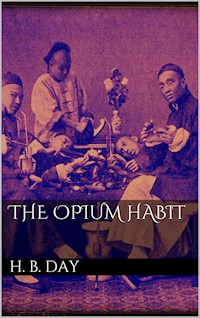
The Opium Habit
UUID: 36a9cf8e-0e7c-11e5-99d4-4fc950d1ab4a
This ebook was created with BackTypo (http://backtypo.com)by Simplicissimus Book Farm
Table of contents
INTRODUCTION.
THE OPIUM HABIT.
DE QUINCEY'S "CONFESSIONS OF AN ENGLISH OPIUM-EATER."
OPIUM REMINISCENCES OF COLERIDGE.
WILLIAM BLAIR.
OPIUM AND ALCOHOL COMPARED.
INSANITY AND SUICIDE FROM AN ATTEMPT TO ABANDON MORPHINE.
A MORPHINE HABIT OVERCOME.
ROBERT HALL—JOHN RANDOLPH—WM. WILBERFORCE,
WHAT SHALL THEY DO TO BE SAVED?
OUTLINES OF THE OPIUM-CURE.
"After
my death, I earnestly entreat that a full and unqualified narrative
of my wretchedness, and of its guilty cause, may be made public, that
at least some little good may be effected by the direful
example."—COLERIDGE.
INTRODUCTION.
This
volume has been compiled chiefly for the benefit of opium-eaters. Its
subject is one indeed which might be made alike attractive to medical
men who have a fancy for books that are professional only in an
accidental way; to general readers who would like to see gathered
into a single volume the scattered records of the consequences
attendant upon the indulgence of a pernicious habit; and to moralists
and philanthropists to whom its sad stories of infirmity and
suffering might be suggestive of new themes and new objects upon
which to bestow their reflections or their sympathies. But for none
of these classes of readers has the book been prepared. In strictness
of language little medical information is communicated by it.
Incidentally, indeed, facts are stated which a thoughtful physician
may easily turn to professional account. The literary man will
naturally feel how much more attractive the book might have been made
had these separate and sometimes disjoined threads of mournful
personal histories been woven into a more coherent whole; but the
book has not been made for literary men. The philanthropist, whether
a theoretical or a practical one, will find in its pages little
preaching after his particular vein, either upon the vice or the
danger of opium-eating. Possibly, as he peruses these various
records, he may do much preaching for himself, but he will not find a
great deal furnished to his hand, always excepting the rather
inopportune reflections of Mr. Joseph Cottle over the case of his
unhappy friend Coleridge. The book has been compiled for
opium-eaters, and to their notice it is urgently commended. Sufferers
from protracted and apparently hopeless disorders profit little by
scientific information as to the nature of their complaints, yet they
listen with profound interest to the experience of fellow-sufferers,
even when this experience is unprofessionally and unconnectedly told.
Medical empirics understand this and profit by it. In place of the
general statements of the educated practitioner of medicine, the
empiric encourages the drooping hopes of his patient by narrating in
detail the minute particulars of analagous cases in which his skill
has brought relief.Before
the victim of opium-eating is prepared for the services of an
intelligent physician he requires some stimulus to rouse him to the
possibility of recovery. It is not the
dicta
of the medical man, but the experience of the relieved patient, that
the opium-eater, desiring—nobody but he knows how ardently—to
enter again into the world of hope, needs, to quicken his paralyzed
will in the direction of one tremendous effort for escape from the
thick night that blackens around him. The confirmed opium-eater is
habitually hopeless. His attempts at reformation have been repeated
again and again; his failures have been as frequent as his attempts.
He sees nothing before him but irremediable ruin. Under such
circumstances of helpless depression, the following narratives from
fellow-sufferers and fellow-victims will appeal to whatever remains
of his hopeful nature, with the assurance that others who have
suffered even as he has suffered, and who have struggled as he has
struggled, and have failed again and again as he has failed, have at
length escaped the destruction which in his own case he has regarded
as inevitable.The
number of confirmed opium-eaters in the United States is large, not
less, judging from the testimony of druggists in all parts of the
country as well as from other sources, than eighty to a hundred
thousand. The reader may ask who make up this unfortunate class, and
under what circumstances did they become enthralled by such a habit?
Neither the business nor the laboring classes of the country
contribute very largely to the number. Professional and literary men,
persons suffering from protracted nervous disorders, women obliged by
their necessities to work beyond their strength, prostitutes, and, in
brief, all classes whose business or whose vices make special demands
upon the nervous system, are those who for the most part compose the
fraternity of opium-eaters. The events of the last few years have
unquestionably added greatly to their number. Maimed and shattered
survivors from a hundred battle-fields, diseased and disabled
soldiers released from hostile prisons, anguished and hopeless wives
and mothers, made so by the slaughter of those who were dearest to
them, have found, many of them, temporary relief from their
sufferings in opium.There
are two temperaments in respect to this drug. With persons whom opium
violently constricts, or in whom it excites nausea, there is little
danger that its use will degenerate into a habit. Those, however,
over whose nerves it spreads only a delightful calm, whose feelings
it tranquillizes, and in whom it produces an habitual state of
reverie, are those who should be upon their guard lest the drug to
which in suffering they owe so much should become in time the direst
of curses. Persons of the first description need little caution, for
they are rarely injured by opium. Those of the latter class, who have
already become enslaved by the habit, will find many things in these
pages that are in harmony with their own experience; other things
they will doubtless find of which they have had no experience. Many
of the particular effects of opium differ according to the different
constitutions of those who use it. In De Quincey it exhibited its
power in gorgeous dreams in consequence of some special tendency in
that direction in De Quincey's temperament, and not because dreaming
is by any means an invariable attendant upon opium-eating. Different
races also seem to be differently affected by its use. It seldom,
perhaps never, intoxicates the European; it seems habitually to
intoxicate the Oriental. It does not generally distort the person of
the English or American opium-eater; in the East it is represented as
frequently producing this effect.It
is doubtful whether a sufficient number of cases of excess in
opium-eating or of recovery from the habit have yet been recorded, or
whether such as have been recorded have been so collated as to
warrant a positive statement as to all the phenomena attendant upon
its use or its abandonment. A competent medical man, uniting a
thorough knowledge of his profession with educated habits of
generalizing specific facts under such laws—affecting the nervous,
digestive, or secretory system—as are recognized by medical
science, might render good service to humanity by teaching us
properly to discriminate in such cases between what is uniform and
what is accidental. In the absence, however, of such instruction,
these imperfect, and in some cases fragmentary, records of the
experience of opium-eaters are given, chiefly in the language of the
sufferers themselves, that the opium-eating reader may compare case
with case, and deduce from such comparison the lesson of the entire
practicability of his own release from what has been the burden and
the curse of his existence. The entire object of the compilation will
have been attained, if the narratives given in these pages shall be
found to serve the double purpose of indicating to the beginner in
opium-eating the hazardous path he is treading, and of awakening in
the confirmed victim of the habit the hope that he may be released
from the frightful thraldom which has so long held him, infirm in
body, imbecile in will, despairing in the present, and full of
direful foreboding for the future.In
giving the subjoined narratives of the experience of opium-eaters,
the compiler has been sorely tempted to weave them into a more
coherent and connected story; but he has been restrained by the
conviction that the thousands of opium-eaters, whose relief has been
his main object in preparing the volume, will be more benefited by
allowing each sufferer to tell his own story than by any attempt on
his part to generalize the multifarious and often discordant
phenomena attendant upon the disuse of opium. As yet the medical
profession are by no means agreed as to the character or proper
treatment of the opium disease. While medical science remains in this
state, it would be impertinent in any but a professional person to
attempt much more than a statement of his own case, with such general
advice as would naturally occur to any intelligent sufferer. Very
recently indeed, some suggestions for the more successful treatment
of the habit have been discussed both by eminent medical men and by
distinguished philanthropists. Could an Institution for this purpose
be established, the chief difficulty in the way of the redemption of
unhappy thousands would be obviated. The general outline of such a
plan will be found at the close of the volume. It seems eminently
deserving the profound consideration of all who devote themselves to
the promotion of public morals or the alleviation of individual
suffering.
THE OPIUM HABIT.
A
SUCCESSFUL ATTEMPT TO ABANDON OPIUM.In
the personal history of many, perhaps of most, men, some particular
event or series of events, some special concurrence of circumstances,
or some peculiarity of habit or thought, has been so unmistakably
interwoven and identified with their general experience of life as to
leave no doubt in the mind of any one of the decisive influence which
such causes have exerted. Unexaggerated narrations of marked cases of
this kind, while adding something to our knowledge of the marvellous
diversities of temptation and trial, of success and disappointment
which make up the story of human life, are not without a direct
value, as furnishing suggestions or cautions to those who may be
placed in like circumstances or assailed by like temptations.The
only apology which seems to be needed for calling the attention of
the reader to the details which follow of a violent but successful
struggle with the most inveterate of all habits, is to be found in
the hope which the writer indulges, that while contributing something
to the current amount of knowledge as to the horrors attending the
habitual use of opium, the story may not fail to encourage some who
now regard themselves as hopeless victims of its power to a strenuous
and even desperate effort for recovery. Possibly the narrative may
also not be without use to those who are now merely in danger of
becoming enslaved by opium, but who may be wise enough to profit in
time by the experience of another.A
man who has eaten much more than half a hundredweight of opium,
equivalent to more than a hogshead of laudanum, who has taken enough
of this poison to destroy many thousand human lives, and whose
uninterrupted use of it continued for nearly fifteen years, ought to
be able to say something as to the good and the evil there is in the
habit. It forms, however, no part of my purpose to do this, nor to
enter into any detailed statement of the circumstances under which
the habit was formed. I neither wish to diminish my own sense of the
evil of such want of firmness as characterizes all who allow
themselves to be betrayed into the use of a drug which possesses such
power of tyrannizing over the most resolute will, nor to withdraw the
attention of the reader from the direct lesson this record is
designed to convey, by saying any thing that shall seem to challenge
his sympathy or forestall his censures. It may, however, be of
service to other opium-eaters for me to State briefly, that while
endowed in most respects with uncommon vigor of any tendency to
despondency or hypochondria, an unusual nervous sensibilitv, together
with a constitutional tendency to a disordered condition of the
digestive organs, strongly predisposed me to accept the fascination
of the opium habit. The difficulty, early in life, of retaining food
of any kind upon the stomach was soon followed by vagrant shooting
pains over the body, which at a later day assumed a permanant chronic
form.After
other remedies had failed, the eminent physician under whose advice I
was acting recommended opium. I have no doubt he acted both wisely
and professionally in the prescription he ordered, but where is the
patient who has learned the secret of substituting luxurious
enjoyment in place of acute pain by day and restless hours by night,
that can be trusted to take a correct measure of his own necessities?
The result was as might have been anticipated: opium after a few
months' use became indispensable. With the full consciousness that
such was the case, came the resolution to break off the habit This
was accomplished after an effort no more earnest than is within the
power of almost any one to make. A recurrence of suffering more than
usually severe led to a recourse to the same remedy, but in largely
increased quantities. After a year or two's use the habit was a
second time broken by another effort much more protracted and
obstinate than the first. Nights made weary and days uncomfortable by
pain once more suggested the same unhappy refuge, and after a
struggle against the supposed necessity, which I now regard as
half-hearted and cowardly, the habit was resumed, and owing to the
peculiarly unfavorable state of the weather at the time, the quantity
of opium necessary to alleviate pain and secure sleep was greater
than ever. The habit of relying upon large doses is easily
established; and, once formed, the daily quantity is not easily
reduced. All persons who have long been accustomed to Opium are aware
that there is a
Lesen Sie weiter in der vollständigen Ausgabe!
Lesen Sie weiter in der vollständigen Ausgabe!
Lesen Sie weiter in der vollständigen Ausgabe!
Lesen Sie weiter in der vollständigen Ausgabe!
Lesen Sie weiter in der vollständigen Ausgabe!
Lesen Sie weiter in der vollständigen Ausgabe!
Lesen Sie weiter in der vollständigen Ausgabe!
Lesen Sie weiter in der vollständigen Ausgabe!
Lesen Sie weiter in der vollständigen Ausgabe!