


5,03 €
Mehr erfahren.
- Herausgeber: Heritage Books
- Sprache: Englisch
Dive into the captivating story of the Ottoman Empire's journey through time – from its majestic rise to its eventual fall. Explore the rich history, dramatic events, and the key figures that shaped this powerful empire. A tale of ambition, conquest, and inevitable decline, this book unveils the intricate and diverse elements that make up the history of the once-mighty realm.
Das E-Book können Sie in Legimi-Apps oder einer beliebigen App lesen, die das folgende Format unterstützen:
Seitenzahl: 69
Veröffentlichungsjahr: 2023
Ähnliche



















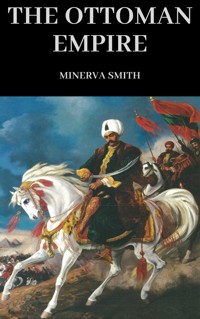
THE OTTOMAN EMPIRE
THE RISE AND FALL
COPYRIGHT ©
Published by Minerva Smith
© 2023 Nigeria. All rights reserved.
No part of this publication may be reproduced, distributed, or transmitted in any form or by any means, including photocopying, recording, or other electronic or mechanical methods, without the prior written permission of the publisher, except in the case of brief quotations embodied in critical reviews and certain other noncommercial uses permitted by copyright law.
Table of Contents
Title Page
Copyright Page
DISCLAIMER
THE HISTORY OF OTTOMAN EMPIRE
A BRIEF PERIOD OF INTERNAL TURMOIL
SULEIMAN THE MAGNIFICENT
COMPLACENCY OF THE SULTANS
THE FRENCH INVASION
A DARKER AND MORE BRUTAL ACTIVITY
JEWISH TRIUMPHS AND TRAGEDIES IN THE OTTOMAN EMPIRE
OTTOMAN EMPIRE'S 16TH CENTURY JEWISH HUB
WHY ARABS REBELLED AGAINST THE OTTOMAN EMPIRE
ORIGIN OF THE 19TH CENTURY ARAB REVOLT
THE IMPACT OF THE TANZIMAT REFORMS
INVOLVEMENT OF FOREIGN POWERS
OTTOMANS' STRUGGLE TO AVERT DECLINE
DRIVE FOR INDUSTRIALIZATION
MAHMUD’S EXPLOITS
ABDULHAMID’S EXPLOITS
MALE CONCUBINES IN THE OTTOMAN ERA
THE CONCEPT OF GENDER IDENTITY IN PREMODERN ERA OF OTTOMAN EMPIRE
THE JANISARRIES, ELITE TROOPS OF OTTOMAN EMPIRE
THE MOTIVE BEHIND JANISSARIES' CHILD ABDUCTIONS
DISCLAIMER
The contents of this book are intended for educational and informational purposes only. The author and publisher disclaim any responsibility for the potential misuse or misinterpretation of the content herein, and any actions taken based on the information provided in this work are the sole responsibility of the individuals involved.
THE HISTORY OF OTTOMAN EMPIRE
On October 29, 2023, the Republic of Turkey marked its centenary since its inception following the dissolution of the Ottoman Empire. The year 1923 symbolized the conclusion of more than six centuries of Ottoman Imperial rule, during which the empire reached its zenith in the mid-16th century, extending its dominion across vast regions in the Middle East, North Africa, and Eastern Europe.
Emerging from relative obscurity as a minor regional power in Northwestern Anatolia, the Ottoman Dynasty initiated a remarkable era of territorial expansion and rapid progress in governmental, social, and economic systems. This transformation led to the establishment of one of the most diverse and prosperous empires in the world.
However, the fate of this once-mighty and powerful state raises intriguing questions about its legacy and how it shaped the modern Turkish nation that exists today. Understanding the establishment of the Ottoman Empire requires delving into the historical backdrop of the migration of Turkic peoples from Eastern Asia. These migrations, which spanned ancient times, were pivotal in shaping the empire's origins.
The Turks, originally an Asiatic people, embarked on a gradual westward migration from Northeastern Asia. By the 7th century, they had reached the region near the Altai Mountains, close to the borders of present-day Russia, Kazakhstan, and Mongolia. Subsequently, they continued their southward and westward movements over the centuries. A significant number of them eventually settled into a semi-nomadic lifestyle in the vicinity of the Caspian and Aral Seas. Among these Turkic tribes, the Oguz emerged as one of the primary inhabitants of this region.
In the late 10th century, a leader from one of the clans within the Oguz tribe, a man named Seljuk, decided to break away from the larger tribal group. He went on to establish his own dynasty, a pivotal development in the broader narrative of the Ottoman Empire's inception.
In the ensuing decades of the new millennium, Seljuk and his descendants embarked on the establishment of the Seljuk Empire. Their expansion into Persia was a pivotal step in this endeavor. They found themselves significantly influenced by Persian language and culture, which they swiftly adopted, alongside their conversion to Islam. By the 1060s, their dominion extended all the way to the borders of the Byzantine Empire in Western Anatolia.
Intermittent clashes between these two mighty powers eventually erupted into the Byzantine-Seljuk War, with a pivotal moment occurring at the Battle of Manzikert in 1071. At this decisive battle, the Seljuks delivered a resounding defeat to the Byzantine Army, effectively granting them control over the Near East and enabling them to push deeper into what is now modern-day Turkey.
Over the subsequent two centuries, the Seljuk Empire experienced a gradual decline, leading to its fragmentation into a mosaic of smaller Turkic states. In Anatolia, the Turkish presence persisted, with the Sultanate of Rum serving as a significant representation of their influence. However, even this sultanate would eventually experience a decline and fragmentation by the early 14th century, giving rise to numerous smaller principalities referred to as the Anatolian Beyliks, scattered across the region.
Among these, in the northwestern reaches of Turkey, a charismatic warlord emerged as the founder of what would evolve into the Ottoman Empire. Although historical sources regarding his life and reign are scant and often unreliable, he is credited as the dynasty's progenitor. This leader, bearing the name Osman, became the central figure in the empire's formation.
The century following Osman's reign was marked by the Ottomans' persistent efforts to conquer the remaining territories of the Byzantine Empire, which had once held sway over much of the Eastern Mediterranean in the 14th century.
By the 14th century, the Byzantine Empire had been considerably reduced, retaining only the southern part of the Balkans, mainland Greece, the Greek Islands, and a small portion of territory in Turkey. Their empire was centered in Constantinople, a city renowned as the most formidable and resilient in the medieval world, having withstood numerous sieges throughout its history.
If the Ottomans aimed to expand beyond Northwestern Turkey, they recognized the necessity of doing so at the expense of the Byzantines and seizing their capital city. A significant turning point came in 1331 when the city of Nicaea fell to the Turks. Subsequently, in 1369, Adrianople, a city situated a mere 200 kilometers from Constantinople, on the borders of Greece, Bulgaria, and Turkey as we know them today, also succumbed to the Turks and served as their capital for a brief period. This conquest was followed by further Ottoman expansions into Serbia and Bulgaria.
A BRIEF PERIOD OF INTERNAL TURMOIL
In the early decades of the 15th century, a brief period of internal turmoil gripped the Ottoman Empire. However, in 1451, Mehmed II was reinstated as the Sultan, and he was determined to achieve the long-held ambition of conquering Constantinople once and for all.
In early April 1453, he commenced a relentless siege of the great city, which endured for seven weeks before the city's formidable walls were finally breached, and the Ottoman army poured in. Significantly, the last emperor of the Byzantines, Constantine XI, shared his name with Constantine the Great, the original founder of the city over a millennium earlier, to whom he had paid homage.
Tragically, Constantine XI met his fate in the battle on May 29, 1453, and on the same day, Constantinople succumbed to the Ottomans.
The city then became the capital of the burgeoning Ottoman Empire, symbolizing the Ottomans' triumph over the city's storied history. As a stark testament to this conquest, the Hagia Sophia, a grand cathedral constructed by Emperor Justinian over 900 years earlier, was re-consecrated as a mosque. Additionally, four minaret towers were soon added at each corner of the complex.
The conquest of the Byzantine Empire and the fall of Constantinople marked just the initial phase in the ascent of the Ottoman Empire. In the century that ensued, the Turks embarked on a relentless course of expansion and conquest across the Eastern Mediterranean, Middle East, North Africa, the Balkans, and the Black Sea.
In the early 1460s, Mehmed II swiftly secured territories, overwhelming regions such as Maria in Greece, the Empire of Trebizond in Northern Turkey, and Bosnia in the Balkans. By the time of his passing in 1481, he had extended the empire's boundaries into Southern and Eastern Turkey, conquered Albania, and even dispatched an expedition to the Crimean Peninsula, establishing Ottoman presence on the northern shores of the Black Sea.
Mehmed II's successor, Bayazid II, was no less formidable as a warlord. Over his 30-year reign, he continued to annex new territories to the empire, particularly in Syria and the Levant, following a victorious conflict against the Mamluks of Egypt in their struggle for dominance in that region.




