


5,31 €
Mehr erfahren.
- Herausgeber: Heritage Books
- Kategorie: Sachliteratur, Reportagen, Biografien
- Sprache: Englisch
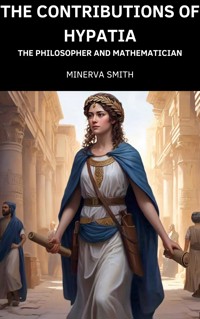
This captivating exploration delves into the life and legacy of Hypatia, one of history's most remarkable scholars. As a philosopher, mathematician, and teacher in ancient Alexandria, Hypatia broke barriers in a world dominated by men, earning widespread acclaim for her brilliance and resilience. Her work bridged the ancient and medieval worlds, preserving critical knowledge and inspiring generations.
Through this book, readers will discover Hypatia's groundbreaking contributions to mathematics and philosophy, her influence as a mentor and community builder, and the tragic circumstances of her untimely death. Beyond her story, the book reflects on broader themes of intellectual freedom, gender roles, and the enduring power of human curiosity.
Perfect for history enthusiasts and those inspired by trailblazing women, this book celebrates Hypatia's enduring impact on the intellectual and cultural fabric of humanity
Das E-Book können Sie in Legimi-Apps oder einer beliebigen App lesen, die das folgende Format unterstützen:
Seitenzahl: 38
Veröffentlichungsjahr: 2025
Ähnliche







THE CONTRIBUTIONS OF HYPATIA
THE PHILOSOPHER AND MATHEMATICIAN
COPYRIGHT PAGE
The Contribution of Hypatia
Copyright © 2024 Minerva Smith.
No part of this ebook may be reproduced, distributed, or transmitted in any form or by any means, including photocopying, recording, or other electronic or mechanical methods, without the prior written permission of the publisher, except in the case of brief quotations used in reviews and certain other noncommercial uses permitted by copyright law.
Table of Contents
Title Page
Copyright Page
DISCLAIMER
AN EXTRAORDINARY GENIUS
EARLY LIFE AND EDUCATION
PHILOSOPHICAL CONTRIBUTIONS
MATHEMATICAL INNOVATIONS
ASTRONOMICAL CONTRIBUTIONS
ROLE IN THE INTELLECTUAL COMMUNITY
POLITICAL AND RELIGIOUS CHALLENGES
HYPATIA’S LEGACY
HYPATIA IN LITERATURE AND POPULAR CULTURE
REFLECTING ON HYPATIA’S LASTING CONTRIBUTIONS
DISCLAIMER
The information provided in this book is for educational and informational purposes only. Every effort has been made to ensure that the information in this book is accurate, up-to-date, and helpful. However, no responsibility is assumed by the author or publisher for any loss or damage resulting from the use of this book or the information contained herein.
AN EXTRAORDINARY GENIUS
Hypatia was a woman of extraordinary genius and one of the most famous historical women. She was a philosopher and mathematician of remarkable intellect. Indeed, Hypatia became an extremely fine woman, especially in an age where she would have to face up against and almost conquer the masculine world. Hypatia lived during the late fourth century CE, when Alexandria had once thrived as a city of culture, commerce, and scholarship; she became a symbol of knowledge and intellect there. Her life entwined the rigors of mathematics, the depths of philosophic inquiry, and the arts of teaching into a legacy that has lasted beyond time. As a teacher, thinker, and pioneer, Hypatia’s story is both inspiring and tragic, illuminating the potential of intellectual pursuit and the dangers of societal and political upheaval.
Hypatia lived in Alexandria, a city not only a port but indeed the cultural and intellectual capital of the ancient world. The Great Library of Alexandria and the internationally famous Mouseion set the city as the oasis of scholars from all over the Mediterranean. It was the melting pot of all cultures, ideas, and religions under the undying Hellenistic legacy of reason and inquiry. Hypatia was the daughter of Theon, an excellent mathematician and astronomer, so she was already acquainted with rich intellectual inheritance from childhood. In fact, she was able to not only lay claim to her father's knowledge but even develop it and add her own ideas, thus bringing herself to extensive popularity as a philosopher and mathematician.
There were many happenings with her time, as the Roman Empire was experiencing important forms of changes because, during Hypatia's relatively short span of life, Christianity was on the rise, displacing a lot from the traditional pagan practices and beliefs. Here, the dynamics of religious and cultural conflicts drove Alexandria's intellectual climate, situating Hypatia herself in the tensions between worlds old and new. As a pagan scholar and a woman in a man's world, Hypatia earned accolades for her learning but, as a symbol of resistance to the Christianization of the city, also attracted accumulated hatreds against her. She died at the gruesome hands of a mob, which many take as a gloomy turning point in the fall, from which every classical open idea interchange proved to be a discolouration.
The investigation of the life and work of Hypatia will not end there or become an academic exercise but will instead be a homage paid to her contributions to mathematics and philosophy, which still influence the present mind. Hypatia's commentaries on Diophantus, Ptolemy, and several other classical thinkers join ancient knowledge with the medieval world so that these ideas are not lost to history. Equally essential is her role as a teacher, creating an active intellectual community in Alexandria and mentoring students who have kept her memory alive.
Hypatia's story also has relevant cultural and social resonance. She raised modern questions about women's roles in intellectual life in antiquity and became a monument to the capabilities and actions of women in a time when much was silenced. Her life reminds us especially about the protection and diversity of intellectual freedom in times of cultural and religious transition.




