


5,03 €
Mehr erfahren.
- Herausgeber: Heritage Books
- Kategorie: Geisteswissenschaft
- Sprache: Englisch
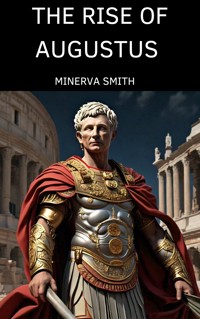
The Rise of Augustus tells the compelling story of how one man transformed a crumbling Roman Republic into a mighty empire. This book explores the life of Augustus, Rome’s first emperor, and the brilliant political maneuvers, military victories, and strategic alliances that helped him secure his power. From his early years as an ambitious young leader to his reign as one of history’s most influential rulers, this account brings his journey to life. Perfect for history lovers, this book offers a fascinating look at the rise of Augustus and the dawn of the Roman Empire.
Das E-Book können Sie in Legimi-Apps oder einer beliebigen App lesen, die das folgende Format unterstützen:
Seitenzahl: 65
Veröffentlichungsjahr: 2024
Ähnliche












THE RISE OF AUGUSTUS
From Republic to Empire in Rome
COPYRIGHT PAGE
The Rise of Augustus
Copyright © 2024 Minerva Smith.
No part of this ebook may be reproduced, distributed, or transmitted in any form or by any means, including photocopying, recording, or other electronic or mechanical methods, without the prior written permission of the publisher, except in the case of brief quotations used in reviews and certain other noncommercial uses permitted by copyright law.
Table of Contents
Title Page
Copyright Page
DISCLAIMER
THE TRANSFORMATION OF ROME
THE ROMAN REPUBLIC IN CRISIS
POLITICAL TURMOIL: KEY EVENTS LEADING TO THE CRISIS
THE LEGACY OF JULIUS CAESAR
THE ASSASSINATION
THE EMERGENCE OF OCTAVIAN
THE FORMATION OF THE SECOND TRIUMVIRATE
CONFLICT AND RIVALRY: TENSIONS WITHIN THE TRIUMVIRATE
THE BATTLE OF PHILIPPI
THE CONFLICT WITH MARK ANTONY
THE TRANSITION TO EMPIRE
THE PAX ROMANA
AUGUSTUS AS A LEADER AND REFORMER
THE ENDURING LEGACY OF AUGUSTUS
DISCLAIMER
The information provided in this book is for educational and informational purposes only. Every effort has been made to ensure that the information in this book is accurate, up-to-date, and helpful. However, no responsibility is assumed by the author or publisher for any loss or damage resulting from the use of this book or the information contained herein
THE TRANSFORMATION OF ROME
The rise of Augustus is considered a turning point in the history of Rome since it marked the end of the chaotic Republic and the birth of an Empire with a central authority. Gaius Octavius, later referred to as Octavian, became the first emperor of the Roman Empire after overcoming the civil disorder in other Roman cities that existed in the late Republican period to found a different system of governance. His importance does not end with his achievements; he is also remembered as the one who put in place a system of control, which regimes, cultural practices and social structures would be based for many years. This opening introduction attempts to explain why Augustus holds historical significance, the transition he made possible, and the main topics present in the phenomenon under consideration.
The Significance of Augustus in Roman History
When it comes to the Roman Empire, Augustus was one of the tallest trees that contributed greatly to its landscape. His advent to political power was not merely a subjective conquest but rather a more significant revolution taking place within the Roman state. After many years of being at war with each other that included the death of Julius Caesar and the wars that followed to take control, Augustus became the first emperor of the Roman Empire by 27 B. C. E. His reign was the first to establish the eminence of the Principate, a system of government that though autocratic in nature, still retain some features of the Republic.
In addition to these factors, Augustus is important in that he was able to bring peace to a torn Rome. The Republic went through civil wars, which caused a lot of chaos and disappointment to the people. Restoration and peace were achieved as a result of extensive structural changes in governance, military and social activities ushered in by Augustus giving birth to the age of peace popularly known as the Pax Romana. It is due to this that Augustus has become a symbol of the Roman spirit and the flourishing age of culture during his reign. The significance of his reign is also seen among the later emperors who would use his concepts and practices in the way they ruled.
Transition from Republic to Empire
It was not a rapid change or easy to execute the transition from a Republic to an Empire; it took many years and... in any case, political struggle, political change and political reorganization. The Roman Republic is well-known for having in its structure a system where power at no time depended on a single individual. This was done in order to ensure that no one person would become powerful enough to lead the army and the state. Yet, with the territorial growth of Rome, the very minimalist defects embedded in the Republican system began to surface more seriously. The elites became divided, conflicts of interest deepened, and figures such as Julius Caesar tactically manipulated these gaps to gain dominance.
The murder of Caesar, 44 BCE, was another violent episode that served as the crux of more prolonged instability in the power dynamics of his allies and enemies. The creation of the second triumvirate also known as the second triumvirate of Octavian, Marc Antony, and Lepidus was designed to bring peace but this enraged the divisions instead. The resulting civil wars included the famous battle fought between ships that took place in 31 BC, known as the Battle of Actium, in which Octavian’s army prevailed over Antony and Cleopatra. With this, Octavian was therefore buttressed in the position of the highest leader of the Roman Empire.
After solidifying and rallying his backing, Octavian made his way back to Rome in 27 BCE. He received the honorific title of Augustus, thereby officially bringing to an end the Republic and ushering in the Empire Age. The emergence of the principate introduced a new order in which his power was unquestioned by all, save virtue and the outward forms of republican government. This change is remarkable of the complexity between power and politics, how Augustus was able to resolve the opposition of the two in order to transform Rome.
Key Themes: Power, Political Strategy, and Societal Change
The transformation of Rome during Augustus's rise is characterized by several interrelated themes: power, political strategy, and societal change.
The concept of power fills a prominent place among themes, particularly as Augustus's rise to power marked the beginning of a new era in the perception and use of power in Rome. In contrast to his instinctive predecessors, who relied heavily on violence and suppression, Augustus conceived a softer strategy for rule. Rather than projecting his identity as a Ruler of a state, he viewed himself as the first among citizens (princeps), which enabled him to construct a well crafted image of collective leadership under his unilateral rule. The very nature of this earned him allegiance from various social groups in Romans without fear of opposition, as power was not democratized.
The ascending of Augustus was significantly influenced by political tactics. His knack for creating consensus, shaping opinions, and using cheap publicity knew no equal. He understood the need for popularity and sought it through writing, painting and display acts among other things to promote his ideals and justify his rule. How he used, applied and even over mastered the use of agriculture, but not only planting crops and rearing animals, was witnessed in the politics of that era and it was how Augustus cleverly survived.
Changes in society is also an important subject that goes hand in hand with the ascension of Augustus. His rule saw great changes in Roman society such as the propagation of civic custom, peace and the achievement of wealth. Augustus carried out a series of reforms to curb immorality, increase reproduction through marriage, and limit vice. Works intended to revive the temples of ancient Rome gave its people a sense of togetherness which encouraged another concept: the people of Rome were one.
The ascendance of Augustus and the change of Rome from a Republic to an Empire is one of the most important eras in history. His importance goes beyond the individual; it mirrors the structural power, politics and historical changes of the social order that existed during that particular period. These themes assist the reader to appreciate the full scope of the reign of Augustus, including the implications it has for the history of Roman politics and society.
THE ROMAN REPUBLIC IN CRISIS
O




