


0,49 €
Niedrigster Preis in 30 Tagen: 1,99 €
Niedrigster Preis in 30 Tagen: 1,99 €
Mehr erfahren.
- Herausgeber: DigiCat
- Kategorie: Wissenschaft und neue Technologien
- Sprache: Englisch
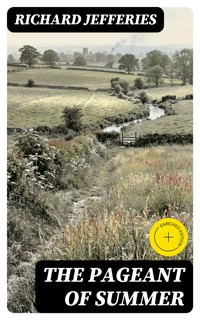
In "The Pageant of Summer," Richard Jefferies masterfully intertwines natural observation with reflective prose, creating a vivid tapestry that celebrates the lush beauty of the English countryside. The book adopts an impressionistic style, blending poetic descriptions with philosophical musings. Jefferies captures the essence of rural life during the height of summer, invoking not only the serene landscapes but also the intricate relationships between humanity and nature. This work is contextualized within the Victorian era's growing interest in natural philosophy and the Romantic movement's emphasis on the sublime, making it a pivotal exploration of ecological awareness during a period of industrial transformation. Richard Jefferies, an influential English author and naturalist, was deeply connected to the landscapes of his native Wiltshire. His upbringing in a rural environment instilled in him a profound appreciation for nature, which is vividly reflected in his writing. Jefferies's struggles with health and the pressures of urbanization further fueled his desire to depict the beauty of the natural world, offering a poignant escape for himself and his readers from the rapidly changing society of the time. For readers seeking a poetic exploration of the natural world and a meditation on the passage of time, "The Pageant of Summer" is an essential read. Jefferies's evocative prose invites readers to pause and reflect on the beauty around them, making it a timeless classic for both nature lovers and literary enthusiasts alike.
Das E-Book können Sie in Legimi-Apps oder einer beliebigen App lesen, die das folgende Format unterstützen:
Veröffentlichungsjahr: 2022
Ähnliche












The Pageant of Summer
Table of Contents
Introduction
Summer promises abundance, yet its very fullness can sharpen our awareness of time, desire, and loss.
Richard Jefferies’ The Pageant of Summer belongs to the tradition of English nature writing, shaped by close observation and reflective prose rather than plot-driven incident. Jefferies is best known for writing about the countryside and the life of fields, lanes, and woods, and this book draws on that characteristic attention to the natural world. While precise publication details vary by edition, it is generally associated with the late nineteenth-century period in which Jefferies was active, and it reflects the era’s appetite for essays that joined description with thought.
The book offers a sequence of impressions centered on the season itself, inviting the reader to move through summer as through a procession of scenes, sensations, and encounters. Instead of advancing a conventional narrative, it dwells on weather, light, growth, and the countless small events that compose rural days. The premise is simple and enduring: to attend closely to the world at its most vivid and to register what such attention does to the mind. The reading experience is immersive and unhurried, with emphasis on atmosphere and perception.
Jefferies writes with a patient, sensory exactness that turns familiar things into renewed experience. His voice tends toward contemplative intensity, balancing the outward gaze of the naturalist with the inward resonance of the essayist. The tone is often celebratory, yet not careless; it lingers over beauty while remaining alert to the limits of human control and understanding. Rather than asking the reader to solve a puzzle, the prose asks the reader to notice—how heat changes sound, how distance alters color, how the ordinary field becomes charged with meaning under sustained attention.
Among the book’s central concerns is the relationship between human consciousness and the nonhuman world. Summer appears not merely as backdrop but as an active force that shapes mood, thought, and bodily life, pressing the senses outward and drawing reflection inward. The text repeatedly tests the boundary between scientific seeing and imaginative feeling, suggesting that accuracy of observation and depth of response can coexist. It also engages, in a broad and understated way, with the question of what it means to belong to a place, and what is lost when that belonging weakens.
The Pageant of Summer also matters as a work of attention in an age of distraction. Its method is to slow the reader down and to treat perception as a discipline, not a casual glance. Contemporary readers may recognize in Jefferies’ pages an early form of what is now called ecological awareness: a sense that land, weather, plants, and animals are interdependent with human life and not simply resources or scenery. Without leaning on argument, the book models how values can be formed by sustained encounter with the living world.
Approached today, the book can be read as both seasonal celebration and quiet critique of human self-importance. Its lasting power lies in how it translates the immediacy of summer into language that keeps the senses awake while leaving room for thought. Readers who come for countryside description will find, alongside it, a meditation on time, vitality, and the desire to hold experience before it passes. In that balance—between rapture and restraint, immersion and reflection—Jefferies offers a durable way of reading the natural world and, through it, ourselves.
Synopsis
The Pageant of Summer by Richard Jefferies is a short, non-fiction piece of nature writing that unfolds as an attentive survey of the summer season. Rather than building a plotted story, it proceeds by observation and reflection, treating the countryside as a shifting spectacle whose meaning emerges through close, patient looking. Jefferies sets out to register what summer presents—its light, heat, growth, and movement—while testing how much human perception can grasp without forcing the scene into sentiment or abstraction. The work’s organizing question is how to render a living season with accuracy and vitality.
paragraphs
As the essay advances, Jefferies focuses on the immediate, sensory character of summer: brightness, color, and the dense activity that fills fields, hedgerows, and open sky. The “pageant” idea frames nature as a continuous procession of forms—plants, insects, birds, and weather—each briefly prominent before giving way to the next. He attends to change within apparent steadiness, noting how small shifts in wind, cloud, and sun alter the entire character of a place. The countryside becomes an arena where abundance is visible, yet never fully countable or fixed.
paragraphs
Jefferies develops his account by moving between particular scenes and broader generalizations about seasonal life. He treats growth and ripeness as central summer facts, and he is drawn to the way energy seems to radiate through the landscape. At the same time, he insists on the limits of casual seeing: what appears uniform from a distance contains intricate variation up close. This tension—between the vast, composite impression of summer and the minute detail that sustains it—drives the piece forward, giving it a steady argumentative rhythm without turning it into a treatise.
paragraphs
Alongside description, the essay introduces a reflective human presence that asks what this seasonal spectacle does to the mind. Jefferies considers how immersion in summer can intensify attention, sharpen memory, and provoke a desire to understand the natural world beyond mere naming. Yet he does not pretend that observation produces mastery; he repeatedly returns to the idea that nature’s richness exceeds the observer’s reach. The reader is led through a disciplined kind of wonder, where appreciation depends on steadiness and humility rather than dramatic events or revelations.
Historical Context
Richard Jefferies wrote in late Victorian Britain, when the United Kingdom was the world’s leading industrial and imperial power and London dominated national publishing. Born in 1848 at Coate near Swindon, Wiltshire, he came of age as railways, mechanized agriculture, and expanding markets reshaped rural life in southern England. The Pageant of Summer belongs to his nature-writing and essayistic work of the 1870s–1880s, produced for a large readership of newspapers and magazines. Its attention to seasonal change and countryside detail reflects a period when “the country” was increasingly discussed from an urban perspective.
Jefferies’ formative setting was the chalk-and-downland landscape of Wiltshire and nearby counties, long shaped by enclosure and commercial farming. The 19th century saw continued consolidation of farms, improved drainage, fertilizers, and new machinery, alongside persistent reliance on hired labor. Rural institutions—parish governance, estates, and market towns—remained influential, but rural depopulation intensified as people sought wages in growing industrial centers. The expansion of railway lines, including those serving Swindon (a major Great Western Railway works town), increased mobility and made the countryside more accessible to visitors and readers, affecting how rural scenes were observed and described.
The decades before and during Jefferies’ career were marked by major public health and municipal reforms that altered the relation between city and countryside. The Public Health Acts of 1848 and 1875 expanded state involvement in sanitation and local administration, while rapid urbanization raised anxieties about crowding, smoke, and disease. Against this background, literary depictions of open air and field life carried added cultural weight, often serving as a counterpoint to industrial urban experience. Jefferies’ detailed natural observation resonated with readers negotiating these changes and with an expanding middle-class market for descriptive prose and essays.
Scientific and intellectual movements also shaped the era’s understanding of nature. Charles Darwin’s On the Origin of Species (1859) and later works intensified public discussion of ecology, adaptation, and deep time, while geology and natural history grew through societies, museums, and popular lectures. Victorian periodicals regularly published natural-history notes, field reports, and debates over science and religion. Jefferies was known for close attention to animal behavior, plants, weather, and landscape processes, aligning with a broader culture that valued empirical observation. His prose participates in this environment without needing to serve as scientific treatise, reflecting a widespread appetite for informed encounters with the natural world.
Economic pressures on agriculture were particularly acute in the late 1870s and 1880s. The so-called Great Depression of British Agriculture, often dated from 1873 into the 1890s, was driven by falling grain prices, international competition, and changing land use. Rural wages, employment patterns, and tenancies were affected, and political attention to the countryside increased. Organized labor also reached farm workers: Joseph Arch helped found the National Agricultural Labourers’ Union in 1872, bringing national visibility to rural conditions. Jefferies’ countryside writing emerged during these strains, when pastoral images coexisted with real debates about rural poverty and agricultural change.
Victorian literary culture provided an established tradition for rural description while also transforming it. Earlier Romantic and pastoral modes persisted, yet the period increasingly favored realism, journalism, and essays grounded in place. The growth of cheap print, serialization, and illustrated magazines broadened access to literature and encouraged shorter, scene-based prose. Jefferies published widely in such venues, and his style blends lyrical description with topical observation typical of late 19th-century periodical writing. His focus on the immediacy of field and hedgerow can be read as part of a wider effort to document local environments amid national modernization and shifting readerships.
Debates over land, access, and property rights were prominent in the later 19th century, intersecting with recreation and the use of the countryside. Enclosure had largely taken place earlier, but its social effects continued, and movements for allotments, smallholdings, and public access gained ground; the Commons Preservation Society was founded in 1865, and Parliament passed measures such as the Allotments Act (1887). Leisure walking and nature study became popular pursuits, aided by rail travel and guide literature. Jefferies’ attentiveness to lanes, fields, and marginal spaces reflects a culture increasingly conscious of who could use rural land and how that land was being managed.
Within this historical frame, The Pageant of Summer reflects late Victorian interest in the countryside as both lived environment and cultural idea. Its emphasis on seasonal abundance, weather, and minute natural particulars aligns with contemporary natural-history enthusiasm and with a readership seeking respite from urban-industrial life. At the same time, its rural scenes are inseparable from an England undergoing agricultural uncertainty, demographic change, and debates over land and labor. By presenting nature with seriousness and precision, Jefferies contributes to a critique implicit in much Victorian nature writing: that modern economic and social transformations risk obscuring direct experience of the nonhuman world and the local textures of rural existence.




