


15,59 €
Mehr erfahren.
- Herausgeber: Independent Thinking Press
- Kategorie: Bildung
- Sprache: Englisch
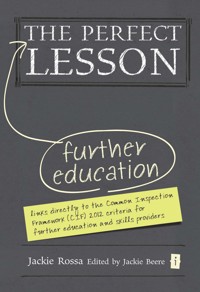
The Perfect (Ofsted) Further Education Lesson will help teachers, trainers, tutors and assessors provide consistently outstanding learning experiences that make a real difference to their learners. It removes the mystery surrounding outstanding learning, and enables staff to make the 'Great ESCAPE'- setting them free to do what really matters for their learners. It identifies key factors that make learning outstanding and provides practical advice and strategies to achieve this. This book links directly to the Common Inspection Framework (CIF) 102 criteria for further education and skills providers.
Das E-Book können Sie in Legimi-Apps oder einer beliebigen App lesen, die das folgende Format unterstützen:
Veröffentlichungsjahr: 2014
Ähnliche











Praise for The Perfect Further Education Lesson
Jackie Rossa has brilliantly crafted a book that succinctly and eloquently addresses the perennial question of deliverers of learning about what constitutes a grade one lesson. Through the use of a wide range of practical examples drawn from the breadth of the FE curriculum, readers can select and adopt key strategies to experiment with within their own delivery sessions.
There is excellent referencing to key components of the Ofsted 2012 Common Inspection Framework (CIF) which deepens the reader’s understanding of the essence of this framework in relation to delivering outstanding teaching and learning and allows them to gain a useful insight as to how judgements are made. This knowledge enables the reader to reflect, adapt and adopt working practices which directly enhance their students’ learning experience, as well as (incidentally) meeting the CIF observation criteria.
The structure and accessibility of the writing in this book makes it an essential read for every deliverer of learning who is constantly endeavouring to improve their students’ learning experience. The clear structuring of chapters enables readers to dip in to topics, or simply to extend or reinforce their existing knowledge. The end of chapter checklists ensure that time-pressed educational professionals can use this book frequently as a useful source of reference.
This book is suitable for those new to the teaching profession and seasoned professionals. The Ofsted CIF is, in itself, an articulation of what constitutes best practice in teaching and learning, and this book definitely delivers on this agenda too.
Elaine Martin, Director of Quality and Performance, Vision West Nottinghamshire College
Jackie Rossa writes with a sound understanding of the challenges and opportunities that staff work with on a daily basis in the FE sector. Her practical ideas are based on sound pedagogical practice and are shared in a simple style that makes this book accessible to all. The explicit use of words such as ‘high expectations’ and quotes from Toffler will resonate with both staff and managers. Well done and thank you.
Jane Lord, Learning and Quality Manager, Blackpool and The Fylde College
A comprehensive must-read for both practitioners and leaders/managers within the further education sector who wish to provide their students with an outstanding learning experience. This book offers a magical recipe for achieving outstanding teaching and learning and provides a clear interpretation of what is regarded as ‘outstanding’ under the Common Inspection Framework. This invaluable resource provides readers with a plethora of quick-win strategies and top tips which are essential for busy practitioners, as well as a thorough justification of why the strategies are essential for achieving outstanding teaching, learning and assessment.
The Perfect Further Education Lesson is an inspirational, easy-to-read, practical guide which provides readers with a combination of explanations, resources and top tips. It provides readers with an array of tips for showcasing the progress of learners when the inspector calls, which is the ‘hallmark’ of an outstanding lesson!
Verity Holman, Teaching, Learning and Assessment Manager
Jackie Rossa puts the common sense back into teaching and learning. This book is essential reading for teachers, but also for managers, observers and others responsible for improving teaching and learning. Not only is it full of helpful tips, but it is so easy to digest that you could do so in a single sitting! I urge teachers to share the content of this book with peers, get to grips with its messages and try out the ideas, adapting and reflecting as they go.
If you need some inspiration to support your teaching and learning practice team meetings, simply use this book. All teachers, no matter how experienced or skilled, will find great value from each and every chapter.
Deborah McVey, Education Consultant, Inspector, Trainer and Head of Improve, Protocol
Jackie Rossa presents her new menu! She has acquired ingredients throughout her career in further education and with private providers. She has worked as a teacher, an advanced practitioner, a coach and a director of quality and effectiveness; currently she is an inspector for Ofsted and a senior consultant for College Leadership services. Her aim is to continue to improve the quality of teaching for the benefit of all learners.
There are many books on the market on how to teach or improve teaching, but this book offers a one-stop set of recipes. It’s a new and fresh vision to reassure teachers that what they are doing in the classroom is exactly what their learners need.
The book is user-friendly and easy to navigate with each chapter offering a set of examples and case studies from the FE sector, top tips and ideas, clarifications and quotes as well as references to current trends. The layout, diagrams and illustrations add to the mix and aid understanding.
Throughout the book, the numerous examples and ideas come from a variety of sectors and providers, so whether in construction or arts, in care or maths, foundation learning or horticulture, teachers will relate to them easily. Jackie reminds teachers to use a common-sense approach and be SMART in their everyday practice. She clarifies how to include functional skills, ILT or PLTS in lessons through practical tips and demonstrations.
Employability skills are highlighted throughout as a key focus to prepare all learners for their future working life and how a ‘graduate profile’ might enthuse learners to think ahead concretely by demonstrating an attitude to learning in the classroom. Questioning techniques, from Socratic questioning to the use of EVS, to support the formative aspects of learning are covered, as is how to track and evidence progress. It pushes teachers to constantly reassess what learners need to do to learn and how they can work collaboratively to achieve their goals. The tick-list at the end of each chapter makes this a very useful tool when preparing a lesson or getting ready for an observation.
On a practical note, I hope the cover of this book is sturdy because it won’t stay on a shelf for very long. It will be passed around the office, used in training sessions, transported home to prepare lessons, and maybe even taken on holiday!
Dr Barbara Van der Eecken, Associate Director for Quality, Birmingham Metropolitan College
A great and very refreshing book, written in plain English. The Perfect Further Education Lesson provides workable strategies to tackle issues that teachers find difficult such as embedding equality and diversity, and literacy and numeracy, demonstrating progress and developing broader skills. It’s not overly theoretical and pedagogical but referenced where appropriate and covers different vocational areas. The case studies bring the book to life and the reader can relate them to their own experiences. It gives teachers the tools to make improvements to their teaching and learning without making huge efforts and so reduces the barriers they put up (time being a favourite).
Written in a user-friendly way with lots of practical ideas to use with students, it echoes much of what I believe makes for outstanding teaching and learning.
Karen Green, Director of Quality Improvement, Chesterfield College
For Geoff, who made everything possible, and Nanny, for always believing.
Contents
Acknowledgements
My thanks go to all the learning providers and the hundreds of dedicated, committed teachers who demonstrate brilliant teaching and learning, often in challenging conditions. These teachers have inspired many of the ideas in this book, and I sincerely hope I have done them justice.
Very special thanks go to: Jo Byrne of the East Midlands Centre for Excellence in Teacher Training (emCETT), for her support, encouragement, advice and copious cups of coffee; Jenny Escritt for her support over many years, for always making me stop and think, and for her fabulous illustrations; and Jackie Beere, my editor, who inspired and excited me to write this book in the first place, then enabled me to finally do it.
Foreword
Further education has changed. When I started my teaching career, FE colleges were the places we recommended to our ‘awkward’ students who wouldn’t be able to cope with A levels and who needed a ‘fresh start’. They were places where we could go to get cheap but scary makeovers with trainee beauticians. Colleges were invited in to school careers events, hoping that their practical courses would be tempting alternatives for 16-year-old school leavers intent on giving up full-time education to earn some cash.
Fast forward to 2014, and FE colleges offer a full range of vocational and academic courses to degree level. They also take learners from the age of 14, who may be leaving school for a variety of reasons. Now that education is compulsory until 18, so attendance isn’t optional, FE teachers and tutors have to be incredibly adaptable and inspiring. Many teachers in FE have a professional or vocational background so they are able to share their experience of the world of work – and how to survive it.
The range of teaching that takes place in FE – from bricklaying to accountancy, animal husbandry, law and sport – presents a unique set of challenges for leaders of these organisations in terms of monitoring the quality of teaching and learning. Many teachers are part time and work on fixed-term contracts. Some have not enjoyed high-quality teacher training and teach with unqualified status. Yet they are subject to the same rigorous scrutiny when the Ofsted inspection team visits, with the focus now clearly on the quality of learning and progress. All teachers need to demonstrate progress and continually improve their classroom practice. The challenge for leadership teams is to support all staff, of whatever background, to deliver the very best lessons that result in the very best outcomes for the students – every day.
Jackie Rossa knows what excellent teaching in FE looks like and delivers it. She is the product of an excellent FE learning experience and knows that the varied opportunities FE presents to students are crucial to their future success.
In this book, she has allied her excellent teaching ideas with her extensive experience of leading and training FE teachers. The book is full of strategies which engage learners and fascinating case studies which demonstrate how well they work in practice. Jackie covers every aspect of being a great teacher in FE and offers so much for you to try and develop in your own style and subject. In addition, she has ensured that all her ideas are well researched and referenced to current Ofsted thinking. In one book, she addresses planning, engagement, assessment, behaviour and student personal development in ways that will appeal to all.
FE colleges are set to play an even more important role in our education system, so her timing couldn’t be better. However, this little book has much to offer any teacher, in an FE or a school setting, because Jackie has gathered together some great ideas that you can adapt and experiment with. At the heart of this book there is an enthusiasm and passion for supporting our young people to learn and grow. And it is contagious … enjoy!
Jackie Beere, Tiffield
Introduction
The further education and skills sector has considerably less status and fewer resources than schools and universities (Nash et al. 2008), and was memorably described as the ‘neglected “middle child”’ of the British education system by Sir Andrew Foster (2005: 48). As such, the demands placed on teachers working in this sector are huge, complex and constantly changing.
In recent years, we have seen the introduction of the new Ofsted Common Inspection Framework for Further Education and Skills, study programmes, traineeships, changes to funding, the reform of vocational training and the raising of the participation age, to name but a few. All of this has happened in a climate of economic instability where jobs are hard to get and increasing numbers of young people are classed as NEETs (not in employment, education or training). In addition, the speed of technological, global, social and economic advancement means that the only thing we can be certain of is that things will change, and that, first and foremost, we need to equip our learners to thrive in such a world. Learners who now need to stay in education and training until they are 18!
The need for great teaching has never been more challenging or more essential. Teaching and learning are central to the 2012 Common Inspection Framework, and rightly so. It is only teachers who can ensure that learners achieve and succeed, and, if teaching and learning are working well, then everything else (including success rates) will fall into place. This book is designed to go some way towards helping teachers maintain their focus on what really matters, so that they can continue to make that important difference to the lives of so many learners.
Note: This book does not cover the full range of contexts, such as on-the-job training, one-to-one reviews and tutorials. This does not mean that they are not important; it simply means that I could not do them justice here.
The term ‘teacher’ is used to describe all teaching roles (e.g. trainers, assessors, tutors) and the terms ‘learner’ and ‘student’ are used interchangeably.
I have seen every single one of the teaching and learning ideas in this book used to great effect by teachers, trainers and assessors, but that does not necessarily mean that they will work for you. So, take the ones you like and make them your own by changing, mixing, matching or layering – whatever it takes.
Above all, have fun and enjoy your teaching.
Chapter 1
Planning a Brilliant FE Lesson
Brilliant learning rarely happens by accident. It is usually the result of careful planning based on a thorough understanding of your learners. Lesson planning should be an exciting, creative and enjoyable process which ensures that you are well prepared, organised and confident. Good planning also means your learners develop the knowledge and skills that will effectively equip them for life and work.
Before you plan your lesson, however, you need to know exactly what it is that makes learning outstanding in your setting. What are the magic ingredients that will make your lesson brilliant for your learners (and, incidentally, outstanding in the eyes of an observer)? In the same way that you would not expect your learners to successfully complete a task or assignment without knowing what success looks like, you need to know exactly what an outstanding lesson looks like.
The most significant feature of outstanding learning is the progress that learners make. Some of the other essential ingredients that will make your FE lesson outstanding include:
Learners developing their skills and understanding exceptionally well.
Demonstrating consistently high expectations for all learners.
Generating high levels of enthusiasm for participation in and commitment to learning.
Actively involving and engaging learners in a wide range of activities.
Fostering resilient, confident and independent learners.
Learners developing the critical skills needed to achieve qualifications.
Demonstrating excellent subject and/or industry experience and using this to motivate and engage learners.
Using assessment as an integral part of the learning process.
Challenging all learners to exceed their expectations.
Closely matching support and intervention to individual needs.
Differentiating tasks and activities for various groups of learners.
Using collaborative peer learning and assessment.
Utilising technology to contribute to learner progress and success.
Making strong links between learning and the world of work.
Teaching outstanding lessons is not easy and every teacher will do it slightly differently. However, the only way you can make sure that you are able to demonstrate the features listed above is to constantly experiment and practice, to take risks and do things differently. To achieve consistently great learning, you need to regularly adapt and tweak your practice. This means that you will probably make mistakes and things will go wrong. But that is the joy of learning, and learning from your mistakes and your achievements will help you to improve.
This may feel difficult at first but, over time, you and your learners will develop the habits of outstanding learning. This means that when the inspector does arrive, they will just see you doing what you usually do – teaching a highly effective lesson.
One factor to bear in mind: planning a brilliant lesson does not mean writing a long, detailed lesson plan. Lesson plans are useful in that they set out what you want your learners to learn and how you intend to achieve this. You need to set clear objectives and assess whether these have been achieved, but keep it smart and simple. Remember also that the lesson needs to deliver progress for all – and that takes planning. As all teachers know, very few lesson plans survive the reality of the learners, so you should regard your plan as a flexible framework for learning, rather than something to be slavishly followed. When it comes to observations, inspectors are looking for well-planned lessons rather than extensive lesson plans – they will make judgements on what they observe rather than what they read.
The rest of this chapter will give you information on how to effectively plan your outstanding lesson, and the remaining chapters will provide you with more detail to explore when you need it.
It is essential to bear in mind that there is no set formula for any lesson or learning. The only thing that really matters is the learning that is taking place and the progress each individual learner is making.




