


60,99 €
Mehr erfahren.
- Herausgeber: John Wiley & Sons
- Kategorie: Wissenschaft und neue Technologien
- Sprache: Englisch
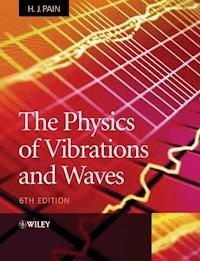
The main theme of this highly successful book is that the transmission of energy by wave propogation is fundamental to almost every branch of physics. Therefore, besides giving students a thorough grounding in the theory of waves and vibrations, the book also demonstrates the pattern and unity of a large part of physics.
This new edition has been thoroughly revised and has been redeisgned to meet the best contemporary standards. It includes new material on electron waves in solids using the Kronig-Penney model to show how their allowed energies are limited to Brillouin zones, The role of phonons is also discussed. An Optical Transform is used to demonstrate the modern method of lens testing. In the last two chapters the sections on chaos and solitons have been reduced but their essential contents remain.
As with earlier editions, the book has a large number of problems together with hints on how to solve them. The Physics of Vibrations and Waves, 6th Edition will prove invaluable for students taking a first full course in the subject across a variety of disciplines particularly physics, engineering and mathematics.
Sie lesen das E-Book in den Legimi-Apps auf:
Seitenzahl: 708
Veröffentlichungsjahr: 2013
Ähnliche


















Contents
Introduction to First Edition
Introduction to Second Edition
Introduction to Third Edition
Introduction to Fourth Edition
Introduction to Fifth Edition
Introduction to Sixth Edition
1 Simple Harmonic Motion
Displacement in Simple Harmonic Motion
Velocity and Acceleration in Simple Harmonic Motion
Energy of a Simple Harmonic Oscillator
Simple Harmonic Oscillations in an Electrical System
Superposition of Two Simple Harmonic Vibrations in One Dimension
Superposition of Two Perpendicular Simple Harmonic Vibrations
* Polarization
Superposition of a Large Number n of Simple Harmonic Vibrations of Equal Amplitude a and Equal Successive Phase Difference δ
* Superposition of n Equal SHM Vectors of Length a with Random Phase
Some Useful Mathematics
2 Damped Simple Harmonic Motion
Methods of Describing the Damping of an Oscillator
3 The Forced Oscillator
The Operation of i upon a Vector
Vector form of Ohm’s Law
The Impedance of a Mechanical Circuit
Behaviour of a Forced Oscillator
Behaviour of Velocity v in Magnitude and Phase versus Driving Force Frequency ω
Behaviour of Displacement versus Driving Force Frequency ω
Problem on Vibration Insulation
Significance of the Two Components of the Displacement Curve
Power Supplied to Oscillator by the Driving Force
Variation of Pav with ω. Absorption Resonance Curve
The Q-Value in Terms of the Resonance Absorption Bandwidth
The Q-Value as an Amplification Factor
The Effect of the Transient Term
4 Coupled Oscillations
Stiffness (or Capacitance) Coupled Oscillators
Normal Coordinates, Degrees of Freedom and Normal Modes of Vibration
The General Method for Finding Normal Mode Frequencies, Matrices, Eigenvectors and Eigenvalues
Mass or Inductance Coupling
Coupled Oscillations of a Loaded String
The Wave Equation
5 Transverse Wave Motion
Partial Differentiation
Waves
Velocities in Wave Motion
The Wave Equation
Solution of the Wave Equation
Characteristic Impedance of a String (the string as a forced oscillator)
Reflection and Transmission of Waves on a String at a Boundary
Reflection and Transmission of Energy
The Reflected and Transmitted Intensity Coefficients
The Matching of Impedances
Standing Waves on a String of Fixed Length
Energy of a Vibrating String
Energy in Each Normal Mode of a Vibrating String
Standing Wave Ratio
Wave Groups and Group Velocity
Wave Group of Many Components. The Bandwidth Theorem
Transverse Waves in a Periodic Structure
Linear Array of Two Kinds of Atoms in an Ionic Crystal
Absorption of Infrared Radiation by Ionic Crystals
Doppler Effect
6 Longitudinal Waves
Sound Waves in Gases
Energy Distribution in Sound Waves
Intensity of Sound Waves
Longitudinal Waves in a Solid
Application to Earthquakes
Longitudinal Waves in a Periodic Structure
Reflection and Transmission of Sound Waves at Boundaries
Reflection and Transmission of Sound Intensity
7 Waves on Transmission Lines
Ideal or Lossless Transmission Line
Coaxial Cables
Characteristic Impedance of a Transmission Line
Reflections from the End of a Transmission Line
The Transmission Line as a Filter
Effect of Resistance in a Transmission Line
Characteristic Impedance of a Transmission Line with Resistance
The Diffusion Equation and Energy Absorption in Waves
Wave Equation with Diffusion Effects
Appendix
8 Electromagnetic Waves
Maxwell’s Equations
The Wave Equation for Electromagnetic Waves
Illustration of Poynting Vector
Impedance of a Dielectric to Electromagnetic Waves
Electromagnetic Waves in a Medium of Properties μ, ε and σ (where σ ≠ 0)
Skin Depth
Electromagnetic Wave Velocity in a Conductor and Anomalous Dispersion
When is a Medium a Conductor or a Dielectric?
Why will an Electromagnetic Wave not Propagate into a Conductor?
Impedance of a Conducting Medium to Electromagnetic Waves
Reflection and Transmission of Electromagnetic Waves at a Boundary
Reflection from a Conductor (Normal Incidence)
Electromagnetic Waves in a Plasma
Electromagnetic Waves in the Ionosphere
9 Waves in More than One Dimension
Plane Wave Representation in Two and Three Dimensions
Wave Equation in Two Dimensions
Wave Guides
Normal Modes and the Method of Separation of Variables
Two-Dimensional Case
Three-Dimensional Case
Normal Modes in Two Dimensions on a Rectangular Membrane
Normal Modes in Three Dimensions
Frequency Distribution of Energy Radiated from a Hot Body. Planck’s Law
Debye Theory of Specific Heats
Reflection and Transmission of a Three-Dimensional Wave at a Plane Boundary
Total Internal Reflection and Evanescent Waves
10 Fourier Methods
Fourier Series
Application of Fourier Sine Series to a Triangular Function
Application to the Energy in the Normal Modes of a Vibrating String
Fourier Series Analysis of a Rectangular Velocity Pulse on a String
The Spectrum of a Fourier Series
Fourier Integral
Fourier Transforms
Examples of Fourier Transforms
The Slit Function
The Fourier Transform Applied to Optical Diffraction from a Single Slit
The Gaussian Curve
The Dirac Delta Function, its Sifting Property and its Fourier Transform
Convolution
The Convolution Theorem
11 Waves in Optical Systems
Light. Waves or Rays?
Fermat’s Principle
The Laws of Reflection
The Law of Refraction
Rays and Wavefronts
Ray Optics and Optical Systems
Power of a Spherical Surface
Magnification by the Spherical Surface
Power of Two Optically Refracting Surfaces
Power of a Thin Lens in Air (Figure 11.12)
Principal Planes and Newton’s Equation
Optical Helmholtz Equation for a Conjugate Plane at Infinity
The Deviation Method for (a) Two Lenses and (b) a Thick Lens
The Matrix Method
12 Interference and Diffraction
Interference
Division of Amplitude
Newton’s Rings
Michelson’s Spectral Interferometer
The Structure of Spectral Lines
Fabry – Perot Interferometer
Resolving Power of the Fabry – Perot Interferometer
Division of Wavefront
Interference from Two Equal Sources of Separation f
Interference from Linear Array of N Equal Sources
Diffraction
Scale of the Intensity Distribution
Intensity Distribution for Interference with Diffraction from N Identical Slits
Transmission Diffraction Grating (N Large)
Resolving Power of Diffraction Grating
Resolving Power in Terms of the Bandwidth Theorem
Fraunhofer Diffraction from a Rectangular Aperture
Fraunhofer Diffraction from a Circular Aperture
Fraunhofer Far Field Diffraction
The Michelson Stellar Interferometer
The Convolution Array Theorem
The Optical Transfer Function
Fresnel Diffraction
Holography
13 Wave Mechanics
Origins of Modern Quantum Theory
Heisenberg’s Uncertainty Principle
Schrödinger’s Wave Equation
One-dimensional Infinite Potential Well
Significance of the Amplitude ψn(x) of the Wave Function
Particle in a Three-dimensional Box
Number of Energy States in Interval E to E + dE
The Potential Step
The Square Potential Well
The Harmonic Oscillator
Electron Waves in a Solid
Phonons
14 Non-linear Oscillations and Chaos
Free Vibrations of an Anharmonic Oscillator – Large Amplitude Motion of a Simple Pendulum
Forced Oscillations – Non-linear Restoring Force
Thermal Expansion of a Crystal
Non-linear Effects in Electrical Devices
Electrical Relaxation Oscillators
Chaos in Population Biology
Chaos in a Non-linear Electrical Oscillator
Phase Space
Repellor and Limit Cycle
The Torus in Three-dimensional (, x, t) Phase Space
Chaotic Response of a Forced Non-linear Mechanical Oscillator
A Brief Review
Chaos in Fluids
Recommended Further Reading
References
15 Non-linear Waves, Shocks and Solitons
Non-linear Effects in Acoustic Waves
Shock Front Thickness
Equations of Conservation
Mach Number
Ratios of Gas Properties Across a Shock Front
Strong Shocks
Solitons
Bibliography
References
Appendix 1: Normal Modes, Phase Space and Statistical Physics
Mathematical Derivation of the Statistical Distributions
Appendix 2: Kirchhoff’s Integral Theorem
Appendix 3: Non-Linear Schrödinger Equation
Index
Copyright © 2005 John Wiley & Sons Ltd, The Atrium, Southern Gate, Chichester, West Sussex PO19 8SQ, England
Telephone (+44) 1243 779777
Email (for orders and customer service enquiries): [email protected]
Visit our Home Page on www.wileyeurope.com or www.wiley.com
All Rights Reserved. No part of this publication may be reproduced, stored in a retrieval system or transmitted in any form or by any means, electronic, mechanical, photocopying, recording, scanning or otherwise, except under the terms of the Copyright, Designs and Patents Act 1988 or under the terms of a licence issued by the Copyright Licensing Agency Ltd, 90 Tottenham Court Road, London W1T 4LP, UK, without the permission in writing of the Publisher. Requests to the Publisher should be addressed to the Permissions Department, John Wiley & Sons Ltd, The Atrium, Southern Gate, Chichester, West Sussex PO19 8SQ, England, or emailed to [email protected], or faxed to (+44) 1243 770620.
This publication is designed to provide accurate and authoritative information in regard to the subject matter covered. It is sold on the understanding that the Publisher is not engaged in rendering professional services. If professional advice or other expert assistance is required, the services of a competent professional should be sought.
Other Wiley Editorial Offices
John Wiley & Sons Inc., 111 River Street, Hoboken, NJ 07030, USA
Jossey-Bass, 989 Market Street, San Francisco, CA 94103-1741, USA
Wiley-VCH Verlag GmbH, Boschstr. 12, D-69469 Weinheim, Germany
John Wiley & Sons Australia Ltd, 33 Park Road, Milton, Queensland 4064, Australia
John Wiley & Sons (Asia) Pte Ltd, 2 Clementi Loop #02-01, Jin Xing Distripark, Singapore 129809
John Wiley & Sons Canada Ltd, 22 Worcester Road, Etobicoke, Ontario, Canada M9W 1L1
Wiley also publishes its books in a variety of electronic formats. Some content that appears in print may not be available in electronic books.
Library of Congress Cataloging-in-Publication Data
(to follow)
British Library Cataloguing in Publication Data
A catalogue record for this book is available from the British Library
ISBN 0 470 01295 1 hardback
ISBN 0 470 01296 X paperback
Introduction to First Edition
The opening session of the physics degree course at Imperial College includes an introduction to vibrations and waves where the stress is laid on the underlying unity of concepts which are studied separately and in more detail at later stages. The origin of this short textbook lies in that lecture course which the author has given for a number of years. Sections on Fourier transforms and non-linear oscillations have been added to extend the range of interest and application.
At the beginning no more than school-leaving mathematics is assumed and more advanced techniques are outlined as they arise. This involves explaining the use of exponential series, the notation of complex numbers and partial differentiation and putting trial solutions into differential equations. Only plane waves are considered and, with two exceptions, Cartesian coordinates are used throughout. Vector methods are avoided except for the scalar product and, on one occasion, the vector product.
Opinion canvassed amongst many undergraduates has argued for a ‘working’ as much as for a ‘reading’ book; the result is a concise text amplified by many problems over a wide range of content and sophistication. Hints for solution are freely given on the principle that an undergraduates gains more from being guided to a result of physical significance than from carrying out a limited arithmetical exercise.
The main theme of the book is that a medium through which energy is transmitted via wave propagation behaves essentially as a continuum of coupled oscillators. A simple oscillator is characterized by three parameters, two of which are capable of storing and exchanging energy, whilst the third is energy dissipating. This is equally true of any medium.
The product of the energy storing parameters determines the velocity of wave propagation through the medium and, in the absence of the third parameter, their ratio governs the impedance which the medium presents to the waves. The energy dissipating parameter introduces a loss term into the impedance; energy is absorbed from the wave system and it attenuates.
This viewpoint allows a discussion of simple harmonic, damped, forced and coupled oscillators which leads naturally to the behaviour of transverse waves on a string, longitudinal waves in a gas and a solid, voltage and current waves on a transmission line and electromagnetic waves in a dielectric and a conductor. All are amenable to this common treatment, and it is the wide validity of relatively few physical principles which this book seeks to demonstrate.
H. J. PAINMay 1968
Introduction to Second Edition
The main theme of the book remains unchanged but an extra chapter on Wave Mechanics illustrates the application of classical principles to modern physics.
Any revision has been towards a simpler approach especially in the early chapters and additional problems. Reference to a problem in the course of a chapter indicates its relevance to the preceding text. Each chapter ends with a summary of its important results.
Constructive criticism of the first edition has come from many quarters, not least from successive generations of physics and engineering students who have used the book; a second edition which incorporates so much of this advice is the best acknowledgement of its value.
H. J. PAINJune 1976
Introduction to Third Edition
Since this book was first published the physics of optical systems has been a major area of growth and this development is reflected in the present edition. Chapter 10 has been rewritten to form the basis of an introductory course in optics and there are further applications in Chapters 7 and 8.
The level of this book remains unchanged.
H. J. PAINJanuary 1983
Introduction to Fourth Edition
Interest in non-linear dynamics has grown in recent years through the application of chaos theory to problems in engineering, economics, physiology, ecology, meteorology and astronomy as well as in physics, biology and fluid dynamics. The chapter on non-linear oscillations has been revised to include topics from several of these disciplines at a level appropriate to this book. This has required an introduction to the concept of phase space which combines with that of normal modes from earlier chapters to explain how energy is distributed in statistical physics. The book ends with an appendix on this subject.
H. J. PAINSeptember 1992
Introduction to Fifth Edition
In this edition, three of the longer chapters of earlier versions have been split in two: Simple Harmonic Motion is now the first chapter and Damped Simple Harmonic Motion the second. Chapter 10 on waves in optical systems now becomes Chapters 11 and 12, Waves in Optical Systems, and Interference and Diffraction respectively through a reordering of topics. A final chapter on non-linear waves, shocks and solitons now follows that on non-linear oscillations and chaos.
New material includes matrix applications to coupled oscillations, optical systems and multilayer dielectric films. There are now sections on e.m. waves in the ionosphere and other plasmas, on the laser cavity and on optical wave guides. An extended treatment of solitons includes their role in optical transmission lines, in collisionless shocks in space, in non-periodic lattices and their connection with Schrödinger’s equation.
H. J. PAINMarch 1998
Acknowledgement
The author is most grateful to Professor L. D. Roelofs of the Physics Department, Haverford College, Haverford, PA, USA. After using the last edition he provided an informed, extended and valuable critique that has led to many improvements in the text and questions of this book. Any faults remain the author’s responsibility.
Introduction to Sixth Edition
This edition includes new material on electron waves in solids using the Kronig – Penney model to show how their allowed energies are limited to Brillouin zones. The role of phonons is also discussed. Convolutions are introduced and applied to optical problems via the Array Theorem in Young’s experiment and the Optical Transfer Function. In the last two chapters the sections on Chaos and Solutions have been reduced but their essential contents remain.
I am grateful to my colleague Professor Robin Smith of Imperial College for his advice on the Optical Transfer Function. I would like to thank my wife for typing the manuscript of every edition except the first.
H. J. PAINJanuary 2005, Oxford
Chapter Synopses
Chapter 1 Simple Harmonic Motion
Simple harmonic motion of mechanical and electrical oscillators (1) Vector representation of simple harmonic motion (6) Superpositions of two SHMs by vector addition (12) Superposition of two perpendicular SHMs (15) Polarization, Lissajous figures (17) Superposition of many SHMs (20) Complex number notation and use of exponential series (25) Summary of important results.
Chapter 2 Damped Simple Harmonic Motion
Damped motion of mechanical and electrical oscillators (37) Heavy damping (39) Critical damping (40) Damped simple harmonic oscillations (41) Amplitude decay (43) Logarithmic decrement (44) Relaxation time (46) Energy decay (46) Q-value (46) Rate of energy decay equal to work rate of damping force (48) Summary of important results.
Chapter 3 The Forced Oscillatior
The vector operator i (53) Electrical and mechanical impedance (56) Transient and steady state behaviour of a forced oscillator (58) Variation of displacement and velocity with frequency of driving force (60) Frequency dependence of phase angle between force and (a) displacement, (b) velocity (60) Vibration insulation (64) Power supplied to oscillator (68) Q-value as a measure of power absorption bandwidth (70) Q-value as amplification factor of low frequency response (71) Effect of transient term (74) Summary of important results.
Chapter 4 Coupled Oscillations
Spring coupled pendulums (79) Normal coordinates and normal modes of vibration (81) Matrices and eigenvalues (86) Inductance coupling of electrical oscillators (87) Coupling of many oscillators on a loaded string (90) Wave motion as the limit of coupled oscillations (95) Summary of important results.
Chapter 5 Transverse Wave Motion
Notation of partial differentiation (107) Particle and phase velocities (109) The wave equation (110) Transverse waves on a string (111) The string as a forced oscillator (115) Characteristic impedance of a string (117) Reflection and transmission of transverse waves at a boundary (117) Impedance matching (121) Insertion of quarter wave element (124) Standing waves on a string of fixed length (124) Normal modes and eigenfrequencies (125) Energy in a normal mode of oscillation (127) Wave groups (128) Group velocity (130) Dispersion (131) Wave group of many components (132) Bandwidth Theorem (134) Transverse waves in a periodic structure (crystal) (135) Doppler Effect (141) Summary of important results.
Chapter 6 Longitudinal Waves
Wave equation (151) Sound waves in gases (151) Energy distribution in sound waves (155) Intensity (157) Specific acoustic impedance (158) Longitudinal waves in a solid (159) Young’s Modulus (159) Poisson’s ratio (159) Longitudinal waves in a periodic structure (162) Reflection and transmission of sound waves at a boundary (163) Summary of important results.
Chapter 7 Waves on Transmission Lines
Ideal transmission line (173) Wave equation (174) Velocity of voltage and current waves (174) Characteristic impedance (175) Reflection at end of terminated line (177) Standing waves in short circuited line (178) Transmission line as a filter (179) Propagation constant (181) Real transmission line with energy losses (183) Attenuation coefficient (185) Diffusion equation (187) Diffusion coefficients (190) Attenuation (191) Wave equation plus diffusion effects (190) Summary of important results.
Chapter 8 Electromagnetic Waves
Permeability and permittivity of a medium (199) Maxwell’s equations (202) Displacement current (202) Wave equations for electric and magnetic field vectors in a dielectric (204) Poynting vector (206) Impedance of a dielectric to e.m. waves (207) Energy density of e.m. waves (208) Electromagnetic waves in a conductor (208) Effect of conductivity adds diffusion equation to wave equation (209) Propagation and attenuation of e.m. waves in a conductor (210) Skin depth (211) Ratio of displacement current to conduction current as a criterion for dielectric or conducting behaviour (213) Relaxation time of a conductor (214) Impedance of a conductor to e.m. waves (215) Reflection and transmission of e.m. waves at a boundary (217) Normal incidence (217) Oblique incidence and Fresnel’s equations (218) Reflection from a conductor (222) Connection between impedance and refractive index (219) E.m. waves in plasmas and the ionosphere (223) Summary of important results.
Chapter 9 Waves in More than One Dimension
Plane wave representation in 2 and 3 dimensions (239) Wave equation in 2-dimensions (240) Wave guide (242) Reflection of a 2-dimensional wave at rigid boundaries (242) Normal modes and method of separation of variables for 1, 2 and 3 dimensions (245) Normal modes in 2 dimensions on a rectangular membrane (247) Degeneracy (250) Normal modes in 3 dimensions (250) Number of normal modes per unit frequency interval per unit volume (251) Application to Planck’s Radiation Law and Debye’s Theory of Specific Heats (251) Reflection and transmission of an e.m. wave in 3 dimensions (254) Snell’s Law (256) Total internal reflexion and evanescent waves (256) Summary of important results.
Chapter 10 Fourier Methods
Fourier series for a periodic function (267) Fourier series for any interval (271) Application to a plucked string (275) Energy in normal modes (275) Application to rectangular velocity pulse on a string (278) Bandwidth Theorem (281) Fourier integral of a single pulse (283) Fourier Transforms (285) Application to optical diffraction (287) Dirac function (292) Convolution (292) Convolution Theorem (297) Summary of important results.
Chapter 11 Waves in Optical Systems
Fermat’s Principle (307) Laws of reflection and refraction (307) Wavefront propagation through a thin lens and a prism (310) Optical systems (313) Power of an optical surface (314) Magnification (316) Power of a thin lens (318) Principal planes of an optical system (320) Newton’s equation (320) Optical Helmholtz equation (321) Deviation through a lens system (322) Location of principal planes (322) Matrix application to lens systems (325) Summary of important results.
Chapter 12 Interference and Diffraction
Interference (333) Division of amplitude (334) Fringes of constant inclination and thickness (335) Newton’s Rings (337) Michelson’s spectral interferometer (338) Fabry–Perot interferometer (341) Finesse (345) Resolving power (343) Free spectral range (345) Central spot scanning (346) Laser cavity (347) Multilayer dielectric films (350) Optical fibre wave guide (353) Division of wavefront (355) Two equal sources (355) Spatial coherence (360) Dipole radiation (362) Linear array of N equal sources (363) Fraunhofer diffraction (367) Slit (368) N slits (370) Missing orders (373) Transmission diffraction grating (373) Resolving power (374) Bandwidth theorem (376) Rectangular aperture (377) Circular aperture (379) Fraunhofer far field diffraction (383) Airy disc (385) Michelson Stellar Interferometer (386) Convolution Array Theorem (388) Optical Transfer Function (391) Fresnel diffraction (395) Straight edge (397) Cornu spiral (396) Slit (400) Circular aperture (401) Zone plate (402) Holography (403) Summary of important results.
Chapter 13 Wave Mechanics
Historical review (411) De Broglie matter waves and wavelength (412) Heisenberg’s Uncertainty Principle (414) Schrödinger’s time independent wave equation (417) The wave function (418) Infinite potential well in 1 dimension (419) Quantization of energy (421) Zero point energy (422) Probability density (423) Normalization (423) Infinite potential well in 3 dimensions (424) Density of energy states (425) Fermi energy level (426) The potential step (426) The finite square potential well (434) The harmonic oscillator (438) Electron waves in solids (441) Bloch functions (441) Kronig–Penney Model (441) Brillouin zones (445) Energy band (446) Band structure (448) Phonons (450) Summary of important results.
Chapter 14 Non-linear Oscillations and Chaos
Anharmonic oscillations (459) Free vibrations of finite amplitude pendulum (459) Non-linear restoring force (460) Forced vibrations (460) Thermal expansion of a crystal (463) Electrical ‘relaxation’ oscillator (467) Chaos and period doubling in an electrical ‘relaxation’ oscillator (467) Chaos in population biology (469) Chaos in a non-linear electrical oscillator (477) Phase space (481) Chaos in a forced non-linear mechanical oscillator (487) Fractals (490) Koch Snowflake (490) Cantor Set (491) Smale Horseshoe (493) Chaos in fluids (494) Couette flow (495) Rayleigh–Benard convection (497) Lorenz chaotic attractor. (500) List of references
Chapter 15 Non-linear waves, Shocks and Solitons
Non-linear acoustic effects (505) Shock wave in a gas (506) Mach cone (507) Solitons (513) The KdV equation (515) Solitons and Schrödinger’s equation (520) Instantons (521) Optical solitons (521) Bibliography and references.
Appendix 1 Normal Modes, Phase Space and Statistical Physics
Number of phase space ‘cells’ per unit volume (533) Macrostate (535) Microstate (535) Relative probability of energy level population for statistical distributions (a) Maxwell–Boltzmann, (b) Fermi–Dirac, (c) Bose–Einstein (536) Mathematical derivation of the statistical distributions (542).
Appendix 2 Kirchhoff’s Integral Theorem
Appendix 3 Non-linear Schrödinger Equation
Index
1
Simple Harmonic Motion
At first sight the eight physical systems in Figure 1.1 appear to have little in common.
1.1(a)
is a simple pendulum, a mass
m
swinging at the end of a light rigid rod of length
l
.
1.1(b)
is a flat disc supported by a rigid wire through its centre and oscillating through small angles in the plane of its circumference.
1.1(c)
is a mass fixed to a wall via a spring of stiffness
s
sliding to and fro in the
x
direction on a frictionless plane.
1.1(d)
is a mass
m
at the centre of a light string of length 2
l
fixed at both ends under a constant tension
T
. The mass vibrates in the plane of the paper.
1.1(e)
is a frictionless U-tube of constant cross-sectional area containing a length
l
of liquid, density
ρ
, oscillating about its equilibrium position of equal levels in each limb.
1.1(f)
is an open flask of volume
V
and a neck of length
l
and constant cross-sectional area
A
in which the air of density
ρ
vibrates as sound passes across the neck.
1.1(g)
is a hydrometer, a body of mass
m
floating in a liquid of density
ρ
with a neck of constant cross-sectional area cutting the liquid surface. When depressed slightly from its equilibrium position it performs small vertical oscillations.
1.1(h)
is an electrical circuit, an inductance
L
connected across a capacitance
C
carrying a charge
q
.
All of these systems are simple harmonic oscillators which, when slightly disturbed from their equilibrium or rest postion, will oscillate with simple harmonic motion. This is the most fundamental vibration of a single particle or one-dimensional system. A small displacement x from its equilibrium position sets up a restoring force which is proportional to x acting in a direction towards the equilibrium position.
Thus, this restoring force F may be written
where s, the constant of proportionality, is called the stiffness and the negative sign shows that the force is acting against the direction of increasing displacement and back towards the equilibrium position. A constant value of the stiffness restricts the displacement x to small values (this is Hooke’s Law of Elasticity). The stiffness s is obviously the restoring force per unit distance (or displacement) and has the dimensions
The equation of motion of such a disturbed system is given by the dynamic balance between the forces acting on the system, which by Newton’s Law is
or
where the acceleration
This gives
or
where the dimensions of
Here T is a time, or period of oscillation, the reciprocal of v which is the frequency with which the system oscillates.
Figure 1.1 Simple harmonic oscillators with their equations of motion and angular frequencies ω of oscillation. (a) A simple pendulum. (b) A torsional pendulum. (c) A mass on a frictionless plane connected by a spring to a wall. (d) A mass at the centre of a string under constant tension T. (e) A fixed length of non-viscous liquid in a U-tube of constant cross-section. (f) An acoustic Helmholtz resonator. (g) A hydrometer mass m in a liquid of density ρ. (h) An electrical L C resonant circuit
where s/m is now written as ω2. Thus the equation of simple harmonic motion
becomes
(1.1)
(Problem 1.1)
Displacement in Simple Harmonic Motion
The behaviour of a simple harmonic oscillator is expressed in terms of its displacement x from equilibrium, its velocity , and its acceleration at any given time. If we try the solution
where A is a constant with the same dimensions as x, we shall find that it satisfies the equation of motion
for
and
Another solution
Lesen Sie weiter in der vollständigen Ausgabe!
Lesen Sie weiter in der vollständigen Ausgabe!
Lesen Sie weiter in der vollständigen Ausgabe!
Lesen Sie weiter in der vollständigen Ausgabe!
Lesen Sie weiter in der vollständigen Ausgabe!
Lesen Sie weiter in der vollständigen Ausgabe!
Lesen Sie weiter in der vollständigen Ausgabe!
Lesen Sie weiter in der vollständigen Ausgabe!
Lesen Sie weiter in der vollständigen Ausgabe!
Lesen Sie weiter in der vollständigen Ausgabe!
Lesen Sie weiter in der vollständigen Ausgabe!
Lesen Sie weiter in der vollständigen Ausgabe!
Lesen Sie weiter in der vollständigen Ausgabe!
Lesen Sie weiter in der vollständigen Ausgabe!
Lesen Sie weiter in der vollständigen Ausgabe!
Lesen Sie weiter in der vollständigen Ausgabe!
Lesen Sie weiter in der vollständigen Ausgabe!
Lesen Sie weiter in der vollständigen Ausgabe!




