


2,99 €
2,99 €
-100%
Sammeln Sie Punkte in unserem Gutscheinprogramm und kaufen Sie E-Books und Hörbücher mit bis zu 100% Rabatt.
Mehr erfahren.
Mehr erfahren.
- Herausgeber: Books on Demand
- Kategorie: Gesellschafts- und Liebesromane
- Sprache: Englisch
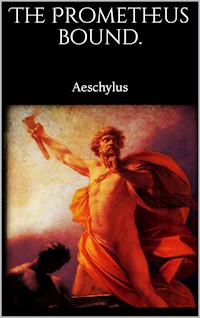
Lo, the earth's bound and limitary land, The Scythian steppe, the waste untrod of men! Look to it now, Hephaestus-thine it is, Thy Sire obeying, this arch-thief to clench Against the steep-down precipice of rock, With stubborn links of adamantine chain. Look thou: thy flower, the gleaming plastic fire, He stole and lent to mortal man-a sin That gods immortal make him rue today, Lessoned hereby to own th' omnipotence Of Zeus, and to repent his love to man!
Das E-Book können Sie in Legimi-Apps oder einer beliebigen App lesen, die das folgende Format unterstützen:
Seitenzahl: 201
Veröffentlichungsjahr: 2019
0,0
Bewertungen werden von Nutzern von Legimi sowie anderen Partner-Webseiten vergeben.
Legimi prüft nicht, ob Rezensionen von Nutzern stammen, die den betreffenden Titel tatsächlich gekauft oder gelesen/gehört haben. Wir entfernen aber gefälschte Rezensionen.
Ähnliche


















The Prometheus Bound
The Prometheus BoundINTRODUCTIONTHE SUPPLIANT MAIDENSTHE PERSIANSTHE SEVEN AGAINST THEBESPROMETHEUS BOUNDCopyrightThe Prometheus Bound
Aeschylus
INTRODUCTION
The surviving dramas of Aeschylus are seven in number, though
he is believed to have written nearly a hundred during his life of
sixty-nine years, from 525 B.C. to 456 B.C. That he fought at
Marathon in 490, and at Salamis in 480 B.C. is a strongly
accredited tradition, rendered almost certain by the vivid
references to both battles in his play of The Persians, which was
produced in 472. But his earliest extant play was, probably, not
The Persians but The Suppliant Maidens—a mythical drama, the fame
of which has been largely eclipsed by the historic interest of The
Persians, and is undoubtedly the least known and least regarded of
the seven. Its topic—the flight of the daughters of Danaus from
Egypt to Argos, in order to escape from a forced bridal with their
first-cousins, the sons of Aegyptus—is legendary, and the lyric
element predominates in the play as a whole. We must keep ourselves
reminded that the ancient Athenian custom of presenting dramas in
Trilogies —that is, in three consecutive plays dealing with
different stages of one legend—was probably not uniform: it
survives, for us, in one instance only, viz. the Orestean Trilogy,
comprising the Agamemnon, the Libation-Bearers, and the Eumenides,
or Furies. This Trilogy is the masterpiece of the Aeschylean Drama:
the four remaining plays of the poet, which are translated in this
volume, are all fragments of lost Trilogies—that is to say, the
plays are complete as poems, but in regard to the poet's larger
design they are fragments; they once had predecessors, or sequels,
of which only a few words, or lines, or short paragraphs, survive.
It is not certain, but seems probable, that the earliest of these
single completed plays is The Suppliant Maidens, and on that
supposition it has been placed first in the present volume. The
maidens, accompanied by their father Danaes, have fled from Egypt
and arrived at Argos, to take sanctuary there and to avoid capture
by their pursuing kinsmen and suitors. In the course of the play,
the pursuers' ship arrives to reclaim the maidens for a forced
wedlock in Egypt. The action of the drama turns on the attitude of
the king and people of Argos, in view of this intended abduction.
The king puts the question to the popular vote, and the demand of
the suitors is unanimously rejected: the play closes with thanks
and gratitude on the part of the fugitives, who, in lyrical strains
of quiet beauty, seem to refer the whole question of their marriage
to the subsequent decision of the gods, and, in particular, of
Aphrodite.
Of the second portion of the Trilogy we can only speak
conjecturally. There is a passage in the Prometheus Bound (ll.
860-69), in which we learn that the maidens were somehow reclaimed
by the suitors, and that all, except one, slew their bridegrooms on
the wedding night. There is a faint trace, among the Fragments of
Aeschylus, of a play called Thalamopoioi,—i.e. The Preparers of the
Chamber,—which may well have referred to this tragic scene. Its
grim title will recall to all classical readers the magnificent,
though terrible, version of the legend, in the final stanzas of the
eleventh poem in the third book of Horace's Odes. The final play
was probably called The Danaides, and described the acquittal of
the brides through some intervention of Aphrodite: a fragment of it
survives, in which the goddess appears to be pleading her special
prerogative. The legends which commit the daughters of Danaus to an
eternal penalty in Hades are, apparently, of later origin. Homer is
silent on any such penalty; and Pindar, Aeschylus' contemporary,
actually describes the once suppliant maidens as honourably
enthroned (Pyth. ix. 112: Nem. x. ll. 1-10). The Tartarean part of
the story is, in fact, post-Aeschylean.
The Suppliant Maidens is full of charm, though the text of the part
which describes the arrival of the pursuers at Argos is full of
uncertainties. It remains a fine, though archaic, poem, with this
special claim on our interest, that it is, probably, the earliest
extant poetic drama. We see in it the tendency to grandiose
language, not yet fully developed as in the Prometheus: the
inclination of youth to simplicity, and even platitude, in
religious and general speculation: and yet we recognize, as in the
germ, the profound theology of the Agamemnon, and a touch of the
political vein which appears more fully in the Furies. If the
precedence in time here ascribed to it is correct, the play is
perhaps worth more recognition than it has received from the
countrymen of Shakespeare.
The Persians has been placed second in this volume, as the oldest
play whose date is certainly known. It was brought out in 472 B.C.,
eight years after the sea-fight of Salamis which it commemorates,
and five years before the Seven against Thebes (467 B.C.). It is
thought to be the second play of a Trilogy, standing between the
Phineus and the Glaucus. Phineus was a legendary seer, of the
Argonautic era—"Tiresias and Phineus, prophets old"—and the play
named after him may have contained a prophecy of the great conflict
which is actually described in The Persae: the plot of the Glaucus
is unknown. In any case, The Persians was produced before the eyes
of a generation which had seen the struggles, West against East, at
Marathon and Thermopylæ, Salamis and Plataea. It is as though
Shakespeare had commemorated, through the lips of a Spanish
survivor, in the ears of old councillors of Philip the Second, the
dispersal of the Armada.
Against the piteous want of manliness on the part of the returning
Xerxes, we may well set the grave and dignified patriotism of
Atossa, the Queen-mother of the Persian kingdom; the loyalty, in
spite of their bewilderment, of the aged men who form the Chorus;
and, above all, the royal phantom of Darius, evoked from the
shadowland by the libations of Atossa and by the appealing cries of
the Chorus. The latter, indeed, hardly dare to address the kingly
ghost: but Atossa bravely narrates to him the catastrophe, of
which, in the lower world, Darius has known nothing, though he
realizes that disaster, soon or late, is the lot of mortal power.
As the tale is unrolled, a spirit of prophecy possesses him, and he
foretells the coming slaughter of Plataea; then, with a last royal
admonition that the defeated Xerxes shall, on his return, be
received with all ceremony and observance, and with a
characteristic warning to the aged men, that they must take such
pleasures as they may, in their waning years, he returns to the
shades. The play ends with the undignified reappearance of Xerxes,
and a melancholy procession into the palace of Susa. It was,
perhaps, inevitable that this close of the great drama should verge
on the farcical, and that the poltroonery of Xerxes should, in a
measure, obscure Aeschylus' generous portraiture of Atossa and
Darius. But his magnificent picture of the battle of Salamis is
unequalled in the poetic annals of naval war. No account of the
flight of the Armada, no record of Lepanto or Trafalgar, can be
justly set beside it. The Messenger might well, like Prospero,
announce a tragedy by one line—
Sit still, and hear the last of our sea-sorrow.
Five years after The Persians, in 467 B. C., the play which we call
the Seven against Thebes was presented at Athens. It bears now a
title which Aeschylus can hardly have given to it for, though the
scene of the drama overlooks the region where the city of Thebes
afterwards came into being, yet, in the play itself, Thebes is
never mentioned. The scene of action is the Cadmea, or Citadel of
Cadmus, and we know that, in Aeschylus' lifetime, that citadel was
no longer a mere fastness, but had so grown outwards and enlarged
itself that a new name, Thebes, was applied to the collective city.
(All this has been made abundantly clear by Dr. Verrall in his
Introduction to the Seven against Thebes, to which every reader of
the play itself will naturally and most profitably refer.) In the
time of Aeschylus, Thebes was, of course, a notable city, his great
contemporary Pindar was a citizen of it. But the Thebes of
Aeschylus' date is one thing, the fortress represented in
Aeschylus' play is quite another, and is never, by him, called
Thebes. That the play received, and retains, the name, The Seven
against Thebes, is believed to be due to two lines of Aristophanes
in his Frogs (406 B.C.), where he describes Aeschylus' play as "the
Seven against Thebes, a drama instinct with War, which any one who
beheld must have yearned to be a warrior." This is rather an
excellent description of the play than the title of it, and could
not be its Aeschylean name, for the very sufficient reason that
Thebes is not mentioned in the play at all. Aeschylus, in fact, was
poetizing an earlier legend of the fortress of Cadmus. This being
premised, we may adopt, under protest as it were, the Aristophanic
name which has accrued to the play. It is the third part of a
Trilogy which might have been called, collectively, The House of
Laius. Sophocles and Euripides give us their versions of the
legend, which we may epitomize, without, however, affirming that
they followed exactly the lines of Aeschylus Trilogy—they, for
instance, speak freely of Thebes. Laius, King of Thebes, married
Iokaste; he was warned by Apollo that if he had any children ruin
would befall his house. But a child was born, and, to avoid the
threatened catastrophe, without actually killing the child he
exposed it on Mount Cithaeron, that it should die. Some herdsmen
saved it and gave it over to the care of a neighbouring king and
queen, who reared it. Later on, learning that there was a doubt of
his parentage, this child, grown now to maturity, left his foster
parents and went to Delphi to consult the oracle, and received a
mysterious and terrible warning, that he was fated to slay his
father and wed his mother. To avoid this horror, he resolved never
to approach the home of his supposed parents. Meantime his real
father, Laius, on his way to consult the god at Delphi, met his
unknown son returning from that shrine—a quarrel fell out, and the
younger man slew the elder. Followed by his evil destiny, he
wandered on, and found the now kingless Thebes in the grasp of the
Sphinx monster, over whom he triumphed, and was rewarded by the
hand of Iokaste, his own mother! Not till four children—two sons
and two daughters—had been born to them, was the secret of the
lineage revealed. Iokaste slew herself in horror, and the wretched
king tore out his eyes, that he might never again see the children
of his awful union. The two sons quarrelled over the succession,
then agreed on a compromise; then fell at variance again, and
finally slew each other in single combat. These two sons, according
to one tradition, were twins: but the more usual view is that the
elder was called Eteocles, the younger, Polynices.
To the point at which the internecine enmity between Eteocles and
Polynices arose, we have had to follow Sophocles and Euripides, the
first two parts of Aeschylus' Trilogy being lost. But the third
part, as we have said, survives under the name given to it by
Aristophanes, the Seven against Thebes: it opens with an
exhortation by Eteocles to his Cadmeans that they should "quit them
like men" against the onslaught of Polynices and his Argive allies:
the Chorus is a bevy of scared Cadmean maidens, to whom the very
sound of war and tramp of horsemen are new and terrific. It ends
with the news of the death of the two princes, and the lamentations
of their two sisters, Antigone and Ismene. The onslaught from
without has been repulsed, but the male line of the house of Laius
is extinct. The Cadmeans resolve that Eteocles shall be buried in
honour, and Polynices flung to the dogs and birds. Against the
latter sentence Antigone protests, and defies the decree: the
Chorus, as is natural, are divided in their sentiments.
It is interesting to note that, in combination with the Laius and
the Oedipus, this play won the dramatic crown in 467 B.C. On the
other hand, so excellent a judge as Mr. Gilbert Murray thinks that
it is "perhaps among Aeschylus' plays the one that bears least the
stamp of commanding genius." Perhaps the daring, practically
atheistic, character of Eteocles; the battle-fever that burns and
thrills through the play; the pathetic terror of the Chorus—may
have given it favour, in Athenian eyes, as the work of a poet
who—though recently (468 B.C.) defeated in the dramatic contest by
the young Sophocles—was yet present to tell, not by mere report,
the tale of Marathon and Salamis. Or the preceding plays, the Laius
and the Oedipus, may have been of such high merit as to make up for
defects observable in the one that still survives. In any case, we
can hardly err in accepting Dr. Verral's judgment that "the story
of Aeschylus may be, and in the outlines probably is, the genuine
epic legend of the Cadmean war."
There remains one Aeschylean play, the most famous—unless we except
the Agamemnon—in extant Greek literature, the Prometheus Bound.
That it was the first of a Trilogy, and that the second and third
parts were called the Prometheus Freed, and Prometheus the
Fire-Bearer, respectively, is accepted: but the date of its
performance is unknown.
The Prometheus Bound is conspicuous for its gigantic and strictly
superhuman plot. The Agamemnon is human, though legendary the
Prometheus presents to us the gods of Olympus in the days when
mankind crept like emmets upon the earth or dwelt in caves, scorned
by Zeus and the other powers of heaven, and—still aided by
Prometheus the Titan—wholly without art or science, letters or
handicrafts. For his benevolence towards oppressed mankind,
Prometheus is condemned by Zeus to uncounted ages of pain and
torment, shackled and impaled in a lonely cleft of a Scythian
precipice. The play opens with this act of divine resentment
enforced by the will of Zeus and by the handicraft of Hephaestus,
who is aided by two demons, impersonating Strength and Violence.
These agents if the ire of Zeus disappear after the first scene,
the rest of the play represents Prometheus in the mighty solitude,
but visited after a while by a Chorus of sea nymphs who, from the
distant depths of ocean, have heard the clang of the demons'
hammers, and arrive, in a winged car, from the submarine palace of
their father Oceanus. To them Prometheus relates his penalty and
its cause: viz., his over tenderness to the luckless race of
mankind. Oceanus himself follows on a hippogriff, and counsels
Prometheus to submit to Zeus. But the Titan who has handled the sea
nymphs with all gentleness, receives the advice with scorn and
contempt, and Oceanus retires. But the courage which he lacks his
daughters possess to the full; they remain by Prometheus to the
end, and share his fate, literally in the crack of doom. But before
the end, the strange half human figure of Io, victim of the lust of
Zeus and the jealousy of Hera, comes wandering by, and tells
Prometheus of her wrongs. He, by his divine power, recounts to her
not only the past but also the future of her wanderings. Then, in a
fresh access of frenzy, she drifts away into the unknown world.
Then Prometheus partly reveals to the sea maidens his secret, and
the mysterious cause of Zeus' hatred against him—a cause which
would avail to hurl the tyrant from his power. So deadly is this
secret, that Zeus will, in the lapse of ages, be forced to
reconcile himself with Prometheus, to escape dethronement. Finally,
Hermes, the messenger of Zeus, appears with fresh threats, that he
may extort the mystery from the Titan. But Prometheus is firm,
defying both the tyrant and his envoy, though already the lightning
is flashing, the thunder rolling, and sky and sea are mingling
their fury. Hermes can say no more; the sea nymphs resolutely
refuse to retire, and wait their doom. In this crash of the world,
Prometheus flings his final defiance against Zeus, and amid the
lightnings and shattered rocks that are overwhelming him and his
companions, speaks his last word, "It is unjust!"
Any spectacular representation of this finale must, it is clear,
have roused intense sympathy with the Titan and the nymphs alike.
If, however, the sequel-plays had survived to us, we might
conceivably have found and realized another and less intolerable
solution. The name Zeus, in Greek, like that of God, in English,
comprises very diverse views of divine personality. The Zeus in the
Prometheus has little but the name in common with the Zeus in the
first chorus of the Agamemnon, or in The Suppliant Maidens (ll.
86-103): and parallel reflections will give us much food for
thought. But, in any case, let us realize that the Prometheus is
not a human play: with the possible exception of Io, every
character in it is an immortal being. It is not as a vaunt, but as
a fact, that Prometheus declares, as against Zeus (l. 1053), that
"Me at least He shall never give to death."
A stupendous theological drama of which two-thirds has been lost
has left an aching void, which now can never be filled, in our
minds. No reader of poetry needs to be reminded of the glorious
attempt of Shelley to work out a possible and worthy sequel to the
Prometheus. Who will not echo the words of Mr. Gilbert Murray, when
he says that "no piece of lost literature has been more ardently
longed for than the Prometheus Freed"?
But, at the end of a rather prolonged attempt to understand and
translate the surviving tragedies of Aeschylus, one feels inclined
to repeat the words used by a powerful critic about one of the
greatest of modern poets—"For man, it is a weary way to God, but a
wearier far to any demigod." We shall not discover the full sequel
of Aeschylus' mighty dramatic conception: we "know in part, and we
prophesy in part." The Introduction (pp. xvi.-xviii.) prefixed by
Mr. A. O. Prickard to his edition of the Prometheus is full of
persuasive grace, on this topic: to him, and to Dr. Verrall of
Cambridge—lucida sidera of help and encouragement in the study of
Aeschylus—the translator's thanks are due, and are gratefully and
affectionately rendered.
E. D. A. M.
THE SUPPLIANT MAIDENS
DEDICATION
Take thou this gift from out the grave of Time.
The urns of Greece lie shattered, and the cup
That for Athenian lips the Muses filled,
And flowery crowns that on Athenian hair
Hid the cicala, freedom's golden sign,
Dust in the dust have fallen. Calmly sad,
The marble dead upon Athenian tombs
Speak from their eyes "Farewell": and well have fared
They and the saddened friends, whose clasping hands
Win from the solemn stone eternity.
Yea, well they fared unto the evening god,
Passing beyond the limit of the world,
Where face to face the son his mother saw,
A living man a shadow, while she spake
Words that Odysseus and that Homer heard,—
I too, O child, I reached the common doom,
The grave, the goal of fate, and passed away.
—Such, Anticleia, as thy voice to him,
Across the dim gray gulf of death and time
Is that of Greece, a mother's to a child,—
Mother of each whose dreams are grave and fair—
Who sees the Naiad where the streams are bright
And in the sunny ripple of the sea
Cymodoce with floating golden hair:
And in the whisper of the waving oak
Hears still the Dryad's plaint, and, in the wind
That sighs through moonlit woodlands, knows the horn
Of Artemis, and silver shafts and bow.
Therefore if still around this broken vase,
Borne by rough hands, unworthy of their load,
Far from Cephisus and the wandering rills,
There cling a fragrance as of things once sweet,
Of honey from Hymettus' desert hill,
Take thou the gift and hold it close and dear;
For gifts that die have living memories—
Voices of unreturning days, that breathe
The spirit of a day that never dies.
ARGUMENT
Io, the daughter of Inachus, King of Argos, was beloved of Zeus.
But Hera was jealous of that love, and by her ill will was Io given
over to frenzy, and her body took the semblance of a heifer: and
Argus, a many-eyed herdsman, was set by Hera to watch Io
whithersoever she strayed. Yet, in despite of Argus, did Zeus draw
nigh unto her in the shape of a bull. And by the will of Zeus and
the craft of Hermes was Argus slain. Then Io was driven over far
lands and seas by her madness, and came at length to the land of
Egypt. There was she restored to herself by a touch of the hand of
Zeus, and bare a child called Epaphus. And from Epaphus sprang
Libya, and from Libya, Belus; and from Belus, Aegyptus and Danaus.
And the sons of Aegyptus willed to take the daughters of Danaus in
marriage. But the maidens held such wedlock in horror, and fled
with their father over the sea to Argos; and the king and citizens
of Argos gave them shelter and protection from their
pursuers.
THE SUPPLIANT MAIDENS
DRAMATIS PERSONAE
DANAUS, THE KING OF ARGOS, HERALD OF AEGYPTUS.
Chorus of the Daughters of Danaus. Attendants.
Scene. —A sacred precinct near the gates of Argos: statue and
shrines of Zeus and other deities stand around.
CHORUS
ZEUS! Lord and guard of suppliant hands!
Look down benign on us who crave
Thine aid—whom winds and waters drave
From where, through drifting shifting sands,
Pours Nilus to the wave.
From where the green land, god-possest,
Closes and fronts the Syrian waste,
We flee as exiles, yet unbanned
By murder's sentence from our land;
But—since Aegyptus had decreed
His sons should wed his brother's seed,—
Ourselves we tore from bonds abhorred,
From wedlock not of heart but hand,
Nor brooked to call a kinsman lord!
And Danaus, our sire and guide,
The king of counsel, pond'ring well
The dice of fortune as they fell,
Out of two griefs the kindlier chose,
And bade us fly, with him beside,
Heedless what winds or waves arose,
And o'er the wide sea waters haste,
Until to Argos' shore at last
Our wandering pinnace came—
Argos, the immemorial home
Of her from whom we boast to come—
Io, the ox-horned maiden, whom,
After long wandering, woe, and scathe,
Zeus with a touch, a mystic breath,
Made mother of our name.
Therefore, of all the lands of earth,
On this most gladly step we forth,
And in our hands aloft we bear—
Sole weapon for a suppliant's wear—
The olive-shoot, with wool enwound!
City, and land, and waters wan
Of Inachus, and gods most high,
And ye who, deep beneath the ground,
Bring vengeance weird on mortal man,
Powers of the grave, on you we cry!
And unto Zeus the Saviour, guard
Of mortals' holy purity!
Receive ye us—keep watch and ward
Above the suppliant maiden band!
Chaste be the heart of this your land
Towards the weak! but, ere the throng,
The wanton swarm, from Egypt sprung,
Leap forth upon the silted shore,
Thrust back their swift-rowed bark again,
Repel them, urge them to the main!
And there, 'mid storm and lightning's shine,
And scudding drift and thunder's roar,
Deep death be theirs, in stormy brine!
Before they foully grasp and win
Us, maiden-children of their kin,
And climb the couch by law denied,
And wrong each weak reluctant bride.
And now on her I call,
Mine ancestress, who far on Egypt's shore
A young cow's semblance wore,—
A maiden once, by Hera's malice changed!
And then on him withal,
Who, as amid the flowers the grazing creature
ranged,
Was in her by a breath of Zeus conceived;
And, as the hour of birth drew nigh,
By fate fulfilled, unto the light he came;
And Epaphus for name,
Born from the touch of Zeus, the child received.
On him, on him I cry,
And him for patron hold—
While in this grassy vale I stand,
Where lo roamed of old!
And here, recounting all her toil and pain,
Signs will I show to those who rule the land
That I am child of hers; and all shall understand,
Hearing the doubtful tale of the dim past made plain.
And, ere the end shall be,
Each man the truth of what I tell shall see.
And if there dwell hard by
One skilled to read from bird-notes augury,
That man, when through his ears shall thrill our
tearful wail,
Shall deem he hears the voice, the plaintive tale
Of her, the piteous spouse of Tereus, lord of guile—
Whom the hawk harries yet, the mourning nightingale.
She, from her happy home and fair streams scared
away,
Wails wild and sad for haunts beloved erewhile.
Yea, and for Itylus—ah, well-a-day!
Slain by her own, his mother's hand,
Maddened by lustful wrong, the deed by Tereus
planned.
Like her I wail and wail, in soft Ionian tones,
And as she wastes, even so
Wastes my soft cheek, once ripe with Nilus' suns
And all my heart dissolves in utter woe
Sad flowers of grief I cull,
Fleeing from kinsmen's love unmerciful—
Yea, from the clutching hands, the wanton crowd,




