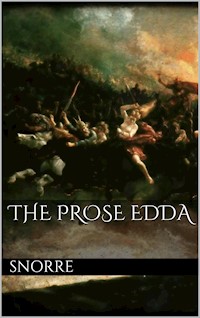
The Prose Edda
The Prose EddaPREFACE.INTRODUCTION.FOREWORD.THE FOOLING OF GYLFE.BRAGE’S TALK.EXTRACTS FROM THE POETICAL DICTION. (SKALDSKAPARMAL.)76FOOTNOTESVOCABULARY.Copyright
The Prose Edda
Snorre
PREFACE.
In the beginning, before the heaven and the earth and the sea were
created, the great abyss Ginungagap was without form and void, and
the spirit of Fimbultyr moved upon the face of the deep, until the
ice-cold rivers, the Elivogs, flowing from Niflheim, came in
contact with the dazzling flames from Muspelheim. This was before
Chaos.
And Fimbultyr said: Let the melted drops of vapor quicken into
life, and the giant Ymer was born in the midst of Ginungagap. He
was not a god, but the father of all the race of evil giants. This
was Chaos.
And Fimbultyr said: Let Ymer be slain and let order be established.
And straightway Odin and his brothers—the bright sons of Bure—gave
Ymer a mortal wound, and from his body made they the universe; from
his flesh, the earth; from his blood, the sea; from his bones, the
rocks; from his hair, the trees; from his skull, the vaulted
heavens; from his eye-brows, the bulwark called Midgard. And the
gods formed man and woman in their own image of two trees, and
breathed into them the breath of life. Ask and Embla became living
souls, and they received a garden in Midgard as a dwelling-place
for themselves and their children until the end of time. This was
Cosmos.
The world’s last day approaches. All bonds and fetters that bound
the forces of heaven and earth together are severed, and the powers
of good and of evil are brought together in an internecine feud.
Loke advances with the Fenris-wolf and the Midgard-serpent, his own
children, with all the hosts of the giants, and with Surt, who
flings fire and flame over the world. Odin advances with all the
asas and all the blessed einherjes. They meet, contend, and fall.
The wolf swallows Odin, but Vidar, the Silent, sets his foot upon
the monster’s lower jaw, he seizes the other with his hand, and
thus rends him till he dies. Frey encounters Surt, and terrible
blows are given ere Frey falls. Heimdal and Loke fight and kill
each other, and so do Tyr and the dog Garm from the Gnipa Cave.
Asa-Thor fells the Midgard-serpent with his Mjolner, but he
retreats only nine paces when he himself falls dead, suffocated by
the serpent’s venom. Then smoke wreathes up around the ash
Ygdrasil, the high flames play against the heavens, the graves of
the gods, of the giants and of men are swallowed up by the sea, and
the end has come. This is Ragnarok, the twilight of the gods.
But the radiant dawn follows the night. The earth, completely
green, rises again from the sea, and where the mews have but just
been rocking on restless waves, rich fields unplowed and unsown,
now wave their golden harvests before the gentle breezes. The asas
awake to a new life, Balder is with them again. Then comes the
mighty Fimbultyr, the god who is from everlasting to everlasting;
the god whom the Edda skald dared not name. The god of gods comes
to the asas. He comes to the great judgment and gathers all the
good into Gimle to dwell there forever, and evermore delights
enjoy; but the perjurers and murderers and adulterers he sends to
Nastrand, that terrible hall, to be torn by Nidhug until they are
purged from their wickedness. This is Regeneration.
These are the outlines of the Teutonic religion. Such were the
doctrines established by Odin among our ancestors. Thus do we find
it recorded in the Eddas of Iceland.
The present volume contains all of the Younger Edda that can
possibly be of any importance to English readers. In fact, it gives
more than has ever before been presented in any translation into
English, German or any of the modern Scandinavian tongues.
We would recommend our readers to omit the Forewords and Afterwords
until they have perused the Fooling of Gylfe and Brage’s Speech.
The Forewords and Afterwords, it will readily be seen, are written
by a later and less skillful hand, and we should be sorry to have
anyone lay the book aside and lose the pleasure of reading Snorre’s
and Olaf’s charming work, because he became disgusted with what
seemed to him mere silly twaddle. And yet these Forewords and
Afterwords become interesting enough when taken up in connection
with a study of the historical anthropomorphized Odin. With a view
of giving a pretty complete outline of the founder of the Teutonic
race we have in our notes given all the Heimskringla sketch of the
Black Sea Odin. We have done this, not only on account of the
material it furnishes as the groundwork of a Teutonic epic, which
we trust the muses will ere long direct some one to write, but also
on account of the vivid picture it gives of Teutonic life as shaped
and controlled by the Odinic faith.
All the poems quoted in the Younger Edda have in this edition been
traced back to their sources in the Elder Edda and elsewhere.
Where the notes seem to the reader insufficient, we must refer him
to our Norse Mythology, where he will, we trust, find much of the
additional information he may desire.
Well aware that our work has many imperfections, and begging our
readers to deal generously with our shortcomings, we send the book
out into the world with the hope that it may aid some young son or
daughter of Odin to find his way to the fountains of Urd and Mimer
and to Idun’s rejuvenating apples. The son must not squander, but
husband wisely, what his father has accumulated. The race must
cherish and hold fast and add to the thought that the past has
bequeathed to it. Thus does it grow greater and richer with each
new generation. The past is the mirror that reflects the
future.
INTRODUCTION.
The records of our Teutonic past have hitherto received but slight
attention from the English-speaking branch of the great world-ash
Ygdrasil. This indifference is the more deplorable, since a
knowledge of our heroic forefathers would naturally operate as a
most powerful means of keeping alive among us, and our posterity,
that spirit of courage, enterprise and independence for which the
old Teutons were so distinguished.
The religion of our ancestors forms an important chapter in the
history of the childhood of our race, and this fact has induced us
to offer the public an English translation of the Eddas. The purely
mythological portion of the Elder Edda was translated and published
by A. S. Cottle, in Bristol, in 1797, and the whole work was
translated by Benjamin Thorpe, and published in London in 1866.
Both these works are now out of print. Of the Younger Edda we have
likewise had two translations into English,—the first by Dasent in
1842, the second by Blackwell, in his 16 edition of Mallet’s
Northern Antiquities, in 1847. The former has long been out of
print, the latter is a poor imitation of Dasent’s. Both of them are
very incomplete. These four books constitute all the Edda
literature we have had in the English language, excepting, of
course, single lays and chapters translated by Gray, Henderson, W.
Taylor, Herbert, Jamieson, Pigott, William and Mary Howitt, and
others.
The Younger Edda (also called Snorre’s Edda, or the Prose Edda), of
which we now have the pleasure of presenting our readers an English
version, contains, as usually published in the original, the
following divisions:
1. The Foreword.
2. Gylfaginning (The Fooling of Gylfe).
3. The Afterword to Gylfaginning.
4. Brage’s Speech.
5. The Afterword.
6. Skaldskaparmal (a collection of poetic paraphrases, and
denominations in Skaldic language without paraphrases).
7. Hattatal (an enumeration of metres; a sort of Clavis
Metrica).
In some editions there are also found six additional chapters on
the alphabet, grammar, figures of speech, etc.
There are three important parchment manuscripts of the Younger
Edda, viz:
1. Codex Regius, the so-called King’s Book. This was presented to
the Royal Library in Copenhagen, by Bishop Brynjulf Sveinsson, in
the year 1640, where it is still kept.
2. Codex Wormianus. This is found in the University Library in
Copenhagen, in the Arne Magnæan collection. It takes its name from
Professor Ole Worm [died 1654], to whom it was presented by the
learned Arngrim Jonsson. Christian Worm, the grandson of Ole Worm,
and Bishop of Seeland [died 1737], afterward presented it to Arne
Magnusson.
3. Codex Upsaliensis. This is preserved in the Upsala University
Library. Like the other two, it was found in Iceland, where it was
given to Jon Rugmann. Later it fell into the hands of Count Magnus
Gabriel de la Gardie, who in the year 1669 presented it to the
Upsala University. Besides these three chief documents, there exist
four fragmentary parchments, and a large number of paper
manuscripts.
The first printed edition of the Younger Edda, in the original, is
the celebrated “Edda Islandorum,” published by Peter Johannes
Resen, in Copenhagen, in the year 1665. It contains a translation
into Latin, made partly by Resen himself, and partly also by Magnus
Olafsson, Stephan Olafsson and Thormod Torfason.
Not until eighty years later, that is in 1746, did the second
edition of the Younger Edda appear in Upsala under the auspices of
Johannes Goransson. This was printed from the Codex
Upsaliensis.
In the present century we find a third edition by Rasmus Rask,
published in Stockholm in 1818. This is very complete and critical.
The fourth edition was issued by Sveinbjorn Egilsson, in Reykjavik,
1849; the fifth by the Arne-Magnæan Commission in Copenhagen,
1852.1 All these five editions have long been out of print, and in
place of them we have a sixth edition by Thorleif Jonsson
(Copenhagen, 1875), and a seventh by Ernst Wilkin (Paderborn,
1877). Both of these, and especially the latter, are thoroughly
critical and reliable.
Of translations, we must mention in addition to those into English
by Dasent and Blackwell, R. Nyerup’s translation into Danish
(Copenhagen, 1808); Karl Simrock’s into German (Stuttgart and
Tübingen, 1851); and Fr. Bergmann’s into French (Paris, 1871).
Among the chief authorities to be consulted in the study of the
Younger Edda may be named, in addition to those already mentioned,
Fr. Dietrich, Th. Mobius, Fr. Pfeiffer, Ludw. Ettmuller, K.
Hildebrand, Ludw. Uhland, P. E. Muller, Adolf Holzmann, Sophus
Bugge, P. A. Munch and Rudolph Keyser. For the material in our
introduction and notes, we are chiefly indebted to Simrock, Wilkin
and Keyser. While we have had no opportunity of making original
researches, the published works have been carefully studied, and
all we claim for our work is, that it shall contain the results of
the latest and most thorough investigations by scholars who live
nearer the fountains of Urd and Mimer than do we. Our translations
are made from Egilsson’s, Jonsson’s and Wilkins’ editions of the
original. We have not translated any of the Hattatal, and only the
narrative part of Skaldskaparmal, and yet our version contains more
of the Younger Edda than any English, German, French or Danish
translation that has hitherto been published. The parts omitted
cannot possibly be of any interest to any one who cannot read them
in the original. All the paraphrases of the asas and asynjes, of
the world, the earth, the sea, the sun, the wind, fire, summer,
man, woman, gold, of war, arms, of a ship, emperor, king, ruler,
etc., are of interest only as they help to explain passages of Old
Norse poems. The same is true of the enumeration of metres, which
contains a number of epithets and metaphors used by the scalds,
illustrated by specimens of their poetry, and also by a poem of
Snorre Sturleson, written in one hundred different metres.
There has been a great deal of learned discussion in regard to the
authorship of the Younger Edda. Readers specially interested in
this knotty subject we must refer to Wilkins’ elaborate treatise,
Untersuchungen zur Snorra Edda (Paderborn, 1878), and to P. E.
Muller’s, Die Æchtheit der Asalehre (Copenhagen, 1811).
Two celebrated names that without doubt are intimately connected
with the work are Snorre Sturleson and Olaf Thordsson Hvitaskald.
Both of these are conspicuous, not only in the literary, but also
in the political history of Iceland.
Snorre Sturleson2 was born in Iceland in the year 1178. Three years
old, he came to the house of the distinguished chief, Jon Loptsson,
at Odde, a grandson of Sæmund the Wise, the reputed collector of
the Elder Edda, where he appears to have remained until Jon
Loptsson’s death, in the year 1197. Soon afterward Snorre married
into a wealthy family, and in a short time he became one of the
most distinguished leaders in Iceland, He was several times elected
chief magistrate, and no man in the land was his equal in riches
and prominence. He and his two elder brothers, Thord and Sighvat,
who were but little inferior to him in wealth and power, were at
one time well-nigh supreme in Iceland, and Snorre sometimes
appeared at the Althing at Thingvols accompanied by from eight
hundred to nine hundred armed men.
Snorre and his brothers did not only have bitter feuds with other
families, but a deadly hatred also arose between themselves, making
their lives a perpetual warfare. Snorre was shrewd as a politician
and magistrate, and eminent as an orator and skald, but his
passions were mean, and many of his ways were crooked. He was both
ambitious and avaricious. He is said to have been the first
Icelander who laid plans to subjugate his fatherland to Norway, and
in this connection is supposed to have expected to become a jarl
under the king of Norway. In this effort he found himself outwitted
by his brother’s son, Sturle Thordsson, and thus he came into
hostile relations with the latter. In this feud Snorre was
defeated, but when Sturle shortly after fell in a battle against
his foes, Snorre’s star of hope rose again, and he began to occupy
himself with far-reaching, ambitious plans. He had been for the
first time in Norway during the years 1218-1220, and had been well
received by King Hakon, and especially by Jarl Skule, who was then
the most influential man in the country. In the year 1237 Snorre
visited Norway again, and entered, as it is believed, into
treasonable conspiracies with Jarl Skule. In 1239 he left Norway
against the wishes of King Hakon, whom he owed obedience, and
thereby incurred the king’s greatest displeasure. When King Hakon,
in 1240, had crushed Skule’s rebellion and annihilated this
dangerous opponent, it became Snorre’s turn to feel the effects of
the king’s wrath. At the instigation of King Hakon, several chiefs
of Iceland united themselves against Snorre and murdered him at
Reykholt, where ruins of his splendid mansion are still to be seen.
This event took place on the 22d of September, 1241, and Snorre
Sturleson was then sixty-three years old. Snorre was Iceland’s most
distinguished skald and sagaman. As a writer of history he deserves
to be compared with Herodotos or Thukydides. His Heimskringla,
embracing an elaborate history of the kings of Norway, is famous
throughout the civilized world, and Emerson calls it the Iliad and
Odyssey of our race. An English translation of this work was
published by Samuel Laing, in London, in 1844. Carlyle’s Early
Kings of Norway (London, 1875) was inspired by the
Heimskringla.
Olaf Thordsson, surnamed Hvitaskald,3 to distinguish him from his
contemporary, Olaf Svartaskald,4 was a son of Snorre’s brother.
Though not as prominent and influential as his uncle, he took an
active part in all the troubles of his native island during the
first half of the thirteenth century. He visited Norway in 1236,
whence he went to Denmark, where he was a guest at the court of
King Valdemar, and is said to have enjoyed great esteem. In 1240 we
find him again in Norway, where he espoused the cause of King Hakon
against Skule. On his return to Iceland he served four years as
chief magistrate of the island. His death occurred in the year
1259, and he is numbered among the great skalds of Iceland.
Snorre Sturleson and Olaf Hvitaskald are the two names to whom the
authorship of the Younger Edda has generally been attributed, and
the work is by many, even to this day, called Snorra Edda—that is,
Snorre’s Edda. We do not propose to enter into any elaborate
discussion of this complicated subject, but we will state briefly
the reasons given by Keyser and others for believing that these men
had a hand in preparing the Prose Edda. In the first place, we find
that the writer of the grammatical and rhetorical part of the
Younger Edda distinctly mentions Snorre as author of Hattatal (the
Clavis Metrica), and not only of the poem itself, but also of the
treatise in prose. In the second place, the Arne Magnæan parchment
manuscript, which dates back to the close of the thirteenth or
beginning of the fourteenth century, has the following note
prefaced to the Skaldskaparmal. “Here ends that part of the book
which Olaf Thordsson put together, and now begins Skaldskaparmal
and the Kenningar, according to that which has been found in the
lays of the chief skalds, and which Snorre afterward suffered to be
brought together.” In the third place, the Upsala manuscript of the
Younger Edda, which is known with certainty to have been written in
the beginning of the fourteenth century, contains this preface,
written with the same hand as the body of the work: “This book
hight Edda. Snorre has compiled it in the manner in which it is
arranged: first, in regard to the asas and Ymer, then
Skaldskaparmal and the denominations of many things, and finally
that Hattatal, which Snorre composed about King Hakon and Duke
Skule.” In the fourth place, there is a passage in the so-called
Annales Breviores, supposed to have been written about the year
1400. The passage relates to the year 1241, and reads thus: “Snorre
Sturleson died at Reykholt. He was a wise and very learned man, a
great chief and shrewd. He was the first man in this land who
brought property into the hands of the king (the king of Norway).
He compiled Edda and many other learned historical works and
Icelandic sagas. He was murdered at Reykholt by Jarl Gissur’s
men.”
It seems, then, that there is no room for any doubt that these two
men have had a share in the authorship of the Younger Edda. How
great a share each has had is another and more difficult problem to
solve. Rudolf Keyser’s opinion is (and we know no higher authority
on the subject), that Snorre is the author, though not in so strict
a sense as we now use the word, of Gylfaginning, Brage’s Speech,
Skaldskaparmal and Hattatal. This part of the Younger Edda may thus
be said to date back to the year 1230, though the material out of
which the mythological system is constructed is of course much
older. We find it in the ancient Vala’s Prophecy, of the Elder
Edda, a poem that breathes in every line the purest asa-faith, and
is, without the least doubt, much older than the introduction of
christianity in the north, or the discovery and settlement of
Iceland. It is not improbable that the religious system of the
Odinic religion had assumed a permanent prose form in the memories
of the people long before the time of Snorre, and that he merely
was the means of having it committed to writing almost without
verbal change.
Olaf Thordsson is unmistakably the author of the grammatical and
rhetorical portion of the Younger Edda, and its date can therefore
safely be put at about 1250. The author of the treatise on the
alphabet is not known, but Professor Keyser thinks it must have
been written, its first chapter, about the year 1150, and its
second chapter about the year 1200. The forewords and afterwords
are evidently also from another pen.
Their author is unknown, but they are thought to have been written
about the year 1300. To sum up, then, we arrive at this conclusion:
The mythological material of the Younger Edda is as old as the
Teutonic race. Parts of it are written by authors unknown to fame.
A small portion is the work of Olaf Thordsson. The most important
portion is written, or perhaps better, compiled, by Snorre
Sturleson, and the whole is finally edited and furnished with
forewords and afterwords, early in the fourteenth
century,—according to Keyser, about 1320-1330.
About the name Edda there has also been much learned discussion.
Some have suggested that it may be a mutilated form of the word
Odde, the home of Sæmund the Wise, who was long supposed to be the
compiler of the Elder Edda. In this connection, it has been argued
that possibly Sæmund had begun the writing of the Younger Edda,
too. Others derive the word from óðr (mind, soul), which in
poetical usage also means song, poetry. Others, again, connect Edda
with the Sanscrit word Veda, which is supposed to mean knowledge.
Finally, others adopt the meaning which the word has where it is
actually used in the Elder Edda, and where it means
great-grandmother. Vigfusson adopts this definition, and it is
certainly both scientific and poetical. What can be more beautiful
than the idea that our great ancestress teaches her descendants the
sacred traditions, the concentrated wisdom, of the race? To sum up,
then, we say the Younger, or Prose, or Snorre’s Edda has been
produced at different times by various hands, and the object of its
authors has been to produce a manual for the skalds. In addition to
the forewords and afterwords, it contains two books, one greater
(Gylfaginning) and one lesser (Brage’s Speech), giving a tolerably
full account of Norse mythology. Then follows Skaldskaparmal,
wherein is an analysis of the various circumlocutions practiced by
the skalds, all illustrated by copious quotations from the poets.
How much of these three parts is written by Snorre is not certain,
but on the other hand, there is no doubt that he is the author of
Hattatal (Clavis Metrica), which gives an enumeration of metres. To
these four treatises are added four chapters on grammar and
rhetoric. The writer of the oldest grammatical treatise is thought
to be one Thorodd Runemaster, who lived in the middle of the
twelfth century; and the third treatise is evidently written by
Olaf Thordsson Hvitaskald, the nephew of Snorre, a scholar who
spent some time at the court of the Danish king, Valdemar the
Victorious.
The Younger Edda contains the systematized theogony and cosmogony
of our forefathers, while the Elder Edda presents the Odinic faith
in a series of lays or rhapsodies. The Elder Edda is poetry, while
the Younger Edda is mainly prose. The Younger Edda may in one sense
be regarded as the sequel or commentary of the Elder Edda. Both
complement each other, and both must be studied in connection with
the sagas and all the Teutonic traditions and folk-lore in order to
get a comprehensive idea of the asa-faith. The two Eddas
constitute, as it were, the Odinic Bible. The Elder Edda is the Old
Testament, the Younger Edda the New. Like the Old Testament, the
Elder Edda is in poetry. It is prophetic and enigmatical. Like the
New Testament, the Younger Edda is in prose; it is lucid, and gives
a clue to the obscure passages in the Elder Edda. Nay, in many
respects do the two Eddas correspond with the two Testaments of the
Christian Bible.
It is a deplorable fact that the religion of our forefathers seems
to be but little cared for in this country. The mythologies of
other nations every student manifests an interest for. He reads
with the greatest zeal all the legends of Rome and Greece, of India
and China. He is familiar with every room in the labyrinth of
Crete, while when he is introduced to the shining halls of Valhal
and Gladsheim he gropes his way like a blind man. He does not know
that Idun, with her beautiful apples, might, if applied to, render
even greater services than Ariadne with her wonderful thread. When
we inquire whom Tuesday and Wednesday and Thursday and Friday are
named after, and press questions in reference to Tyr, Odin, Thor
and Freyja, we get at best but a wise and knowing look. Are we,
then, as a nation, like the ancient Jews, and do we bend the knee
before the gods of foreign nations and forsake the altars of our
own gods? What if we then should suffer the fate of that unhappy
people—be scattered over all the world and lose our fatherland? In
these Eddas our fathers have bequeathed unto us all their
profoundest, all their sublimest, all their best thought. They are
the concentrated result of their greatest intellectual and
spiritual effort, and it behooves us to cherish this treasure and
make it the fountain at which the whole American branch of the
Ygdrasil ash may imbibe a united national sentiment. It is not
enough to brush the dust off these gods and goddesses of our
ancestors and put them up on pedestals as ornaments in our museums
and libraries. These coins of the past are not to be laid away in
numismatic collections. The grandson must use what he has inherited
from his grandfather. If the coin is not intelligible, then it will
have to be sent to the mint and stamped anew, in order that it may
circulate freely. Our ancestral deities want a place in our hearts
and in our songs.
On the European continent and in England the zeal of the priests in
propagating Christianity was so great that they sought to root out
every trace of the asa-faith. They left but unintelligible
fragments of the heathen religious structure. Our gods and
goddesses and heroes were consigned to oblivion, and all knowledge
of the Odinic religion and of the Niblung-story would have been
well nigh totally obliterated had not a more lucky star hovered
over the destinies of Iceland. In this remotest corner of the world
the ancestral spirit was preserved like the glowing embers of Hekla
beneath the snow and ice of the glacier. From the farthest Thule
the spirit of our fathers rises and shines like an aurora over all
Teutondom. It was in the year 860 that Iceland was discovered. In
874 the Teutonic spirit fled thither for refuge from tyranny. Here
a government based on the principles of old Teutonic liberty was
established. From here went forth daring vikings, who discovered
Greenland and Vinland, and showed Columbus the way to America. From
here the courts of Norway, Sweden, Denmark, England and Germany
were supplied with skalds to sing their praises. Here was put in
writing the laws and sagas that give us a clue to the form of old
Teutonic institutions. Here was preserved the Old Norse
language, and in it a record of the customs, the institutions and
the religion of our fathers. Its literature does not belong to that
island alone,—it belongs to the whole Teutonic race! Iceland is for
the Teutons what Greece and Rome are for the south of Europe, and
she accomplished her mission with no less efficiency and success.
Cato the Elder used to end all his speeches with these words:
“Præterea censeo Carthaginem esse delendam.” In these days, when so
many worship at the shrine of Romanism, we think it perfectly just
to adopt Cato’s sentence in this form: Præterea censeo Romam esse
delendam.
FOREWORD.
1. In the beginning Almighty God created heaven and earth, and all
things that belong to them, and last he made two human beings, from
whom the races are descended (Adam and Eve), and their children
multiplied and spread over all the world. But in the course of time
men became unequal; some were good and right-believing, but many
more turned them after the lusts of the world and heeded not God’s
laws; and for this reason God drowned the world in the flood, and
all that was quick in the world, except those who were in the ark
with Noah. After the flood of Noah there lived eight men, who
inhabited the world, and from them the races are descended; and
now, as before, they increased and filled the world, and there were
very many men who loved to covet wealth and power, but turned away
from obedience to God, and so much did they do this that they would
not name God. And who could then tell their sons of the wonderful
works of God? So it came to pass that they lost God’s name; and in
the wide world the man was not to be found who could tell of his
Maker. But, nevertheless, God gave them earthly-gifts, wealth and
happiness, that should be with them in the world; he also shared
wisdom among them, so that they understood all earthly things, and
all kinds that might be seen in the air and on the earth. This they
thought upon, and wondered at, how it could come to pass that the
earth and the beasts and the birds had the same nature in some
things but still were unlike in manners.
One evidence of this nature was that the earth might be dug into
upon high mountain-peaks and water would spring up there, and it
was not necessary to dig deeper for water there than in deep dales;
thus, also, in beasts and birds it is no farther to the blood in
the head than in the feet. Another proof of this nature is, that
every year there grow on the earth grass and flowers, and the same
year it falls and withers; thus, also, on beasts and birds do hair
and feathers grow and fall off each year. The third nature of the
earth is, that when it is opened and dug into, then grass grows on
the mould which is uppermost on the earth. Rocks and stones they
explained to correspond to the teeth and bones of living things.
From these things they judged that the earth must be quick and must
have life in some way, and they knew that it was of a wonderfully
great age and of a mighty nature. It nourished all that was quick
and took to itself all that died. On this account they gave it a
name, and numbered their ancestors back to it This they also
learned from their old kinsmen, that when many hundred winters were
numbered, the course of the heavenly bodies was uneven; some had a
longer course than others. From such things they suspected that
some one must be the ruler of the heavenly bodies who could stay
their course at his own will, and he must be strong and mighty; and
of him they thought that, if he ruled the prime elements, he must
also have been before the heavenly bodies, and they saw that, if he
ruled the course of the heavenly bodies, he must rule the sunshine,
and the dew of the heavens, and the products of the earth that
follow them; and thus, also, the winds of the air and therewith the
storms of the sea. They knew not where his realm was, but they
believed that he ruled over all things on the earth and in the air,
over the heavens and the heavenly bodies, the seas and the weather.
But in order that these things might be better told and remembered,
they gave him the same name with themselves, and this belief has
been changed in many ways, as the peoples have been separated and
the tongues have been divided.
2. In his old age Noah shared the world with his sons: for Ham he
intended the western region, for Japheth the northern region, but
for Shem the southern region, with those parts which will hereafter
be marked out in the division of the earth into three parts. In the
time that the sons of these men were in the world, then increased
forthwith the desire for riches and power, from the fact that they
knew many crafts that had not been discovered before, and each one
was exalted with his own handiwork; and so far did they carry their
pride, that the Africans, descended from Ham, harried in that part
of the world which the offspring of Shem, their kinsman, inhabited.
And when they had conquered them, the world seemed to them too
small, and they smithied a tower with tile and stone, which they
meant should reach to heaven, on the plain called Sennar. And when
this building was so far advanced that it extended above the air,
and they were no less eager to continue the work, and when God saw
how their pride waxed high, then he sees that he will have to
strike it down in some way. And the same God, who is almighty, and
who might have struck down all their work in the twinkling of an
eye, and made themselves turn into dust, still preferred to
frustrate their purpose by making them realize their own
littleness, in that none of them should understand what the other
talked; and thus no one knew what the other commanded, and one
broke what the other wished to build up, until they came to strife
among themselves, and therewith was frustrated, in the beginning,
their purpose of building a tower. And he who was foremost, hight
Zoroaster, he laughed before he wept when he came into the world;
but the master-smiths were seventy-two, and so many tongues have
spread over the world since the giants were dispersed over the
land, and the nations became numerous. In this same place was built
the most famous city, which took its name from the tower, and was
called Babylon. And when the confusion of tongues had taken place,
then increased the names of men and of other things, and this same
Zoroaster had many names; and although he understood that his pride
was laid low by the said building, still he worked his way unto
worldly power, and had himself chosen king over many peoples of the
Assyrians. From him arose the error of idolatry; and when he was
worshiped he was called Baal; we call him Bel; he also had many
other names. But as the names increased in number, so was truth
lost; and from this first error every following man worshiped his
head-master, beasts or birds, the air and the heavenly bodies, and
various lifeless things, until the error at length spread over the
whole world; and so carefully did they lose the truth that no one
knew his maker, excepting those men alone who spoke the Hebrew
tongue,—that which flourished before the building of the tower,—and
still they did not lose the bodily endowments that were given them,
and therefore they judged of all things with earthly understanding,
for spiritual wisdom was not given unto them. They deemed that all
things were smithied of some one material.
3. The world was divided into three parts, one from the south,
westward to the Mediterranean Sea, which part was called Africa;
but the southern portion of this part is hot and scorched by the
sun. The second part, from the west and to the north and to the
sea, is that called Europe, or Enea. The northern portion of this
is cold, so that grass grows not, nor can anyone dwell there. From
the north around the east region, and all to the south, that is
called Asia. In that part of the world is all beauty and pomp, and
wealth of the earth’s products, gold and precious stones. There is
also the mid-world, and as the earth there is fairer and of a
better quality than elsewhere, so are also the people there most
richly endowed with all gifts, with wisdom and strength, with
beauty and with all knowledge.
4. Near the middle of the world was built the house and inn, the
most famous that has been made, which was called Troy, in the land
which we call Turkey. This city was built much larger than others,
with more skill in many ways, at great expense, and with such means
as were at hand. There were twelve kingdoms and one over-king, and
many lands and nations belonged to each kingdom; there were in the
city twelve chief languages.5 Their chiefs have surpassed all men
who have been in the world in all heroic things. No scholar who has
ever told of these things has ever disputed this fact, and for this
reason, that all rulers of the north region trace their ancestors
back thither, and place in the number of the gods all who were
rulers of the city. Especially do they place Priamos himself in the
stead of Odin; nor must that be called wonderful, for Priamos was
sprung from Saturn, him whom the north region for a long time
believed to be God himself.