


1,99 €
0,99 €
Niedrigster Preis in 30 Tagen: 1,99 €
0,99 €
Niedrigster Preis in 30 Tagen: 1,99 €
Mehr erfahren.
- Herausgeber: Musaicum Books
- Kategorie: Ratgeber
- Sprache: Englisch
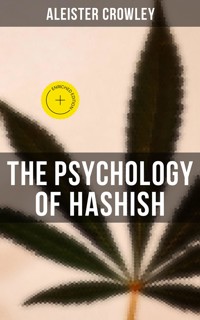
Aleister Crowley's 'The Psychology of Hashish' delves into the psychological effects of hashish consumption through an introspective examination of altered states of consciousness. Written in a thought-provoking and scholarly tone, Crowley explores the profound impact of hashish on perception, cognition, and creativity, drawing on his own experiences and research to provide a comprehensive analysis of the substance. Drawing parallels between hashish consumption and mysticism, Crowley's literary style is both informative and engaging, making it a valuable read for those interested in the intersection of psychology and altered states of consciousness. Aleister Crowley, a controversial and enigmatic figure in the world of occultism, was known for his adventurous spirit and unique perspective on spirituality and psychotropic substances. His interest in exploring the depths of human consciousness and the unconventional paths to enlightenment influenced his writing of 'The Psychology of Hashish', making it a fascinating insight into both his personal experiences and philosophical beliefs. Recommended for readers intrigued by the complex relationship between the mind and psychoactive substances, Crowley's book offers a captivating exploration of the psychological effects of hashish consumption. In this enriched edition, we have carefully created added value for your reading experience: - A succinct Introduction situates the work's timeless appeal and themes. - The Synopsis outlines the central plot, highlighting key developments without spoiling critical twists. - A detailed Historical Context immerses you in the era's events and influences that shaped the writing. - An Author Biography reveals milestones in the author's life, illuminating the personal insights behind the text. - A thorough Analysis dissects symbols, motifs, and character arcs to unearth underlying meanings. - Reflection questions prompt you to engage personally with the work's messages, connecting them to modern life. - Hand‐picked Memorable Quotes shine a spotlight on moments of literary brilliance. - Interactive footnotes clarify unusual references, historical allusions, and archaic phrases for an effortless, more informed read.
Das E-Book können Sie in Legimi-Apps oder einer beliebigen App lesen, die das folgende Format unterstützen:
Veröffentlichungsjahr: 2022
Ähnliche



















The Psychology of Hashish
Published by
Books
Introduction
A fearless mind enters the green-lit labyrinth of consciousness and, taking hashish as both key and compass, tests whether ecstasy clarifies perception or merely burnishes illusion, tracing with deliberate steps the shifting frontier where psychology meets mysticism, sensation shades into symbol, and the sober observer risks dissolution in order to return with maps of experience, instruments of comparison, and the troubling suspicion that the self is both experimenter and experiment, witness and theatre, a stage whose scenery changes with a pinch of resin and a vow to look without blinking, however dazzling the lights may become.
The Psychology of Hashish endures as a classic because it weds audacity to lucidity: a writer renowned for esoteric ambitions undertakes a careful inquiry into altered states, producing prose that is at once analytical and evocative. Its reputation rests not on notoriety alone but on craft and clarity—the rare attempt, in early twentieth-century English, to treat cannabis as a philosophical and psychological problem worthy of sustained, disciplined description. The book’s continued readership reflects a double appeal: it invites the curious into vivid experiences while insisting on terms that challenge easy romance, idle thrill-seeking, or pious dismissal.
Its author, Aleister Crowley, was an English writer and occultist whose work helped define the modern occult revival and the spiritual philosophy of Thelema. Composed in the early twentieth century and first published in The Equinox, the journal he edited to present research in magic, mysticism, and allied arts, this study takes hashish as a lens for examining consciousness. The premise is straightforward yet daring: subject the mind to a known agent, observe the transformations with as much precision as language allows, and consider their bearing on spiritual practice and psychological theory, without presuming in advance either sanctity or pathology.
Crowley’s approach is neither pamphleteering nor mere memoir. He writes as an experimenter who knows that subjective states can be described with care, and as a stylist who understands that description itself must be made to carry meaning. The result is a hybrid form—part case study, part inner travelogue, part essay in first principles—where narrative episodes are checked against reflection and the vocabulary of the day’s psychology. Even when the scenes are voluptuous or strange, the governing tone remains disciplined: distance without chill, warmth without credulity, and a readiness to revise when a hypothesis fails the ordeal of experience.
As literature, the work helped stabilize a mode for writing about intoxication that does not collapse into moralizing or spectacle. It models candor without exhibitionism and analysis without clinical aridity, a balance that later discussions of altered states often pursue. By demonstrating that personal testimony can be organized with method, it broadened the ways English-language authors could treat visionary experience, providing an example of how inward adventures might be made intelligible to an exacting reader. Its impact persists because it shows that the art of precision need not banish wonder, and that wonder need not excuse imprecision.
The themes that animate these pages are enduring because they are as old as philosophy and as immediate as a racing pulse. What is a self when its usual boundaries soften? How far can language follow sensation before it breaks or becomes metaphor? Where lies the difference between revelation and projection, and by what tests might we propose one over the other? Crowley frames such questions not as riddles to decorate a page but as working problems, insisting that any serious account of experience must face their difficulty, especially when the experience is deliberately intensified by a defined, repeatable cause.
The book also wrestles with the ethics and practice of inquiry. To induce an altered state is to assume risk, yet to fear risk absolutely is to refuse knowledge; between these poles the author urges preparation, context, and a sober intention. He considers the role of setting, the discipline of record-keeping, and the need to compare like with like, so that striking episodes do not eclipse quieter data. Even as sensations swell, a methodological conscience keeps time: do not mistake novelty for value, or intensity for truth; let corroboration, not impulse, guide the claims you dare to make.
Its historical moment matters. In the decades around 1900, European and British writers were newly attentive to psychology, comparative religion, and the study of mystical states. Cannabis had already appeared in medical and literary discussions, yet the field lacked a coherent, English-language synthesis that addressed practice, phenomenology, and interpretation together. Crowley’s contribution enters that conversation with a distinctive emphasis on self-experiment and spiritual application, informed by a background in ritual practice and by the editorial culture of The Equinox, which sought to bring observation and experiment to bear on questions usually banished to faith or anecdote.
Readers will notice how the book’s language moves between registers. At times the prose adopts a measured cadence suited to notation; at others it leans into image to grasp what bare taxonomy cannot hold. This shifting style is not ornament for its own sake but a tool: when one idiom fails, another is tried, as though the writer were rotating an object under different lights. The cumulative impression is of a mind determined to remain exact even when exactness requires music, and to remain musical without surrendering to vagueness masquerading as depth.
Over time, the text has continued to circulate among readers of occult literature, historians of drug culture, and those interested in the phenomenology of consciousness. Its longevity owes less to shock than to its steadiness: it neither condemns nor celebrates, but examines. Reprints and scholarly attention have kept it within reach, and its method—observe, compare, infer—has proved durable. While many voices have since addressed cannabis and visionary experience, this work remains a touchstone for the proposition that inward episodes can be investigated with the same poise we expect in other domains of inquiry.
New readers should expect, then, not a tract or a diary alone, but a study that welcomes skepticism and curiosity in equal measure. The opening setup is simple—ingest, observe, record—but what unfolds is a layered meditation on attention, memory, and meaning. Approach it as both laboratory notebook and spiritual reflection, and it will reward patience. The author invites you to become a co-examiner, to weigh claims, to pause over definitions, and to notice how your own assumptions bend the evidence, for the argument of the book is also an argument about how to read experience at all.
Today, as discussions of cannabis, psychedelics, and mental health re-enter public and scientific forums, the questions this book raises feel newly present. What counts as knowledge when the knower changes with the method? How can personal narrative and disciplined analysis cooperate rather than compete? The Psychology of Hashish remains compelling because it insists that intellectual rigor and visionary daring are not enemies. Its classic status lies in that union, and its lasting appeal in the invitation it extends: to bring one’s best powers of observation to the most elusive subject we have—the changing weather of the mind.
Synopsis
Aleister Crowley’s The Psychology of Hashish is a reflective, investigative essay that examines the mental and mystical implications of cannabis intoxication. First appearing in The Equinox in 1909 under his pseudonym Oliver Haddo, it approaches the topic as both a psychological case study and a contribution to occult inquiry. Crowley frames the work as an attempt to classify the states of consciousness induced by hashish and to evaluate their relevance to spiritual practice. Rather than presenting a polemic for or against the substance, he pursues a controlled, observational tone, seeking to distinguish persistent characteristics of the experience from accidents of personality, mood, or circumstance.
The opening movement situates hashish within a wider history of fascination and skepticism, noting that the substance has long been associated with extraordinary experiences, extravagant claims, and contradictory reputations. Crowley emphasizes the need for disciplined, first-hand observation to navigate between sensationalism and denial. He outlines a program of repeated trials, recorded with attention to dose, timing, and setting, and he frames his inquiry as part of a broader effort to translate visionary states into intelligible psychological terms. This contextual groundwork positions the study as both empirically oriented and sensitive to the traditions that have treated intoxication as a doorway to insight.
Crowley then describes the methodological concerns that shape his experiments. He stresses the variability of responses to hashish, highlighting how expectation, emotional climate, and prior training can magnify or mute its effects. The text places special weight on keeping accurate notes during and after sessions, so that fleeting impressions can be compared across trials. He argues that only through such repetition and comparison can the investigator determine which features are intrinsic to the drug and which arise from suggestion. This insistence on rigor reflects his broader view that esoteric subjects demand the same standards of observation as more conventional psychological phenomena.
With these controls in place, the essay turns to characteristic phases of the experience. Crowley catalogs an initial lift in mood, heightened sensory vividness, and rapid ideation, often accompanied by changes in bodily awareness. He reports distortions of time and space that can feel profound yet remain internally coherent while they last. Moments of intense clarity may alternate with confusion, and the boundary between inner imagery and outer perception can seem permeable. Throughout, he refrains from glamorizing these scenes, presenting them instead as data points that illuminate how attention, memory, and affect cooperate to build a world.
A central section addresses transformations of self-sense. Crowley notes that under hashish, the ordinary center of identity may loosen, expanding to embrace a wider field of sensation or seeming to dissolve altogether. This shift can be associated with feelings of unity, symbolic insight, or an abstracted sense of meaning. He underscores, however, that such impressions are not self-validating. The essay repeatedly returns to the problem of interpretation: what appears as revelation in one moment may, on sober reflection, reveal itself as a misattribution or a product of associative thinking amplified by emotion.
From these observations, Crowley considers the faculty of imagination, arguing that hashish intensifies both the inventiveness and the credulity of the mind. The heightened flow of images can stimulate creativity, yet it also magnifies the role of suggestion. He warns that ambiguities easily become certainties under the influence, and that narrative coherence can be retrofitted to chaotic material after the fact. The text therefore treats visionary content with caution, proposing that its value lies less in any single message than in the light it throws on how beliefs are formed, reinforced, and resisted within the stream of consciousness.
The work then appraises the relation between drug-induced states and disciplined spiritual training. Crowley acknowledges that hashish may catalyze experiences resembling those sought in contemplative practice, such as intensified concentration or a sense of boundlessness. Yet he argues that without preparation and subsequent integration, such episodes are unstable and prone to misinterpretation. He frames the substance as a potential instrument rather than a path in itself, insisting that sober repetition, ethical clarity, and methodological consistency remain the decisive criteria for progress in any serious inquiry into the mind.
Practical considerations follow, including the importance of moderation, suitable surroundings, and careful self-observation. Crowley discusses the risk of overgeneralizing from exceptional moments and cautions against treating pleasant states as proof of attainment. He advises investigators to separate phenomenology from metaphysics, and to let long-term patterns, not single sessions, guide judgment. The essay’s pragmatic tone extends to its recognition of individual differences: what illuminates one student may confuse another, and the same procedure can yield different outcomes depending on temperament, health, and prior training.
The Psychology of Hashish closes by situating the study within a larger project: a sober, comparative science of altered states that neither dismisses nor romanticizes them. Crowley’s enduring contribution is to model a stance of disciplined curiosity, using introspection, repetition, and critical review to map experiences that are often treated as ineffable. Without claiming final answers, he encourages readers to value careful method over anecdote, and discrimination over credulity. The broader message is that extraordinary consciousness can be investigated with the same seriousness as ordinary awareness, enriching both psychological understanding and the reflective dimensions of spiritual practice.
Historical Context
Aleister Crowley wrote The Psychology of Hashish in the first decade of the twentieth century, with London and Paris as principal reference points and the British Empire as the dominant global framework. Monarchic authority, the established churches, and a rapidly professionalizing scientific and medical establishment shaped elite discourse. Industrial capitalism, imperial trade, and a powerful press produced a culture both confident and anxious about modernity. Against this backdrop, esoteric societies flourished, promising access to hidden wisdom. Crowley, trained in the rituals of the Hermetic Order of the Golden Dawn and steeped in the language of science, positioned his study at the intersection of occult inquiry and empirical observation.
The British Empire’s governance of India crucially informed Western knowledge of cannabis. Colonial administrators and physicians encountered bhang, ganja, and charas as widely used preparations across South Asia. In 1839, physician W. B. O’Shaughnessy reported on cannabis’ medical uses after work in Calcutta, helping introduce it to European therapeutics. The Indian Hemp Drugs Commission (1893–94), an extensive colonial inquiry, concluded that moderate use was not generally harmful and advised regulation rather than prohibition. Crowley’s essay echoes this colonial archive: he treats hashish as a substance with a deep non-European history, accessible to study partly because imperial networks carried both the plant and knowledge about it to Britain.
By Crowley’s time, hashish already had a nineteenth‑century European literary genealogy. In Paris, the Club des Hashischins (1840s) gathered figures such as Théophile Gautier and, indirectly, Charles Baudelaire, whose Les Paradis artificiels (1860) reflected on intoxication as an aesthetic and moral problem. The psychiatrist J.-J. Moreau de Tours published Du Hachisch et de l’aliénation mentale (1845), arguing that cannabis could model forms of insanity for clinical study. In the United States, Fitz Hugh Ludlow’s The Hasheesh Eater (1857) offered a confessional account of visionary excess and collapse. Crowley’s analysis enters this tradition, acknowledging both the allure of “artificial paradises” and the risks of romanticization.




