


1,99 €
Niedrigster Preis in 30 Tagen: 1,99 €
Niedrigster Preis in 30 Tagen: 1,99 €
Mehr erfahren.
- Herausgeber: DigiCat
- Kategorie: Lebensstil
- Sprache: Englisch
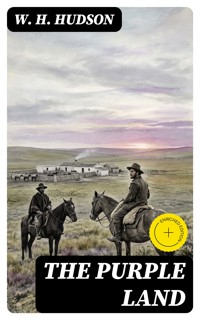
Set against the vibrant backdrop of 19th-century Uruguay, W. H. Hudson's "The Purple Land" weaves a rich narrative that blends adventure, romance, and social commentary. Employing a lyrical prose style, Hudson intricately describes the lush landscapes, cultural nuances, and complex human relationships within a region tumultuously shaped by colonialism and socio-political conflicts. The book is not merely a travelogue; it is an immersive exploration of identity and belonging, infused with Hudson's deep appreciation for nature and his acute observations of society's intricacies. W. H. Hudson, an English writer and naturalist known for his passionate environmental advocacy, drew extensively from his own experiences living in South America. His commitment to understanding the land and its inhabitants is evident in the vivid characterization and intricate descriptions throughout the novel. Hudson's unique perspective, having arrived in Argentina as a child of English immigrants, brings authenticity to his portrayal of Uruguay, reflecting both his love for the region and his critique of imperialism. "The Purple Land" is an essential read for those interested in classic literature that transcends mere adventure. It invites readers to reflect on the interplay of culture, identity, and the natural world, making it a compelling addition to the canon of travel literature and historical fiction. In this enriched edition, we have carefully created added value for your reading experience: - A succinct Introduction situates the work's timeless appeal and themes. - The Synopsis outlines the central plot, highlighting key developments without spoiling critical twists. - A detailed Historical Context immerses you in the era's events and influences that shaped the writing. - A thorough Analysis dissects symbols, motifs, and character arcs to unearth underlying meanings. - Reflection questions prompt you to engage personally with the work's messages, connecting them to modern life. - Hand‐picked Memorable Quotes shine a spotlight on moments of literary brilliance. - Interactive footnotes clarify unusual references, historical allusions, and archaic phrases for an effortless, more informed read.
Das E-Book können Sie in Legimi-Apps oder einer beliebigen App lesen, die das folgende Format unterstützen:
Veröffentlichungsjahr: 2022
Ähnliche





The Purple Land
Table of Contents
Introduction
Between the disciplined certainties of an English upbringing and the unruly openness of the River Plate frontier, The Purple Land follows a young outsider as he tests courage against custom, romance against prudence, and personal freedom against the claims of a land whose beauty, danger, hospitality, and honor codes incessantly press upon him, so that each mile ridden, each doorstep crossed, and each story traded becomes a negotiation between inherited habits and new allegiances, until the country itself seems to instruct and refashion him, not through grand conclusions but through the textures of weather, horse sweat, campfire talk, and sudden, necessary choices.
First published in 1885 in two volumes as The Purple Land That England Lost and later known simply as The Purple Land, W. H. Hudson’s novel blends picaresque adventure with the observational richness of travel writing. Drawing on the author’s intimate familiarity with the South American plains, it is set chiefly in Uruguay, from coastal towns to the interior estancias and open grasslands. The historical backdrop is nineteenth-century civic turbulence, but the book keeps its focus on roads, river crossings, and the households and horsemen who populate them. The result is a swift, atmospheric fiction that moves with a rider’s momentum.
The narrator is Richard Lamb, an inexperienced Englishman whose hasty marriage pushes him across the estuary and into a country he barely understands. Seeking temporary refuge and employment while keeping a low profile, he rides out from the capital into a landscape where news, danger, and kindness arrive on horseback. The first-person voice is buoyant, candid, and often amused, inviting the reader into confidences without pedantry. Episodes accumulate as encounters rather than engineered set pieces: a roadside meal, a night in a ranch house, a detour for a stray horse. The tone balances exuberant freedom with watchful caution and tact.
Central to the book is the education of an outsider, not in classrooms but through codes of honor, hospitality, and reciprocity that govern a sparsely policed countryside. Courage, loyalty, and resourcefulness are weighed against vanity and haste, and the narrator learns that survival depends as much on listening as on bravado. Freedom is everywhere, yet it is never costless; allegiances matter, reputations travel, and missteps carry consequences. Love is present as delight and risk, not as courtly abstraction. Throughout, the novel meditates on how character is shaped by place, and how place demands respect in return.
Hudson’s lifelong attention to birds, weather, and ground lends the pages an alert naturalism that gives the action its texture. The grasslands and river margins are not backdrops but actors: winds shift intentions, a water crossing rearranges schedules, and a night sky steadies or unsettles the mind. The prose flows with long, flexible sentences, then tightens for sudden action, mirroring the swing between leisure and alarm on the road. Dialogues carry regional cadences without exoticizing gloss, and small material details—saddles, mates, fences—anchor the romance of travel to work and habit. This sensuous realism heightens rather than softens danger.
For contemporary readers, the novel’s enduring power lies in its exploration of encounter: how a traveler negotiates foreignness without reducing people to scenery, and how hospitality binds strangers to obligations. It invites reflection on migration, belonging, and the limits of imported certainties, subjects that remain pressing well beyond its nineteenth-century setting. At the same time, some social views and assumptions are anchored in the era that produced them, offering opportunities to question perspective and voice. Reading it today means experiencing its vigor while also interrogating how admiration, desire, and observation can shade into simplification—and how attentive witnessing can resist that.
Approached in this spirit, The Purple Land remains a bracing, generous journey narrative that rewards lingering over descriptions as much as racing ahead for incident. It situates a lively individual story within a living landscape, letting movement and mood do interpretive work that a thesis never could. Without foreclosing surprises, it promises companionship in uncertainty and joy in discovery, guided by a narrator whose candor grows more discerning as the miles pass. Readers can expect adventure without bombast, romance without sentimentality, and reflection without didacticism, and to finish with a sharpened sense of how place reshapes expectation and self.
Synopsis
W. H. Hudson’s The Purple Land, first published in 1885, is a picaresque novel set in nineteenth-century Uruguay and narrated by a young Englishman, Richard Lamb. Having impulsively eloped with Paquita in Buenos Aires, Lamb flees across the estuary to the Banda Oriental seeking safety and a future. He recounts his travels retrospectively, blending personal misadventure with vivid sketches of the country. The work’s tone is exploratory rather than sensational, tracing how an unseasoned outsider is remade by a land of open horizons, strong passions, and local codes. Hudson’s naturalist eye and cosmopolitan sympathy frame the narrative as both journey and discovery.
On reaching Montevideo, Lamb finds that legal, social, and financial pressures shadow his new marriage. As an unconnected foreigner with few resources, he must navigate bureaucratic suspicion and shifting allegiances in a restless port city. Practical necessity compels him to venture inland to seek employment and allies, while Paquita remains sheltered and out of immediate danger. This separation, undertaken with the promise of reunion, becomes the novel’s organizing absence, sending Lamb into the interior where the country’s character—its people, speech, and customs—gradually shapes his understanding and tests his resolve.
Away from the coast, Lamb encounters gauchos and small landholders who embody a distinctive ethic of hospitality, horsemanship, and honor. The rhythm of mate shared at a wayside fire, the centrality of the horse, and the informal justice of the open country introduce him to a social texture unlike anything he has known. Episodes of generosity alternate with precarious moments, but he learns to read the land and its unwritten rules. Through these acquaintances, he acquires not only guidance and protection but also a lexicon of local terms and a new measure for courage, self-sufficiency, and personal loyalty.
The interior is also a theatre of political turbulence. Factional conflicts simmer, erupt, and recede, turning byroads into strategic corridors and estancias into provisional redoubts. Lamb’s foreignness makes him at once inconspicuous and conspicuous: useful to some, suspect to others. He is intermittently entangled in the maneuvers of local leaders and their followers, learning how quickly friendship and fortune can change in a country where law and personal authority compete. Skirmishes, pursuits, and sudden dispersals punctuate his travels, revealing how ordinary lives persist within and around recurrent unrest.
Complicating his path are encounters with striking, strong-willed women whose presence brings both solace and danger. Lamb’s reflections on marriage, fidelity, and desire are provoked by a society that treats love as a force equal to honor and risk. Flirtations and misunderstandings carry the possibility of violence in a culture alert to reputation, yet these episodes also humanize the landscapes he crosses. His sensibility matures as he weighs impulse against duty, learning to honor commitments in an environment where emotion is openly expressed and quickly defended.
Throughout, Hudson’s descriptive power anchors the narrative in the natural world: vast plains burnished by evening light, river margins alive with birds, and estancias set like islands in sea-like grass. Lamb comes to see the “purple” of the land in its luminous distances and in the mood it casts over human affairs—expansive, perilous, liberating. The novel’s travelogue qualities complement its adventures, and the accumulation of local detail builds a persuasive picture of a society at once sparse and abundant, rough and gracious, whose customs make sense on their own terms.
As Lamb’s journey arcs toward fulfillment of earlier promises, the novel gathers its themes without relying on melodramatic revelation. The Purple Land endures for its portrayal of how a restless outsider is transformed by a place that rewards courage and candor, and for its argument—implicit in action—that freedom is learned through attachment as much as escape. Its resonance lies in the balance it strikes between romance and realism, documenting a world in flux while honoring the people who inhabit it. The result is a classic of Anglo-American writing about the Río de la Plata, still valued for its vitality and insight.
Historical Context
Published in 1885, The Purple Land by W. H. Hudson is set in the Banda Oriental, the historical name for Uruguay, during the unsettled decades after independence. The narrative follows an English traveler across a landscape shaped by ranching, river ports, and small interior towns. Mid-nineteenth-century Uruguay was defined by rival political factions, tenuous national institutions, and porous borders with Argentina and Brazil. British merchants, consuls, and immigrants frequented Montevideo, while rural districts retained gaucho lifeways. This setting provides the social and political horizons for the novel’s encounters, from estancias and pulperías to militia outposts, Catholic parishes, and the roads linking them.
Uruguay emerged as a buffer state in 1828, when British mediation ended the Cisplatine conflict between Brazil and the United Provinces of the Río de la Plata. The nation inherited the federalist legacy of José Gervasio Artigas and the martial habits of frontier militias. Early presidents Fructuoso Rivera and Manuel Oribe embodied competing networks that hardened into the Colorado and Blanco parties. Their rivalry culminated in the Guerra Grande (1839–1851), including the long siege of Montevideo, with Argentine strongman Juan Manuel de Rosas backing Oribe and volunteers like Giuseppe Garibaldi fighting for the besieged capital. These upheavals left enduring factional loyalties.
In the 1850s and 1860s, Uruguay’s politics remained volatile as rural caudillos mobilized mounted followers, and governments rose and fell through alliances and coups. Venancio Flores launched the Cruzada Libertadora in 1863, supported by Brazil and Argentina’s Bartolomé Mitre, toppling the Blanco leadership and bringing the Colorados to power. This campaign overlapped with the opening phase of the War of the Triple Alliance (1864–1870), which drew Uruguay into regional conflict. In this environment, militia levies, partisan checkpoints, and shifting loyalties affected everyday movement across the interior. Foreign travelers, sailors, and adventurers found both opportunities and hazards amid these fluid power structures.
Uruguay’s rural economy rested on extensive cattle and, increasingly, sheep ranching. Saladeros exported salted beef and hides, while a mid-century wool boom reshaped estancias and labor. Social relations were organized through patronage between estancieros and peons, reinforced by hospitality norms, compadrazgo, and local influence. The state’s reach remained uneven beyond Montevideo; justices of the peace, mounted police, and militia commanders often imposed order piecemeal. Pulperías served as trading posts and gathering places, where quarrels might be settled with the facón as readily as with legal writs. Catholic parishes administered baptisms and marriages, reflecting ecclesiastical authority over family life before civil marriage laws.
Gaucho culture shaped everyday life in the pampas and sierras: horsemanship, mate shared around a fire, payadores singing improvised verses, and a code of honor that prized courage and loyalty. Mounted bands—montoneras—could assemble rapidly under a local chief, then disperse across an open frontier threaded by rivers like the Uruguay and Negro. Contraband moved along backcountry tracks linking Rio Grande do Sul, Entre Ríos, and the Banda Oriental. Although railways began appearing near the decade’s end—Uruguay’s first line opened in 1869—much of the interior remained a rider’s domain, a world of long distances where news traveled by word of mouth.
Montevideo functioned as a cosmopolitan enclave and free port, hosting Italian, Basque, British, and other immigrant communities, consulates, and shipping agents. British capital financed trade and infrastructure across the Río de la Plata, providing steamship connections and markets for wool and hides without formal colonial rule. Treaties in 1851 helped fix Uruguay’s borders with Brazil, yet cross-border interventions and refugee flows persisted during crises. Consular protections could aid foreigners, but outside the capital personal ties and local reputation often mattered more. The novel’s English narrator moves through this world at the intersection of international commerce, diplomatic shelter, and frontier custom.
The book intersects with Southern Cone debates about civilization and barbarism that framed rural life after Rosas. Domingo F. Sarmiento’s Facundo (1845) cast caudillo rule and gaucho culture as obstacles to liberal modernization, a view that influenced regional elites. Later works, such as José Hernández’s Martín Fierro (1872, 1879), gave the gaucho a central, sympathetic voice. Hudson, an Anglo-Argentine naturalist who settled in England in 1874, wrote within this conversation, drawing on personal familiarity with the pampas to describe landscapes and customs with ethnographic attention. The Purple Land participates in, and complicates, prevailing portrayals of frontier society and authority.
Seen against this backdrop, The Purple Land reflects a country balancing fragile institutions, partisan militias, and a pastoral economy bound by honor and hospitality. Its episodes highlight how caudillo patronage, ecclesiastical authority in marriage and morality, and the sparse reach of formal law shaped daily choices. The narrative also registers the permeability of borders and the imprint of foreign merchants and diplomats on local affairs. By pairing an outsider’s gaze with grounded observation, Hudson’s work mirrors the period’s conflicts between urban liberal projects and rural autonomy, offering a literary critique that favors lived custom and personal allegiance over abstract, centralized order.




