


9,59 €
Mehr erfahren.
- Herausgeber: Saqi Books
- Kategorie: Gesellschafts- und Liebesromane
- Sprache: Englisch
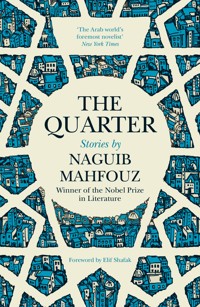
Meet the people of Cairo's Gamaliya quarter. There is Nabqa, son of Adam the waterseller who can only speak truths; the beautiful and talented Tawhida who does not age with time; Ali Zaidan, the gambler, late to love; and Boss Saqr who stashes his money above the bath. A neighbourhood of demons, dancing and sweet halva, the quarter keeps quiet vigil over the secrets of all who live there. This collection by pre-eminent Egyptian writer Naguib Mahfouz was recently discovered among his old papers. Found with a slip of paper titled `for publishing 1994', they are published here for the first time. Resplendent with Mahfouz's delicate and poignant observations of everyday happenings, these lively stories take the reader deep into the beating heart of Cairo.
Das E-Book können Sie in Legimi-Apps oder einer beliebigen App lesen, die das folgende Format unterstützen:
Veröffentlichungsjahr: 2019
Ähnliche




















THE QUARTER
Naguib Mahfouz (1911–2006) was Egypt’s most eminent writer. Over a career that lasted more than five decades, he wrote thirty-four novels, thirteen short story anthologies, numerous plays and thirty screenplays. His works range from re-imaginings of ancient myths to subtle commentaries on contemporary Egyptian politics and culture. A writer of incredible discipline, every day he wrote for one hour, smoked three cigarettes and walked by the Nile. In 1994, he was stabbed in the neck by religious extremists and was seriously wounded. The injury caused nerve damage that partly paralysed his right hand, preventing him from writing. Of his many novels, his most famous in English translation is The Cairo Trilogy, consisting of Palace Walk, Palace of Desire and Sugar Street. Other notable works include Children of the Alley, The Thief and The Dogs and Autumn Quail. Naguib Mahfouz received the Nobel Prize in Literature in 1988, the first writer in Arabic to do so.
Praise for Naguib Mahfouz
‘The Arab world’s foremost novelist … Arabic has a rich tradition in poetry, but the novel was not a strong art form until Mahfouz made it accessible.’ New York Times
‘[Mahfouz] populated his works with a cast of memorably strong urban characters. … The result was a body of work that bore comparison with Balzac and Dickens. Mahfouz introduced his audience to a new way of seeing.’ The Economist
‘The world of Naguib Mahfouz is vast and extremely rich. He spans the various changes in the reality, dreams and aspirations of his nation. Although his world is mainly Cairo and the old quarter of Gamaliya in which he spent his childhood, he made the urban scene an elaborate and highly significant metaphor of the national condition.’ Independent
‘Egypt’s greatest living writer … one of the world’s most humane literary figures. Like Zola, Mahfouz chronicled the lives of the most ordinary of his countrymen ... Like Dostoyevsky, he set most of his novels in one beloved city – Cairo, in his case. Like his elders Taha Husayn and Tawfiq al-Hakim, he took on the role of national storyteller.’ The Nation
‘Mahfouz’s work is freshly nuanced and hauntingly lyrical. The Nobel Prize acknowledges the universal significance of [his] fiction.’ Los Angeles Times
‘Mahfouz’s scope is vast and his concerns are not only still evident today, but crucial.’ The Scotsman
Praise for The Cairo Trilogy
‘Luminous … All the magic, mystery and suffering of Egypt in the 1920s are conveyed on a human scale.’ New York Times Book Review
‘It is Mahfouz’s wonderful ability to delineate human beings from their outer appearances which gives Palace Walk its universal appeal. I shall read it again and again.’ The Guardian
‘A masterpiece.’ The Times
‘Teeming with life and contention ... it promises riches.’ Independent
‘Naguib Mahfouz’s Cairo Trilogy puts all contemporary writers in the shade. He is the Arab Tolstoy.’ Simon Sebag Montefiore
‘The alleys, the houses, the palaces and mosques and the people who live among them are evoked as vividly as the streets of London were conjured up by Dickens.’ Newsweek
‘An engrossing work, whose author can take his place alongside any European master you care to name’ Sunday Times
‘A magnificent, Tolstoyan saga ... unmissable.’ Cosmopolitan
‘The Cairo Trilogy extends our knowledge of life; it also confirms it.’ Boston Globe
‘A grand novel of ideas … a marvellous read.’ Washington Post
‘Sugar Street is a marvellous novel, with many messages, open and concealed, for those who will be instructed.’ TLS
‘A masterful kaleidoscope of emotions, ideas and perspective.’ Newsday
‘Mahfouz’s genius is not just that he shows us Egyptian colonial society in all its complexity; it is that he makes us look through the vision of his vivid characters and see people and ideas that no longer seem alien.’ Philadelphia Inquirer
ALSO BY NAGUIB MAHFOUZ
Palace Walk
Palace of Desire
Sugar Street
The Harafish
Midaq Alley
Autumn Quail
God’s World
The Search
Love in the Rain
Heart of the Night
Children of the Alley
The Thief and the Dogs
The Beginning and the End
Miramar
The Beggar
Naguib Mahfouz
THE QUARTER
Translated from Arabic by Roger Allen
SAQI
Saqi Books
26 Westbourne Grove
London W2 5RH
www.saqibooks.com
Published 2019 by Saqi Books
First published in Arabic by Dar al Saqi in 2018
Copyright © The Estate of Naguib Mahfouz 2019
Translation © Roger Allen 2019
Foreword © Elif Shafak 2019
The Estate of Naguib Mahfouz has asserted their right under the Copyright, Designs and Patents Act, 1988, to identify Naguib Mahfouz as the author of this work.
Nobel Prize Acceptance Speech © The Nobel Foundation 1988 Translated by Mohammed Salmawy
This book is sold subject to the condition that it shall not, by way of trade or otherwise, be lent, resold, hired out, or otherwise circulated without the publisher’s prior consent in any form of binding or cover other than that in which it is published and without a similar condition including this condition being imposed on the subsequent purchaser.
Printed and bound by Clays Ltd, Elcograf S.p.A
A full cip record for this book is available from the British Library
ISBN 978 0 86356 375 1
eISBN 978 0 86356 385 0
CONTENTS
Foreword by Elif Shafak
Introduction by Roger Allen
The Oven
Your Lot in Life
Pursuit
Son of the Quarter
Nabqa in the Old Fort
The Scream
Namla’s Prophesy
Bad Luck
Shaikhun
The Arrow
The Whisper of the Stars
Our Father Igwa
The Storm
The End of Boss Saqr
Life is a Game
Late Night Secret
The Prayer of Sheikh Qaf
Tawhida
Nobel Prize for Literature Acceptance Speech
Selected Handwritten Stories




