


4,49 €
Mehr erfahren.
- Herausgeber: Altus Press
- Kategorie: Fantasy und Science-Fiction
- Sprache: Englisch
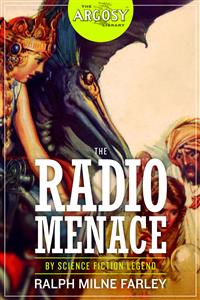
When Boston's U.S. Assistant District Attorney disappeared, not even the investigators knew that this was the opening gun of a weird and secret invasion of America. Trailing this disappearance, reporter Larry Larrabee finds himself pitted against amazing adversaries with strange scientific weapons and stranger, non-human allies: an overwhelming army of robots led by beast scientists from the planet Venus. One of the most beloved of the fantastic story pulp authors akin to Edgar Rice Burroughs, author Ralph Milne Farley pens another installment of his popular Radio series, The Radio Menace.
Das E-Book können Sie in Legimi-Apps oder einer beliebigen App lesen, die das folgende Format unterstützen:
Veröffentlichungsjahr: 2018
Ähnliche




















The Radio Menace
by
Ralph Milne Farley
Altus Press • 2018
Copyright Information
© 2018 Steeger Properties, LLC, under license to Altus Press
Publication History:
“The Radio Menace” originally appeared in the June 7, 14, 21, 28, July 5 and 12, 1930 issues of Argosy magazine (Vol. 212, No. 6–Vol. 213, No. 5). Copyright © 1930 by The Frank A. Munsey Company. Copyright renewed © 1957 and assigned to Steeger Properties, LLC. All rights reserved.
“About the Author” originally appeared in the February 22, 1930 issue of Argosy magazine (Vol. 210, No. 3). Copyright © 1930 by The Frank A. Munsey Company. Copyright renewed © 1957 and assigned to Steeger Properties, LLC. All rights reserved.
No part of this book may be reproduced or utilized in any form or by any means, electronic or mechanical, without permission in writing from the publisher.
FOREWORD
THE MOST important news stories never get onto the front page. For a number of years I have been keeping a scrapbook of obscure newspaper clippings about events which, little noted at the time, were to make history.
The collection starts with half a “stick”—paragraph—of filler from a newspaper of June 29, 1914, telling how some unimportant nobleman and his wife were shot by a crazy student in some never-before-heard-of city in the Balkans. Sarajevo, I think the name was. You’ve probably heard of the war to which it led.
Then there is the Boston Post clipping of July 1, 1919, telling of the mysterious disappearance of Myles Standish Cabot from his Back Bay radio laboratory. He turned up later on the planet Venus, as you doubtless recall.
And the clipping about the escaped lunatic from the Danvers asylum, terrorizing an electric plant in Lynn. It wasn’t a lunatic at all, but rather that same Myles Cabot, transmitting himself back to earth by wireless.
And the clipping about two game-hunting young aviators being lost on the Greenland ice-cap in the spring of 1926. They were really Eric Redmond and Angus Selkirk of the Milwaukee Eagle polar expedition, and they weren’t lost. They eventually discovered the north polar orifice, the existence of which science now admits.
And the clipping about Scarface Boston Jimmy quitting the bootleg racket in the spring of 1929, and moving out. He followed Eric and Angus to the land of the Vikings inside the earth, and shot up things quite badly there before he got through.
And then—but wait until you hear this one!
The Boston Post of June 3, 1931, contained the following item under date-line of Rockingham Junction, N.H.:
The B. & M. agent here reports seeing a large dragon as big as a horse, with leathery batlike wings, fly over the station at about five o’clock this morning. The agent had been to a lodge party the night before. It is reported that it was some party.
I saved this clipping for two reasons. First, because I used to cover Rockingham County myself for the Post, and used to receive twenty-five cents apiece for inventing fillers like that. Secondly, because I am interested in pterodactyls and other prehistoric beasts.
But it was not until some time later that I added this clipping to my collection of obscure items about events which were afterward discovered to be epoch-making.
Nor does the world yet realize that that news-story is entitled to take its place with the assassination at Sarajevo. It is time that the world knew. Hence this account which I am now writing.
The flame which was kindled at Sarajevo required tens of millions of men to stamp it out.
Two men and a girl, with some assistance from a few friends, confronted the menace represented by that Rockingham Junction winged monster, which threatened the free existence of the whole human race. For a greater Kaiser than Wilhelm set out to dominate the world in 1931.
I NOTED only the one item at the time; and did not realize how many people throughout the United States thought they were seeing things until the Literary Digest compiled a collection of accounts of over four hundred separate similar apparitions. Congressmen Tinkham of Massachusetts and Schafer of Wisconsin promptly made this the text for a renewed demand for the repeal of the Volstead Act. Public interest was at last aroused. Seeing the dragon, usually in the early morning or at twilight, became the most popular outdoor sport.
The mythical beast was even reported to have been seen on the same evening at such widely separated points as Boston and San Francisco. This at first was scoffed at, until a leading professor of aerodynamics wrote a Sunday syndicate article, in which he proved, to his own satisfaction at least, that with the wing-spread claimed for the creature, it could easily have flown across the continent in the period represented between Eastern Standard Time and Pacific Standard Time.
Finally a certain circus king claimed to have killed the beast, and made considerable money by exhibiting its stuffed carcass at a dollar a head, children twenty-five cents. At this, every one came to believe that the whole matter had been a colossal hoax, for the mere purpose of laying the foundation for this very exhibit; that the showman had planted a few news-stories, and the contagion of mass imagination had supplied the rest. Popular interest suddenly lagged, and a new sensation took its place—for the public must at all times have its pet sensation. This was the remarkable increase in missing persons.
Then the missing persons were in turn forgotten—by all except their loved ones—and the front pages were given over to the next new sensation, whatever that may have been. I have forgotten.
CHAPTER I
LARRY GETS A CLUE
THE UNEXPLAINED disappearance of Assistant United States Attorney Eliot Endicott from his office in the Federal Building, Boston, ought to have attracted more notice than it did. All that appeared in the press was a brief notice that young Endicott had left his bachelor apartment in the evening, had told the night clerk that he was bound for his office, and had not been seen since. It came just too late to be featured as a part of the missing persons epidemic.
The Department of Justice did not give out the fact that Endicott had actually reached his office, accompanied by Operative Riley, his personal bodyguard; had bolted the door on the inside, leaving Riley on guard in the hall; had been heard to call for help; and had totally disappeared while rescuers were battering down the door.
One reason why these facts were withheld was that they sounded preposterous, and the Department feared ridicule. Another and more vital reason was that the missing man had been engaged in a highly confidential investigation of the establishment and gradual development of a gang of super-intelligent criminals in Boston, and accordingly the Department did not wish this gang to realize what a haul they had made, or that the Department had any clues whatever as to what had become of the young assistant.
The Department did not wish the gang to know how many clues it had, and was equally unwilling to have the public know how few; for the clues were indeed nearly negligible.
On the evening of Eliot Endicott’s disappearance, Lawrence Larrabee, a young reporter of the Boston Post, happened to be on his way from the newspaper office on Washington Street to the South Station, bound home for the night. It was dark and sultry. Heat lightning was playing in the distance. The streets were practically deserted.
“A fine night for a murder,” thought Larry, “in which case I hope I get the scoop.”
As he passed through Post Office Square, he thought he heard a leathery flapping overhead. Involuntarily, he looked up. The lightning flickered, and he thought he saw outlined the huge shape of a pterodactyl winging through the night.
“Too bad the flying dragon is no longer news,” he said to himself. “This would have made a good story a few months ago. I wonder if the beast was stealing any mail. Guess I’ll go into the Federal Building and find out if any one else saw him. Perhaps I can make up a story out of it after all.”
So he turned and mounted the steps. He had followed pure hunches before, and they had led to news.
Downstairs the building was deserted, but he heard an air-hammer at work on the second floor. Following the sound, he found Operative Riley, several policemen, the night watchman, and the wrecking crew engaged in breaking into Eliot Endicott’s office. The door-frame crashed inward just as he arrived. The rescuers rushed in, and Larry followed them. But the room was empty.
“Gone!” exclaimed “Mr. Endicott is gone! He was here a minute ago. He hollered for help. We broke down the door, and now he’s gone!”
The office seemed normal except for the absence of the assistant district attorney.
Here was a story, a whale of a story! Young Larrabee got all the details from Riley, then hastened back to the city room of the Post. He hunted through the filed clippings which newspaper men call the “morgue” to write up a full biography of the victim. But he carefully omitted all mention of the flying dragon; he would save that for later. Turning his story in to the night editor, he sped back to the Federal Building.
Nothing further had developed. Riley and a squad of police and Secret Service operatives were on guard. So Larry chummed around with them, smoked innumerable cigarettes, and waited.
ALONG toward morning, newsboys began crying their papers in the streets below. Larry bought one of each variety. The Herald and the Globe had merely a brief paragraph, announcing Eliot Endicott’s disappearance. Then the Post appeared.
Larrabee’s story was not on the front page. That was strange! Feverishly he thumbed the sheets looking for it, and at last found—not his story, but rather merely the same brief item as had come out in the Herald and the Globe.
Suppressed! That was what had happened. His great scoop had been suppressed. For a moment he was horribly disappointed, and then he was glad.
He made up his mind to follow out his hunch about the pterodactyl. His paper was the only one to have any information, any clues so far. The scoop would be all the greater, if and when he succeeded in locating the missing assistant district attorney.
Shortly after sunrise the district attorney arrived, visibly agitated. So agitated, in fact, that he didn’t notice Larry’s presence.
Striding into the room, the official glanced quickly around. Then he asked Riley for a full report, taking notes as Riley explained. Larry also scribbled on the back of an envelope what few points had been omitted before.
When the interrogation had been completed, the district attorney put his hand under the edge of the desk of his missing assistant, and pushed something. Then he walked over to one of the bookcases which lined the walls of the room and tugged at it. It swung forward, showing a cavity behind; in this cavity were the steel doors of a large wall safe.
It was now broad daylight. The inevitable pigeons which infest the ledges of every down town building in Boston were parading up and down, preening themselves in the morning sunshine, and chattering: “Look—look—look—at a coo! Look—look—look—at a coo!” to each other. Morning had come.
“Those infernal birds will drive me crazy,” muttered the district attorney, as he twirled the knobs of the safe.
So Riley went to the window and shooed them away. They circled with much flapping and returned.
The doors of the safe opened at last, and the district attorney pounced on a small red leatherboard packet bound with tape.
“It’s here!” he exclaimed. “They didn’t get it, after all!”
Extricating the package, he flung it down on the desk.
“Watch that!” he admonished the operative. “I’ll see if there’s anything missing.”
As he returned to the safe and knelt before it, one of the pigeons flew in the window, and straight at Riley’s face. Riley beat it away, but it came at him again and again, pecking at his eyes, driving him back into a corner. The policeman and other operatives rushed to the poor Irishman’s assistance. The packet on the desk lay unguarded. The district attorney rose to his feet, and turned to see what was the matter.
At that instant another pigeon swooped in through the window, seized the packet in its beak, and swooped out again. The district attorney rushed to the window and hurled a law book after the departing bird which promptly dropped its precious burden and soared away.
Larry followed the official to the window. They both leaned far out. A short thick-set man, with a cap pulled low over his face, was pacing up and down on the sidewalk below. As the red packet thumped upon the concrete, this man snatched it up, and jumped into an auto which was standing beside the curb, with its engine running. The car promptly sped off with its prize.
“After them!” shouted the district attorney. “They’ve got Mr. Endicott’s secret report.”
The bird which had been attacking Riley now soared out and joined its mate.
Every one rushed to the street. But it was too late. Not a sign of the departing car. Police headquarters were promptly notified by phone, but no one was able to give an adequate description of either the thieves or their auto.
WHEN all the excitement had finally quieted down, the district attorney noticed Larrabee.
“Who are you?” he bellowed.
“Reporter for the Boston Post, sir,” Larry explained, exhibiting his badge.
“What the devil are you doing here?”
“Getting the story, of course.”
“Hey, one of you cops, take this bird into custody. He may be mixed up in this.”
So, despite Larry’s protests, he was manacled and marched off to the police station. An hour or so later, however, he was released, and ordered to report at once to his boss.
The editor received the reporter in his sanctum, and carefully closed the door.
“Well, Larry,” said he, “you got a good scoop. I’ve read it. I’m sorry that the night editor had to kill it; but we’ve promised to cooperate with the department, as you’ve probably guessed. Now I understand from the district attorney that you’ve gone and got a lot more information that you ought not to have. Good boy! Of course, have to kill that, too, but they can’t keep it suppressed forever. Now, tell me the whole story.”
So Larrabee told him everything, not omitting even the pterodactyl nor the two pigeons.
When he had finished, the editor remarked, “It sounds perfectly crazy. No wonder the authorities are leery about its appearing in print. I take it that you have a hunch that the winged dragon flew off with young Endicott?”
“I can’t believe it—but I think that’s it.”
“Well, none of the other papers appear to be in on the story at all. Have you any plans for running down your clues?”
“Yes, sir.”
“All right. Go and get it. I’ve followed your hunches before. Sometimes they’re positively uncanny. Go up to the city room, take your typewriter, and write out all that you know, and what you plan to do. Seal it up and bring it to me. Then go and get that story! I hope you scoop the authorities as well as the other papers.”
“Yes, sir.”
Later in the morning, Lawrence Larrabee handed his chief a sealed envelope.
“Where now?” asked the editor.
“I’d rather not say it aloud,” replied the reporter. “There’s a pigeon on your window ledge, and he might overhear me.”
The editor guffawed.
“This thing seems to be getting on your nerves,” said he. Then, sobering, “And yet I don’t know but what you are right. Follow your hunch to the end, Larry. Go and get it.”
The pigeon cocked its head on one side, just as if it were listening, and then soared off down Washington Street.
Larrabee hastened to the North Station, where he purchased a ticket to Rockingham Junction, N.H. He was going there first, because he had ascertained from the files of his newspaper that that was where the winged monster had made its initial appearance that spring.
A man stood behind him in the waiting line at the ticket window. This man also bought a ticket to Rockingham Junction and followed Larry onto the train.
Later that morning both of them got off at the junction. It had been Larry’s plan to interview the station agent, who was reported to have been the first to see the pterodactyl, but the other man beat him to the window.
Larry hung around until the other had transacted his business. Then he in turn approached the window, while the other retired to one of the waiting room seats and furtively watched him.
The station agent was seated at the telegraph instruments, so the young reporter leaned against the counter waiting, and idly turning over in his mind how to broach the matter to the agent, who quite likely had been kidded about the dragon until he was very touchy on the subject.
As Larry waited, he suddenly heard his own name—slightly misspelled, it is true—ticked off by the agent. Telegraphy happened to be one of his accomplishments; used to cover sporting events. Instantly he was all alert.
The agent finished sending, and closed the switch. Back came the repeat from the other end: “Washington Jones, Intervale, N.H. Reporter named Laraby here on King’s trail, Send reëforcements quick. Jackson.”
“Aha!” said the newspaper man to himself. “So I’m shadowed, am I? Well, I guess that means I’m hot on the trail!”
Then to the station agent, as the latter approached the window, “ A time-table, please.”
LARRY perused the time-table. Then, his plans made up, he went outside and hailed a taxi. The man who had been following him promptly got into a green taxi next in line.
“About three miles out the Exeter road,” announced the reporter in a loud voice, then leaning forward he spoke quietly in the driver’s ear: “I’m being shadowed. Can you shake that other car?”
“Can I, eh?” replied the taxi man. “You’re on, buddy. Just watch me.”
In a few moments they drew up in front of his company’s garage. The green cab drew up just behind them.
Larry’s driver turned around and shouted at him through the glass partition, “Sorry, sir, but the ignition’s loose again. And we haven’t another car. Would you mind waiting until I fix it? It ’ll only take a minute or two.”
“All right. All right,” Larry shouted back, with mock testiness. “Only please hurry.”
So the driver honked, the garage doors swung open, and they drove in.
“Quick, buddy, this way,” commanded the taxi man. “I’ve another car in the alley back of the garage.”
And soon they were hurrying to the station again, while the man who had been following him sat patiently in the green taxi outside the garage, watching through a window the top of the taxi inside, to make sure they didn’t leave. And with his meter running!
Larry rewarded his friend with a five-dollar bill, and bought a ticket to Boston, inquiring ostentatiously about the time of departure and arrival of the train, its accommodations, and so forth. Then he went out onto the platform.
The train for Boston arrived and left. The northbound limited stopped for water and went on again. A worried-looking man dashed into the station and up to the window.
“Say,” he blurted out, “was there a young fellow in a dark blue suit here just now?”
“I’ll say there was!” replied the agent. “He talked me deaf, dumb and blind about the accommodations to Boston.”
“Where is he now?” asked the other eagerly.
“On his way to Boston, I guess,” replied the agent. “He bought a ticket for there, and got onto the train. There is another in twenty minutes, to save you from asking.”
“Then take this wire,” said the man, and he hurriedly wrote out, “Washington Jones, Intervale, N.H. Never mind Laraby. He give me the slip back to Boston. Jackson.”
“That’s two words extra,” remarked the agent with New England thrift.
“Hell!” replied the man. “ What do I care!”
Meanwhile Lawrence Larrabee was settling himself comfortably in the northbound limited, en route for Intervale, New Hampshire. There must be something to his hunch, after all, for how could that man have happened to follow him, unless the pigeon outside the window of the editor of the Post had actually overheard, and had told on him? Of course, he had taken great care not to say where he was going; but if the pigeon had even overheard him say that he was on the trail of Eliot Endicott, that might account for this man following him. And if pigeons could act human—a fantastic theory that was strongly borne out by the actions of the two that had stolen the packet from the Federal Building—then might not the pterodactyl be human too, and in cahoots with whoever had made away with Eliot Endicott?
At this point he was diverted from his thoughts by noticing the girl across the aisle. A pippin! Larry promptly forgot all about his quest. Here was the neatest thing in skirts that he had ever seen. Promptly he resolved to make this young lady’s acquaintance at the earliest possible moment. He noticed particularly that there was no ring on the important finger.
But his hopes were dashed by the arrival, from another car, of a stern and forbidding male parent. A distinguished-looking gentleman at that, gray-haired, black-mustached and courtly.
Larry was no mean detective. His career on the Boston Post, including his work on the present case, had demonstrated that. Now he planned to devote his talents to discovering the identity of the beautiful girl.
He listened intently to her conversation with her father, in the hope of hearing some clue, but all that he learned was that the girl’s name appeared to be “Helen.” There was a “K” on one of their bags, and another bag bore a tag, which, however, was turned blank side up.
When father and daughter went to the diner, Larry pounced on this tag, and turned it over; but it was blank on the other side, too. Then he followed them into the diner, but was unable to get a seat near them.
When they all returned to the parlor car, he heard them mention “Bartlett.” Was that a station or a man’s name? He felt a twinge of jealousy, until he had looked it up in his time-table and found that it was the name of a station just beyond Intervale.
At Portland they all changed trains. The girl and her father took the same train that Larry did, namely the Maine Central for Intervale and Bartlett.
WHEN the train stopped at Intervale, Larry’s destination, he stayed on, and got off with the pair at Bartlett. The criminals and their pet pterodactyl could wait; he had more important business on hand just now. At that, it might after all be well for him to leave the train at some other station than Intervale, and so divert suspicion from himself. Thus he kidded himself into believing that his duty coincided with his pleasure.
It was quite late in the evening when the train reached Bartlett, and somehow he lost the girl and her father in the crowd at the station, nor did any one of whom he inquired seem to recognize the pair from his description of them.
So he put up at a hotel for the night, registering as “John O’Brien,” as his real name and the fact that he was on the trail of the missing attorney were known to the latter’s abductors.
All the next day he spent wandering around the town in the hope of catching a glimpse of his fair quarry. It was not until late in the afternoon that his patience was rewarded, for he saw her enter the post office.
As he followed her in he heard the postmaster say to her, “Here’s a letter for you. It was addressed to the lumber camp, but I guess it’s for you, all right.”
The girl tore it open, threw the envelope in the wastebasket, and started to read the letter. Then gasped and staggered backward, clutching a desk for support. It looked as though she were going to faint.
Larry’s first impulse was to spring to her assistance. But his agile mind quickly realized that, unless she actually fainted, such an action on his part would be likely to bar forever any chance which he might have of acquaintance with the young lady. So while she gasped and clung to the edge of the desk with the hand which held the letter, he stepped forward as though hunting for a pen, and read rapidly the contents of the letter thus displayed before him.
What he read caused him to gasp, too. But with an effort he steadied himself. The girl by this time had recovered her composure. She carefully reread the letter; then folded it, stuffed it in one of her pockets, and hurried out of the building.
Larry retrieved her envelope from the wastebasket, glanced at it quickly, thrust it into his pocket and approached the delivery window.
“That was Miss Helyn Kent, wasn’t it?” he asked.
“Yes,” answered the postmaster guardedly.
“I thought I recognized her,” Larry continued. “An old friend of mine. Haven’t seen her for several years. But she didn’t seem to recognize me. What’s she doing up here?”
“Staying at the Mortons’,” was the reply. “You know the Morton camp? Well, she and her dad take the camp for a few weeks ’most every summer, while the Mortons themselves are away.”
“Then it’s me for the Mortons’!” announced Larry jubilantly.
CHAPTER II
THE GIANT BEAST
MEANWHILE the missing assistant district attorney, whom Larry had set out to find, was becoming the storm center of this gigantic world-menace which is about to be related.
Eliot Endicott was only recently out of Harvard Law School, where he had stood nearly at the head of his class. While in the school he had been one of the most active organizers of the Intercollegiate Republican League, in recognition of which activity he had landed the assistant district attorney-ship almost immediately upon graduation. As he was possessed of a keen, inquiring and analytical mind, the district attorney finally assigned to him the investigation of the clever criminal band whose activities were worrying New England.
The records of the investigation he kept in his office, which was amply reënforced against robbery.
The windows had burglar-proof catches, and were also wired to a burglar-alarm system, so contrived that if any window were opened, except during regular office-hours, a gong would ring in the corridor of the building, and a light would flash both in the office of the burglar-alarm company and also at city police headquarters.
To cut the wires of the system, for the purpose of preventing the sounding of the alarm, would have exactly the opposite effect, and would sound it at once, for it was a break circuit rather than a make circuit. To render assurance doubly sure, in case the apparatus should get out of order, all messages were also transmitted, both to police headquarters and to the burglar-patrol company, from a radio set within the room.
Inside the windows there were heavy steel shutters with Yale locks.
The door was reënforced with steel, and hitched up to the same system as the windows, but with one exception, namely, that although the window-alarm could be switched off from within the room, the door-alarm could only be switched off at company headquarters after a visit from an inspector. This requirement of a visit from an inspector was an additional precaution, to make sure that whoever opened the door was an authorized person.
Even when the burglar-alarm company was notified that Endicott himself was on the way to his office, they nevertheless sent over the inspector, lest some one else might reach the office first and impersonate Endicott.
In addition to this system, Endicott was personally guarded with the utmost care. Everywhere he went he was accompanied by an operative of the Department of Justice and was shadowed by still other operatives.
On the evening in question he entered the Federal Building in the company of Operative Riley and an inspector from the burglar-alarm company whom he had brought along for the speedy turning off of the alarm. On the way up to his office on the second floor he spoke to the night watchman and to the foreman of the night wrecking-crew, which were engaged in the remodeling of part of the building.
Of course, when he unlocked and opened his door, the gong in the corridor set up a tremendous clatter which reverberated ominously through the empty building, and did not cease when he entered and closed the door from the inside. The inspector then hurried back to his company to turn off the gong, and Riley placed himself on guard just outside the door.
Endicott bolted the door on the inside. He then switched on the lights, switched off the window burglar-alarm, unlocked the steel shutters, and unlatched the windows, opening them wide to let some air into the stuffy office, for the season was summer. While he was doing this, the clatter of the gong outside his door ceased, thus indicating that the inspector had returned to the company. The young attorney heard a policeman arrive, receive Riley’s report that everything was O.K., and depart.
AS Endicott flung open the last window, a man who had been crouching on the sill outside leaped in upon him. The intruder had the advantage of being thoroughly prepared and rehearsed. Endicott being taken by surprise, was forced backward by the onslaught; and before he could recover his balance, the intruder had seized Endicott’s coat by the lapels, and had pulled it down off his shoulders, pinioning his upper arms.
At first the young attorney was too startled to call for help. Then, as he collected his senses, he realized that calling for help would do no good, for the office door was bolted on the inside. So he might just as well devote his attentions to his assailant, and leave the faithful Riley out of consideration for the present.
For a moment the two men stared into each other’s faces. Endicott studied his captor. The man was thick-set, almost apelike in his proportions, with long gangling arms, red hair, and a pugilistic face dotted with freckles. His features, especially his eyes, were indescribably non-human.
Eliot Endicott, although rather slightly built, was hard as nails, and had in fact at one time held the college championship in catch-as-catch-can wrestling. He knew that when one’s arms are pinioned by one’s coat in the manner in which the red-headed intruder now held him, there is only a single possible way to get free, and that the chances are very strongly against even that way succeeding unless the enemy is taken completely by surprise. That way consists in violently throwing one’s hands in a circle: outward, upward, inward and downward. This gets one’s coat back on, and one’s assailant’s hands off, at the same time. So he kicked the red-headed ape-man suddenly in the shins to divert his attention, and then rapidly executed the above-described movement.
The movement wrenched the man’s hands from Endicott’s lapels, Endicott’s coat slid properly back onto his shoulders once more, and his fists drove square at the face of the redhead.
Evidently the red-head was not the pugilist which he looked, for he neither ducked nor warded off the blow. Instead he took it on the point of the jaw, and dropped to the floor without a sound.
“One-two-three-four-five-six-seven-eight-nine-ten,” counted the official, grinning broadly, in spite of the rather mashed condition of his knuckles. “Oh, Riley!”
“Yes, sir,” came the operative’s voice from outside the door. “What’s the trouble?”
“No trouble at all, Riley. Merely that I’ve caught a robber in my office. Just a minute, while I unbolt the door, and you can come in and help me truss him up.”
But as Endicott walked toward the door, a voice behind him said in a low but peremptory tone, “ Halt! Halt, or I fire!”
Endicott had served in the National Guard. He knew a military command when he heard one. He halted.
“Now stick ’em up!”
Promptly he raised his hands aloft.
“I’m sorry,” continued the voice, “but you’ll have to stand just like that until Red comes out of his trance, unless the King takes it into his head to go back and bring another man, which isn’t likely. Your second serious mistake, Eliot, was in not remembering that rattlesnakes hunt in pairs. You may recall that the snake-man of the New York zoo, after a lifetime of experience, died a couple of years ago in the New jersey mountains, due to that same error.”
“And my first mistake?” asked Endicott coolly, still holding his hands aloft. “What was that?”
“That,” laughed the voice, “was in bolting your office door on the inside.”
As if to emphasize the point, Riley began pounding on the outside of the door, and calling, “Are you all right, sir?”
“Better tell him yes,” admonished the voice quietly.
“Yes, Riley,” replied Endicott hurriedly. “The robber is still out cold, and I’ll get to the door in a moment, unless he receives reënforcements.”
“Careful,” cautioned the voice.
Red groaned and blinked his eyes.
“Red,” commanded the voice, “snap out of it! What did he do to you?”
“Dunno,” said Red stupidly, feeling of his jaw.
“I slugged him, right on the button,” explained Endicott, rather proudly.
With a snarl, Red sprang to his feet and rushed him. As they grappled, Endicott got a glimpse at the other intruder, the owner of the voice. He was a young man of just about Endicott’s age. His build was slightly heavier, but not so athletic. His face was Semitic, rather attractive, and certainly strong and intellectual. In his hand was an automatic. He had the pleasing personality of the typical English Jew. And his captive almost liked him in spite of the situation. There was something strangely familiar about him, too.
Even as Endicott took all this in, he realized that the gun-wielder didn’t dare to fire for fear of hitting Red; so the attorney started shouting to his faithful Riley for help.
“Cut that out, or I’ll drill both of you,” commanded the voice. “Let go of him, Red, or you’ll stop a ton of lead.”
The two broke and separated.




