


Erhalten Sie Zugang zu diesem und mehr als 300000 Büchern ab EUR 5,99 monatlich.
- Herausgeber: The Emma Press
- Kategorie: Gesellschafts- und Liebesromane
- Serie: The Emma Press Prose Pamphlets
- Sprache: Englisch
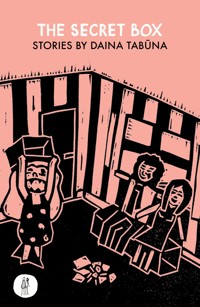
On the cusp of womanhood, Daina Tabūna's heroines are constantly confronted with the unexpected. Adult life seems just around the corner, but so are the kinds of surprise encounter which might change everything. Two siblings realise they're too old to be playing with paper dolls. A girl develops a fixation with Jesus. And a disaffected young woman stumbles into an awkward relationship with an office worker. The narrators of these three stories each try, in their own way, to make sense of how to behave in a world that doesn't give any clear answers.
Sie lesen das E-Book in den Legimi-Apps auf:
Seitenzahl: 95
Veröffentlichungsjahr: 2018
Das E-Book (TTS) können Sie hören im Abo „Legimi Premium” in Legimi-Apps auf:
Ähnliche




















THE SECRET BOX
OTHER TITLES FROM THE EMMA PRESS
PROSEPAMPHLETS
Postcard Stories, by Jan Carson
First fox, by Leanne Radojkovich
Me and My Cameras, by Malachi O’Doherty
POETRYPAMPHLETS
Dragonish, by Emma Simon
Pisanki, by Zosia Kuczyńska
Who Seemed Alive & Altogether Real, by Padraig Regan
Paisley, by Rakhshan Rizwan
POETRYANTHOLOGIES
Urban Myths and Legends: Poems about Transformations
The Emma Press Anthology of the Sea
This Is Not Your Final Form: Poems about Birmingham
The Emma Press Anthology of Aunts
POETRYBOOKSFORCHILDREN
Falling Out of the Sky: Poems about Myths and Monsters
Watcher of the Skies: Poems about Space and Aliens
Moon Juice, by Kate Wakeling
The Noisy Classroom, by Ieva Flamingo
THEEMMAPRESSPICKS
DISSOLVE to: L.A., by James Trevelyan
The Dragon and The Bomb, by Andrew Wynn Owen
Meat Songs, by Jack Nicholls
Birmingham Jazz Incarnation, by Simon Turner
Bezdelki, by Carol Rumens
THEEMMAPRESS
The three stories in The Secret Box were first published in Latvia, as part of Pirmā reize (Mansards, 2014):
Liesa, mans mīļākais organs (‘The Spleen, My Favourite Organ’)
Slepenā kaste (‘The Secret Box’)
Darījumi ar Dievu (‘Deals with God’)
© Daina Tabūna, 2014
First published by Mansards in Rīga, Latvia, in 2014
First published in Great Britain in 2017 by the Emma Press
English language translation © Jayde Will 2017
Illustrations © Mark Andrew Webber 2017
Edited by Emma Wright
All rights reserved.
ISBN 978-1-910139-90-5
A CIP catalogue record of this book is available from the British Library
Printed and bound in Great Britain by Russell Press, Nottingham
Supported by Latvian Writers’ Union (Latvijas Rakstnieku Savienība) and Ministry of Culture of the Republic of Latvia
The Emma Press Ltd
Registered in England and Wales, no. 08587072
Website: theemmapress.com
Email: [email protected]
Jewellery Quarter, Birmingham, UK
CONTENTS
DEALS WITH GOD
THE SECRET BOX
THE SPLEEN, MY FAVOURITE ORGAN
ABOUT THE AUTHOR
ABOUT THE TRANSLATOR
ABOUT THE ILLUSTRATOR
ABOUT THE EMMA PRESS
DEALS WITHGOD
I
I never knew how to behave in that flat. You weren’t allowed to touch anything in it, the sweets were a good decade or so past their expiration date, and there was a distinctive smell – a little like medicine, a little like dust, and a little like old make-up. I suspected my parents weren’t all that keen on it either, but for some reason my mum insisted that we make the trip to Baba’s place every once in a while – all the way across the city, navigating two types of public transport. Baba and everything to do with her felt weighty, saturated in a history unknown to me, there for me to touch ‘only with my eyes’ – as she would say anxiously if I tried to discover what was really inside the numerous drawers that were filled to the brim.
‘Do you pray to God?’ Baba asked me once, when my parents had vanished somewhere for a second and we were left alone. I didn’t really understand what she meant with that question. In the books my mum read to me at night, sometimes the main characters prayed to God. But that was usually if they were in big trouble. I felt that everything was fine with me – at least up to the point I’d been left alone with Baba.
Having understood that I didn’t pray to God, she muttered that my parents didn’t fear anything – this sounded to me more like something to be proud of – and then added, ‘You could pray to God, at least! Pray to God for your parents!’
I was relieved when my mum and dad returned. I wanted nothing more to do with that wrinkled, severe woman with the reproachful stare and veiny hands.
Later, when we arrived home, I couldn’t stop thinking about what Baba had said. I decided to take my uncertainty to my dad. My dad always seemed very smart and had answers to all sorts of questions – even though I didn’t understand them sometimes. This is why I thought he would also be able to shed light on the question of praying to God.
‘How should I put it… Some people believe in God, some don’t,’ my father replied, tearing his eyes away from the paper.
I didn’t understand what that meant.
‘No one has proven that God really exists… And, if God does exist, he could easily be different to the one in the Bible,’ he tried to explain.
‘So you think there isn’t any God at all?’ I was in shock.
‘Maybe there is, maybe there isn’t,’ said my father, turning back to his paper. ‘When you grow up, you’ll find out for yourself.’
‘But if there is no God, why did you have me baptised?’ I tried to find logical flaws in what he had said.
‘Better to be safe than sorry,’ he said, shrugging his shoulders.
I really didn’t like this uncertainty. It seemed more tempting to believe that God did exist after all, and that you could ask him for anything and you would receive it, however impossible; like Santa Claus, but the whole year round. All you had to do was think of what to ask for. Thus I began my first deals with God.
‘Please, please, dear God, I pray for my mum and dad to have a lot of money, so then they can buy a car,’ I whispered to myself as I went to bed – I was trying to bear in mind Baba’s entreaty to me to pray for my parents. I also offered something in return, adding: ‘I promise to pray to you every night.’ I did try to adhere to this dutifully for a while, but my parents’ financial situation didn’t change. Perhaps my desire for them to become rich hadn’t been strong enough – truth be told, I was happy with how my parents were already.
Sometime later, I devised my next request: ‘Please, please, dear God, I want to have my very own big brother.’ If anyone could make that happen for me, it would be God. My mum had already explained that she couldn’t provide me with an older brother, only maybe a younger sister or brother, and at the beginning it would be a baby and scream all the time, and it wouldn’t be able to play any games. That didn’t sound particularly appealing. A little while later I proposed the following deal: ‘Let me wake up tomorrow and have an amazing big brother. Then I won’t complain anymore about having to brush my teeth. Amen.’ By then I was beginning to suspect that maybe I should start with slightly smaller requests.
When I started going to school, I prayed: ‘I promise to always study hard, God, and please make it so we don’t have to go to Baba’s place anymore.’ This was after another boring visit featuring rock-hard little spice cakes. Among other things, Baba had started fighting with my parents yet again. ‘You want to drive me into the grave! One day you’ll drive me into the grave!’ she slurred, upset. I didn’t understand what the argument was about, and nor did it interest me – all I wanted was for it to be over. Deals with God, which Baba had started me on, were turning against her.
In any case, soon afterwards my parents told me that Baba had gone into hospital with Stroke. I didn’t understand what that meant, but I thought that Stroke must be something evil: something diabolical. From my parents’ half-whispered conversations I gathered that apparently Baba could only move one arm and one side of her face; that she couldn’t really talk and didn’t quite understand what was happening. Clearly Stroke was winning. My mum let me draw get-well cards to bring to Baba at the hospital, but she never took me along. I didn’t ask her to either. I was afraid of meeting Stroke.
They didn’t take me along to the funeral either. I would have liked to go – I was interested in what a real funeral looked like and how a real pastor behaved. But my parents didn’t agree. ‘She’s still too small for that,’ I heard my mum and dad whisper to each other in the kitchen. So, on the day, they left me with a neighbour, a woman whose sweets and biscuits tasted exactly how sweets and biscuits should taste, and went to the cemetery without me. I fell asleep on the sofa and had a dream: Baba had turned into a big ball, which my parents pushed down into something like a pit, but each time she sprang up and rolled back up. Then, when I woke up, I wondered: what was it that I was too small for, which meant that they couldn’t take me to the funeral. After all, Stroke had disappeared along with Baba – or had it?
II
After Baba’s death, I put prayer and other such things out of my mind for a while. There wasn’t much to put aside – my knowledge of God and everything related to him was pretty vague. I had read this and that about the characters of the Old Testament, because Baba had given me Bible Stories for Children as a present and I had studied the first few pages. However, I never had the patience to reach the part where Jesus came in, which is why the only thing I knew about him was how he looked: half-naked, with long hair, and tied to a cross for some reason. And also that he was the son of God. It seemed a little off-putting, because I had heard somewhere else that we were all God’s children – but clearly some were more so than others.
Once, I made up a little story about Jesus. I often used to pass the time by imagining unpleasant and abominable things happening to noble-minded and good-looking protagonists, just like in the books my mum read me. Once, while travelling on the tram with my mum, it occurred to me that I could make up my own Bible story, and why not about Jesus. Exceptin my version he was neither noble-minded nor good-looking.
The story went like this: Jesus had a sister,who I couldn’t think up a name for, so she was just called ‘Jesus’s sister’. In this story, God, the father of them both, loved the sister a little more and gave her golden sandals as a sign of his favour. That made it seem like it was her and not Jesus who was destined to do great things in their Father’s name. As a result, Jesus became envious, stole the sandals and hid them. And then he told God that his sister had lost the sandals herself, because she clearly couldn’t care less about their Father’s love – which, of course, was not true. Jesus’s sister really felt bad. So she decided to travel around the world and search for her sandals.
I thought that this kind of set-up was very good and intriguing. It stuck to the classic style of the Old Testament to a large degree, with symbolic devices, deceitful brothers and a father who loves one child more than the others, but at the same time it was something fresh and unusual, because the sisters in the Bible stories I knew never played very big roles. I decided to share my idea with my mum, because my dad was extremely smart and knew the answers to the most wide-ranging of questions, but my mum was usually very understanding. I could tell her everything I ever came up with.




