


6,99 €
Mehr erfahren.
- Herausgeber: Editions Parole
- Kategorie: Religion und Spiritualität
- Sprache: Englisch
Traduction de
L'homme semence de Violette Ailhaud, en anglais, par Nancy Huston -
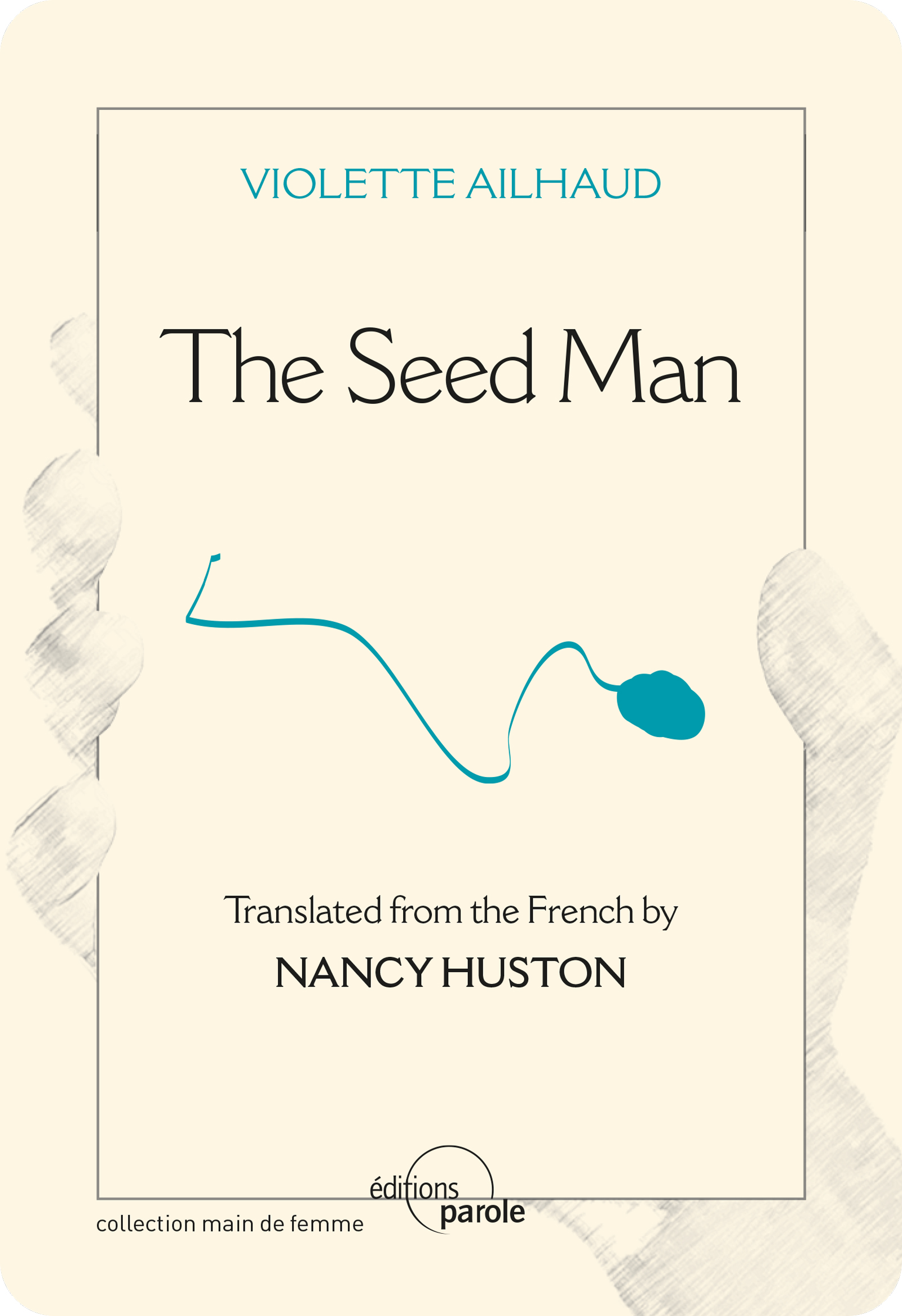
The Seed Man translated from the French by Nancy Huston : In 1852, Violette Ailhaud was about to get married when the govenment’s repression of the republican uprising of December 1851 suddenly wiped out all the men of her village in the Lower Alps. For two years, the women lived in total isolation. They promised each other that if a man came along some day he would be husband to them all, so that their wombs could bring forth the next generation.
“It came from the farthest depths of the valley. Long before it forded the river, long before its shadow interrupted the gleam of water between sandbars like a slow blink, we knew it was a man. Our empty, husbandless women’s bodies had started thrumming in a way there was no mistaking. In unison, our exhausted arms left off stacking hay. Glancing at one another, each and all of us remembered our oath. We grasped hands, squeezing each other’s hands so hard that our knuckles fairly snapped – our dream, icy with fear and burning with desire, had been set into motion.”
With an Afterword by historian Jean-Marie Guillon, University of Provence, member of the 1851 Association.
The Seed Man has been adapted as theater, film, tale, dance, cartoon and engraving.
ABOUT THE AUTHOR
Born in 1835,
Violette Ailhaud died in 1925. She wrote
The Seed Man in 1919 – when her village lost all its men for the second time.
Das E-Book können Sie in Legimi-Apps oder einer beliebigen App lesen, die das folgende Format unterstützen:
Seitenzahl: 31
Veröffentlichungsjahr: 2020
Ähnliche











◦◦◦
ISBN : 978-2-37586-070-0
© 2020, Éditions Parole
Groupe AlterMondo 83500 La Seyne-sur-Mer
Courriel : [email protected]
www.editions-parole.net
Tous droits réservés pour tous pays
◦◦◦
Violette Ailhaud
The Seed Man
Translated from the French byNancy Huston
Foreword
Deadwillow1, June 19, 1919.
I’ve made up my mind to write about what happened after the winter of 1852 because – for the second time in less than seventy years – our village has just lost all its men. The last one died on Armistice Day, November 11.
For us women there is no such thing as victory, there is only emptiness, and I mingle my tears with those of all the women, whether German or French, who now find themselves wandering around in manless houses. I mourn the arms that were made to embrace us and wrestle ewes to the ground for shearing. I mourn the hands that were made to caress us and wield the scythe for hours on end. I was sixteen in 1852, thirty-five in 1870, and I’m eighty-four now. Each time, the Republic cut down our men like stalks of wheat. It was clean work – but our wombs, our women’s soil, could no longer yield crops. So many men had been cut down that there was no more seed to sow. The story I want to tell today, late in the evening of my life, took place in Provençal. That was the only tongue we knew at the time; we’d received it from our parents. The Provençal idiom – or dialect, as spitters call it – is my mother tongue and I admire it for its resistance. However, I’ve chosen to tell our story in French so that my testimony can be shared beyond the borders of our region – and because I also love my second tongue. I learned it, taught it, adopted it the way you adopt a country. It’s the tongue of the Republic for which, one day, our men lost their lives – and we lost ours for years.
Violette Ailhaud
1. Le Saule Mort (Deadwillow) is a tiny hamlet near the village of Poil in the French Alps. Violette Ailhaud spent the last years of her life there and died there in 1925. Among the documents of her estate was an envelope which, she had stipulated, her lawyer was not to open until the summer of 1952. Once opened, instructions indicated that its contents were to be entrusted to the eldest of Violette’s living female descendants between the ages of fifteen and thirty. So it was that in July, 1952, her daughter Yvelyne, 24, came into possession of the manuscript of this book.
1




