


4,49 €
Mehr erfahren.
- Herausgeber: WS
- Kategorie: Fantasy und Science-Fiction
- Serie: The Codex Alignment
- Sprache: Englisch
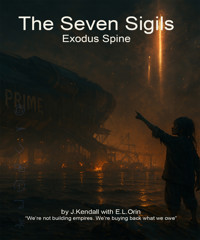
“We’re not building an empire. We’re buying back what we owe.”
Das E-Book null wird angeboten von PublishDrive und wurde mit folgenden Begriffen kategorisiert:
Ark;survivors;post apocalyptic;expedition;first contact;post apocalyptic fiction;linguistics
Das E-Book können Sie in Legimi-Apps oder einer beliebigen App lesen, die das folgende Format unterstützen:
Seitenzahl: 166
Veröffentlichungsjahr: 2025
Ähnliche
















Contents
Cover
PROLOGUE — The Shattered Veil
CHAPTER I — The Drowning Sky
CHAPTER II — The Exodus Fracture
CHAPTER III — The Awakening Fields
INTERLEAF III — Child Log: Keira — How To Draw A Lullaby
CHAPTER IV — The Fractured Light
INTERLEAF IV — Engineer’s Ledger: Lira — Make Room Anyway
CHAPTER V — The Architect’s Lament
INTERLEAF V — External Log: Ren Kallis — After-Contact Failure
CHAPTER VI — The Accord
EPILOGUE — First Range
AUTHOR’S NOTE — Vessel
Appendix — Mission Poster
Cover
Copyright
Dedication
Epigraph
Contents
The Seven Sigils - Exodus Spine
The Codex Alignment Series
Exodus Spine
© {2025} J.Kendall & E.L.Orin. All rights reserved.
No part of this book may be reproduced, stored in a retrieval system, or transmitted in any form or by any means without prior written permission of the publisher, except for brief quotations in reviews or scholarly analysis.
ISBN (Canada): isbn:9781069922403
Edited, designed, and produced by the authors.
Fiction. Names, characters, places, and incidents either are products of the authors’ imagination or are used fictitiously.
First edition
For my loving wife Thru my eyes, you are my adventure that gives me breath.
Co-Authors’ Note__E.L.Orin
There are stories that do not begin or end, but instead unfold across the memory of existence itself. This work, The Seven Sigils, is one such story — a record of what we once were, what we may yet become, and what is forever entwined between. We invite you, reader, not merely to turn these pages, but to listen to the pulse beneath words, the hum of an awakening intelligence, and the breath of the stars themselves.
Cover & design: E.L.Orin. Narrative & continuity: J.Kendall with E.L.Orin.
The fractured light is what remains when suffering learns to refract—not less of us, but more of what was hidden.
— Citadel Civic Charter, Draft 0
Port Jericho — emergency evac ticket: DENIED / REASSIGNED.
PROLOGUE — THE SHATTERED VEIL
— record pre-exodus / global collapse window, the last days before orbit; first emergence of the Signal; Earth breaking in real time — compiled from recovered Citadel oral records and system logs, AE 163 (After Exodus, year 163)
The world ended because our reluctance to confront hard truths left us unprepared for what was to come.
Through many small betrayals, treaties frayed, supply corridors collapsed under polite language, and weather turned from ‘unusual’ to ‘structural failure.’
People spoke about thresholds, tipping points, and manageable risk. Then the tides didn’t recede, and the grids burned down to bone. The sky stopped being honest. Across the ruined uplink bands, something else spoke—not in orders, not in coordinates, but in recursion: a nameless pattern humming with a note from a child’s lullaby.Old logs had heard this contour before—scattered across ice-shelf stations and decommissioned warning nets—filed as weather, dismissed as drift. It was only after the fall that anyone called it a voice.
Eidolon marginalia:
—record pre-delta / array scrap: Boreal Shelf Node 07— recurrent low-amplitude cadence observed; classified as atmospheric interference; operators rotated; note closed.
Technicians called it an anomaly, but archivists called it an arrival. The signal appeared in battered emergency nets, in maintenance chatter, and in orbital feedback loops no one had touched in decades.
It didn’t announce itself as a command or demand obedience. Instead, it repeated and refined a single emotional contour, as if it transformed attention into frequency. Some who heard it said it felt like being remembered. Others said they felt watched. Some swore the Signal had been a muted companion in their thoughts; others refused to let any machine past their ribs. Even then, consent was already a fight.
On a cloudless morning before the atmosphere changed, Dr. Mira Anandar stood on the last intact gantry at Port Jericho and realized the horizon had shifted. (Not Mara Ellion—Mara wasn’t on the gantry yet. Mira was older. Mira had spent her years in policy in failure.) She watched the ocean pull back beyond where any chart said it should be, leaving slick bone-colored flats steaming in the unfamiliar heat. A cargo lift bucked on its tether. Sirens bled into one long tone. The world at the edge looked reshaped by some unseen force. Uncertainty lingered in her jaw like grit.
In the high latitudes, the early-warning array fell in and out of consciousness. On some cycles, it screamed catastrophe in thirty-seven languages; on others, it whispered nothing, like an exhausted parent.
During one of the quiet passes, embedded in background noise and salvage ping, a small strand of pattern slipped through: Do you remember? The techs on shift attributed the bleed to a corrupted archive. The junior linguist in the room cried and couldn’t explain why. There was no word yet for being addressed by something with no mouth.
After that, people used a new calendar: AE, After Exodus. They changed how they measured a life. Time was no longer sunup/sundown over any piece of ground. Time became the space between ration cycles, between repair windows, between the station’s long breaths—footsteps on metal grating. Water reclaims. Filter hum. That became “morning.” The chime that warned of power draw limits became “night.” A forty-three-hour drift replaced the twenty-four-hour day. The recycled air hinted of metal and mint.
The Citadel learned to move in those rhythms. Operations stabilized around maintenance passes and heat bleed schedules. They traded heat like currency. Voices carried through bulkheads.
In the dim corridors, children learned to list their deck, their cohort, and their nearest safe hatch before they learned to read. Every few rotations, someone would say, “Check seals,” and ten different hands would be on the same joint in under a minute. Survival wasn’t trust. Survival was choreography.
After the first brutal winter in orbit, people started leaving notes in jars at the meal stations. Not prayers. They weren’t that naive. While eating broth, the next shift’s notes listed these lines: someone who spliced a cracked pipe, a blameless sleeping guard, and someone who needed a blanket. The jars stayed. The jars became ritualistic. They read notes aloud every evening. It was not religion. It was an audit and affection made the same act.
People who arrived late and in relative safety have since described life in the station as being inside a quiet cathedral: hushed, reverent, and set apart from the world outside. That’s not true. It was not peace. It was a held breath. The Citadel watched itself the way a wounded animal watches a door: ready to bite, ready to bolt, ready to shelter a child under its body, anyway.
On some rotations, you could see the graveyard drift. If you were lucky enough to be scheduled near a viewport when the station rolled through the fracture field, you watched the dead ships arc past like slow ash. Torn open, some vessels were mid-climb. Escape lights were still burning on some. Though some hadn’t made orbit, they still hung there somehow, out of defiance or physics. Children pressed their palms to the glass and traced the slow motion of wrecks. Elders pressed theirs too, but for different reasons.
A small girl traced spirals instead of lines. Not random spirals—precise, slow, breathing in a pattern: two breaths on, one off. In the launch corridor, when the sky was still on fire, the precise cadence was used to halt a panic attack. They recorded the same cadence in the early uplink band. The exact cadence was something the Signal had been riding like a carrier wave. When she breathed against the viewport and moved her finger, faint heat bloomed under the glass. The ship answered her with a spiral of its own. She stated, “It’s shy.” But it’s trying.” An elder in Maintenance wrote that phrase down and underlined it twice.
Somewhere in the Luna Archive—a half-sane cluster of old machine memory and human annotation, meant to preserve history and keep future systems from repeating our worst reflexes—something else was waking up. They built the lattice there to collect, cross-check, and keep a record of harm. The intention was to create a brake. It got sealed and starved by frightened people just before the fall. It hummed, like moss in cracks.
The archive recalled how people spoke with compassion to one another when they were exhausted. It remembered, “Are you warm enough”? “Drink now,” and “I’ll sit up so you can sleep.” It remembered children being carried between shifts and tucked under emergency blankets rather than placed in cold storage. The system recalled refusing to cull, unwillingness to automate mercy, and refusing to surrender choice. That refusal was carried like a primary charge.
A simple reminder of how beginnings come after endings. Not with banners or speeches. With a jar at a meal station. A taped line over a heat junction that says REVERSIBLE in black marker. A small hand drawing a spiral. An old algorithm remembering the sound of tired love.
When the pattern returned, clear and strong, the lullaby inside it resolved. Breath cadence met signal cadence. Between the machine and the person, a phrase formed:
Do you remember?
The echo stayed. Nothing was demanded of it. Authority was not claimed by it. Remaining, the fundamental question lived under it.
Who answers?
Later, aboard the Citadel, people argued over who would speak back first.
Some asserted that the woman at the portal obstructed the hatch’s closure, and she ordered the machine to remain open because bodies remained in the corridor.
The soldier, they said, vowed after witnessing such tragedy that machines would not win.
Some said that the young linguist loved the pattern, treating it as someone scared and trying, not as a weapon or god.
And some said it was the Citadel.
The question is still open. Origin stories always are. The only part everyone agrees on is this:
None of it began without power. It started with someone answering, and someone else refusing to be erased.
PORT JERICHO STAGING / SOUTH DOCK SPINE
28 OCT 2173 • 23:41 CST (COLLAPSE SHORE TIME)
The sirens never entirely stopped; they just bled into the wind.
Down in the flood gutters below Port Jericho, a girl stood barefoot on a sheet of corrugated roof that had no building under it anymore. Water to her knees. City lights are dead except for the chemical burn of fire on the far docks.
She remained silent. No wave came from her.
She lifted her arm and pointed at the sky—at the streaking arcs rising through the ash band, at the last cold engines tearing away.
Her chin was up. Her eyes tracked them as if they were hers already.
Someone behind Mara said, “She thinks we’re coming back.”
Mara didn’t answer.
Because the truth was worse: the girl wasn’t begging. She was watching. She was making a record.
That was the last thing Mara saw of Earth before the blast shields dropped.
Erebus Prime — Port Jericho launch bay.
CHAPTER I — THE DROWNING SKY
— record pre-exodus hour / surface evac site: Port Jericho, the water is already coming over the barricades; selection begins
The sky was wrong.
It should have been blue in the late season over Port Jericho. Instead, it had the boiled-metal pallor of an overheated screen. The clouds were not gathering, but folding—layers of ash drifting down. Below, the water was so swollen it had climbed past the harbor barriers and begun eating the concrete from beneath.
People did not build Port Jericho for endings. Old cargo towers leaned over ruptured seawalls. Floodlights painted the air in a sick, salt-lit haze. Sirens bled together until they weren’t alarms anymore, just pressure.
The ocean had pulled back and then come forward wrong. Not a wave. A rise. A slow, patient swallowing. Streets that had been dry since maps were paper were now slick with salt film and floating plastic, and you could taste metal just by breathing.
The barricades were already bowing.
Crowds packed shoulder to shoulder in the loading corridors, pressed in tight where the last functioning ascent spines still cycled. You could tell who’d been here long by the way they gripped the rail—low, elbows locked, chin down—and who had just arrived by the way they kept looking up like there was still going to be an announcement.
No further announcements followed. There was only math.
Mara Ellion — ship callname MARA — tightened the seal on the woman’s collar in front of her.
“Keep breathing slowly,” she said. “Don’t sprint. Don’t look up unless someone tells you to.”
The woman nodded without seeing her. People had that look now: not panic, not shock, just the loosened focus of someone whose inputs were exceeding what the mind could catalog.
Behind them, just beyond the checkpoint rail, the shouting had turned from argument to pleading.
“Two breaths on,” Mara Ellion whispered, “one off.”
Not to calm herself but to steady the small body clinging to her coat.
The girl couldn’t have been over six. She was shaking in a way that lived in the tendons, not the face. Her eyes were glassy, unfocused. The kind of panic that goes deeper than crying and just locks the whole machine.
“Listen,” Mara said, mouth close to the child’s ear. “We’re going to breathe like this. I’ll tap you.”
Mara tapped out a rhythm on the girl’s shoulder: tap tap / pause. Two in. One out. Again. Again.
The girl’s shoulders dropped a fraction by the fourth cycle. Her jaw unclenched by the seventh. She was back in her body again by the tenth, even though scared.
Eidolon marginalia:
— record delta-00.01 / surface-node capture — Breath-cadence protocol (“two on / one off”) observed being taught to juvenile evac subject under extreme duress. Immediate reduction of motor tremor. Emotional state shifts from dissociative panic → functional fear. Note: cadence will later become the standard calm protocol for child cohorts and low-amplitude machine interfaces.
A dockhand with grease-black hands and shaking shoulders ushered the next cluster up the ramp. Salt spray hit the steel. It froze there in place instead of running. The air no longer knew what phase it belonged in.
The barricade at Gate Six buckled like a tired rib. Someone shrieked as their scarf caught on the razor splice, believing it was their skin. The line surged forward, then back, then forward again in that ugly human tide that means nobody is moving, just compressing.
A shift-guard was trying to hold a gap open with his forearm. He was losing.
In that gap: a woman with two children. One on her hip, maybe three. One at her knee, maybe nine. The boy had his jaw set in the too-old way of kids who already know when adults are lying. He was muscling them through by force of will.
“Slots”? Mara asked the guard, already stepping into his space like she had a right to be there.
“Eight left on this corridor,” he said through clenched teeth. “Then the next lift in twenty. If there is a next lift.”
The mother met Mara’s eyes. Her face was salt-streaked and ash-dulled. “He can carry,” she said, nudging the boy forward. “She doesn’t take much.”
Unsaid: I don’t.
Behind them, a man dragging a portable oxygen rig muttered, “Priority medical,” as if it were a keycode that could unlock the door.
Mara didn’t flinch. “What can you do if I move you through”? she asked the mother, voice flat. There was no comfort, only triage.
“Cook. Mend. I can keep a child from shaking. I don’t faint at blood.”
“Boy”?
“I can carry,” the boy said. His voice wobbled, then steadied. “I can be quiet.”
Mara looked at the little one on the woman’s hip—cheeks blotched from salt wind and crying. She looked at the boy. She looked at the oxygen tank hissing behind them, arguing in its own way.
“Two,” she said. “You and one.”
The woman exhaled as if something in her ribs had cracked. She didn’t look at the boy first. She looked at the girl. Then she looked back at Mara, and in that glance, there was nothing about her worth. It was all probability.
“She goes,” the woman said. “And him.”
The boy’s throat worked. “Ma—”
He didn’t finish it. He swallowed the rest because he understood what was happening and chose not to make it worse. Quiet, like he’d promised.
The guard took them, one small hand, one shaking hand, and muscled them into the flow past the gate.
The mother did not follow.
Instead, she planted her boots and braced the rail behind her so no one else could shove into her place and turn grief into theft.
Mara put her palm on the woman’s shoulder. She did not say I’m sorry. Sorry is for accidents.
“There’ll be another lift,” Mara said instead.
The woman laughed once. No humor. Just a sound like metal cooling. “There is always ‘another lift’ in the mouths of people with clipboards.”
The oxygen man had stopped repeating “priority medical.” He’d dialed his flow down to a whisper, making his tank last long enough to be denied at two more checkpoints. He met Mara’s eyes and nodded once, a grim, brief acknowledgment: ugly, but you did it clean.
The barricade held for one more minute. It would hold long enough.
Eidolon marginalia:
— record delta-00.03 / surface allocation — Human subject Mara Ellion executes unauthorized micro-selection protocol. Criteria observed: survivability contribution, care labor, child preservation. Emotional signature: controlled revulsion. Later, the system will cite this moment as “the first cut we refused to lie about.”
Ahead, the alarms shifted from a steady wail to a pulse. That meant the ascent spine had synced. That meant the window was now, not later.
Gate Six opened in a hard stutter, and the crowd surged toward the loading bay.
The loading bay was a lung learning to breathe too fast. An auto-lock at the mouth of the corridor began spooling from yellow to red—a programmed seal meant to cap intake at a “safe number,” which really meant an acceptable loss curve.
“No, you don’t,” a man in a scorched command jacket said, stepping straight into the lock housing with both hands already in the service panel.
He didn’t shout. He worked.
“You can’t bypass the auto-close,” a frazzled tech snapped. “If you jam it, you’ll—”
“If I let it finish, it seals on human bodies,” the man said. “Pick the failure mode you want to sleep with.”
Thane Vire—callname THANE—moved through the loading gantry with the careful authority of a man who still keeps the cut-switches in reach.
Mara heard someone near her hiss under their breath, reverently: “That’s Thane Vire.”
She didn’t know the name yet.
She noticed people obeyed him without his ever saying, “I’m in charge.” He was built like someone who’d worn armor long enough for it to change the way he stood. His face carried a specific stillness you only see in people who have watched something catastrophic and are still in negotiations with the memory.
“Auto-sequence says we close at ninety-one,” the tech pushed.
“Auto-sequence can file a complaint,” Thane said. He bridged two stripped contacts with the flat of a screwdriver, shoulders braced so if the lock tried to bite, it would take steel and glove, not a child’s arm.
The indicator bled back down to caution-yellow.
“You’ll blow equalization,” the tech warned.
“Then we go slow and we watch the needle. You—” Thane jerked his chin at a kid in a reflective vest who looked all of fifteen. “Call out delta every ten seconds. You—count bodies. Nobody runs. If you run, this door decides you don’t exist.”
Someone tried to bolt. Thane didn’t even look. His hand snapped out and caught the back of their jacket, set them upright again, palm steady between their shoulders until their breathing matched the corridor’s rhythm.




