


0,49 €
Niedrigster Preis in 30 Tagen: 1,99 €
Niedrigster Preis in 30 Tagen: 1,99 €
Mehr erfahren.
- Herausgeber: Booksell-Verlag
- Kategorie: Gesellschafts- und Liebesromane
- Sprache: Englisch
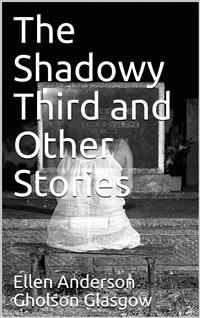
In "The Shadowy Third, and Other Stories," Ellen Anderson Gholson Glasgow weaves a tapestry of Southern Gothic narratives that explore the complexities of human nature and the intricacies of societal expectations in the early 20th century. Glasgow's prose is marked by rich imagery and psychological depth, inviting readers into the minds of her characters who grapple with themes of identity, femininity, and the constraining nature of tradition. The collection evokes a haunting atmosphere, blending elements of realism with an undercurrent of the supernatural, reflective of Glasgow's preoccupation with the social mores of her time. Ellen Glasgow, a prominent American author of the early 1900s, is celebrated for her keen insight into Southern life and the struggles of women. Born into a Virginia family steeped in tradition, her personal experiences and the societal changes around her profoundly influenced her writing. Glasgow was known to challenge the status quo, advocating for women's rights and the examination of personal autonomy, themes that resonate deeply throughout this collection. I highly recommend "The Shadowy Third, and Other Stories" to readers who appreciate meticulously crafted narratives that confront the shadows of society while offering a lens into the tumultuous emotions of human experience. Glasgow's stories are not only engaging but also provide profound reflections on the cultural landscape of her era, making this collection an essential read for both enthusiasts of Southern literature and those interested in early feminist discourse. In this enriched edition, we have carefully created added value for your reading experience: - A comprehensive Introduction outlines these selected works' unifying features, themes, or stylistic evolutions. - A Historical Context section situates the works in their broader era—social currents, cultural trends, and key events that underpin their creation. - A concise Synopsis (Selection) offers an accessible overview of the included texts, helping readers navigate plotlines and main ideas without revealing critical twists. - A unified Analysis examines recurring motifs and stylistic hallmarks across the collection, tying the stories together while spotlighting the different work's strengths. - Reflection questions inspire deeper contemplation of the author's overarching message, inviting readers to draw connections among different texts and relate them to modern contexts. - Lastly, our hand‐picked Memorable Quotes distill pivotal lines and turning points, serving as touchstones for the collection's central themes.
Das E-Book können Sie in Legimi-Apps oder einer beliebigen App lesen, die das folgende Format unterstützen:
Veröffentlichungsjahr: 2019
Ähnliche












The Shadowy Third, and Other Stories
Table of Contents
Introduction
This single-author collection gathers a group of short stories by Ellen Anderson Gholson Glasgow under the capacious title The Shadowy Third, and Other Stories. It presents, in compact form, a representative arc of Glasgow’s shorter fiction, allowing readers to encounter her art at its most concentrated and incisive. While she is often approached through her novels, these tales reveal parallel strengths: disciplined construction, psychological precision, and a uniquely Southern sense of place inflected by memory and doubt. The aim is not to be exhaustive, but to bring into close conversation a set of narratives that illuminate one another, framing Glasgow’s concerns with conscience, history, and the ambiguous borders of experience.
The volume consists exclusively of short stories, and within that single form it spans several recognizable modes. Some pieces move within the tradition of the ghost story, unfolding with a controlled eeriness and an insistence on uncertainty. Others are domestic dramas and moral case studies, attentive to the pressures of marriage, kinship, and community. Still others shade into what is often called the Southern Gothic, where the past presses irreducibly upon the present and houses become repositories of inheritance. Across the set, Glasgow uses the capacities of short fiction—compression, suggestive detail, and decisive turns—to explore character under strain without the scaffolding of the novel.
Read together, these stories cohere around unifying themes that Glasgow pursued throughout her career. They return to the tension between rational explanation and the pull of intuition; to the lingering force of earlier eras on contemporary lives; and to the moral testing of individuals who must decide what they can live with. Professional observers—nurses, physicians, and other intermediaries—often serve as witnesses, bringing habits of attention that both clarify and complicate what is seen. Domestic interiors provide the stage where power is negotiated and secrets accrue. The result is fiction that is at once intimate and societal, situating private choices within inherited frameworks of duty, gender, and class.
Stylistically, Glasgow is notable here for restraint and clarity. Her prose prefers the precise image to the flamboyant gesture, and her irony is cool rather than caustic. She alternates between first-person testimony and closely focalized third-person narration, maintaining a disciplined distance that amplifies unease. Apparitions, when they appear, are handled with careful ambiguity; the sentences never insist, they suggest. Settings in the American South are evoked through specific textures—weather, architecture, manners—without lapse into caricature. The architecture of the stories is economical: beginnings that pose a moral or perceptual problem, middles that test it, and endings that leave a lingering resonance rather than a solved equation.
As a whole, the collection remains significant because it shows how early twentieth-century short fiction could carry both social observation and metaphysical doubt within the same brief compass. Glasgow’s attention to women’s experience, to the costs of silence, and to the limits of authority lends these tales enduring relevance. They complicate the tidy distinctions between realism and the supernatural, suggesting that what haunts may be as much ethical as spectral. For readers familiar with her longer works, these pieces broaden the portrait of her achievement; for new readers, they offer an accessible entry into a writer who balanced sympathy with skepticism and tradition with critique.
Across the collection, narrative situations are sharply drawn and immediately compelling. One tale follows a trained nurse who enters the orbit of a celebrated doctor and his frail wife, her professional detachment unsettled by what she perceives. Another turns on an inherited house and the moral legacies it imposes on those who dwell there. A third traces how a return to familiar rooms awakens what has not been resolved. In one, a child’s safety is bound to the persistence of an old household bond. Elsewhere, an ethical choice frays on contact with life. One story reconsiders a marriage through unwelcome knowledge. Another brings a physician to an isolated estate shadowed by decline.
Approached in sequence or singly, these stories reward attentive reading. Glasgow’s narrators often understate what they know; meanings gather in pauses, in offhand remarks, and in objects that recur with quiet insistence. Thresholds, doors, stairways, and windows mark transitions between the seen and the suspected. The South here is not a backdrop but a living context that complicates conscience. Without grand declarations or melodrama, Glasgow asks how people live with what they have done and with what has been done to them. The cumulative effect is not of puzzle-box solutions, but of moral and emotional clarity arriving, obliquely, as the reader senses the design at last.
Historical Context
Ellen Anderson Gholson Glasgow (April 22, 1873–November 21, 1945) wrote from Richmond, Virginia, charting the South’s long transition from the Civil War to modernity. The Shadowy Third, and Other Stories appeared in 1923 with Doubleday, Page & Company (Garden City, New York), gathering tales largely written across the 1910s and early 1920s. The collection reflects themes that run through her career: the decline of old families, the strains of industrial change, women’s constrained choices, and the persistence of memory. Glasgow’s realism and irony, honed in novels like Virginia (1913) and Barren Ground (1925), also animate these shorter fictions, where intimate dramas are framed by broader historical pressures in postbellum Virginia.
Glasgow matured as a writer while the Lost Cause shaped public memory. In Richmond, monumental culture codified this vision: the Robert E. Lee statue rose on Monument Avenue in 1890, followed by memorials to Jefferson Davis and J. E. B. Stuart in 1907. Organizations like the United Daughters of the Confederacy (founded 1894) curated schoolbooks and rituals. Against this backdrop, Glasgow resisted romantic plantation myth, depicting instead moral ambiguity, economic decay, and the costs of pride. The pervasive cult of ancestry in Virginia society supplied the atmosphere for many of her plots, in which inherited obligations and reputations weigh on households struggling to face the twentieth century.
At the same time, the “New South” creed advanced by figures like Henry W. Grady promised prosperity through industry and urban growth. Glasgow’s own family ties linked her to that transformation: her father, Francis T. Glasgow, served for decades with the Tredegar Iron Works in Richmond, a symbol of Southern heavy industry. Tobacco processing in Richmond and Danville, rail expansion by the Chesapeake and Ohio Railway, and rising commercial classes unsettled agrarian hierarchies. These changes inform the collection’s tension between the city and the countryside, professionals and planters, cash and credit. Characters wrestle with mortgages, modernization, and the erosion of deference that once buttressed Virginia’s gentry.
Questions of women’s authority and marriage run through Glasgow’s oeuvre and echo contemporary campaigns in Virginia. The Equal Suffrage League of Virginia, formed in Richmond in 1909 under Lila Meade Valentine with novelist Mary Johnston as a prominent ally, agitated for the vote until the Nineteenth Amendment was ratified in 1920. Clubwomen debated divorce reform, maternal health, and property rights amid lingering Victorian codes. Glasgow’s women often confront the double standard endorsed by law and custom, measuring fidelity against self-respect. Their moral calculations reflect a wider Progressive Era discourse in which education, employment, and civic participation challenged the paternalism of courthouse politics and parlor etiquette.
Racial caste shaped daily life in the settings Glasgow knew. The Virginia Constitution of 1902 entrenched disfranchisement through poll taxes and literacy tests, while local ordinances segregated streetcars and neighborhoods after Plessy v. Ferguson (1896). The Racial Integrity Act of 1924, administered by registrar Walter A. Plecker, policed identity and intimacy. Black labor, especially domestic service, sustained elite white households even as emancipation’s promises were thwarted. Folklore, church life, and the memory of slavery persisted in stories told across the color line, resonating with literary precedents such as Charles W. Chesnutt’s The Conjure Woman (1899). Glasgow’s haunted spaces and ancestral legacies are inseparable from this Jim Crow order.
The authority of physicians and the ascendancy of psychiatric and hereditary explanations for behavior pervade early twentieth-century debates that Glasgow dramatized. Freud’s 1909 lectures at Clark University popularized psychoanalysis in America, while eugenics won legislative backing. In Virginia, the Virginia Colony for Epileptics and Feeble-Minded opened at Lynchburg in 1910 under Dr. Albert S. Priddy; Buck v. Bell (274 U.S. 200, 1927) later upheld compulsory sterilization in a decision by Justice Oliver Wendell Holmes Jr. Country doctors, as well as city specialists at institutions like the Medical College of Virginia in Richmond, became arbiters of normality and deviance. Her narratives test the limits and ethics of such scientific certainties.
Glasgow’s attraction to the uncanny drew on a transatlantic fascination with spiritualism and psychical research that spanned the Gilded Age and Progressive Era. The Society for Psychical Research was founded in London in 1882 and its American counterpart in 1885, as mediums, table rappings, and spirit photography entered salons and newspapers. Post–Civil War bereavement and, later, the 1918 influenza pandemic primed audiences to imagine porous borders between the living and the dead. Literary models—from Henry James’s The Turn of the Screw (1898) to Edith Wharton’s magazine ghost tales—legitimized sophisticated spectral fiction. Glasgow harnessed these currents to probe memory, guilt, and the moral residues of past injustices.
These stories also belong to a vibrant magazine culture. Before Doubleday, Page issued the collection in 1923, Glasgow frequently placed work in national periodicals such as Harper’s Magazine, The Century, and Scribner’s, whose editors cultivated regional realism with modern psychological shading. World War I (U.S. entry 1917–1918) and the shock of mass death altered tone and theme across American letters, encouraging irony and disillusion. In Virginia, the postwar recession and agricultural collapse foreshadowed Barren Ground (1925) and shadow this collection’s preoccupations. Alongside contemporaries like James Branch Cabell in Richmond, Glasgow bridged local history and cosmopolitan technique, a trajectory later crowned by her Pulitzer Prize in 1942.
Synopsis (Selection)
THE SHADOWY THIRD
A young nurse enters the household of a celebrated surgeon and his fragile wife, where the recurring sense of a child’s presence disturbs the home. The haunting atmosphere reveals hidden tensions and a troubling imbalance of power.
DARE’S GIFT
In an old Virginia house with a revolutionary past, women in two eras face parallel tests that pit private loyalty against public duty. Their choices trace a legacy—the 'gift'—of daring acts that blur betrayal and sacrifice.
THE PAST
A new wife struggles with the lingering pull of her husband’s former life, felt as a presence that clings to their home. She must confront how memory can overshadow the present unless consciously set aside.
WHISPERING LEAVES
The protective ghost of an enslaved nurse returns to watch over a neglected child in a fading Southern household. The rustle at the window signals a steadfast, quiet defiance of indifference and harm.
A POINT IN MORALS
A local scandal forces a conscientious man in a small town to choose between strict principle and compassionate expediency. The decision turns on a subtle 'point in morals' with lasting social consequences.
THE DIFFERENCE
Upon discovering her husband’s infidelity, a society woman seeks out the other woman and reassesses her marriage. The encounter clarifies the 'difference' between how men and women love and the terms on which she will continue.
JORDAN’S END
A country doctor visits a once-grand plantation where a family is succumbing to hereditary decline. His brief stay reveals a stark tableau of decay, confinement, and the burdens of legacy.




