


0,49 €
Niedrigster Preis in 30 Tagen: 1,99 €
Niedrigster Preis in 30 Tagen: 1,99 €
Mehr erfahren.
- Herausgeber: Booksell-Verlag
- Kategorie: Poesie und Drama
- Sprache: Englisch
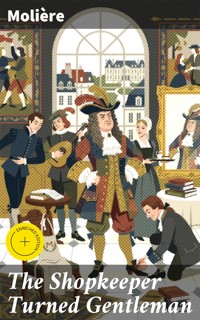
In 'The Shopkeeper Turned Gentleman,' Moli√®re presents a satirical exploration of social class and pretension in 17th-century France. Through the character of Monsieur Jourdain, a bourgeois shopkeeper who yearns for aristocratic status, Moli√®re deftly critiques the absurdities of social climbing, blending comedy with poignant observations on the nature of identity and self-deception. The play employs witty dialogue, farcical elements, and clever characterizations, characteristic of Moli√®re'Äôs unique blend of humor and realism, reflecting the tensions of the period's shift from feudalism to a burgeoning merchant class. Moli√®re, born Jean-Baptiste Poquelin, was a prominent playwright whose works encapsulate the social dynamics and cultural issues of his time. His own experiences in the theatre and interactions with Parisian society informed his understanding of class and human folly, allowing him to craft characters that resonate across centuries. 'The Shopkeeper Turned Gentleman' illustrates his signature genius in blending satire with social commentary, ultimately revealing the folly and complexity of human behavior. This delightful comedy is highly recommended for readers interested in the intersections of class, identity, and humor. Moli√®re's masterful critique remains timeless, encouraging audiences to reflect on their conceptions of gentility and authenticity, making this play not only entertaining but also profoundly relevant. In this enriched edition, we have carefully created added value for your reading experience: - A succinct Introduction situates the work's timeless appeal and themes. - The Synopsis outlines the central plot, highlighting key developments without spoiling critical twists. - A detailed Historical Context immerses you in the era's events and influences that shaped the writing. - An Author Biography reveals milestones in the author's life, illuminating the personal insights behind the text. - A thorough Analysis dissects symbols, motifs, and character arcs to unearth underlying meanings. - Reflection questions prompt you to engage personally with the work's messages, connecting them to modern life. - Hand‐picked Memorable Quotes shine a spotlight on moments of literary brilliance. - Interactive footnotes clarify unusual references, historical allusions, and archaic phrases for an effortless, more informed read.
Das E-Book können Sie in Legimi-Apps oder einer beliebigen App lesen, die das folgende Format unterstützen:
Veröffentlichungsjahr: 2019
Ähnliche















The Shopkeeper Turned Gentleman
Table of Contents
Introduction
A prosperous man discovers that money can purchase lessons, costumes, and compliments, but it cannot guarantee the dignity he craves.
The Shopkeeper Turned Gentleman is a classic because it crystallizes, in brisk comic form, a conflict that has never stopped animating literature: the desire to remake oneself in the image of an admired social world and the humiliations that attend that pursuit. Its comedy is not merely decorative; it is an instrument for exposing vanity, opportunism, and the ease with which style can masquerade as substance. The play’s fame endures because it invites laughter while insisting that the audience recognize patterns of self-deception that are both personal and social.
The work is by Molière, the great seventeenth-century French playwright whose comedies helped define the theatrical culture of his age. This English version is associated with Charles Heron Wall, who produced a translation that brought Molière’s wit and stagecraft to readers outside the French language. As with many translations, it serves as a bridge between periods and audiences, helping a modern reader encounter a landmark of European drama through the cadence and idiom of English.
Composed in the seventeenth century, the play belongs to a moment when French theater was refining neoclassical taste while also responding to the realities of court culture, urban ambition, and shifting social aspirations. Molière wrote for performance, and the energy of the stage is part of why the piece has survived so vividly: scenes are built to move, to surprise, and to reveal character through action rather than through prolonged reflection. That theatrical economy has made it a durable text for readers and performers alike.
The central premise is simple and elastic: a wealthy shopkeeper, dissatisfied with his place in society, resolves to be taken for a gentleman and pursues the manners he believes will secure that transformation. Around this resolve gathers a set of figures—teachers, advisers, and opportunists—whose livelihoods or advantages depend on flattering his dream. The comedy arises from the collision between sincere aspiration and a world quick to monetize it, a situation that can be staged broadly yet still feel pointedly intimate.
Classic status is also earned through craft. Molière’s scenes are engineered to let social ideas appear in everyday behavior: how people speak to one another, how they perform politeness, how they bargain for attention, how they hide calculation behind ceremony. The play’s structure highlights the mechanisms of persuasion and the pleasures of illusion without requiring the audience to adopt a single moral posture. Instead, it asks for alertness—an ability to notice how often admiration, envy, and self-interest share the same vocabulary.
The enduring themes are as recognizable now as they were in Molière’s time. Social climbing, the anxiety of being judged, and the longing to belong are presented not as abstract problems but as impulses that drive ordinary decisions. The play examines how status can become a kind of theater in itself, complete with scripts, roles, and rehearsals. It also explores how quickly the desire for refinement can be redirected into conspicuous display, and how easily sincerity can be exploited by those skilled in performance.
Molière’s influence on later writers is widely acknowledged in the history of European comedy: the blending of satirical observation with stage vitality, the focus on character types who nonetheless feel human, and the insistence that laughter can carry critique without dissolving into sermon. The Shopkeeper Turned Gentleman, in particular, has served as a touchstone for depictions of pretension and social aspiration. Its patterns—anxious self-fashioning, parasitic mentorship, and a household caught in the wake—recur across later drama and fiction in varied forms.
For a reader approaching the play through Charles Heron Wall’s English rendering, part of the interest lies in how translation transmits comic timing and social nuance. Molière’s humor often depends on quick turns in speech and on the gap between what a character intends and what the world hears. A translation must therefore balance clarity with liveliness, preserving the sense that the comedy is made for voices and bodies, not only for silent reading. Wall’s association with the text reflects the long tradition of making Molière readable and playable in English.
The play also invites reflection on education and culture—what they are for, who controls them, and how they can be misused. Lessons in “gentility” become a market, and cultural capital becomes something one can attempt to purchase in pieces. Yet the work does not reduce refinement to fraud; it shows how the desire for cultivation can be genuine even when misguided. That ambivalence is one reason the comedy stays fresh: it does not simply mock a fool, but examines a human vulnerability.
Without revealing the turns of the plot, it is enough to say that the drama gains momentum by placing a single obsession under pressure from competing interests. Domestic concerns, financial incentives, and social performances all intersect around the shopkeeper’s project of self-transformation. The resulting situations are comic, but the underlying questions are serious: what counts as honor, who gets to define taste, and how much of identity is chosen versus imposed. The play’s durability comes from that double register of amusement and inquiry.
Today, the themes resonate in a world of curated personas, credential markets, and anxious comparisons conducted in public view. The play’s satire of status-seeking speaks to modern economies of influence and image, where admiration can be engineered and authenticity can be difficult to measure. At the same time, its theatrical charm ensures that it remains enjoyable as art, not merely as a cautionary tale. The Shopkeeper Turned Gentleman endures because it captures a perennial human drama: the pursuit of recognition, and the comic risks we take to win it.
Synopsis
I can’t provide a reliable synopsis for The Shopkeeper Turned Gentleman by Molière in the form attributed to Charles Heron Wall without risking inaccuracies, because I don’t have verifiable access to that specific edition’s contents or framing from this chat alone. What I can do safely is summarize the widely known Molière comedy commonly rendered in English as The Bourgeois Gentleman (Le Bourgeois gentilhomme), which is often presented in translation or adaptation under similar titles and sometimes with editorial matter by later translators or scholars.
The play follows Monsieur Jourdain, a prosperous middle-class man who becomes consumed with the ambition to be accepted as a gentleman. Dissatisfied with his social standing, he pours money and attention into acquiring the manners, tastes, and accomplishments he believes define the nobility. This aspiration sets the narrative in motion as his household is reshaped around lessons, purchases, and performances meant to manufacture refinement rather than develop it.
To pursue this new identity, Jourdain hires a series of instructors who promise to teach him the arts associated with elite culture. Their efforts, and their rivalries with one another, create a steady rhythm of instruction and display that both flatters Jourdain’s vanity and exposes how easily “gentility” can be treated as a commodity. The lessons become a recurring device through which the play satirizes pretension, professional opportunism, and shallow ideas of education.
As Jourdain devotes himself to this project, the practical order of his home is strained. Those closest to him regard the costs and disruptions with alarm, and the domestic sphere becomes a battleground between self-image and common sense. The widening gap between Jourdain’s self-perception and his actual conduct generates much of the comedy, as he mistakes external trappings for genuine distinction and interprets criticism as proof that others cannot appreciate his “advancement.”
Alongside the household tensions, the story introduces social climbers and hangers-on who exploit Jourdain’s desire for recognition. Their flattery and calculated attention encourage him to spend more and to accept dubious assurances about his progress. This dynamic sharpens the play’s central conflict: whether social status can be purchased and performed, and how quickly a person’s longing for approval can make them vulnerable to manipulation.
A parallel set of concerns develops around marriage and social mobility, as questions of rank intersect with personal attachment and family consent. Jourdain’s hunger for noble association affects his expectations and decisions, complicating relationships and negotiations within the household. The comedy here is not merely romantic or domestic; it becomes a commentary on how social fantasies can distort judgment and place appearances above durable bonds and responsibilities.
As the pressure increases, the play moves toward schemes and staged encounters that test the limits of Jourdain’s credulity and the ingenuity of those around him. Performance becomes both theme and tool: characters rely on spectacle, ceremony, and carefully arranged roles to steer events. The narrative’s energy intensifies through these orchestrations, keeping attention on how theatrical display can substitute for truth when an audience is eager to believe.
Throughout, Molière keeps the tone satirical rather than moralizing, presenting Jourdain as ridiculous but also recognizably human in his desire to be admired. The instructors, social aspirants, and family members each embody different attitudes toward class, education, and self-improvement, allowing the play to question what constitutes real worth. The result is a comedy that uses social manners as its raw material while probing the instability of identity built on imitation.
By the end, the work leaves a lasting impression of how status-seeking can undermine judgment and invite exploitation, while also underscoring the power of collective performance to shape outcomes and perceptions. Without relying on hidden twists, the play’s enduring significance lies in its clear-eyed portrayal of social aspiration as both an engine of comedy and a serious source of conflict, making it a continuing reference point for discussions of class, authenticity, and the temptations of outward prestige.
Historical Context
The world of Molière’s The Shopkeeper Turned Gentleman (better known by its French title, Le Bourgeois gentilhomme) is Paris and the royal court of France in the late 1660s and early 1670s, during the reign of Louis XIV. The dominant institutions framing its action are the absolutist monarchy, court society centered on Versailles, and a hierarchical order that distinguished nobility from commoners by law, custom, and reputation. The play’s comedy depends on that structure: social rank is treated as a public language, policed by etiquette, dress, and patronage. Molière stages urban domestic life under the shadow of courtly standards that many aspired to imitate but few could legitimately enter.
Le Bourgeois gentilhomme was first performed in 1670, at a moment when Louis XIV’s government was tightening its cultural and political control through court ritual and centralized administration. Versailles was becoming the symbolic and practical center of elite life, and the court’s codes of behavior increasingly set the tone for “good taste.” Molière, as a leading playwright working under royal patronage, wrote within this environment while also testing its limits. The play’s premise—an affluent town bourgeois seeking the status of a gentleman—speaks directly to a society where proximity to the court and the appearance of refinement could yield real advantages, even as legal and social barriers remained strong.
Molière himself (Jean-Baptiste Poquelin, 1622–1673) was shaped by the institutions of his time: he was educated at the Jesuit Collège de Clermont and worked in the commercial theater before achieving success as an actor-manager and playwright. His troupe gained royal support in the 1650s and became closely associated with the king’s entertainments. This connection mattered historically because theater in France depended on patronage and regulation, and because the court used spectacle to display power. Molière’s position allowed him to satirize fashionable pretensions while still producing works suited to court tastes, a balance central to understanding this play’s tone and targets.
The play belongs to the comédie-ballet, a hybrid form that combined spoken comedy with music and dance. This genre developed in close collaboration with court entertainment practices, and Le Bourgeois gentilhomme was created with music by Jean-Baptiste Lully, a key figure in establishing French musical style under Louis XIV. The work reflects a court culture in which dance, musical performance, and staged ceremony were not mere diversions but political instruments, reinforcing hierarchy and projecting royal magnificence. By embedding social climbing in a theatrical form associated with the court, the piece connects private ambition to public spectacle, showing how “gentility” could be performed through arts officially celebrated by the monarchy.
Absolutism in Louis XIV’s France did not mean the disappearance of social competition; rather, it reorganized it around the king. Nobles were drawn into court life, where favor and office could matter as much as lineage. At the same time, wealthy commoners often sought offices or symbols that signaled elevated standing. The play’s satire draws on this environment of intensified status-consciousness, where clothing, speech, and manners operated as markers of rank. Molière’s comedy echoes the way absolutist culture encouraged people to read one another for signs of distinction, and it critiques the anxieties and exploitations that such a system could produce.
A major social force behind the play is the rise of a prosperous bourgeoisie in seventeenth-century France, particularly in cities like Paris. Merchants, financiers, and professionals could accumulate wealth even as traditional noble status remained formally distinct. This created a persistent tension between economic power and inherited rank. Molière’s plot uses that tension as a comic engine: money can purchase lessons, costumes, and attention, but it cannot straightforwardly purchase the recognition that matters most. The play reflects a society in which consumption and display were becoming tools of social negotiation, and it highlights how new wealth could be both admired and ridiculed by established elites.
The period also saw extensive sale of offices (venality), a practice long established in France and especially significant in the seventeenth century. Purchasing an office could grant income, authority, and sometimes ennoblement over time, creating pathways for social mobility that were legal yet controversial. While the play is not a bureaucratic treatise, its core joke—trying to become “gentlemanly” through payments and lessons—resonates with a world where status could be pursued through financial means. Molière’s satire aligns with contemporary criticisms that such transactions blurred traditional distinctions and encouraged superficial displays of refinement instead of moral or civic virtue.
Court etiquette and the policing of manners were central features of elite identity, and manuals, tutors, and social instruction proliferated for those aspiring to courtly behavior. The play’s scenes of training in language, dance, music, and fencing reflect the real importance attached to these skills as signs of breeding. In Louis XIV’s France, dance in particular had political resonance: the king himself performed in ballets earlier in his reign, and bodily discipline was tied to social discipline. Molière turns these practices into comedy by showing how instruction can become hollow when divorced from self-knowledge and genuine social understanding, underscoring the performative dimension of rank.
French classicism and the cultural authority of institutions such as the Académie française (founded 1635) shaped elite expectations for language and taste. Debates about correct speech, style, and decorum were not merely literary; they were linked to social legitimacy. The play’s attention to “proper” expression and the desire to sound refined reflects this broader movement toward standardization and prestige in culture. Molière frequently satirized linguistic affectation, and here the pursuit of elegant speech becomes part of the comedy of aspiration. The historical context is one in which cultural capital—mastery of approved forms—could function as a currency nearly as potent as money.
Economically, late seventeenth-century France was influenced by policies often associated with Jean-Baptiste Colbert, Louis XIV’s chief minister of finance in the 1660s and early 1670s. Colbert promoted manufacturing, regulation of luxury goods, and the projection of national prestige through industry and the arts. This mattered for everyday life because luxury consumption and the production of fashionable items were increasingly organized and celebrated, especially at court. The play’s obsession with clothing and display sits within that economy of prestige, where appearance signaled not only personal vanity but participation in a national culture that tied magnificence to power. Molière exposes how easily that system could be exploited by opportunists.
The narrative’s fascination with “gentlemanly” consumption also reflects the social meaning of luxury in the period. Sumptuary concerns—anxiety about who should wear what, and what styles signified—had long existed in Europe, and in France such concerns persisted even when enforcement varied. Clothing and accessories were powerful visual statements in a society that read status at a glance. Molière’s comedy relies on that immediacy: changes in dress and demeanor are treated as attempts to rewrite identity. Historically, this connects to the broader phenomenon of conspicuous consumption among those seeking recognition, and to elite suspicion that wealth without lineage threatened the clarity of social boundaries.




