


Erhalten Sie Zugang zu diesem und mehr als 300000 Büchern ab EUR 5,99 monatlich.
- Herausgeber: Icon Books
- Kategorie: Wissenschaft und neue Technologien
- Sprache: Englisch
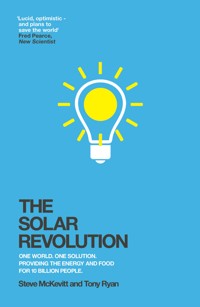
It's an astonishing fact that capturing all the energy in just one hour's worth of sunlight would enable us to meet the planet's food and energy needs for an entire year. The Solar Revolution tells the story of how scientists are working to reconnect us to the 'solar economy', harnessing the power of the sun to provide sustainable food and energy for a global population of 10 billion people: an achievement that would end our dependence on 'fossilised sunshine' in the form of coal, oil and gas and remake our connection with the soil that grows our food. Steve McKevitt and Tony Ryan describe the human race's complex relationship with the sun and take us back through history to see how our world became the place it is today – chemically, geologically, ecologically, climatically and economically – before moving on to the cutting-edge science and technology that will enable us to live happily in a sustainable future.
Sie lesen das E-Book in den Legimi-Apps auf:
Seitenzahl: 547
Veröffentlichungsjahr: 2014
Das E-Book (TTS) können Sie hören im Abo „Legimi Premium” in Legimi-Apps auf:
Ähnliche


















Praise for the previous edition
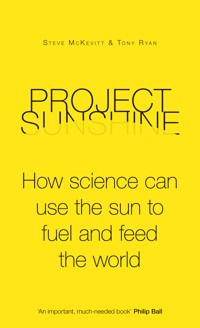
‘This is an important, much needed book. It shows that things can’t go on as they have done: population growth, fossil-fuel burning, greenhouse-gas pollution. But it also explains that they don’t need to. Technologies exist, or are on the threshold of existing, that can keep the lights on and keep food on the shelves. Without being Panglossian or diminishing the challenge, [The Solar Revolution] offers rays of hope.’
Philip Ball, author of Critical Mass and H2O: A Biography of Water
‘This is stirring stuff, and well told. [The Solar Revolution] shows the great promise of solar power … is lucid, optimistic – and plans to save the world.’
Fred Pearce, New Scientist
‘Tony Ryan and Steve McKevitt argue forcefully that if we are to tackle the biggest challenges facing the world today, we need to put our local star at the centre of human affairs. They marshal a wide range of scientific research to show that we could all benefit from becoming a society of sun worshippers.’
Roger Highfield, former editor of New Scientist
‘A sweeping narrative of past and present, [The Solar Revolution] explores the way we use (and waste) our resources and how solar power may yet solve the energy crisis. Written in lay terms, it’s still of great interest to the professional scientist, with wonderful factual nuggets and handy numbers to have up one’s sleeve.’
Dame Athene Donald, Times Higher Education
‘[The Solar Revolution] is pure, unarguable common sense’
Gabriel Winn, Director of Communications, Centrica plc
‘The conclusions are powerful and inevitable … A very powerful and important title that all politicians should have on their shelves.’
Brian Clegg, www.popularscience.co.uk
‘[A] ray of sunshine on the issues of food and energy security … Cogently analysing business as usual won’t work; the authors lay out a science-based, multi-pronged solution’
Nature
‘[The Solar Revolution] essentially seeks to explore the practicalities of the looming transition from the age of carbon to the age of solar. The synergy between the authors’ disciplines is what makes it successful. Skilfully laid out with entertaining diversions to side issues along the way … [The Solar Revolution] is insightful and the handling of complex topics is exemplary.’
John Sweeney, Irish Examiner
‘There is so much in this book. It is most certainly the most important science book that I have seen in a long time.’
Edward Fackerell, Professor of Mathematics, University of Sydney
THE SOLAR REVOLUTION
THE SOLAR REVOLUTION
ONE WORLD, ONE SOLUTION, PROVIDING THE ENERGY AND FOOD FOR 10 BILLION PEOPLE.
Steve McKevitt and Tony Ryan
This revised edition published in the UK in 2014 by Icon Books Ltd, Omnibus Business Centre, 39–41 North Road, London N7 9DP email: [email protected]
Originally published in the UK in 2013 under the titleProject Sunshine by Icon Books Ltd
Sold in the UK, Europe and Asia by Faber & Faber Ltd, Bloomsbury House, 74–77 Great Russell Street, London WC1B 3DA or their agents
Distributed in the UK, Europe and Asia by TBS Ltd, TBS Distribution Centre, Colchester Road, Frating Green, Colchester CO7 7DW
Distributed in India by Penguin Books India, 11 Community Centre, Panchsheel Park, New Delhi 110017
Distributed in South Africa by Jonathan Ball, Office B4, The District, 41 Sir Lowry Road, Woodstock 7925
Distributed in Australia and New Zealand by Allen & Unwin Pty Ltd, PO Box 8500, 83 Alexander Street, Crows Nest, NSW 2065
Distributed in Canada by Penguin Books Canada, 90 Eglinton Avenue East, Suite 700, Toronto, Ontario M4P 2Y3
ISBN: 978-184831-655-3
Text copyright © 2013, 2014 Steve McKevitt and Anthony J. Ryan The authors have asserted their moral rights.
No part of this book may be reproduced in any form, or by any means, without prior permission in writing from the publisher.
Typeset in Bembo by Marie Doherty Printed and bound in the UK by Clays Ltd, St Ives plc
Contents
About the authors
Acknowledgements
Preface: The Time For Change is Now
Chapter 1: Seven Billion and Counting
Chapter 2: Weathering a Perfect Storm
Chapter 3: Star Power
Chapter 4: Taking Control
Chapter 5: States of Emergency
Chapter 6: The Solar Deficit
Chapter 7: Food, Glorious Food
Chapter 8: When the Explosion Stops
Chapter 9: What’s So Good About Oil
Chapter 10: Going Nuclear
Chapter 11: Tilting at Windmills
Chapter 12: Shine
Chapter 13: Whatever Gets You Through the Night
Chapter 14: Feast or Famine?
Chapter 15: The Solar Revolution
References, Sources and Further Reading
Glossary
Index
About the authors
Steve McKevitt is the author of Everything Now, Why the World is Full of Useless Things and City Slackers. His writing has appeared in newspapers around the world from The Guardian to the Kenya Daily Nation. An expert in communications, over a 25-year career his clients have included Nike, Coca-Cola, Deutsche Bank, Sony PlayStation, Harvey Nichols, Motorola, Universal, Virgin, BT and Atari. Steve is also an advisor to national and regional UK government on employment, skills, business innovation and international trade. He is working for a PhD in History at The University of Sheffield.
Tony Ryan is a chemist with a specialism in polymer science. He is a Pro Vice Chancellor at the University of Sheffield, where he leads the Faculty of Science. He was previously the ICI Professor of Physical Chemistry and gave the Royal Institution Christmas Lectures in 2002. Tony’s research is wide-ranging, encompassing synthesis of polymers from renewable feedstocks, the design of drug delivery vehicles, scaffolds for tissue engineering, nanotechnology in home and personal care, the fundamentals of crystallisation, and the self-assembly of block copolymers. He has served on numerous advisory boards and councils and was until recently Chair of the Science Board of the Science and Technology Facilities Council. In 2006 he was made an Officer of the British Empire for Services to Science.
For Maria Ryan, Gemma Ryan, Niamh McKevitt, Evan McKevitt and Aoife McKevitt
Acknowledgements
The Solar Revolution arose philosophically from a dawning realisation in both of us. Science and engineering would need to provide the tools for a political and economic system that could deliver well-being to a burgeoning population: enough food to thrive and enough energy to prosper, at the same time as ameliorating the damage we have done to the biosphere that’s just a thin veneer on the planet. This realisation occurred to each of us separately, but essentially concurrently.
The Solar Revolution happened in practice because there was a reorganisation at The University of Sheffield that allowed an integrated view of the capabilities and potential for coordinated research. And this book was the outcome of Steve’s company Golden being commissioned to make a short film featuring Tony that espoused that vision for the future.
Many University of Sheffield researchers have given generously of their time and expertise: Peter Horton, Duncan Cameron, Jurriaan Ton, Julie Scholes, Paul Quick, Colin Osborne, Andy Fleming, Jonathan Leake, Ian Woodward, David Beerling, Terry Burke, Rob Freckleton, Julie Gray, Neil Hunter, Jim Gilmour, Matt Johnson, Will Zimmerman, Chris Jones, Róbert von Fáy-Siebenbürgen, Sean Quegan, Mark Geoghegan, Richard Jones, Alastair Buckley, David Lidzey, Alan Dunbar, Ahmed Iraqi, Julia Weinstein, Peter Hall, Peter Jackson, Mike Braddick and Steve Banwart. In the Faculty of Science, Angela Simonite, Chris Smith, Sarah Want, Shelagh Cowley and Terry Croft made things happen. And from outside Jim Barber, David Phillips, Athene Donald, Tony Ryan (senior), Helen Storey and Nate Lewis helped in more ways than they could have known. Phil Waywell deserves a special mention for his many contributions and the reading of early drafts.
Writing this book together has been a revelation, and we are grateful for the support and patience of our families. We were looked after by Steph Ebdon of the Marsh Agency and very lucky to have Duncan Heath as our editor at Icon.
Preface:The Time For Change is Now
‘Until about 1800, our species had no safety margin and lived, like other animals up to the limit of the food supply, ebbing and flowing in population.’Jeremy Grantham, investment specialist
For all we might complain about its stresses and strains, our modern way of life is a miracle. Those of us lucky enough to be living in the developed world today are, on average, healthier, wealthier, longer-lived and better-educated than at any other point in history. The range of products, services, comforts, luxuries and opportunities available to the average citizen living in the 21st century would seem an unimaginable, heavenly paradise to all but our most recent ancestors. We take for granted the ubiquity of high-quality goods and services that can be instantly accessed. So much so that the convenience society we live in – where everything is available practically all the time – seems unstoppable and irreversible: like trying to put toothpaste back in the tube.
A consequence of the success of convenience is a growing disconnection between our lives and the things that make our lifestyle possible. We get our food from supermarkets, water from taps, petrol from gas stations. Our electricity comes from small holes in the wall. We seldom think about the journey that any of these commodities have been on, or the enormous effort involved in getting them to the point of delivery, except on those rare occasions when there is a supply problem – a water shortage, power cut or oil crisis – when, ironically, we think about nothing else.
That such supply problems don’t occur more often is remarkable. The hidden demands of providing us with convenience are enormous. In the last holiday season hiatus between Christmas and New Year, we happened to bump into each other in the local supermarket. After an exchange of seasonal pleasantries we both commented on the dramatic change in store that just a few days without deliveries had brought about. Shelves that had been burgeoning with produce on Christmas Eve were now almost bare. The usually extensive bread section had been reduced to just a couple of par-baked baguettes; the fresh meat aisle looked like it had been designed to appeal to vegetarians and the only fruit available came in tins. To be fair, there was no reason to fear anything untoward. There were few shoppers so presumably the logistics department had simply made a judgement call. No doubt the following day, when the wagons began rolling again, normal service would be resumed and shelves filled to bursting once more.
The most startling thing is not so much the empty shelves but what they said about the amount of energy required to keep them stocked. A supermarket receives around fifteen lorry deliveries per day, which equates to 10,800 diesel-fuelled journeys each year. Every one of those HGVs is crammed with produce that has either been grown or fattened using fertiliser derived from oil or manufactured using oil. It is transported by consumers in vehicles running on oil to homes constructed using oil and, in most cases, powered by oil.
In the UK almost all of our oil comes from the Gulf states. It makes its way from the Arabian peninsula to the south coast of England in a non-stop convoy of 100,000-tonne-plus supertankers spaced 300 miles apart. The journey takes it through a combination of the world’s most politically unstable and most dangerously congested waters. Less a robust supply line, more a strand of gossamer. Which only makes the consumer bonanza we enjoy all the more remarkable.
Without the cheap energy provided by oil – and the other fossil fuels, coal and gas – our way of life would be unsustainable. Fossil fuels currently account for over 85 per cent of the energy consumed globally each year. They underpin the modern world.
Integral they may be, but a world without the cheap energy they provide is not unimaginable. For almost all of our species’ 200,000-year-long history, man’s relationship with the Earth was no different to that of any other animal. Humans have a unique ability to create and communicate, which gave our early ancestors significantly more control over the environment and allowed them to build sophisticated societies. In respect of what our ancestors took from the world to sustain themselves they were no different to chimpanzees, bees or trees. All their energy was provided directly by the sun. Sunlight captured by plants using photosynthesis was converted into food and fuel. They ate roots, grains, fruit and cereals to provide their bodies with energy (or to feed to animals, which, in turn, they also ate). They burned wood to keep themselves warm and vegetable oil or animal fat to provide night-time light. It was a successful strategy for survival and over tens of thousands of years the human population spread across six continents. However, locked in to this natural solar cycle, there was a limit to how many people their lifestyle could support, and the total number of inhabitants fluctuated between just 300 million and 500 million, with this variance in the sustainable maximum accounted for by the usual suspects: war, famine, plague and pestilence.
Then, 350 years ago, everything changed. We began to supplement our energy needs with coal and oil; the same captured sunshine, but this time millions of years old, preserved in fossilised form deep underground. In less than two centuries the human population had exploded, doubling in size to 1 billion people. It has continued to grow ever since, but the rate of change has increased significantly. It took 100,000 years to reach the first billion people: today we are adding further billions at a rate of one every twelve years. The result is a huge squeeze on all natural resources. Over the next two decades we will witness a 50 per cent increase in demand for energy, food and water.
We are now living through our fourth century of exponential population growth, but the solutions of the past that have allowed us to cope – burning more oil, gas and coal; expanding the amount of land under cultivation or using more artificially produced fertiliser – simply won’t work any more. Our stocks of fossilised sunlight are dwindling. We are running out of fresh water and of places that we can appropriate for farming. Looking to the future, the key question is not simply, ‘How many people are there going to be?’ but rather, ‘How are they all going to live?’
In 2012, the Royal Society sought to address this issue in a publication called People and the Planet. This report’s frank conclusion was that in the developed and emerging economies, consumption has reached unsustainable levels and must be reduced immediately. It claims that the increase in population will ‘entail scaling back or radical transformation of damaging material consumption and emissions and the adoption of sustainable technologies. This change is critical to ensuring a sustainable future for all.’
We have been here many times before. The whole of human history is essentially the story – albeit usually on a local scale – of population growth and increasing competition for resources. Since ancient times wars have been fought over land, water, food, fuel, metals and other natural capital, while many civilisations have also faced destruction as a result of disease, famine and shortages. Where we have overcome these challenges in the past it is invariably ingenuity and innovation that have provided the solution. And we will require those same qualities in abundance, because we have never had to tackle problems of this magnitude before, nor on a global scale.
What it will take to sustain a world of 10 billion people is the subject of this book. Achieving this goal is possible and realistic, but it will not be easy. It will not happen by accident and it will bring changes for all of us, both in the way that we live and in what we consume. It is without doubt the biggest challenge of our age. This statement is not intended to belittle the impact of climate change, but the repercussions of global warming will play out along a timescale of decades; we have some time to adapt and respond to the consequences. In contrast we are already living with the results of explosive population growth: rising fuel and food prices, wars, immigration, famine, energy shortages and economic uncertainty. These issues affect us all today and all are a direct consequence of adding 1 million people to the population of the developing world every five days.
Big problems usually require radical solutions, but there are genuine grounds for optimism. Fundamentally, we need to reconnect the global economy with the sun and live within our means, just as we did in the past. Capturing a single hour of the sunlight that reaches the Earth – a tiny fraction of our star’s output – would meet our global energy needs for a whole year. Harnessing the power of the sun will allow us to meet the increasing food and energy needs of the world’s population in the context of an uncertain climate and global environment change.
To discover how we can achieve this requires a change in the way that scientists think and work, crossing the traditional boundaries in both the pure and applied sciences and engaging in collaborative research and innovation. Thankfully this is already happening, and in the later sections of the book we explore how the fruits of this activity are already being used in this endeavour: mathematicians are unlocking the secrets of how the sun actually generates its energy so that sunshine can be captured to fuel and feed the world; physicists are developing photovoltaic devices to convert this sunshine into electricity that we can use in our homes and businesses; chemists are investigating how plants and algae could be used to produce alternatives to fossil fuel in the form of biogas and biodiesel; biologists are learning to improve the efficiency of photosynthesis itself to achieve a better yield from crops that will require less fertiliser, water and pesticide; and engineers from all disciplines are working out how to put the results of all this research into practice. While this is undoubtedly good news, it’s not happening quickly enough. Success will require a concerted effort across the spectrum, not just from academics but from policymakers and private enterprise as well. A significant and immediate increase in public and private investment is also required to bring to market as quickly as possible the products that can make a real difference. However, without the social and political will to change the way we live, none of these things will happen. It is not enough to simply espouse sustainability or ‘greenness’: we will all have to actually consume less than we do today and recycle not just more, but everything we use.
Our aim is not to scare, but to inform and inspire. So let us begin with some good news. Our research leads us to believe that sustainably providing the energy for 10 billion is possible. But it will not be easy. It will not happen by accident and will require significantly more investment in research and development than is currently ongoing. Even total success will bring myriad changes for all of us, both in the way that we live and in what we consume. Yet the change may not necessarily be for the worse. Sustainable routes to food and energy security can be found, but time is of the essence. The clock is ticking.
1Seven Billion and Counting
‘The constant effort towards population, which is found even in the most vicious societies, increases the number of people before the means of subsistence are increased.’Thomas Malthus, essayist
On 30 October 2011 the world welcomed its seven-billionth citizen: Danica May Camacho, a Filipina, born in the early hours of the morning at the Dr Jose Fabella Memorial Hospital in Manila. She was chosen by the United Nations Population Fund (UNFPA) to officially mark this milestone and draw attention to the economic, social and practical challenges of managing the world’s rapidly growing population.
The fact that these challenges require such a grandiose PR stunt to make them newsworthy at all is testament to the fact that we find them so easy to ignore. For most of us, the Official Day of Seven Billion was a story to be forgotten as soon as the agenda moved on to something else. Danica May Camacho herself, briefly the most famous baby in the world, is likely to live out the rest of her life in the obscurity endured by twelve-year-old Adnan Nevic of Bosnia Herzegovina and Matej Gaspar, a 24-year-old Croat, respectively the world’s six- and five-billionth inhabitants. It’s easy to understand our indifference. On first inspection, there seems very little truly new to say on the subject. The quote from Thomas Malthus that opens this chapter sounds like it could have been uttered last week rather than 1798. This is because the fundamental issue remains the same: too many people/not enough resources. One could be forgiven for thinking that little else has changed since Malthus penned his Essay on the Principle of Population; the same dire warnings about famine and drought, the same apocalyptic forecast of global wars that will bring about the collapse of civilisation, and the same list of unspeakably miserable consequences for us all: none of which has come to pass. However, this scepticism is misplaced.
Fig. 1: World population growth since 1750. (Source: UNFPA)
It is true that all our lives have played out through a period of explosive population growth, but that doesn’t stop it being extraordinary. Indeed, this is also the only period of explosive population growth in human history. We have taken just 84 years to go from 2 billion to 7 billion earthly inhabitants and, unless we take some decisions about how everyone is going to have to live, we will soon reach a point where the global population becomes unsustainable. While forecasting is a notoriously contentious and difficult discipline, among those who are looking to the future there is a consensus that global population will continue increasing until the middle of the century, at which point it will peak and plateau at somewhere around 10 billion. From less than 2 billion to 10 billion people in little more than a lifetime; the blink of an eye when set against the 200,000 years that our species, Homo sapiens, has been on the planet.
It’s tempting to believe that a simple presentation of the facts will be enough to shake us from our complacency. Certainly, one would assume that was the rationale of the UNFPA when it conceived the idea of Citizen Seven Billion, but unfortunately there’s more to our indifference than this. It’s not just that over-familiarity makes this story easy to ignore, it’s that most of us choose actively to ignore it. We feel reassured by the trappings of our advanced society with its central heating, running water, supermarkets, ready meals and fuel-injected cars; at a comfortable remove from the sources of food and energy. Yet despite our apparent sophistication, in evolutionary terms we have barely set foot out of the forest. We are the same nervous, skittish creatures that were once hunted mercilessly by leopards, wolves and cave bears, with the same reactions to fear and danger.
While we have the intellectual capacity to think about the future and ponder, ‘What might happen if …?’, we are much more focused on the present; driven by today’s needs rather than tomorrow’s consequences. As a result we have evolved to be remarkably good at ignoring ‘What might happen if …?’, especially if we suspect that thinking about it might prove terrifying. The smoker enjoying the first cigarette of the day; the commuter racing down the motorway at 85mph and the student choosing an evening out over a night of revision, are all aware of the possible consequences of their actions at a nebulous point down the line (lung cancer, a car crash, examination failure) but that only makes them easier to disregard. We treat these as things that will happen to other smokers, other drivers and other revellers, not to us. In these cases and many others, this wilful ignorance is bliss. We behave in exactly the same manner when confronted by less personal or unspecific dangers; it’s really just a question of the scale of our denial.
As far as threats with terrifying, immeasurable consequences go, global warming takes some beating. In 2007, Al Gore visited Sheffield to host a conference on climate change. We were fortunate enough to receive an invitation to attend. Whatever your political views, there’s no denying that Al Gore is a very capable and engaging public speaker. Over the course of 90 minutes, the former US Vice President performed a live version of his Oscar-winning documentary, An Inconvenient Truth, during which he clearly laid out all the evidence for human influence on global climate change and explained its consequences. His compelling argument and powerful delivery certainly made for a fascinating lecture, but also for one of the most dispiriting things we have ever seen.
Gore had two stated objectives for An Inconvenient Truth. He wanted to leave audiences believing that global warming is the biggest issue, but he also wanted to persuade them to change their behaviour by making them believe that doing so could help to reverse its effects. To that end, he concludes the film with the following call for action:
Each one of us is a cause of global warming, but each one of us can make choices to change that with the things we buy, the electricity we use, the cars we drive; we can make choices to bring our individual carbon emissions to zero. The solutions are in our hands, we just have to have the determination to make it happen. We have everything that we need to reduce carbon emissions, everything but political will.
While there’s little doubt that he achieved his first objective, he has been much less successful in changing our behaviour. For a week or so following the live lecture, we felt deeply depressed about not only the future, but the futility of our own efforts to reverse the effects of global warming (switching to low-energy light-bulbs, unplugging electrical appliances when not in use, driving at 60mph instead of 70mph – that sort of thing) in the face of the two coal-burning power stations that were being opened in China each week. Within a fortnight, however, we were back to our usual chipper selves, thanks not to thinking of creative solutions to reduce our own carbon footprint, but simply to not thinking about it at all.
Of course ignoring the problem isn’t going to make it go away, but then neither will worrying about it. The most frustrating aspect of all the challenges we face – not just climate change and population growth, but food and energy sustainability as well – is that we already have almost all of the science and technological solutions required to avert disaster; what we lack is the social and political will to implement them. Moreover, if a combination of complacency, fear, and wilful ignorance makes it difficult for us to motivate ourselves and our politicians towards effective action, conversely it provides a fecund opportunity for those wishing to persuade us, however disingenuously, that everything is going to be all right.
One doesn’t have to look very hard to find climate change ‘sceptics’ who focus on minor flaws in the science that ‘undermine the entire argument’. Just because there are naysayers doesn’t mean there needs to be a debate. For example, despite all evidence to the contrary, if you type ‘smoking doesn’t cause cancer’ into Google, your search will yield 143,000 results, all purporting to prove that it doesn’t.
It is noteworthy that almost all the scepticism about climate change comes from the conservative right. Surely if the data was so equivocal, one would expect dissenters across the political spectrum? Yet, for whatever reason, this is not the case. The binary nature of most media outlets – where arguments for and against an issue are given equal weight, regardless of their legitimacy – means that outliers often find a platform for their views that is vastly disproportionate to their credibility. Their cause is furthered by the fact that their claims are much closer to what most people want to believe is true, namely, that the status quo will be maintained and modern life will carry on regardless. It’s certainly what we’d like to believe is true too, but unfortunately, in the face of all the evidence, that is impossible to do.
Our fear of change prevents the adoption of potentially life-saving technologies such as nuclear power, concentrated solar energy and genetically modified plants and animals. We can argue about how much oil is left until finally someone is right and there isn’t enough; and we can argue about whether to genetically modify crops until there’s nothing left to eat. Alternatively, we can act now.
We will certainly reach a point from which it will be impossible to recover, but we are not there yet. It really doesn’t need to end unhappily. And now for the good news – there is something that we can do about it.
Science and technological innovation have driven global prosperity. Since the Enlightenment of the 18th century they have proved consistently capable of meeting the ever-increasing demand for energy and food. In the past 40 years alone, the amount of land used for agriculture has increased by only 8 per cent, while food production has doubled. This success is almost entirely due to chemical and biological breakthroughs and innovations: providing more effective pesticides and fertilisers; improving crop and meat yields through breeding programmes. We must ensure that the fruits of this process of invention are sustainable.
The challenges we face in the next 40 years are complex and difficult, but they are not insurmountable. A study published in January 2011 by the UK’s Institution of Mechanical Engineers suggested there are no scientific breakthroughs required to manage a global population of over 10 billion people:
There is no need to delay action while waiting for the next greatest technical discovery or breakthrough idea on population control … [There are] no insurmountable technical issues in meeting the basic needs of nine billion people … sustainable engineering solutions largely exist.
There are key areas that we need to focus on to ensure food security. The huge improvements in crop yields have to continue, but they are eminently deliverable. We must make less profligate use of our fresh water supplies; and develop genetic solutions to crop protection and rely much less on chemical fertilisers and pesticides. We need to develop a system of agriculture that is holistic, part of the richer ecosystem rather than the wilfully imposed cereal monoculture we have today that operates outside it. Livestock and marine food production can continue only within the context of sustainability. We can also make a big difference by choosing to live less wasteful lifestyles: currently in the developed nations, over a third of all food that is harvested is simply thrown away.
It is naive to suggest, as some learned commentators have done in the past, that tens of millions of African farmers could triple yields with existing crops if only they could afford fertiliser. The global fertiliser crisis might not be the most captivating challenge humankind is facing at the moment, but it is arguably the most important. Oil is an integral part of modern agriculture, accounting for 3 per cent of the global energy budget. Almost all of this oil is used, not for transportation as many people think, but in the production of synthetic fertiliser. We need to be decreasing not increasing our reliance upon synthetic fertiliser. A more sensible strategy is to stop wasting so much of the harvest and seek alternative means of increasing crop yields. And we should be doing this not just in Africa either, but across the whole world.
Providing energy security is rather more complex, particularly because almost all of the fuels we use presently are the major contributors to climate change. We have around two decades to de-carbonise electricity generation, which will require significant investment in emerging technologies and processes. Achieving holistic solutions will require scientists from different disciplines working together across traditional boundaries.
The Solar Revolution is the story of how we are going to provide sustainable food and energy for a global population of 10 billion people. The answers lie in a range of ongoing research across many disciplines: from solar physics, photovoltaics and photosynthesis to plant physiology, biochemistry and ecology. This research is typically disparate, very detailed and difficult to digest. We will provide a real solution only by pulling it all together and putting it into context. This book aims to do exactly that.
Almost 100 per cent of our energy comes from the sun.1We need to understand how the sun works, how it provides us with that energy, and learn how to use some of it to power everything that happens on Earth in real time, rather than relying on the unrenewable stores of ancient sunshine buried in coal, oil and gas. In part, this is about unlocking the mysteries of electrons, molecules and genetics, but we also need to take a much grander view, to understand how carbon, nitrogen and phosphorous are traded on a global level. And so our quest will begin and end with mathematics and theoretical physics. By bringing the many pieces of research together and synthesising them, we can get a true picture of how we are going to live – and going to have to live – in the future. There’s no point in worrying. The future is going to be very different, but that doesn’t mean it’s going to be scary, or even worse. There’s no reason to fear that you’ll be living out a real-life version of The Road any time soon.
To show how we can safeguard the future we need to understand how our world became the place it is today – chemically, geologically, ecologically, climatically and economically. We need to understand where all our food and energy comes from, to help us decide what we need to live and what we can live without. Among all the animals, we have the unique ability to change the environment for the benefit of the species, but if humankind is to survive and prosper we will have to do this more effectively and sustainably. We will have to start living within our means again, rather than beyond them: to go forwards we need to go back to a solar economy.
Footnote
1 The almost singular exception to this statement is nuclear power, which harvests the energy locked inside the atom. (You could also include tidal power, which gets some of its energy from the moon as well as the sun and other celestial bodies; and geothermal energy, which comes from the Earth’s core. However, the energy these sources supply is marginal and, for reasons that will become apparent, is destined forever to remain so.)
2Weathering a Perfect Storm
‘There are dramatic problems out there, particularly with water and food, but energy also, and they are all intimately connected. You can’t think about dealing with one without considering the others. We must deal with all of these together.’John Beddington, former chief science advisor to the UK government
In 2009, the UK Office for Science published a paper called Food, Energy, Water and the Climate: A Perfect Storm of Global Events? Written by John Beddington, then the UK government’s chief science advisor, A Perfect Storm is a harrowing document. At least it is if you take it at face value, which is exactly what the media did. In summary, the report highlights the fact that the world’s projected population growth by 2030 will lead, together with the incumbent economic and environmental factors, to a 30 per cent increase in demand for water and a 50 per cent increase in demand for food and energy. The press went to great lengths to ensure that the scale of these challenges was not understated. Good news sells few papers and in that regard A Perfect Storm made for excellent copy. Yet there’s another way of looking at the information contained in the report. Beddington’s erudite analysis of the challenges is certainly not bedtime reading for those of a nervous disposition, but the report’s real success, and one rarely noted, is that it highlights everything that we need to do: as the starting point for a strategy to address these challenges, it could not be better.
A Perfect Storm describes not the end of the world, but a starting point for its salvation. It’s definitely not the best place to start from, but the most important thing is that we do know where to start. The implications of population growth will not prove to be as easy to ignore for much longer. New inhabitants are being added at the rate of 6 million each month (the equivalent to a city the size of Rio de Janeiro). They will not be spread evenly. In the developed world outside the USA low birth rates mean that indigenous populations are in decline in many countries. By 2020, there will be more people over the age of 60 than under 20 in many European states. Conceived in the 1940s, the UK’s welfare state, which served as a model for many other countries, was designed to cater for citizens who worked for 50 years, paying national insurance while they did, then spent a few brief years in retirement drawing it out before cost-effectively and expediently passing away.
Without reform, this shift in demographic is going to put national health and welfare systems under enormous pressure. Today most people can reasonably expect to live for another 20 or even 30 years after retiring. This means that over the next 30 years, there will be more and more people leaving economic productivity and entering retirement, but conversely fewer and fewer people of working age to look after them. There will also be fewer people to pay for national insurance to meet the increased demand for healthcare and welfare.
The key points here are that we already know this – it’s not some nasty surprise waiting to pounce – and we have 30 years to sort it out. To do that we need to plan for this future today and completely rethink the way that welfare is funded. Yes, there will be more responsibility on individuals to plan and pay for their retirement and healthcare, and services we take for granted today will become much more expensive, but we have the luxury of being able to decide now what we want to deal with this future problem and how we want to pay for it. We don’t have to fire-fight or come up with policies on the hoof.
While Europe deals with its burgeoning pensioners, many parts of the developing world are dealing with the opposite problem: explosive population growth that is outpacing economic growth. In Africa the continent’s population is set to double from 1 billion to 2 billion by 2030, by which point half of its inhabitants will be under the age of 20. Similar rapid expansions are being experienced across much of the developing world, provoking other transformational changes, most notably urbanisation, as people migrate to cities from rural areas in search of work. Half the world is already living in cities, but this will increase to 60 per cent by 2030. There will be at least 29 ‘mega cities’ with more than 10 million inhabitants by 2025. That is ten more than there are today. All of these additional people will require food, water, shelter, energy and a host of other services. The inevitable competition for land that this will create is foreshadowed today by increasing purchases of real estate in developing nations by some countries with hot and dry climates and limited water supplies – notably Egypt, Saudi Arabia and China – and also by multinational corporations.
Our challenge to ensure food security for a global population of 10 billion in a manner that is equitable, healthy and sustainable is simple to understand: we must grow much more food on the same land, using less water, fertiliser and pesticides than ever before. Achieving this in the face of rapidly dwindling natural resources will be no walk in the park, but it is possible. Science and technology will make the most significant contribution, providing practical solutions across the board from engineering to biotechnology, but success will also demand behavioural changes of us all. In future, we will need to manage our lives and societies much more efficiently than we do at the moment.
2008 saw the sudden end of a 20-year economic Golden Age for almost all of the world’s leading economies. It’s easy to be critical with hindsight, but at the time most governments, financiers and economists were of the view that perpetual and sustainable affluence was a realistic objective – ‘the end of boom and bust’ no less. The Credit Crunch brutally dispelled our beguilement by the arcane chicanery of banks and other financial institutions, bringing the blunt realities of commodities markets into sharp focus. Wheat and maize prices rocketed before finally settling down at three times their 2005 levels, thereby marking the end of two decades of low-cost food for consumers. Although prices are less volatile today, cereal stocks remain stubbornly at a 40-year low, which, together with the increasing demand for food, energy and water from the emerging economies, will continue to put pressure on food prices for the foreseeable future. Increasing the yield of cereal crops using existing, proven technologies is both practical and realisable in the short term. This should be the goal for every one of the world’s agricultural ministries.
Not every nation was plunged into recession in 2008. Those states operating more traditional economic models – based on production, manufacturing and government intervention, rather than leveraged borrowing, notional property values and unfettered money markets – continued to perform well, particularly those with large populations and plentiful natural resources. Brazil, Russia, India and China are known collectively as the BRIC countries. These states have all embraced global capitalism and adapted their political systems to facilitate rapid growth. It is expected that they will become the dominant suppliers of manufactured goods and services over the coming decades, with Russia and Brazil also becoming the dominant suppliers of raw materials. The BRICs’ burgeoning prosperity is a further, powerful driving force behind the demand for energy. Since 1900 real income has grown by a factor of 25, and primary energy consumption by a factor of 22.5. Natural resources are in decline and competition for what’s left is going to increase as 1 billion super-consumers of the OECD are joined by a further three billion from the BRICs.
Economic success, within the BRICs at least, will lead directly to an increase in prosperity, lifting tens if not hundreds of millions of people out of poverty. But this positive outcome will only add to our list of challenges. When wages rise in developing and middle-income countries, we find that people consume more meat and dairy products, which in turn causes rapid growth in demand for agricultural commodities to feed the extra livestock. The continued pressure on cereal stocks is due in part to the rising consumption of meat and dairy, especially in China and Brazil. There are no signs that cereal prices will flatten out any time soon, indeed it’s reasonable to expect that they will continue to increase, as incomes grow in India and sub-Saharan Africa; places where per capita meat consumption today is low. The UN Food and Agriculture Organisation (FAO) projects that farms will be required to produce around 40 per cent more food to meet the demand in 2030 than they did in 2008. Yet even this startling estimate – the equivalent of an annual increase in productivity of 1.5 per cent – is not the whole story. Meat demand will double by 2050 and all those additional animals will also need feeding. Each of these production targets has further implications for supplies of land, water and most importantly of all, for supplies of energy.
This pressure on agriculture to produce more with less will make the biggest contribution to a 45 per cent increase in demand for energy between 2006 and 2030. Notwithstanding the real situation regarding how much oil is left in the ground, mitigating climate change means that an alternative to fossil fuel will be required to make up the (significant) shortfall. Biofuels can be used for transportation, while biomass can be burned to produce heat or electricity. This will, however, provide even greater competition for land, water, food and energy. Again, the majority of this demand for energy is going to come from within the BRICs and notably from India and China, which between them contain approximately half of the world’s people.
Like food, water demand is a function of population, incomes, diets and the requirements of irrigated agriculture, but also of industrialisation. Heavy industry – like the kind powering growth in the BRICs – requires lots of water. Agriculture will find itself increasingly competing for water and land not just with commerce, but with the cities it’s being asked to feed. Mid-range estimates suggest that the demand for fresh water by agriculture alone will be 30 per cent higher in 2030, while the total global demand could be as much as 60 per cent higher by 2025. Shortly, we will find water being treated like any other commodity and subjected to the same market forces. The notion of a free natural resource will be consigned to the history books and bottled water will become a fact of life rather than a fad or affectation. Today 1.2 billion people are already living in areas affected by water scarcity; this figure will increase significantly in future. There are already early signs of things to come. Water conflict occurs between two or more neighbouring countries that share a trans-boundary water source, such as a river, artesian basin or lake. In the case of Kazakhstan, Uzbekistan, Turkmenistan, Tajikistan and Kyrgyzstan, the dispute is over access to the Aral Sea. With no satisfactory diplomatic solution on the horizon, relations between the five nations are increasingly hostile.
In January 2014, officials at the California Department of Public Health warned that seventeen communities across the state were in danger of running out of water within 60 to 120 days. The state’s worst drought ever (two years and counting) was the cause of the problem. In mid-February, with no end in sight and barren pastures and dry ponds already wreaking havoc on dairy farms, the State Water Resources Control Board announced they would be shutting the state reservoir in spring for the first time in its 54-year history. This effectively meant there would be ‘Zero Water Allocation’ for 25 million people and 1 million acres of farmland. Relief measures announced on 20 February 2014, in a $647 million drought assistance plan, included financial support for local water conservation and recycling measures, including storm water capture. This was inevitably criticised by the Republican opposition for being too short-term (they demanded more reservoir-building instead). Yet neither side even paid lip service to the fact that hundreds of billions of gallons of water (enough to supply 1 million families) was being exported to China in the form of alfalfa forage from farms in southern California where the water was still flowing. Cheap water rights and the USA’s trade imbalance with China make this an attractive commercial proposition; so much so that it is cheaper to ship the hay to China than it is to transport it elsewhere within California.
Water is not the only essential liquid in our lives. Our entire industrial and agricultural system depends upon a constant supply of oil. We use oil and its derived liquid fuels at a rate of 89 million barrels per day (mb/d); demand in 2030 will be at least 25 per cent higher. There isn’t an infinite supply of oil, and even if we are finding more creative ways to extract what’s left, one day we will run out. It’s impossible to know for sure how much oil remains, but just because we may have underestimated the quantity in the past, that doesn’t mean we’re underestimating how much is there now. Using the 1998 consumption rate as a baseline, the estimated conventional and unconventional reserves of oil remaining would provide enough energy for between 40 and 80 years. However, to say that we are going to run out of oil in 40 years is slightly misleading, because proven oil reserves have been at this ratio for over 100 years. The reason is simply that it doesn’t make economic sense to prove out any more than 40 years’ worth of reserves. The more important figure is how much the United States Geological Survey (USGS) estimates the total resource base to be, i.e. how much oil is there to be had in total? The USGS estimates that, at 1998 consumption rates with 50 per cent confidence, we have between 50 and 150 years’ worth of oil left.
Unfortunately, we won’t know for certain exactly how much there is left until we reach a point where we can’t extract enough to satisfy demand. ‘Peak oil’ is the term used to describe this point: when the maximum rate of global petroleum extraction is reached, after which the rate of production enters into terminal decline. The Day of Peak Oil is even more difficult to estimate than the Day of Seven Billion – we can ‘see’ the people, but the world’s reserves of oil remain hidden from us. The concept of peak oil is based on observations of production from existing oil wells and fields combined with estimates about the likelihood and size of undiscovered reserves. We may have already hit peak oil. The International Energy Agency believes that 2006 was the peak year of production for conventional crude oil, and even the most optimistic estimate forecasts that production will decline after 2020.
An uneasy balance also characterises the oil market. Most or our oil comes from the more politically turbulent areas of the world, while demand fluctuates dramatically. During recessions, industry and consumers use less oil so the market softens; likewise the price increases during periods of growth when demand is greater. Other factors such as the weather can also dramatically affect the price. January 2012 was a typical month, with tensions surrounding Iran counteracting a weaker economic outlook. In Europe the late onset of winter weather pushed prices for Brent Crude to six-month highs in early February, trading at $117.50/barrel. In contrast, slower than expected demand from industry led to rising stocks at some storage depots, pressuring the price of West Texas Indeterminate – a lighter oil variant than Brent – down to $99.50/barrel.
The key point is not just that the supplies of oil are decreasing, but that the global demand for whatever is left is increasing. Global oil demand rose to 89.9 mb/d in 2012, a rise of 0.8 mb/d (or 0.9 per cent) on the previous year. As the price of oil increases, it becomes commercially viable to extract oil from previously uneconomic reserves. America is currently enjoying a second petrochemical boom. The US has already surpassed Russia as the world’s largest oil and gas producer, according to many analysts, and by 2020 is predicted to overtake Saudi Arabia to become the largest oil producer. This fossil-fuel renaissance is due to the ‘tight oil’ business. Tight oil is found in the dense, impermeable rocks – such as shale – that usually lie at the bottom of reservoirs of conventional oil. Oil companies have known about these deposits for decades, but the costs of extraction were uneconomical. The tight oil boom has led several economists to suggest that the energy crisis presented by projections of existing stocks and the moment of ‘peak oil’ has been averted. Yet tight oil is only a palliative – albeit an important and useful one – not a cure-all.
Whichever projection about how much oil is left turns out to be true, it’s unlikely that we will ever be able to increase production much beyond 90 million barrels a day; a lot less than we are predicted to need. But even if the oil runs out, we know how to make liquid fuel out of coal and natural gas for about $40 per barrel, and we have much more of these fossil fuels left. The US Geological Survey estimates the resource base is between 200 and 580 years of gas and over 2,000 years of coal. However, the process produces enormous amounts of CO2. Today, Sasol CTL in South Africa operates the only commercial coal liquification plant in the world. It is also the single biggest point source of CO2 on the planet, observable from outer space. However, while oil remains priced at well over $100 per barrel there is no economic incentive to liquefy either coal or gas. The upshot is that, regardless of how much remains, oil is going to become a lot more expensive over the long term.
Since 2013, the controversial process known as fracking, which liberates natural gas trapped within shale deposits, has picked up media coverage and is seen by many as a greener alternative to petroleum and coal. The key point is that it might well be ‘greener’, but it’s not ‘green’. Yes, natural gas is the least carbon-intensive of the fossil fuels, but it’s a very long way from being carbon-free. Even switching exclusively to natural gas, abandoning oil and coal altogether would do nothing to stop global warming and the effects of climate change, which would continue unabated, with devastating consequences for us all.
If we ignore all the drawbacks and controversy surrounding extraction, and decide that we are happy pumping chemicals into rocks that also provide us with drinking water, then it’s true that fracking could provide us with some cheaper domestic energy for the next twenty years. Unfortunately, there is strong evidence that it may also lead to short-termism, encouraging increased energy consumption at a time when we really need to be working out how to use less. In the USA, where fracking is already up and running, this is exactly what is happening: energy prices have fallen but consumption has increased, which in turn points to higher prices in the future and a further increase in demand. However, the supply-side economics are not the only problem. Fracking will lead to cheaper energy in the short term and that will inevitably increase consumption – particularly of motor vehicles, white goods and consumer electronics and durables. Both the increase in consumption and the fracked gas itself are unsustainable, with significant implications for the remaining deposits of copper, rare earth metals and many other dwindling natural resources. This does not mean that we should necessarily forget fracking altogether, but if we are really serious about meeting our energy needs in the medium and long term, we need to take advantage of the opportunity it affords us to fund greater energy efficiency and research into advanced solar power, instead of providing temporary cheap fuel for another consumer boom.
Clearly we need an alternative to oil to power our homes and industries and to fuel our trains, planes and automobiles, but our reliance extends much further than many of us think. The plastics we take for granted are all currently derived from petroleum, and it’s at the heart of modern agriculture. That means that our alternatives to oil will have to do more than provide power and transportation; oil is used to create artificial fertiliser, so we need to dramatically increase the yield from land and produce crops that don’t need it.
Finally, all these challenges must be dealt with against the backdrop of climate change. Extreme weather, rising global temperatures and rising sea levels will further impact food production and water supplies across the world. The areas likely to be hardest hit are those most important for food production: the mega-deltas of the Nile, Amazon, Ganges, Yangtze and other major rivers. The oceans, already over-exploited, will become less diverse as whole ecosystems vanish completely.
Can we weather the perfect storm? The answer is unequivocally yes, but in doing so we will create a world very different from the one we are living in today. Different – we can’t paddle out of this creek in the same canoe we came in on – but not necessarily worse. Things should be much better for most people, and the lives we must lead will certainly be less wasteful. The one thing we should not fear is change. In helping to achieving this, the most plentiful resource we have is also the one that is most under-exploited. Our sun can give us all the energy we will ever need. As we noted above, if we harness all the energy in just one hour’s worth of sunlight that reaches the Earth, we will be able to meet the planet’s food and energy needs for an entire year. Thomas Edison, inventor of the electric light bulb, pioneer of alternating current and the power station, certainly recognised the opportunity: ‘I’d put my money on the sun and solar energy’, he said. ‘What a source of power! I hope we don’t have to wait till oil and coal run out before we tackle that.’
It’s not beyond our ability to generate all the energy, food and water we need in a way that is affordable, sustainable and widely available. We know already how to increase crop yields five-fold and how to intervene so that waste can be practically eliminated. Nuclear and solar power can provide us with electricity, while biodiesel, harvested from vast third-generation photo-bioreactors connected to factories or on algal-diesel farms located in the world’s barren deserts, can be used to fuel comprehensive public transport systems and private vehicles. But in order to understand fully how we are going to live in – and enjoy – the future, we need to understand how we got here in the first place.
3Star Power
‘We are just an advanced breed of monkeys on a minor planet of a very average star. But we can understand the Universe. That makes us something very special.’Stephen Hawking, research director at the Centre for Theoretical Cosmology, University of Cambridge
The universe, and everything in it, was formed in an instant 13.8 billion years ago. Despite its incomprehensible size and age, the universe is neither infinite nor never-ending; it is a closed system to which nothing can be added, containing a finite amount of stuff. The Big Bang was not just the moment of creation, but the whole of creation as well. For that reason the entire history of the cosmos has been one of recycling and renewal. All the energy that we use on Earth, from the fuel we burn to the food we eat, is simply the latest link in a series of transitions and exchanges that began with the Big Bang.




