


Erhalten Sie Zugang zu diesem und mehr als 300000 Büchern ab EUR 5,99 monatlich.
- Herausgeber: Banipal Books
- Kategorie: Poesie und Drama
- Sprache: Englisch
From the Introduction by Mohammed Sawaie: The Palestinian poets included in The Tent Generations, Palestinian Poems represent different age groups and backgrounds, yet they all express a strong sense of "Palestinian-ness". They include Israeli citizens, the offspring of those who remained in Palestine after 1948. They also include poets who lived or continue to live in the West Bank and Gaza, areas that are still occupied, or controlled by Israelis as of this writing. Finally, they include poets born in Palestine, but whose families were expelled, or migrated to neighboring Arab countries as a result of the Arab-Israeli wars of the Nakba in 1948, and then of 1967 and 1973. The educational backgrounds of the poets represented here vary. Salem Jubran, Samih al-Qasim, Tawfiq Zayyad, and Marwan Makhoul, for example, were products of the Israeli educational system. Others attended institutions of learning in various Arab countries. Fadwa Tuqan received little formal education in her city of Nablus; she, however, acquired instruction in language, support in writing poetry, and encouragement to publish her poems from her brother, the well-known poet Ibrahim Tuqan, mentioned previously. All these poems are written in fusha Arabic, Modern Standard Arabic, the codified literary, written language shared by educated speakers of Arabic in their various respective regions. Palestinian folkloric poetry, referred to as al-Shi'r al-Sha'bi or Shi'r al-'Ammiyya, is not included in this work. Folk poetry, richly expressed orally in the Palestinian dialect, 'Ammiyya, embraces a variety of themes (national pride, panegyric, love, generosity toward guests/strangers, and so on), including the political themes expressed in the poems in this work. There is a rising interest in collecting and preserving this folkloric poetry, and several anthologies of oral poetry as well as studies have recently appeared. The 1948 Nakba, the wars of 1967 and 1973, and their subsequent tragic impact find expression in the work of Palestinian poets. Some of the authors in this collection had firsthand experience of the loss of home, and the up-rootedness from and destruction of their villages and cities. Others acquired knowledge of such experiences, the tragedy that befell Palestinians, through stories told by grandparents or parents, stories of hardship and deprivation transmitted from one generation to another. Thus, poets express in vocabulary specific to the Palestinian experience of the dispossession of homeland, the forced expulsion, the pain of living in the miserable conditions of refugee camps in the diaspora.
Sie lesen das E-Book in den Legimi-Apps auf:
Seitenzahl: 113
Veröffentlichungsjahr: 2022
Das E-Book (TTS) können Sie hören im Abo „Legimi Premium” in Legimi-Apps auf:
Ähnliche









The Tent Generations, Palestinian Poems
First published in English translation
by Banipal Books, London, 2022
Arabic copyright © the poets & their estates, 2022
English translation copyright © Mohammed Sawaie, 2022
Introduction Copyright © Mohammed Sawaie, 2022
The moral right of Mohammed Sawaie to be identified as he who selected, introduced and translated this work has been asserted in accordance with the Copyright, Designs and Patents Act, 1988.
No part of this book may be reproduced in any form or by any means without the prior written permission of the publisher
A CIP record for this book is available in the British Library
ISBN 978-1-913043-18-6
E-book: ISBN: 978-1-913043-19-3
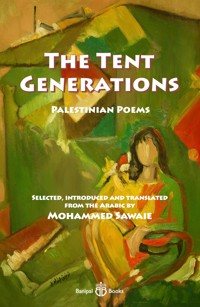
Front cover painting “Melancholic Homeland”by Toufic Abdul-Al (1938–2002)
Banipal Books
1 Gough Square, LONDON EC4A 3DE, UK
www.banipal.co.uk/banipalbooks/
Banipal Books is an imprint of Banipal PublishingTypeset in Cardo
Printed and bound in Great Britain by Clays Ltd, Elcograf S.p.A.
For all those who fight for justice and equality
CONTENTS
Introduction
The Poets and Poems
Asma Rizq Tubi
To Jaffa
Fadwa Tuqan
The Plague
A Letter to Two Children on the East Bank of Jordan
Hamza
At Allenby Bridge
I Shall Never Cry
My Sorrowful City on the Day of the Zionist Occupation
Mu’in Bseiso
The God of Jerusalem
Harun Hashim Rasheed
Among Strangers
Tawfiq Zayyad
A Nation on the Cross
Dare
Here we are Staying
I Firmly Clasp your Hands
Leave Us Alone
Let the Whole World Hear
Youssef al-Khatib
The Lark
Rashid Hussein
Love and the Ghetto
The Woman and the Land
Abdel Wahab Zahida
The Identity Documents of Father Christmas
Samih al-Qasim
A Letter from Jail
The Gate of Tears
Salem Jubran
1948
A Hanged Man
A Refugee
A Song
Evening Stroll
In Lieu of an Elegy
Kufr Qasim
On Native Americans
Safad
Songs from the Prison
The Herald of Wind and Rain
The Refugees’ Winter
The Slaughtered Village
The Tent Generation
To a Visitor
To Eve
To Jean Paul Sartre
Whatever It Wishes
Without Medals
Zeinab Habash
Eva Stahl
Kufr Qasim
Muhammad al-Qaisi
Emmaus, the Bride
Reem and the Wound
Mahmoud al-Najjar
Homeland
A Will
Yousef al-Deek
Abbas’s State
Oslo
Rita Odeh
Christmas Misgivings
Marwan Makhoul
Daily Poems
On the Tel Aviv Train
Biographies of the Poets
Mohammed Sawaie
Toufic Abdul-Al
Glossary
Acknowledgments
Other Titles by Banipal Books
INTRODUCTION
This collection gathers a select number of twentieth-century Palestinian poets who give expression to the Palestinian experience under Israeli rule as well as the experience of dispersion of the Palestinian population from their homeland ensuing from the 1948 Arab-Israeli War and the subsequent wars of 1967 and 1973. All these tragic conflicts contributed to the loss of homeland, life under occupation, and the fragmentation of society and community. Through the work of the poets translated in this anthology, my goal is to illuminate Palestinian responses to the Israeli-Palestinian conflict, which has spawned competing narratives of belonging and blame in both Palestinian and Israeli cultures.
It should be noted that poetry has had an extremely high status among other cultural productions in Arab culture. Poetry arises for a variety of occasions; it is not some rarified genre of literature, but one with some mass appeal to a variety of audiences and readerships. More than other literary genres, poetry has played a similar role among Palestinians in Israel, and it is characterized as a product created spontaneously in reaction to events. Poetic themes, as evidenced by this anthology, are very much linked to historical, political and cultural changes before and after 1948.
The poetry belongs to a larger body of literature encompassing a variety of genres that deal with experiences suffered by Palestinians. While these poems cannot hope to resolve the deep contradictions and disagreements that divide Palestinians and Israelis today, it is my hope to show how Palestinian poets in this collection have used poetry to describe their relationship to the Palestinian people, their homeland, and the presence of an Israeli adversary in their midst. The following overview briefly reflects on the social and cultural life of those Palestinians who remained in Israel in 1948, numbering about 160,000, and provides the context for the collection.1 It is beyond the scope of this work to provide a detailed social, cultural, and political life of Palestinians in the diaspora.
As a consequence of the 1948 Arab-Israeli War and the establishment of the state of Israel, the majority of Palestinians, whether villagers or city dwellers, men and women of letters, and those with education and other professional skills fled, or were forced to leave their places of residence. Cities such as Jaffa, Haifa, Akka (Acre), among others, were the centers of political leadership, journalism, educational institutions, and culture. Poets and intellectuals like Abd al-Karim al-Karmi, popularly known by the agnomen Abu Salma, Muhammad al-Adnani, Hasan al-Buhayri, Mahmoud al-Afghani, Harun Hashim Rasheed, Burhan al-Din al-Abushi, and many others became refugees in neighboring Arab countries. Cities such as Jaffa, a metropolis of approximately 100,000 Palestinian inhabitants before 1948, were flourishing centers of culture, commerce, education, journalism, printing presses, social and sports clubs, health institutions, women’s organizations, and political activities. Once a prospering city, Jaffa suddenly became a place where only several thousand impoverished Palestinians assembled to live in a ghetto after 1948. Many of those new inhabitants were destitute internal refugees who converged in the city from neighboring villages and rural communities that were destroyed by Israeli forces. Arab Palestinians in Israel became isolated under Israeli rule, cut off politically, culturally, and educationally from other Palestinians outside the Israeli borders at that time, as well as from other Arabs generally.
The state of war that endured between Israel and the Arab countries compounded the cultural and geographical isolation of the Arab Palestinians, adding to their misery. Moreover, the suffering of this Palestinian minority in Israel deteriorated under the imposition of military rule from 1948 until 1966. This harsh regime gave state, regional, and local military governors authority to confiscate more Arab land, to suppress fundamental human rights such as freedom of expression and political association, to restrict freedom of movement, to deny employment, to impose house arrest, as well as to banish Palestinian citizens to other localities at will for any perceived infringement of military rule.2 At times, the extent of this iron-fisted military administration reached the absurd, Kafkaesque level of even criminalizing individuals for purchasing the newspaper al-Ittihad, whose publishing was sanctioned by the state.3
Few of those Palestinians who remained in Israel in 1948 were teachers, writers, or journalists.4 For example, in 1949 only fifty Palestinian Arabs with a university education remained in Israel. (Their academic degrees had presumably been obtained at universities outside Palestine before 1948.)5 Despite the economic hardships, the military restrictions, and the forced separation from their compatriots and other Arabs, those few teachers, journalists, and writers suddenly found themselves burdened with immense responsibilities. They were compelled to assume the role of defenders of and spokespersons for the rights of this small Arab minority. Few poets and writers emerged from among this Palestinian minority, yet in the midst of this dark cultural and political situation, a new light came forth.
Although Palestinian poets in Israel had limited venues to disseminate their creations and faced hardships and limited access to printing facilities, a few anthologies were published, albeit in crude editions paid for by the poets themselves. Poet and author Fahd Abu Khadra presents a partial study of the first stage of Palestinian poetry in Israel, extending from 1948 to 1958, which is characterized by the creation of anthologies.6 He claims that there was an abundance of Palestinian poetry. The published anthologies, he asserts, represent only a small portion of the poems that appeared in newspapers and journals. In his view, poems by Palestinians that appeared in the press number in the thousands. They could amount to volumes, provided they were easily accessible. During the period of his study, Abu Khadra counted eight collections, diwans as they are referred to in Arabic. The first was by George Najib Khalil (1932–2001), titled Ward wa Qatad [Roses and Thorns] published in 1953, five years after the establishment of the state of Israel.7 This anthology was followed a year later by another titled ‘Ahlam Ha’ir [Dreams of a Perplexed Man] by Isa Lubani. Michel Iskandar Haddad, editor of a journal by the title of al-Mujtama’, published ‘Alwan min al-Shi’r al-‘Arabi fi Israel in 1955, an anthology comprising poems by seventeen contributors, four of whom were recent Arabic-speaking Jewish immigrants from Iraq.8 Haddad’s collection contains both experienced authors and novices just starting out as writers and poets; some of the names of the contributors did not resurface beyond his anthology. The poems follow, with few exceptions, the traditional, classical format of the poem in Arabic, and adhere to one meter throughout the poem. Two hemistichs comprise each line, and the second half ends with the same rhyme. The poems are mostly lyrics dealing with personal themes, with titles such as “First Love”, “Hope”, “Regret”, “To the Dark Lady”, “Kiss Me”, “Come Back to Me”, and so on. Political issues facing Palestinians there at the time, or those outside Israel, were avoided generally, either because of the interference of the heavy-handed Israeli censor, or out of fear of punishment by the harsh military rule at the time.
Besides publishing anthologies at their own expense, Palestinian poets and other writers had alternative venues for disseminating their writings. These included publication by cooperating with Israeli governmental agencies or publishing through political parties that enjoyed state financial support. The support provided by government agencies and political parties, for example, was motivated by a desire to reach a wide swath of speakers of Arabic, Palestinians as well as Arabic-speaking Jews who had migrated from Arab countries. For example, the newspaper al-Yawm [Today] was established as a daily in Jaffa in October 1948 as the organ for the views of the influential Zionist Labor Mapai, the leading force in the 1948 War, which was in charge of the state for many years after its foundation.9 The United Workers Party, Mapam, supported other Arabic publications, an example being the literary monthly al-Fajr [Dawn] established in Fall 1958. The Palestinian poets Rashid Hussein and George Najib Khalil were the editors of the literary section and the editorial secretary of this paper, respectively. Al-Fajr came under attack in some Jewish circles; however, its Arab editors were accused of publishing articles and poems in praise of Arab national themes. The charges of chauvinistic Arab nationalism directed against the editors eventually resulted in the closure of the paper in Fall 1962.10
Affiliation with the Israeli Communist Party enabled its Arab members to initiate talks with Israeli communists aimed at giving Palestinians a degree of voice, and some publications arose as a result of this affiliation.11 Thus, the Palestinian members of the Communist Party were able to re-establish in October 1948 the newspaper al-Ittihad, which was first published in the city of Haifa in May 1944 as the mouthpiece of the Palestinian ‘Usbat al-Taharrur al-Watani, League of National Emancipation, (a branch of the Arab Communist Party), and had been closed by the British Mandate authorities in January 1948. Al-Ittihad resumed publishing on October 18, 1948 as the weekly Arabic supplement to the Hebrew newspaper ‘al Hamishmar. Al-Jadid, first issued in 1951 as a monthly literary and cultural supplement to al-Ittihad, was published as an independent literary and cultural journal in 1953. This publication opened its pages to the leading Palestinian poets and writers, regardless of their party affiliation. Among its contributors were the poets and writers Rashid Hussein, George Najib Khalil, Emil Habibi, Isam Abbasi, Hanna Abu Hanna, among many others. Contributors to al-Jadid also included several Arabic-speaking Jewish immigrants from Iraq such as Shimon Ballas, David Semah, Sasson Somekh, to name only a few.12 Both publications served as major forums for Palestinian literary and cultural production. Furthermore, they were instrumental in raising issues of national identity among Palestinians in Israel.
Other venues available to Palestinian poets and writers were organizations that promoted poetry and Palestinian culture as well as Arab identity, such as Rabitat Shu’ara’ al-‘Arabiyya, The League of Arabic Poets, formed in March 1954. This was followed in March 1955 by Rabitat al-Qalam al-Arabi, The League of the Arab Pen, and, finally, Rabitat al-‘udaba’ wa al-Muthaqqafin al-Arab, The League of Arab Intellectuals, formed in September 1957. None of these organizations lasted long, however, because of political and ideological differences between their members, which translated into different goals and strategies. At the same time, they were under pressure from an ever-present sword of Damocles, the Israeli military rule.13
Access to print materials such as newspapers decreased with growing poverty and structural challenges to literacy among Palestinians who remained in Israel at the time of the establishment of the state in 1948. Books were scarce and hard to find due to the closure of borders. Consequently, poets resorted to another strategy to disseminate their poetry. Arab culture has traditionally placed emphasis on reciting poetry, on listening to it in a communal setting. Poems were customarily memorized, passed on from one individual to another and from one generation to the next. Among Palestinians in Israel, poetic festivals or mahrajans, were a means to connect poetry with the wider public, whose access to print was limited.14 At those festivals, held in cities such as Haifa, Nazareth, Akka (Acre), as well as in small and remote villages, poets often appealed to the emotions of the crowds, to their hopes for freedom, to their struggle for rights, while affirming their Palestinian identity. These poetry mahrajans eventually morphed into literary and political demonstrations. Beyond this, mahrajans




