


0,93 €
Mehr erfahren.
- Herausgeber: Wildside Press
- Kategorie: Fantasy und Science-Fiction
- Sprache: Englisch
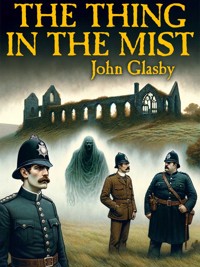
When a team of archaeologists unearths a mysterious burial site Iin a quiet English village, they unleash a terror beyond imagining. As bodies are discovered, horribly mutilated, whispers of an old legend sweep through the town -- a legend of a monstrous creature that stalks the night. Inspector Glasby must confront the unthinkable to solve the case and stop the killings. But as he delves deeper into the mystery, he realizes he may be facing a horror from before the dawn of history...
Das E-Book können Sie in Legimi-Apps oder einer beliebigen App lesen, die das folgende Format unterstützen:
Seitenzahl: 41
Veröffentlichungsjahr: 2006
Ähnliche




















Table of Contents
COPYRIGHT INFORMATION
THE THING IN THE MIST
COPYRIGHT INFORMATION
Copyright © 1967 by John Glasby.
Originally published in Supernatural Stories #109.
Published by Wildside Press LLC.
wildsidepress.com
THE THING IN THE MIST,by John Glasby
It was a hot, sultry mid-summer afternoon when I arrived in the small village of Twyford to find the cause of the horror which had struck in the vicinity three times in as many weeks. For the most part, the country around the village was bare and barren but possessing a curiously humped appearance as if an army of gigantic moles had been at work there at some time in the distant past, throwing up huge, rounded mounds which had, over the ages, become mossy and grass-covered, hiding what might lie underneath.
I did not go alone in my search but took three stalwart constables with me, for the meagre details which had reached me at Forsham, the nearest town to the scene, had spoken of gruesome discoveries and unnameable violence, and in the village itself there were said to be all the signs of panic over the murders. Constable Parkins was a stolid, unimaginative man and he drove the car skilfully along the twisting, narrow roads, staring straight ahead, obviously oblivious to the sinister aspect of the surrounding countryside. As for myself, I found it increasingly difficult to shake off the feeling of morbid fascination which came crowding in on me as I viewed the uncultivated fields and small copses which stood on top of the undulating rises of ground with here and there the thin silver splash of a stream that ran down from the heights and disappeared into lanes of thickly-tangled undergrowth.
We topped a low rise and, acting on impulse, I ordered Parkins to stop the car, getting out to take a look around. Here, where it stretched away in front of us, the country was wilder and more threatening. Long, curving ridges lay across the horizon with outcroppings of bare rock interspersed by pressing green slopes of thick briar and stunted bushes. There were two broad streams which converged at the point where the village lay, obviously giving rise to its name and along the banks, half-hidden roads, so overgrown in places that they vanished altogether beneath the weight of the undergrowth, leading to unguessable depths of dimness.
Even the village itself, touched by the bright sunlight, shimmering in a heat-haze, offered no relief to the curious foreboding in my mind. I tried to tell myself that such imaginings had no part in the mental make-up of a police-Inspector, certainly not when he had been ordered to investigate three exceptionally brutal and perplexing murders.
Five minutes spent in scanning the countryside was enough for me. I turned to go back to the waiting car and it was then that I noticed something strange about half a mile beyond the village. There was a solitary building, very like an ancient church though long-since fallen into ruin, standing at the bottom of one of the rounded hills, and close by a deep brown scar in the earth as if one of the swelling humps had been gouged open. Standing as it did on the edge of a wide stretch of dark-green, marshy ground, it leapt out starkly from its background yet, from that distance, giving no hint as to its true nature.
We drove slowly along the winding road to the village, halting in front of the small police station standing a little way back from the road. There was a strange atmosphere in the village which made itself immediately felt, stirring me oddly. The houses were too quiet. There were no children in the street and the way in which the curtains over the windows twitched as we alighted from the car and made our way into the police station told their own story. There was fear and terror here, not only connected with the fact that murder had been done but rather in the way in which it had been done.
While the three constables made discreet enquiries in the village, I listened to what Henson, the village police-Sergeant had to say. I found him to be more intelligent and imaginative than the usual type of country policeman and the story he had to tell was given to me concisely and yet in minute detail. When he had done, I did not wonder that he had asked for help from outside, or that the villagers remained indoors even in full daylight, no longer daring to venture into the hills, especially in the direction of the spectral ruins which I’d seen from the hilltop.




