


20,39 €
Mehr erfahren.
- Herausgeber: Independent Thinking Press
- Kategorie: Bildung
- Sprache: Englisch
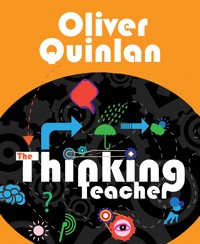
Good Teachers do, great teachers think'. Oliver Quinlan presents ideas from education, business and other areas of life that teachers and educational leaders can use to enhance and explore their thinking. In order to progress we must philosophise about learning, question traditional practice and be resourceful in providing solutions for better education. The only way the education system can improve standards and be at its best is by ensuring that those who govern it don't stop thinking about it! Innovation is the key to our progress as individuals and society as a whole
Das E-Book können Sie in Legimi-Apps oder einer beliebigen App lesen, die das folgende Format unterstützen:
Veröffentlichungsjahr: 2014
Ähnliche
















Praise for The Thinking Teacher
I was recently sat at the back of a secondary school classroom in a Middle-Eastern country waiting for the lesson to start. Why was I there? I was on a fact-finding mission to inform me of what might be needed for a curriculum development project I had been commissioned to undertake. I had asked to meet key stakeholders: education ministers, funders, teacher-education college lecturers, school teachers and students. The ministry was suspicious of me wanting to go into a school – they had asked me to write curriculum materials to a brief for teachers to ‘deliver’, but why would I want to consult with teachers, more so students? They relented as I had argued that it would help me create better materials if I understood the audience. So here I was. The teacher walked in to start the lesson, powered up the electronic whiteboard and started by going through his intended learning outcomes point by point. My heart sank – I could well have been in any classroom in England. The lesson was good in many respects, but formulaic and predictable. There isn’t anything wrong with learning objectives, learning outcomes and success criteria per se, it is just that their mechanical use often leads to uninspiring teaching and passive learning. Let’s have some more thought from teachers beyond the obvious. I was thus intrigued to receive The Thinking Teacher to review.
The Thinking Teacher is not a ‘how to’ book; indeed, Quinlan notes that ‘there is no one model of a highly effective teacher, no one set of things that these people do to make things happen’. There are many good teachers who achieve good results by following a tried and tested repertoire of teaching approaches. Quinlan argues that what separates the truly great teachers from the good ones is that they truly understand learning and the different forms it can take; they spot opportunities for encouraging it in ways that they were never taught to do. These are the individuals who can adapt their teaching to the changing world that young people are in; these are the individuals that move teaching forward. These teachers think for themselves and get their pupils to think for themselves too. I could not agree more.
The book is divided into twelve chapters each exploring an aspect of schooling with intriguing titles such as ‘All you need is love’; ‘Technology as a mirror’ and ‘Learning as becoming’, but each with a consistent argument: teachers should reflect on their own practice and students should think for themselves if their learning is to be deep and meaningful. In Chapter 2, Quinlan asks: ‘What kind of teacher are you?’ and explains that how you define yourself as a teacher is one of the most powerful areas to consider. Rehearsed are the typical tensions between progressives (characterised by Dewey as being more interested in expression, the cultivation of individuality and interacting with the world in a way that prepares young people for participation in a changing world) and traditionalists (who see education as the transmission of a body of knowledge and skills formulated in the past). Quinlan argues that asking questions that we already know the answers to simply reproduces the world as it is, or was, but by asking questions that we do not know the answers to can lead to change – either a change in how we interact with the world or about how we think about the way it works. Indeed, the argument of Chapter 6 is that replicating ‘best practice’ is not good enough as this is a retrospective exercise; rather we should strive for ‘next practice’, that is, the best practice of tomorrow.
There is a thoughtful section on reflection and references to Donald Schon’s concepts of ‘reflection on action’ and ‘reflection in action’, which are now standard as part of the curriculum in many teacher-education institutions, and most teachers are encouraged to continue learning from their practice by reflecting on it afterwards and considering how they could move forward in terms of developing students. I also like the discussion of how much information we should supply learners to help them formulate problems and come up with solutions. There is a strong argument to give learners ‘spaces to think’. On the use of silence, Quinlan writes: ‘Imagine what would happen if when you asked a question you met the answer with silence. The result could be similar to providing thinking time before choosing a member of the class to answer.’
Following Mick Waters’s excellent book Thinking Allowed on Schooling (2013), we now have another ‘must buy’ book for the thinking teacher: The Thinking Teacher. Continuing the same theme, Quinlan gets the reader to move on from thinking of ‘learning as acquiring to learning as becoming’; in other words, he is advocating a classroom based around students becoming participants in the subject rather than possessors of certain, closely defined slices of it. This shift in thinking transforms a subject from a collection of knowledge or skills to be gained to a field of discussion, a community and a space.
Dr Jacek Brant, Institute of Education
This is not a teaching manual. It’s not a guide to help you impress your senior leadership team or Ofsted. There are no checklists or worksheets. And you’d struggle to place it one side or the other of any of the either/or debates about education that are the current focus of so many pedagogues and politicians.
Quinlan doesn’t have an axe to grind, nor a method to sell – he simply wants all of us involved in education to pause and take some time to think, properly, about what we’re doing and, perhaps more importantly, why. Through a series of gently challenging essays, he questions ingrained assumptions, suggests avenues of mental exploration and encourages honest, open reflection. There are some practical ideas you could try out in your own classroom, but the main aim of this book is to inspire you to develop yourself as a ‘thinking teacher’, who will naturally help to nurture thinking children with the skills and aspirations to shape a truly successful and fulfilled future.
Helen Mulley, Editor, Teach Secondary magazine
‘If we want thinking children, we need thinking teachers’, says Oliver Quinlan at the start of his book. He’s dead right – and systematically and skilfully he shows us what that means. The result is a book of considerable depth, yet written with a lightness of touch that makes it eminently readable. For me, now approaching my thirtieth year as a teacher, I learnt a huge amount that was new and was nudged to rethink ideas that I have for too long taken for granted as the only way of doing things. Like all the best education books, this one left me genuinely excited about my work as a teacher and thoroughly refreshed in my own thinking.
Geoff Barton, Head Teacher, King Edward VI School, Suffolk
Oliver Quinlan makes an impassioned plea in this manifesto for teachers and school leaders everywhere: don’t stop thinking. He makes a convincing case that making time to think is not just the key ingredient of great learning, it’s also in the make-up of our top teachers.
Ewan McIntosh, founder NoTosh.com
Acknowledgements
I have been fortunate to know and work with many people who have shaped my thinking over the past few years, people without whom this book would be much sparser and my life much less rich.
I owe a great debt to Neil Hopkin, the first head teacher I worked for, who has consistently helped me to see the balance between the ideal and the practical, helped me maintain and realise my ambitions, and encouraged me to question and seek out challenge.
I would also like to thank Nick Cooper, Simone Haughey, Zoe Case and others I worked with at Robin Hood School, without our conversations challenging the preconceptions of how we ‘do school’ much that is here would be lacking.
Many colleagues at Plymouth University have shaped my thinking through their work, our discussions and debates. Lorraine McCormack, Rachael Hinks Knight, Steve Wheeler, Orla Kelly, Roger Cutting, Pete Kelly and Nick Pratt have all introduced me to their perspectives and ideas that have shaped this book. I cannot thank Pete Yeomans enough, firstly for persuading me to make the move to Plymouth, secondly for his intellectual challenges, but mostly for being a dear friend who has helped me with figuring it out.
Many people have influenced me over the last five years through their blogs, tweets, and our all too occasional face to face discussions at events. Thanks to everyone who has shared their nuggets of insight, and their reflections on learning online.
Of those, I must particularly thank Ewan McIntosh, for his clear thinking on opening up learning to the challenges of the real world, Doug Belshaw for his ideas on Digital Literacy and ambiguity and Carl Gombrich whose ongoing thinking on the place of academic disciplines in the connected world has changed my thinking.
Many of the ideas in this book grew from posts on my blog, and most of those were prompted by the many young children I have worked with in schools and students at Plymouth University. I hope I have managed to develop your thinking as much as you have all developed mine, working with you has been a great privilege.
The final thanks must go to my family and friends for their support whilst writing this book, and always. Most of them have listened to me verbally working out ideas for this book many times, and have often helped me to see the wood for the trees. I am lucky that there are too many people here to name individually, but thanks to all of you for your support and friendship.
To my Mum and Dad I owe thanks for the obvious reasons, but also for bringing me up to value exploring possibilities, not getting stuck in boxes and thinking differently.
Contents
Preface
In one of those moments when you know you have been at something too long, I looked out of the library window. I was halfway through the reading list for my PGCE essay on managing children’s behaviour and felt totally uninspired. I wondered, not for the first time, whether what was expected of me was to simply paraphrase all the instructions I was reading about how to control children. I thought teaching was going to be about more than this.
I moved on to the next book on the pile, opening the simple blue and orange cover expecting more instructions. This one was different; the author hadn’t set out to tell me what to do, but to raise some questions and present some research on the evidence that might inform the answers. The case studies encouraged me to think about what effect the way the furniture in a classroom might affect how the children perceived it, raise questions about the messages that were being put across through the way tasks were designed, and question the assumptions I was making about how people think when implementing reward charts, even if they do appear to work … This, I thought, is what teaching should be about; not ticking off the answers, but starting to think.
Several months later, as I walked off the stage, I felt a hand on my arm. Turning round, I saw a teacher whose blog I had been following for the past year and who had been giving me ideas for the classroom since I had started training to be a teacher. ‘Great stuff,’ he said, ‘you really made me think differently about that; you took some research, thought about it and made it happen in your classroom. More of us should be thinking like that.’
I had found out about TeachMeets only a few months before, when I heard about a group of teachers who got together in Nottingham to share ideas that had worked in their classrooms. The empowering nature of them appealed to me and, as a newly qualified teacher in a school with a remit for trying new things, I was hungry for ideas I could develop. So, when I saw a similar get-together was happening at an education technology show I was going to, I signed up to attend, and without thinking too much about it, I also signed up to share an idea, just thinking that was the way it worked.
I did not expect to be picked by the random generator to be one of the first to present. I did not expect to stand on a stage in front of 300 people. I certainly did not expect for so many of those people to say I had made them think about taking perspectives from research to think differently about their teaching. That, I thought, is what teaching is about; not ticking off the next new idea, but always trying to think.
Some weeks later, I was teaching subtracting two-digit numbers, and I was demonstrating to the class of 8-year-olds how to use a hundred square to calculate the difference between 100 and any two-digit number. I was halfway through when Barnes put his hand up. So as not to confuse things, I thought I would come to his question once I had finished explaining. But Barnes couldn’t wait, and he politely but assertively interrupted me. ‘Mr Quinlan, please don’t say “count down”,’ he said. ‘It might be moving down the board but you are counting up in tens – that could really confuse some people.’
He knew what I meant, but he was thinking beyond that – thinking about the implications of the language I was using on the understanding of the rest of the class. That, I thought, is what teaching should be about; getting them thinking.
If we want thinking children, we need thinking teachers.
Introduction
This book is about thinking about teaching and learning. There is a lot of thinking that goes on in schools, in teachers’ cars on the way to and from school, in their homes when planning, and in the holidays when reflecting on the term that has just gone and the one ahead. There is also a lot about teaching and learning that we do not think about so much, assumptions that are so ingrained we never question them, possibilities we never spot because we are so accustomed to the ways of schools.
There are few other careers than teaching where everyone entering already has thirteen years of experience in the workplace. There are tremendous strengths that come with this, but also tremendous problems because once you have spent so long immersed in something it is very difficult to see it in different ways. Education systems move very slowly, in part because we all have so much ingrained experience and memories that often we repeat the kind of teaching we experienced without thinking about it. Even if we aim to repeat only the best and forget the worst, it requires taking a step outside and some distance to see the different ways that teaching and learning might happen, ways which might just work better for our changing young people and changing society than those that suited us in a time that is already ancient history to them.
Here, I want to share some possible avenues to those different ways, some challenges to the assumptions we make and some perspectives from outside to encourage new thinking. This book is not about telling you how things should be done, what new forms of teaching should look like or where education should be going. This book is an invitation to start to build the answers to those questions, to think them through and see where they might go. It is an invitation to seek out challenges and perspectives that, in the hectic life of teaching, you might not see unless you take the time out to see them, and to keep looking for more.
There are many incredible teachers out there, teachers who get others excited about their subject, who open up opportunities to young people by developing their knowledge and skills, and who make their students aspire to great things. Amongst these individuals there are a huge range of outlooks, ways of teaching and ways of thinking about what they do. There is no one model of a highly effective teacher, no one set of things that these people do to make things happen. Thinking back to the teachers that made a big impression on me, there were those that created exciting and unusual lessons, but also those that were very traditional. There were those that were very approachable and friendly, but also those that we never chatted to informally but that had high expectations and made us live up to them. As teachers, this is both exciting and frustrating: frustrating in that there is no clear, step-by-step model that we can follow, but exciting in that it is something that we can make our own, something that is more about who you are than any instructions that you follow.
What is more important than the specific things that teachers do is the ways in which they think. There are some good teachers who have a bank of different things they do that they know work, and deploy these over and over without thinking too much about them. It is more than possible to get good results by doing this, particularly if the context of your teaching does not change too much. What marks the truly great teachers from the good ones is that they are not leafing through a library of strategies, they just get it. They really understand learning and the different forms it can take; they spot opportunities for encouraging it in ways that they were never taught to do. These are the individuals who can adapt their teaching to the changing world that young people are in; these are the individuals that move teaching forward. It is not just about a limited palette of what they know – it is about how they think.
The kind of person you are, the way you think; these are not the kinds of things we usually consider changing or working on. They are the kinds of attributes possessed by people who come to things naturally, people who just think differently, people who just ‘get it’.
If we are in the business of teaching and learning we have to believe that most things are learnable. All things being equal, it is possible to make significant changes in yourself and to learn. Of course, many things are situational: I am never going to be an Olympic gymnast – I am too old and my body is past it already. However, with enough time, dedication and practice I could certainly learn some gymnastic skills and improve.
Thinking is no different. We tend to give great credence to the idea that our thinking and intelligence is quite fixed, but many researchers are now exploring what optimistic teachers have thought forever: intelligence is much more complex than being born smart.1 Given some attention and some belief in the power of learning it can be developed in many ways.
This book is about thinking differently about teaching, about taking the time to question our assumptions and the things we don’t always take the time to consider. It is about opening our eyes to the changes and contrasts in the world that might influence the way we think about learning, and not accepting things as they are but looking to what they could be.
Who do we remember?
I work with student teachers and when interviewing prospective new students I often get a fascinating insight into the motivations people have for becoming a teacher. It is always interesting hearing their answers to the question, ‘Why do you want to become a teacher?’, largely because they are all so similar. Of course, an interview situation is far from scientific – prospective students are hardly going to tell me it is for the holidays. Even if the situation did allow them to be more candid, the vast majority of people do seem to go into the profession because they care, because they really want to make a difference.
Often people cite positive reasons for going into teaching and occasionally they are spurred on by negative experiences at school – wanting to provide children with the education ‘they didn’t have’. What is common to both of these very different approaches is the desire to be a teacher that students remember. Most people have very strong memories of certain teachers, and it strikes me that in most cases this correlates with the ‘difference’ that individuals starting out as teachers set out to make.
It could be argued that any moderately successful teaching constitutes ‘making a difference’. A child comes to you unable to read; the lessons you teach them and the experiences you provide them with means that at the end of their time with you they can read. A difference has been made. Reading is a profound example, given how central it is to schooling and life in general, but the same is true for less fundamental things. Understanding a scientific concept such as condensation, knowing the reasons why an election in a democracy works in the way it does, being able to select the colours needed to create a desired artistic effect; making any kind of learning happen is creating a difference. Making such differences is not necessarily difficult – although causing these differences to happen consistently and regularly for all learners in the large classes most people teach takes skill – but all teachers make some kind of difference. In his comprehensive review of educational research, John Hattie found that everything and anything a teacher does has an impact.2
However, it is not these small differences that the prospective teachers I interview are talking about. Causing a small change in someone’s memories does not a memorable teacher make. Think about the teacher or teachers you remember and why they stand out. Generally, the teachers people remember are ones that they perceive to have made a bigger difference – a difference that has affected the way they think.
Sometimes this is for academic reasons, but it is usually about an individual who really engaged them through their teaching. This could be by simply being enthusiastic about their subject, but sheer enthusiasm alone is unlikely to engage students in such a way they continue with that subject. For teachers to be memorable, they also have to present the subject in such a way that their students can understand it, see its relevance, enjoy its challenge and get enthusiastic about it themselves. These memorable teachers open up their subject to others, often in a way that causes them to pursue the subject, or a related field, further and always in a way that allows them to use that subject as a different lens to look at the world.




