


8,49 €
Mehr erfahren.
- Herausgeber: Corvus
- Kategorie: Gesellschafts- und Liebesromane
- Sprache: Englisch
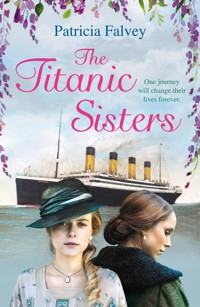
One journey will change their lives forever __________________________________ To follow her dreams, she must sacrifice everything... Sisters Nora and Delia have been given the chance of a lifetime - to escape their poor Irish farm and travel on the Titanic to a new life in America. Nora is to become a treasured governess for a rich family, while Delia has only a lowly maid's position. But when disaster strikes, and Nora dies, a small misunderstanding leads to Delia taking Nora's place as governess. As Delia grows closer to her charge, and the girl's father, will she be able to reveal the truth to find a chance at happiness? And what will happen when she finds out that Nora is actually alive, and coming to take what is rightfully hers...?
Das E-Book können Sie in Legimi-Apps oder einer beliebigen App lesen, die das folgende Format unterstützen:
Veröffentlichungsjahr: 2019
Ähnliche



















The Titanic Sisters
PATRICIA FALVEY was born in Newry, County Down, Northern Ireland. She emigrated alone to the United States at the age of twenty. Patricia still has close family in Ireland and returns often.
Also by Patricia Falvey
The Girls of Ennismore
The Linen Queen
The Yellow House
The Titanic Sisters
Patricia Falvey
Published in paperback in Great Britain in 2019 by Corvus, an imprint of Atlantic Books Ltd.
Copyright © Patricia Falvey, 2019
The moral right of Patricia Falvey to be identified as the author of this work has been asserted by her in accordance with the Copyright, Designs and Patents Act of 1988.
All rights reserved. No part of this publication may be reproduced, stored in a retrieval system, or transmitted in any form or by any means, electronic, mechanical, photocopying, recording, or otherwise, without the prior permission of both the copyright owner and the above publisher of this book.
This novel is entirely a work of fiction. The names, characters and incidents portrayed in it are the work of the author’s imagination. Any resemblance to actual persons, living or dead, events or localities, is entirely coincidental.
1 3 5 7 9 10 8 6 4 2
A CIP catalogue record for this book is available from the British Library.
Paperback ISBN: 978 1 78649 064 3E-book ISBN: 978 1 78649 065 0
Printed in Great Britain
CorvusAn imprint of Atlantic Books LtdOrmond House26–27 Boswell StreetLondonWC1N 3JZ
www.corvus-books.co.uk
For my sister, Connie
DONEGAL, IRELAND
1911
DELIA
The letter from America changed all our lives. The postman presented it to me with great ritual as if it were a fine jewel. In his memory, he said, no one in my small village of Kilcross, in County Donegal at the north-west tip of Ireland, had ever received such a thing, nor had he himself ever delivered anything so rare. After he pedalled away from our cottage whistling, I stood at the door holding the envelope, with its bright ribbon of stamps, in my hands like a colourful bird.
I didn’t have long to examine it. Ma came up behind me and peered over my shoulder. Instinctively, I shrank away from her. She roughly plucked the letter from me, scanning it with greedy eyes.
‘’Tis addressed to me,’ she said, looking at me accusingly. ‘You should have brought it to me at once instead of standing there like a statue. You’re useless, so you are!’
I watched her walk back down the hall and wondered, as I often did, how such a small woman could command such a large presence. She was no taller than myself, but in my mind she still towered over me the same way she had when I was a small child. After she disappeared into the kitchen, I fled outside. I ran around the back of the cottage and up the fields to my favourite place – a group of rocks, bleached white and smooth, which formed a circle beneath an ancient oak tree and from which I could look out across the vast Atlantic sea. I sat down on one of the rocks, panting, struggling to catch my breath. I shivered, suddenly aware of the winter cold settling around me. I had been coming up here since childhood to escape Ma’s wrath. When I was young, I often cried out of self-pity and I was convinced it was my tears that had washed the rocks so clean. Now, at eighteen, I no longer cried, but the hurt in my heart remained.
I was born a twin. My brother, born first, only lived two minutes after birth. My ma took it into her head I was a changeling who had been left by the fairies in place of my brother whom they had stolen away. Such stories about fairy children are common in our part of Ireland. The villagers thought it was the stress of childbirth that had put such a notion in my mother’s mind, and that she’d get over it in time. But Ma couldn’t be talked out of her belief and had always treated me with suspicion and, sometimes, disgust. I knew her reasons, but it did not ease the pain of her rejection.
Had my brother lived, he would have worked with Da on the farm. It was the way of things. Fathers teach their sons how to run a farm so that they, at least the eldest of them, could manage the farm when the father died. Mothers, in turn, train their daughters to run the house – to cook, clean, do laundry and rear children so that they, at least the younger ones, would be well prepared for marriage. Sadly, it fell to the eldest daughter to stay and look after her father and brothers after the mother died and the rest of the family left.
As the elder daughter, my sister Nora, born two years before me, should have been the one doomed to stay after Ma died, but Ma would never allow that. Her dream for Nora was that she become a wealthy man’s wife, and thus have no need to learn to run a house. I took on a son’s role on the farm; Da needed the help and Ma refused to have me in the kitchen.
Spending time alone with Da was the only good thing in my life. We set out together each morning before the sun was up. As if by unspoken agreement, no words were exchanged between us as we went about our labours. Farming on the rocky soil of County Donegal required a persistence often born out of desperation. Like his da before him, Da had learned how to eke out a subsistence on this unforgiving land. We had four dairy cows, which was rare around Kilcross, chickens and a few hardy sheep. We harvested potatoes and grain, and carved turf out of a nearby bog to heat the house. My job was to milk the cows, collect the eggs and rescue the sheep that occasionally wandered too far up the hills. Had it not been for school, I would have stayed outdoors all day and night, enjoying Da’s peaceful companionship.
Even on rainy days, I loved being outdoors. It rained often in Donegal, washing the hills green and slaking the thirsty soil. Sometimes it fell in a fine mist that caressed my face, other times in pellets sharp as glass, and every now and then in unrelenting waves propelled by fierce winds. I welcomed it in all its forms, turning my face skyward to greet its baptism. And when it was over, I waited in anticipation of a beautiful rainbow arcing across the sky.
When I turned seven Da walked with me into Kilcross village to make my holy communion. Kilcross could hardly be called a village. It sat at a crossroads with the local pub on one corner and the small grocery shop on the other, flanked by a row of a dozen houses in which lived a doctor, a vet, and a handful of elderly spinsters. Most Kilcross villagers lived in farmhouses or cottages like ours, scattered about the local countryside.
Kilcross church, on the outskirts of the village, was the largest building, and its spire was visible for miles. Next to it was the school, and the priest’s house. Father McGinty, the parish priest, was a short, hunchbacked man who ruled as judge and jury over the morals of his flock. He had a voice like thunder and put the fear of God in every man, woman and child in the village. When I arrived in my second-hand communion dress, he wagged his finger at me.
‘I see the changeling has come to ask for grace,’ he shouted, ‘but our Lord will only grant it if you convince Him that you are worthy of his mercy. You have reached the age of reason now, my girl, and your sins will be on your own head. ’Twill be your own fault if you fall from grace. And you know what happens then?’
‘You go to hell, Father,’ I whispered.
Da said nothing but put his arm around me as if trying to protect me from the priest’s wrath. After that, I went to mass every Sunday and day of holy obligation, and confession every week hoping to convince God and Father McGinty of my inherent goodness.
But there were also times when I was a child that a rebellious spirit took hold of me and I was tempted to do the bad things that a changeling might do. I dreamed of taking Ma’s favourite plates from the dresser and smashing them; dousing the turf fire with water when no one was looking; pouring paraffin into the churn turning the milk sour; and when Ma confronted me, shrugging my shoulders and asking what else did she expect from a changeling? Such fantasies made my helplessness bearable for the moment, but I knew I wouldn’t dare to make them reality. Ma was hard enough on me as it was, and doing such things might cause her to throw me out of the house altogether. So they remained in my head.
There were times, though, when I wondered if Ma wasn’t right about me being a bad fairy. From when I was quite young I was often able to predict things before they happened. Sometimes I was wrong, but as time went on, I was right often enough that I realized it was not chance. I was nothing like the old biddies in the village who Ma often visited to get her fortune read from the tea leaves. This was something much more subtle and happened only once in a while. I knew when misfortune was going to befall a villager, or when good fortune would come someone’s way. I never mentioned this ability to anyone – it would only have brought me ridicule.
Although he never said as much, I knew my da loved me. By contrast, I knew Ma did not. She doted on my sister Nora while she treated me as an afterthought at best, and a burden at worst.
‘By the sacred heart of Mary,’ she often said, ‘sure, I don’t know what sin from the past has brought the scourge of yourself into my life.’
My stutter did not help my situation. It developed soon after I began to speak and persisted over the years. It was worse when I was nervous, and particularly pronounced when Ma was shouting at me. I tried everything I could to suppress it, but with no success. After a while I realized all I could do was limit the amount of talking I did.
As the years passed, I took refuge in books. The local schoolmistress, Miss Fagan, a young woman from Belfast, took a liking to me and brought books to me from the library in Donegal Town. ‘You’re a clever girl, Delia,’ she said. ‘You deserve more of an education than this wee school can give you.’ I was delighted with the books. They became my friends and my comfort in long winter evenings when the wind whistled through the window and rain pounded the roof. I would sit on my small bed in the stark attic holding a candle and devouring the pages one by one.
Over time, my dreams of outward rebellion were replaced with something more subtle. I came to find joy in the new words I was learning from my books – not just the joy of new knowledge gained, but joy in the notion that it was setting me apart from the rest of my family. Slowly, the word ‘imposter’ began to take on a new and positive meaning. The books I loved best were the ones where the people in them sailed away to foreign places in search of adventure, discovery and, sometimes, love. On fine days, I used to sit amidst my rocks and stare out over the distant Atlantic, lost in visions of lush jungles, hot deserts, sea-swept islands and teeming cities which surely lay beyond it. Such places were a far cry from my little Donegal village, and even further from my miserable home, and I longed to see them.
As I sat now on a rock looking out at the sea, its rough waves roiling with grey and white foam, I heard a noise behind me. I turned around and saw Da in the distance, his tall, gaunt frame bent against the wind. He trudged towards the cottage carrying a bucket in each hand, containing sods of turf for the fire. As a child I used to run to greet him and he would nod as I ran along beside him, holding the handle of a bucket and trying to keep up with his long strides. I was used to his silence. I sometimes wondered if it was because he had grown up speaking Irish and was still uncomfortable with English words. I asked him once to teach me Irish, but he shook his head. ‘’Twould be of no use to ye,’ he said. ‘’Tis the English that rule this country, and ’tis the English tongue ye’ll be needing.’
I went up to him now, took one of the buckets and fell into step beside him, lost in my own thoughts. Then I remembered the letter from America and my steps quickened. What surprises might it hold? Had it brought fortune? But by the time I pushed in through the cottage door, I knew. No matter what fortune the letter held, it would not be for me.
NORA
The letter lay like a tasty, forbidden morsel on the kitchen table. Ma refused to open it until Da came home for his tea.
‘Ah, Ma, would you not let me look inside? ’Twill only be a quick peek. I’ll just tear off the corner. I won’t even open it all the way,’ I pleaded.
But Ma wouldn’t budge. She just sat, looking at me like a cat teasing a mouse. ‘We’ll wait until your da comes in. Such an important thing as a letter from America should be opened by the man of the house.’
I inwardly rolled my eyes. Man of the house, my arse, I thought. When had she ever given the poor man say over anything in the house? No, Ma liked things her way and Da never got a look-in.
But why she was torturing me now, and seeming to enjoy it, I didn’t understand at all. Usually I had only to hint that I wanted this or that thing and she fell over herself rushing to give it to me. After all, I was the favourite daughter. Ma made no secret of the fact that my sister, Delia, needed to fend for herself.
When Delia and I were younger we played happily together. She was a delicate wee thing, fair-haired and grey-eyed, and at times I thought Ma must be right, she did look like a wee fairy. I was only two years older, but I was taller and stronger than she was, with hair as dark as a sod of turf. I was delighted to have a sister for company. But when we got a bit older, things changed. Ma did her best to divide us, pulling me into the house and shooing Delia outside like an unwelcome neighbour. I never really understood why Ma disliked Delia, but I never stood up for her. I was afraid that if I did, Ma would turn on me as well, and I liked being spoiled. Besides, I was jealous of Delia because of Da. She spent all hours of the day traipsing around with him on the farm and just by the way they looked at each other I could see how close they were. Da was always kind to me, but I knew he was closer to Delia.
I often wished things were different though. There were times when I would see other girls laughing with their sisters and sharing secrets and I wished myself and Delia were more like them. It would have been great craic to giggle together over the boys in the village. But our Delia wasn’t interested in things like that. She was always away up the fields daydreaming about God knows what or sitting with her head stuck in a book. Slowly, I began to agree with Ma that she was a useless chit who’d never amount to much.
At last, Da was home. He came into the kitchen, ducking his head under the low doorframe. He went to the fireplace and dropped two buckets of turf on the hearth, looked around at Ma and myself and then at the table.
‘Where’s me tea?’ he asked.
Ma sighed. I could see from the way she slumped her shoulders that some of the excitement over the letter had gone out of her. I wondered if she was thinking again of her mistake in marrying Da. She told me about it often enough, particularly when she was drilling it into me that I had to set my sights high when choosing a husband.
‘Don’t make the same mistake I did,’ she would say, ‘marrying for love! What good did it do me? Stuck out in the middle of nowhere with only the cows and sheep for company, no running water, not even an outhouse. I’d be disgraced if my old school friends knew how I was living. I was the best-looking girl there and they all said I’d marry a toff. Don’t end up like me, my girl.’
She looked up at Da. ‘Hold your horses, Peadar, sure the tea’ll be ready in a minute. Now, sit you down,’ she said, smiling. ‘We’ve had a great surprise arrive – a letter all the way from America. And we’ve been waiting all day for you to come home and open it.’
Da looked suspiciously at the envelope and then at Ma. ‘’Tis addressed to yourself. Could you not have just opened it without all this oul’ palaver?’ he said. ‘Or have ye forgot how to read?’
It was seldom Da spoke to Ma this way. In fact, it was seldom he spoke at all. The smile left Ma’s face. She snatched the envelope up and ripped it open, muttering under her breath. I felt a bit sorry for her. She’d wanted to make a big ceremony out of this thing that was so out of the ordinary in our everyday lives, and now Da had thrown cold water all over it.
She took the flimsy letter out of the envelope and unfolded it, holding it in her rough red fingers and mouthing the words to herself. When she was finished, she looked up at us with glassy eyes, as if she’d just witnessed a miracle.
‘You’ll never believe this . . .’ she began, and then stopped as she rummaged inside the envelope. She turned it upside down and some foreign-looking bank notes tumbled out.
‘Mother of God,’ she breathed, ‘will you look at that!’
I wanted to shake her. ‘Will you ever put us out of our misery, Ma?’ I shouted.
Even Da peered at her with sudden interest.
Ma took her time. She smiled at Da and then at me before she took a deep breath and began to speak.
‘’Tis a letter from my niece’s husband. He says the poor girl died of the fever. Ah, may God rest her soul. She’d have been older than yourself, but too young to die. She was the only child of my oldest sister and that blackguard she married named Sullivan. I didn’t know her that well, because Sullivan moved the family to America when Mary was young . . .’
I thought I would burst with curiosity. ‘For the love of God, will you get on with it, Ma?’
Ma straightened up. ‘The letter is from a Mr Aidan O’Hanlon in New York City. It seems he was married, as I told you, to my niece, Mary . . .’
I was close to screaming. Seeing my face, she hurried up the story. ‘Well, he says Mary left him with a young girl by the name of Lily. He says before she died Mary begged him to send for one of her Irish cousins to come over and help take care of the child and asked him to write to me. He wants the girl to be a governess, he says. What do you think that means?’
‘It means a t-teacher.’
Delia must have come into the kitchen without us noticing. She often seemed to float here and there like a ghost. We looked up at her and then back at the letter. Ma cleared her throat and went on. ‘And here’s the good part. He asks if I have any daughters who would be suitable.’
I felt my heart flip inside my chest. Could this be my chance to get away to America? I’d secretly hoped for such a chance for years. There was nothing for me in Kilcross and, truthfully, Ma was beginning to suffocate me. I wasn’t a good scholar and I didn’t have many choices. But surely I could teach a young girl something useful.
‘Wait now till you hear this.’ Ma pointed to the money. ‘He’s enclosed the money to buy a first-class ticket on the Titanic, which he says is being built in Belfast. It’s due to sail next April.’
Ma was breathless now as she picked up the strange-looking bills and threw them down on the table again in triumph. ‘He says ’twas Mary insisted ye travel first-class since ye’d be doing her the biggest favour in the world coming to look after her child.’ Ma pursed her lips. ‘He must be swimming in money, so.’ She turned to me. ‘What do you think of that now?’
For once I was as speechless as Da. Surely Ma would pick me to go. But, for the first time in memory, my confidence deserted me. What if she didn’t? What if she picked Delia instead? After all, she’d made no secret of wanting to be rid of her. Maybe she wouldn’t want me going so far away since she was so dependent on me for company. I held my breath and waited for what seemed like an eternity.
Finally, Ma grinned. ‘Ah, you should see the look on your face, darlin’,’ she said. ‘And who do you think I’d be sending? Not that sister of yours!’
As I was letting Ma’s words sink in, I noticed Da looking off towards the door. I turned just in time to see Delia’s back as she slipped out into the hallway.
DELIA
Islid down on the floor in the corner of the attic, closed my eyes and rested my head on my knees. I wanted to cry, but no tears would come. It was no surprise, I thought, that Ma would pick Nora. Nora was bright-eyed and cheerful, dark-haired and buxom, and sure of her place in the world. In contrast, I was of slight build, with fair hair and grey eyes. I always shrank away when I was beside Nora, believing no one would ever look at me twice while she was there. Of course Nora was the better choice to take on the challenge of America.
What hurt was that I had finally held the possibility of escape in my very hands only to have it snatched away. It caught me by surprise that I should be so disappointed when there had never really been any hope that one day I would see those faraway places I read about in my books. Maybe the arrival of the letter had made me face up to how much I really wanted to get away and live my own life. But how? I took in sewing from time to time but given the little money I made from that it would be a hundred years before I could afford to move to Dublin, let alone New York.
I ran away once when I was fifteen. I got a lift with a local farmer as far as Donegal Town and was lingering at the station wondering how I would get money for the train to Dublin when Da appeared. He said nothing, just lifted my suitcase and walked away. We drove home in the pony and cart in silence. Ma said he should have let me go.
There were few jobs to be had in Kilcross for which I was qualified. I couldn’t even get a job serving in a shop because of my stutter. That was why, after I left school, I went back to the farm. As I was free all day, Da gave me more jobs than before. Soon I was helping him sow and harvest the crops and cutting turf beside him on the bog with a two-sided spade, called a slane. But much as I loved the outdoors and Da’s company, I had begun to realize that it was time to leave.
My thoughts were interrupted by the sound of footsteps on the stairs. I stiffened. No one ever came up here. It was my bedroom, my safe place. The door creaked open and there stood Da. He hesitated for a second, but then bent over to enter through the small opening. When he straightened up in the tiny room, he looked like a giant in a fairy tale.
I waited, saying nothing. He stood in the middle of the room, shuffling uncomfortably. Then he cleared his throat.
‘’Tis sorry I am,’ he said at last.
I pretended I didn’t know what he was talking about.
‘For what?’
‘For your sadness. I could see it on your face when your ma told Nora she’d be the one to go.’
These were the most words he had said to me in a long time. I wanted to ignore him, but I could see the effort it was taking for him to talk and my heart softened.
‘It doesn’t matter, Da,’ I whispered, even though everything in me wanted to shout that it did matter, that I wanted this more than anything in my whole life.
He moved a little closer. I noticed, for the first time, that his boots were cracked and caked with dirt. His trousers were rolled up at the ankles and tied with string. As my eyes travelled up, I saw the stained old jacket that he seemed to have worn for as long as I could remember. My gaze lingered on his face. His eyes were sad and watery and the same grey as my own. I realized then that I had never really seen my da, and my heart lurched. I rose to my feet and hugged him, something I hadn’t done since I was a child.
‘Do you want to go?’
I nodded my head.
‘Aye, Da, I do. More than anything else in the world.’ I paused, and all my repressed anger finally erupted. ‘I do want to go! I want to get away from the misery I’ve suffered here. I want to be free to live my life without being criticized at every turn. I want adventures and, yes, maybe even love. Why can’t I be loved, Da? Don’t I deserve it like anybody else?’
‘I love you, daughter,’ he whispered.
I looked up in astonishment. I’d always known that he loved me, but to hear him say it . . . I wanted to throw my arms around him. But my despair returned.
‘What’s the use in talking about it, Da? This will be like everything else – Nora will get what she wants and, as usual, I’ll get nothing!’
He dug his hands into his jacket pockets and nodded his head.
‘Maybe so,’ he said. ‘But what if I found a way for you to go, daughter. Would you want it?’
‘Yes,’ I cried. ‘Yes!’
‘That’s the answer then, so,’ he said, and turned towards the door.
I wanted to cry out after him, ‘Why are you doing this, Da? Why are you torturing me with the hope of it?’ but I kept silent.
I thought nothing more of it. For the next week I went about my business on the farm and Da went back to his usual silence. Then, one day, he came over to where I sat in the circle of rocks and thrust an envelope into my hands.
‘There’s an address in there of a house in New York needs a maid,’ he said. ‘Father McGinty gave it to me when I asked did he know of anybody. He said ’tis a good Catholic family and he’d pray they’d be a good influence on your soul.’
Da’s face didn’t betray what he thought of Father McGinty’s motives, and I decided it didn’t matter whose idea it was.
‘Their name is Boyle and the housekeeper will meet you when the boat docks. Your man O’Hanlon in America sent enough money will buy you and Nora a berth in steerage on that new boat.’
‘B-But what...’
I looked up at him in astonishment. I waited for him to explain more. What would Ma say? Why was he letting me go?
I would get no answers. Da turned around and continued his way down to the cottage, leaning on a blackthorn stick, our old sheepdog lumbering behind him. As I watched him go, a thought, fragile and elusive as a tiny bird, began to form. Could it be that fortune had finally smiled on me?
NORA
I was fit to be tied when I found out what Da had done. I screamed aloud at Ma, tears stinging my eyes. ‘But it was my money, Ma. You promised I’d be the one to go.’
Ma looked up at me from where she sat at the kitchen table. Then she looked away, staring out the window. She couldn’t even face me.
‘You’re still going,’ she said quietly, ‘’tis only that your sister’s going too.’
‘Aye, travelling down in steerage with the rabble. It might suit Delia, but it doesn’t suit me.’
I’d been looking forward to the journey in first class; I’d pictured myself strolling around the deck in the company of all the toffs. I even let myself imagine one of the rich young fellers would take a notion for me. And now Ma, by not standing up to Da, had ruined all of it. Who was I going to meet down in steerage? Second sons of farmers forced out because they wouldn’t inherit the farm; scrawny shop boys who had a bob on themselves because their boots weren’t caked in mud like the farm boys; and chancers of every kind. I could stay home and meet the likes of them!
While the shame of having to travel in steerage fuelled my temper, I realized there was something more to it. Da had proved, once and for all, that Delia was his favourite daughter. I’d always suspected it, but now I knew for sure; I meant little to him. I used to put my feelings down to jealousy of Delia, but I realized now it was not jealousy, but hurt. I’d wanted Da to love me. I suppose you always yearn for what you know you can never have.
After a while my fury quieted down. ‘But why, Ma? Why did you let him do it? You never listened to him before.’
Ma looked me straight in the eyes.
‘Oh I fought him on it all right! We went at it hammer and tongs. But he wouldn’t give an inch. I’ve never seen your da so stubborn.’ She paused as if making up her mind what else to say. When she spoke again, her words were angry. ‘I should never have shown him that ticket. He took it down from the dresser and got the priest to help him exchange it for the two third-class berths. Went behind my back, so he did, the sly oul’ fox.’
She shrugged. ‘Besides, I’m not sorry to see her go. How could I have stood it with you away and herself left here to taunt me from morning till night?’ She stood up and smiled. ‘At least she’ll get her comeuppance in that house – if Father McGinty recommended them they must be tyrants altogether.’
She stood up, all business now, and came over to stand close to me. She wasn’t a tall woman, but when she was right next to you, which she was now, you’d swear she was as big as Da. I leaned away from her the way I always did when I felt her smothering me.
‘I know what you’ve been thinking, my girl,’ she began. ‘You’ve been imagining that you’d have met a rich young feller in first class. Well so you might have, but that’s not what I have in mind for you. You’ll go to work for Mr O’Hanlon in New York and you’ll coax him into marrying you. On my oath I’d bet that feller has more money than any of the young idlers you’d be meeting in first class who would promise you anything to get their way with you and then throw you over for some girl more equal to their station.’ She paused. ‘On the other hand, Mr O’Hanlon is a settled man who is most likely looking for a wife, and you’ll be the one to fill the bill.’
I could see the wisdom of her words, but a small part of me wanted to rebel at being told what to do. I should have been used to it by now – she’d been telling me what to do all my life and I had given in because I was rewarded with praise and finery. I liked being told that I was beautiful and too good for the local boys. I liked wearing the latest fashions and making all my friends jealous. Some of them, like Delia, had to be satisfied with hand-me-downs and others had to wear clothes their ma sewed out of dyed, rough flour sacks. I was far and away the best dressed of any of them and I strutted into mass on a Sunday morning knowing that everybody was looking at me. I told myself ’twas a small price to pay to let Ma have her say.
I did the same thing now. I nodded. ‘You’re right, Ma. You always are.’
She gave a satisfied nod.
From then on up to the time the Titanic was ready to sail, Ma took down from the dresser the wee box where she kept the money she’d saved from selling eggs. She took me to Donegal Town and spoiled me with new dresses and hats, ribbons and new boots, and even a small bottle of perfume I’d begged for. She even took me to get my hair styled. I was going to be the belle of the ball, she said.
It was a pity all that effort was going to be wasted in steerage.
TITANIC
1912
DELIA
I was trembling with nerves and excitement when the big day arrived; the day we were to travel to Queenstown in County Cork to board the Titanic, which would sail the next day. Queenstown harbour was at the far end of the country and it would be a long journey. First, we’d have to go by pony and cart to the station in Donegal Town and then on by train, making several stops to change lines along the way. It would take us a full day. I’d never travelled that far in my life, nor had Nora. I couldn’t wait to see the rest of Ireland.
I’d scarcely slept the night before, my mind jumping between excitement and anxiety. As we left the cottage, the morning was still dark. Ma stood at the door, her arms folded as Da readied the pony and cart. When he had hauled our luggage up into the bed of the cart, Nora ran over to Ma and threw her arms around her. Ma hugged Nora back. I knew by her loud sniffs she was crying even though I couldn’t see her plainly.
‘God bless, darlin’,’ she said, ‘and remember everything I told you. You’ll no doubt have boys traipsing around after you on the boat, but you’re to set your sights higher.’
‘Yes, Ma. I will,’ Nora said fervently as she turned away, although I knew she was only humouring her. When it came to boys Nora always did exactly what she wanted no matter what she promised Ma.
I waited for Ma to say something to me. We stood looking at each other for what seemed a long time. At last she said, ‘Safe journey,’ and turned and went back into the cottage. I fought back tears. I’d hoped against hope for some kind words. After all, this might well be the last time we would ever lay eyes on each other. I suppose I should have known better.
Just as we were ready to board the cart, our house cat raced out of the cottage door and jumped up into Nora’s arms, purring. Nora let out a squeal of delight.
‘Poor puss,’ she said as she stroked it. ‘Will you miss me? I’m sorry I can’t take you with me. Be a good girl now and go and keep Ma company.’
She gently set the cat back down on the ground. Nora was very fond of animals, a trait I always found curious in her. It seemed to me they were the only creatures she loved more than herself.
As we travelled away from the cottage, pale red streaks spanned the sky ahead of us. Dawn was coming, the last dawn I would see in Ireland for I believed in my heart that I would never return. My sadness came as a surprise. I’d imagined I would feel only joy at finally being able to escape the cottage and Kilcross. But I hadn’t realized I would miss Donegal itself. Its green hills rose on either side of us like hazy, dark shadows in the dim light. In the distance I could hear the splashing of the Atlantic against the cliffs. A squealing sheep ran across the road in front of us. I thought back to my favourite place, the circle of rocks beneath the oak tree where I had spent so many afternoons, lost in my imagination. I took a deep breath. I would miss all of it.
Da said nothing to either me or Nora as the cart rattled along the rutted road. He sat upright, holding the reins loosely in his hands and looking straight ahead. Every now and then he urged the pony on in the lovely soft Gaelic of his childhood. I sat beside him while Nora sat up on the wooden seat behind us. She moved about restlessly, her dress rustling in the silence. She wore one of her fancy new dresses – hardly the thing for a long journey. But then Nora never set foot outside the door without looking her best. I smiled to myself. She would hardly be caught dead in the likes of the plain cotton blouse and skirt I wore.
When we finally arrived at the station, I was surprised there were only a few stragglers on the platform. I had expected hordes of people, all making for the Titanic. I realized then the coming adventure loomed much larger in my life than in that of my neighbours.
Da lifted the suitcases out of the cart and brought them over to the platform. The two largest ones belonged to Nora. She had fussed and fumed the night before, refusing even Ma’s advice to leave some of her clothes behind. I, on the other hand, had no such problems. My scant belongings fitted easily into a small suitcase. I also carried a leather bag containing our identity papers, tickets and the money left over from what Mr O’Hanlon had sent, which I was to divide between Nora and me when we docked in New York. Nora had said she couldn’t be bothered with all that carry-on, which was hardly surprising since Nora was used to having everything done for her. I did say she ought to take her share of the money, but she waved me away with a sigh. For all her confidence, our Nora could be very naïve at times.
When he had set the luggage down, Da straightened up and looked at us. We both waited to see if he was going to speak. At last he stepped closer, his arms held out stiffly as if ready to hug us, but Nora stepped back and looked away.
‘Goodbye, Da,’ I said quickly to cover the awkwardness, ‘wish us luck.’
He nodded, and let his arms drop. I realized he had no need to hug me, I could see the sadness in his eyes. Even though I realized he had no need to hug me, I realized I had need to hug him. I stepped forward and put my arms around him.
The moment was interrupted by the arrival of the train, the cloud of steam from its engine enveloping the platform in a momentary fog. We climbed up the metal steps to a third-class carriage and Da handed our suitcases to the conductor. We found seats in an empty compartment. Nora rushed to the window and lifted it open. As the train began to move, she stuck her head out and waved in Da’s direction. ‘Bye!’ she called. ‘Goodbye, Da.’ I wondered if she was doing it all for the benefit of the people left on the platform. Our Nora loved a bit of drama.
She sat down, sniffed and glared at me. ‘First-class compartments wouldn’t have wooden seats.’
I said nothing. As the train picked up steam, two young people came into the compartment. Nora jumped up and greeted them. They were a sister and brother named Maeve and Dom Donnelly whom Nora and I had known from school. They, too, they said, would be travelling on the Titanic. The girl’s face was as white as a ghost and she clung to her brother for dear life. Nora seemed to ignore the girl’s fear as she attached herself to them, prattling away about the upcoming journey, leaving me to myself as if I were a stranger. No matter, I thought. I reached into my bag and pulled out a book. A book was a better companion than my sister any day of the week.
Eventually I put the book down and sat looking out the window at the lush scenery. When I got tired of it, I went back to reading, dozing off now and then. The other girl fell asleep almost immediately. The boy ran out of conversation, leaned his head back against the wooden seat and began to snore softly. Nora closed her eyes. Soon she was asleep too, her head lolling on my shoulder. I glanced down at her. In sleep she looked very young, and I had a brief memory of when we were both young children and had played happily together. I sighed. How different life would have been had our relationship stayed that way.
NORA
When we arrived at the Queenstown dock I stopped in my tracks and looked up in awe. The Titanic loomed above me, like a massive, rocking beast.
‘A hundred feet tall and almost nine hundred feet long,’ said Dom, who stood behind me. I looked around at him. His ruddy face glowed and his eyes were wide. His sister, Maeve, clung to him, still looking terrified.
I strained my neck to look up at the top deck. There were people looking down at us on the dock. Although they were only small specks, I could see the outline of fancy feathered hats on the women and black bowler hats on the men. They would be the first-class passengers who had boarded at Southampton and Cherbourg the day before. My annoyance with Delia returned. If it wasn’t for her, I’d be up there among them, looking down on the ragged crowd below; men in shabby clothes and women carrying babies wrapped in shawls.
We went through the health examination where we were poked and prodded like cattle. I suppose they were afraid we’d bring our germs on board and infect the toffs up on first deck.
‘Come on, Nora, hurry up.’ Delia took me by the arm and steered me towards the gangplank. ‘Here’s your ticket!’ I shook off her arm and took the ticket. She’d become bossy all of a sudden. She wouldn’t have dared speak to me that way at home. I followed her, struggling a little with the weight of my suitcases.
As I walked up the gangplank, I caught sight of the dark water lapping below. I swallowed hard. I was deathly afraid of water – ever since the time Delia tried to drown me in the river near our cottage. She always denied it, saying she was only trying to hold me up when I started to struggle. But I didn’t believe her. Ma didn’t either. I looked away quickly and let my eyes bore into the porter’s back instead.
The porter led us down several sets of stairs. The suitcases grew heavier in my grip and my breathing laboured from exhaustion. With every new flight of stairs, I groaned. Mother of God, was he leading us down into hell itself? At last we came to a long, narrow corridor with doors lined on either side. The porter stopped at number 23 and unlocked the door. He smiled at Delia and me.
‘Here’s your cabin, girls,’ he said, as if it was the Taj Mahal. ‘You should find everything you need. Ye are lucky, ye have this cabin all to yourselves; the other two passengers cancelled. The toilets are around the corner there.’ He pointed to his right. ‘They’re flushing toilets,’ he went on. ‘I bet ye have never seen the likes of them in your life.’
I glared at him. ‘That’ll be all, thank you,’ I said in my most polite voice. ‘We’ll let you know if we need anything.’
His mouth dropped open. Then he let out a loud guffaw. ‘Ah sure, you’re a great teaser, love,’ he said. ‘A great teaser altogether.’ With that he moved on to the next cabin.




