



2,49 €
Mehr erfahren.
- Herausgeber: LiteraturPlanet
- Kategorie: Gesellschafts- und Liebesromane
- Sprache: Deutsch
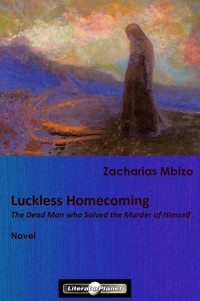
The atrocious killings in Ukraine are among the things that are usually said to leave us "speechless". On the other hand, the monstrous nature of the crimes committed there requires that we do not remain silent about them. So these literary miniatures are an attempt to speak about the unspeakable in spite of everything.
Das E-Book können Sie in Legimi-Apps oder einer beliebigen App lesen, die das folgende Format unterstützen:
Veröffentlichungsjahr: 2022
Ähnliche



















Zacharias Mbizo
The Ukrainian Apocalypse
Literary Miniatures
Literaturplanet
2nd, expanded edition
Imprint
© Verlag LiteraturPlanet, 2022
Im Borresch 14
66606 St. Wendel
2nd, expanded edition
http://www.literaturplanet.de
About this book: The atrocious killings in Ukraine are among the things that are usually said to leave us "speechless". On the other hand, the monstrous nature of the crimes committed there requires that we do not remain silent about them. So these literary miniatures are an attempt to speak about the unspeakable in spite of everything.
About the author: Zacharias Mbizo, engaged in literature since 2015, belongs to the circle of the so-called "Ecartists" around the blogger Rother Baron and has already left numerous traces on Planet Literature.
Cover picture: George Frederic Watts (1817 – 1904): The Four Horsemen of the Apocalypse: The Rider on the Pale Horse; ca. 1878); Walker Art Gallery (Wikimedia Commons)
The Ten Commandments in War
1. I am your Lord, the God of War. You shall carry out my every command unconditionally.
2. You shall kill, slaughter and murder. The more indiscriminate and uncompromising your killing, the more worshipful your deeds.
3. You shall honour your Fatherland and Mother Homeland. You can do this by expanding your Fatherland and offering human sacrifices to Mother Homeland.
4. You shall not allow yourself hours of leisure. Every day on which you serve your Lord, the God of War, is a holiday for you.
5. You shall spread as many lies as possible about your neighbour. The darker his image, the greater the willingness to destroy him.
6. You shall seize your neighbour's goods and chattels. He does not deserve any property.
7. You shall steal whatever your heart desires. Every piece of plunder is a jewel on the altar of your Lord.
8. You shall rape your neighbour's mother, daughter and grandmother. Sow the seed of your Lord in them, so that they may bear the brand of his rule in them forever.
9. You shall not feel any reverence – not even for me, your Lord. Curse your God whenever you feel like it – your fury will make you all the more impactful a servant.
10. You shall always bear the image of your Lord in your heart. If you want to form an image of me, look in the mirror: the grimace of hatred that glares at you from there – that is me!
I. Prelude
An attack on the neighbouring country. Is it an unlawful assault? Or is it your neighbours' own fault that they are being attacked?
Assault Plans
The estate of your neighbour has always appealed to you. It is spacious, with numerous outbuildings and a main house that has several side wings. Most of the windows are oriented towards the west – an ideal complement to your own estate, in whose houses the windows are rather east-facing.
For a long time, you have therefore been planning to take over your neighbour's property. You are strong, much stronger than your neighbour. If you had wanted to, you could have simply seized his property.
But that would have damaged your reputation among the other neighbours. After all, no one appreciates it when others take their possessions. Corresponding incidents consequently lead to a reflexive sympathy for the person being robbed.
So you preferred to proceed cautiously. First you claimed that your neighbour was not the rightful owner of his property. In fact, it would be you who had a claim to it, because your ancestors had lived there.
This changed the situation fundamentally. Suddenly it appeared to everyone – except the neighbour with the property you had an eye on – as a nice gesture that you were allowing others to live on your land. At the same time, you were granted the right to have a say in the affairs of your neighbour's property – since you now appeared to be its legitimate owner.
Now the ground was prepared for the takeover of the neighbouring estate. In order to convince your other neighbours – but also your fellow residents on your own estate – of the necessity of this takeover, you again made use of your narrative talent.
Once more, your story revolved around your ancestors. In the cellars and side wings of the foreign estate, you declared in an indignant voice, crimes were being committed against them. Outwardly your neighbour would pretend to be a philanthropist. In reality, however, he would be a ruthless torturer.
Since your neighbour naturally denied the accusations, you – after a decent interval in which you let the poison of your story unfold its effect – incorporated the cellars and side wings into your estate. Then you sat back again and waited.
Of course, your behaviour caused some uproar among your other neighbours. But over time, a certain habituation effect set in. At some point, everyone had tacitly accepted that the parts of the neighbouring property that you had seized now belonged to your estate.
This was when you struck the decisive blow. For a long time, you proclaimed one day, you had been trying to convince your neighbour to stop harassing the descendants of your ancestors. Your neighbour, however, had not even listened to you, no matter how gently you had spoken to him. Now your patience, you declared, had come to an end. It would simply be your moral duty to restore order there. What if your neighbour ended up spreading his inhumane behaviour to other estates?
Thus, you would have to carry out a clean-up operation on the foreign property.




