


22,99 €
Mehr erfahren.
- Herausgeber: RAR Medical Services Ltd
- Kategorie: Bildung
- Sprache: Englisch
“A journey of a thousand miles starts with a single step…”
As you may have already experienced, hardest part of a big project is the first step. It’s easy to plan to start something, but when it actually comes to writing the first words, what do you do? As you stare at the blank page in front of you, how can you fill it?
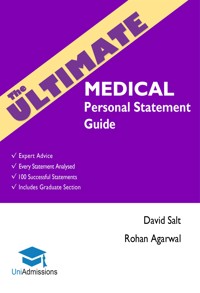
Published by the UKs Leading Medical Admissions Company, the Ultimate Medical Personal Statement Guide is the most comprehensive personal statement book available. It contains detailed expert advice for every stage of the writing process; from starting the opening sentence to making the finishing touches.
It also includes 100 Successful Medical School Personal Statements so you can see what the admissions tutors at your university like (and don’t like!).
With contributions and advice from over 25 Specialist Medical Tutors, this is a MUST-BUY for those looking to secure their place at medical school.
Das E-Book können Sie in Legimi-Apps oder einer beliebigen App lesen, die das folgende Format unterstützen:
Veröffentlichungsjahr: 2018
Ähnliche

















The Ultimate Medicine Personal Statement Guide
Copyright © 2017 UniAdmissions. All rights reserved.
ISBN 978-0-9932311-7-9
No part of this publication may be reproduced or transmitted in any form or by any means, electronic or mechanical, including photocopying, recording, or by any information retrieval system without the prior written permission of the publisher. This publication may not be used in conjunction with or to support any commercial undertaking without the prior written permission of the publisher.
Published by RAR Medical Services Limited
www.uniadmissions.co.uk
Tel: 0208 068 0438
UCAS is a registered trademark and was not involved in the production of, and does not endorse, this book. The authors and publisher are not affiliated with UCAS.
This book is neither created nor endorsed by any medical schools, nor by UCAS, nor by any other body. The authors and publisher claim no affiliation with any medical school. The information offered in this book is purely advisory and any advice given should be taken within this context. As such, the publishers and authors accept no liability whatsoever for the outcome of any applicant’s university applications or for any other loss. Although every precaution has been taken in the preparation of this book, the publisher and author assume no responsibility for errors or omissions of any kind. Neither is any liability assumed for damages resulting from the use of information contained herein. Example personal statements are provided for illustrative purposes only and are not to be copied; they are copyrighted material and copying is illegal. This does not affect your statutory rights.
The Ultimate Medicine Personal Statement Guide
Dr David Salt
Dr Rohan Agarwal
Introduction
The Basics
What do Admissions Tutors look for?
Application Timeline
Getting Started
When Should I Start?
Brainstorming
What is the Purpose of your Statement?
Finding the Right Balance
Structuring Your Statement
The Introduction
The Main Body
The Conclusion
Work Experience
Professional Awareness
Extra-Curricular
Skills
Oxbridge
Deferred Entry and Gap Years
Re-applying
Extra Reading
Mature and Graduate Applicants
Standing out from the crowd
Interviews
Omissions
Things to Avoid
Power Words
The Reference
Using the Personal Statements
Undergraduate Personal Statements
Graduate Personal Statements
Final Advice
About UniAdmissions
Your Free Book
UKCAT Intensive Course
BMAT Intensive Course
Medicine Intensive Interview Course
About the Authors

David is Director of Services at UniAdmissions, taking the lead in product development and customer service. David read medical sciences at Gonville and Caius College Cambridge, graduating in 2012, completed his clinical studies in the Cambridge Clinical School and now works as a medical doctor.
David is an experienced tutor, having helped students with all aspects of the university applications process. He has authored five books to help with university applications and has edited four more. Away from work, David enjoys cycling, outdoor pursuits and good food.

Rohan is the Director of Operations at UniAdmissions and is responsible for its technical and commercial arms. He graduated from Gonville and Caius College, Cambridge and is a fully qualified doctor. Over the last five years, he has tutored hundreds of successful Oxbridge and Medical applicants. He has also authored ten books on admissions tests and interviews.
Rohan has taught physiology to undergraduates and interviewed medical school applicants for Cambridge. He has published research on bone physiology and writes education articles for the Independent and Huffington Post. In his spare time, Rohan enjoys playing the piano and table tennis.
Introduction
Medical school is, and always has been, extremely competitive. It consistently attracts the top students from every school. Therefore medical schools have the most difficult decisions to make. They have to decide who are the very best amongst a sea of excellent applicants. And their duty goes beyond simply allocating the space to the highest achievers: those who may deserve it most. Medical schools are selecting the doctors of the future – those who will look after the health of many generations across the course of their career, and who will rise through the ranks to, in turn, train new doctors and shape the health service of the future.
This decision, therefore, has vast and wide-ranging consequences. Medical schools have both a moral and indeed a legal duty to properly assess applicants and choose the ones who will make the best doctors. But how do they decide, and how can you convince them that you are the one who deserves that all important place?
Although the personal statement is just one component of the applications process, it is the only component that, before interview selection takes place, provides the admissions tutor with information about the real you. It is your opportunity to show your reasons for choosing medicine, your motivation and your personal skills which will make you succeed as an excellent doctor of the future.
This book first guides you through the process of writing your personal statement, giving top tips and advice to help you show yourself in the best possible light whilst avoiding common pitfalls. Next, there are 101 successful medical personal statements from recent applicants. Each is labelled with the student’s applications and the outcome, and comes with a commentary showing you the stronger and weaker points of the statement to help you hone the structure and content of your own.
So, what are you waiting for?!
The Basics
Your Personal Statement
Applying to university is both an exciting and confusing time. You will make a decision that will decide the next 3-6 years and potentially your entire life. Your personal statement is your chance to show the universities you apply to who you really are. The rest of the application is faceless statistics – the personal statement gives the admissions tutor the opportunity to look beyond those statistics at you as an individual: the person they may spend four to six years training and who may eventually become a doctor.
Some people may tell you there is a right and wrong way to write a personal statement, but this is a myth. One of the reasons we produced this book is to show you the vastly different styles that successful personal statements have. Yes, there are rules of thumb that can help you along the way, but never lose sight of the fact that this is your opportunity to tell your story.
How does the Process Work?
University applications are made through the online UCAS system. You can apply to 4 universities (and a 5th non-medical option). After receiving the outcomes of all applications, you make a confirmed (i.e. first) and reserve choice. Your place at university is only confirmed once you’ve achieved the conditions set out in the conditional offer.
It’s important to remember that the same application will be sent to all of your choices. There is therefore, little point in applying to completely unrelated subjects e.g. English for your fifth choice. Many applicants don’t even apply to a fifth university. Of the ones that do, most opt for a scientific course e.g. Biomedical Science.
Other than exam marks, GCSE grades and teacher references, the only part of the application which you have direct control over is your personal statement. This is your chance to convince the reader (i.e. admissions tutor) to give you a place at their university. Although not a job interview, it is important to treat the personal statement with the respect it deserves.
The Timescale
For medicine, be aware of an earlier deadline, 15 October – if you don’t get your application in on time it won’t be considered. Remember that schools often have an earlier internal deadline so they can ensure punctuality and sort out their references in time. Different schools have different procedures, so it is very important that you know what the timescale is at your school before the end of your AS year. Internal deadlines for medicine can be as early as the beginning of September, which is only a couple of weeks after the summer break. Submitting earlier can be good- as it frees up your time to concentrate on admission test preparation, interview preparation and your A2 studies.
What are the requirements?
➢Maximum 4000 characters
➢Maximum 47 lines
➢Submitted by the early deadline – 15 October
What do Admissions Tutors look for?
Academic ability
This is the most obvious. Every university will have different entrance requirements for the same course titles, so make sure that you are aware of these. Some universities may have extra requirements, e.g. Medical applicants to UCL must have three full A levels and one AS. It is your responsibility to ensure that you meet the entry criteria for the course that you’re applying to.
Extra-curricular activities
Unlike in the US, the main factor in the UK for deciding between candidates for university places is their academic suitability for the course to which they have applied, and little else. Whilst extra-curricular activities can be a positive thing, it is a common mistake for students to dedicate too much of their Personal Statement to these. There is however an important place for subject-related extra-curricular activities in a personal statement i.e. work experience.
Passion for your subject
This is the most important part of a personal statement. This is what makes your statement personal to you, and is where you can truly be yourself, so do not hold back! Whether you’ve dreamt of being a doctor since birth or a historian since learning to read, if you are truly passionate about your chosen subject this will be shine through in the personal statement.
It is not necessary for you to have wanted to do a particular subject for your entire life. In fact, it is entirely possible to choose a subject because you found a course that really appealed to you on a university open day. Whatever the case, you should find reasons to justify your decision to pursue a course that will cost a lot of time and money. If the personal statement does not convince the reader that you’re committed to medicine, then you’ll likely be rejected.
I have the grades, will I be accepted?
In short – not necessarily. Achieving the entrance grades required is considered to be the basic requirement for all successful applicants, and will certainly be the case for all applicants who gain interviews. If an applicant’s personal statement is terrible but they meet the minimum grade criteria, they may still be rejected. Likewise, if an applicant’s personal statement is amazing but they fall slightly under the minimum grade requirements, the applicant may still be accepted.
Application Timeline
1)Researching Courses
This includes both online research and attending university open days. Whilst some of you reading this guide will already know that you want to apply for medicine, some may not have decided. Course research is still very important even if you’re certain you want to study medicine. This is because the ‘same’ courses can vary significantly between universities. Some courses have a very separated pre-clinical science and clinical transition, whereas others are fully integrated where clinical experience starts from day one. Some are taught traditionally with lectures and practicals, whereas others have a much more self-directed problem-based learning (PBL) style. Do your course research and decide which style of course is best for you. As only one personal statement is sent to all universities that you apply to, it is important that you write in a way that addresses the different needs of each university you apply to.
If you cannot make it to university open days (e.g. if you are an international applicant), you can usually email a department and request a tour. If you allow plenty of time for this, quite often universities are happy to do this. Be proactive – do not sit around and expect universities to come to you and ask for your application! The worst possible thing you can do is appear to be applying to a course which you don’t understand or haven’t have researched.
You’re highly recommended to research the course content of courses that you interested in. Every university will produce a prospectus, which is available printed and online. This will help to not only choose the 4 universities that you should apply for, but also be aware of exactly what it is that you are applying for.
2)Start Brainstorming
At this stage, you will have narrowed down your subject interests and should be certain that you’re applying for medicine (if you’re not then check out our “Ultimate Personal Statement Guide” for other non-medical subjects).
A good way to start a thought process which will eventually lead to a personal statement is by simply listing all of your ideas, why you are interested in your course and the pros and cons between different universities. If there are particular modules which capture your interest that are common across several of your university choices, do not be afraid to include this in your personal statement. This will not only show that you have a real interest in your chosen subject, but also that you have taken the time to do some research.
3)Complete First Draft
This will not be the final personal statement that you submit. In all likelihood, your personal statement will go through multiple revisions and re-drafts before it is ready for submission. In most cases, the final statement is wildly different from the first draft.
The purpose of completing a rough draft early is so that you can spot major errors early. It is easy to go off on a tangent when writing a personal statement, with such things not being made obvious until somebody else reads it. The first draft will show the applicant which areas need more attention, what is missing and what needs to be removed altogether.
4)Re-Draft
This will probably be the first time at which you receive any real feedback on your Personal Statement. Obvious errors will be spotted, and any outrageous claims that sound good in your head, but are unclear or dubious will be obvious to the reader at this stage.
It is important to take advice from family and friends, however with a pinch of salt. Remember that the admissions tutor will be a stranger and not familiar with the applicant’s personality.
5)Complete Final Draft
This will not be the final product, and until now, you probably won’t have had much real criticism. However, a complete draft with an introduction, main body and conclusion is important as you can then build on this towards the final personal statement.
6)Expert Check
This should be completed by the time you return for your final year at school/college. Once the final year has started, it is wise to get as many experts (teachers and external tutors) to read through the draft personal statement as possible
Again, you should take all advice with a pinch of salt. At the end of the day, this is your UCAS application and although your teachers’ opinions are valuable, they are not the same as that of the admissions tutors. In schools that see many Oxbridge and Medical applications, many teachers believe there is a correct ‘format’ to personal statements, and may look at your statement like ‘number’ in the sea of applications that are processed by the school. There is no ‘format’ to successful personal statements, as each statement should be personal to you.
At schools that do not see many Oxbridge/Medical applications, the opposite may be true. Many applicants are coerced into applying to universities and for courses which their teachers judge them likely to be accepted for. It is your responsibility to ensure that the decisions you make are your own, and you have the conviction to follow through with your decisions.
7)Final Checks
Armed with a rough draft, and advice from friends, family and teachers you should be ready to complete your final personal statement.
8)Submit to School
Ideally, you will have some time off before submitting your statement for the internal UCAS deadline. This is important because it’ll allow you to look at your final personal statement with a fresh perspective before submitting it. You’ll also be able to spot any errors that you initially missed. You should submit your personal statement and UCAS application to your school on time for the internal deadline. This ensures that your school has enough time to complete your references.
9)Submit to UCAS
That’s it! Take some time off from university applications for a few days, have some rest and remember that you still have A levels/IB exams to get through (and potentially admissions tests and interviews).
Getting Started
The personal statement is an amalgamation of all your hard work throughout both secondary school and your other extracurricular activities. It is right to be apprehensive about starting your application and so here are a few tips to get you started…
General Rules
If you meet the minimum academic requirements then it is with the personal statement that your application to university will be made or broken. With many applicants applying with identical GCSE and A-level results (if you’re a gap year student) the personal statement is your chance to really stand out and let your personality shine through. As such there is no concrete formula to follow when writing the personal statement and indeed every statement is different in its own right. Therefore throughout this chapter you will find many principles for you to adopt and interpret as you see fit whilst considering a few of these introductory general rules.
Firstly: space is extremely limited; as previously mentioned a maximum of 4000 characters in 47 lines. Before even beginning the personal statement utilise all available space on the UCAS form. For example do not waste characters listing exam results when they can be entered in the corresponding fields in the qualifications section of the UCAS form.
Secondly: always remember it easier to reduce the word count than increase it with meaningful content when editing. Be aware that is not practical to perfect your personal statement in just one sitting. Instead write multiple drafts starting with one substantially exceeding the word limit but containing all your ideas. As such starting early is key to avoid later time pressure as you approach the deadline. Remember this is your opportunity to put onto paper what makes you the best and a cut above the rest – you should enjoy writing the personal statement!
Lastly and most importantly: your statement is just one of hundreds that a tutor will read. Tutors are only human after all and their interpretation of your personal statement can be influenced by many things. So get on their good side and always be sympathetic to the reader, make things plain and easy to read, avoid contentious subjects and never target your personal statement at one particular university (unless you’re only applying there!).
When Should I Start?
TODAY!
Although it might sound like a cliché, but the earlier you start, the easier you make it. Starting early helps you in four key ways:
1)The most important reason to start early is that it is the best way to analyse your application. Many students start writing their personal statement then realise, for example, that they haven’t done enough work experience, or that their extra reading isn’t focused enough. By starting early, you give yourself the chance to change this. Over the summer, catch up on your weak areas to give yourself plenty to say in the final version.
2)You give yourself more time for revisions. You can improve your personal statement by showing it to as many people as possible to get their feedback. With an earlier start, you have more time to modify, thus improving the final result.
3)Steadier pace. Starting early gives you the flexibility of working at a steadier pace – perhaps just an hour or so per week. If you start later, you will have to spend much longer on it, probably some full days, reducing the time you have for the rest of your work and importantly for unwinding, too.
4)You can finish it earlier. If you start early, you can finish early too. This gives you time to change focus and start preparing for the UKCAT, BMAT (if needed), and for your interviews, which can sometimes start by mid-November.
What people think is best:
What is actually best:
Doing your Research
The two most important things you need to establish are: What course? + What University?
If you’re unsure where to begin, like most things in life, success with the personal statement begins with preparation and research.
Your choice of university is entirely personal and similar to your course choice; it needs to be somewhere that you are going to enjoy studying. Remember that where you end up will form a substantial part of your life. This could mean going to a university with a rich, active nightlife or one with strict academic prowess or perhaps one that dominates in the sporting world. In reality each university offers its own unique experience and hence the best approach is to attend as many open days as feasibly possible. At which you will have the opportunity to meet some of your potential tutors, talk to current students (who offer the most honest information) and of course tour the facilities.
The best way to prevent future stress is to start researching courses and universities early i.e. 12 months before your apply through UCAS. There is a plethora of information that is freely available online, and if you want something physical to read, you can request free prospectuses from most UK universities. It is important to remember that until you actually submit your UCAS application, you are in control. Universities are actively competing against one another for your application! When initially browsing, a good place to start is by simply listing courses and universities which interest you, and 2 pros and cons for each. You can then use this to shortlist to a handful of universities that you should then attend open days for.
There are no right choices when it comes to university choices, however there are plenty of wrong choices. You must make sure that the reasons behind your eventual choice are the right ones, and that you do not act on impulse. Whilst your personal statement should not be directed at any particular one of your universities, it should certainly be tailored to the course you are applying for.
With a course in mind and universities short listed your preparation can begin in earnest. Start by ordering university prospectuses or logging onto the university’s subject specific websites. You should be trying to find the application requirements. Once located there will be a range of information from academic demands including work experience to personal attributes. Firstly at this point be realistic with the GCSE results you have already achieved and your predicted A-level grades. Also note that some universities will require a minimum number of hours of work experience – this should have been conducted through the summer after GCSE examinations and into your AS year. Work experience is not something to lie about as the university will certainly seek references to confirm your attendance. If these do not meet the minimum academic requirements a tutor will most likely not even bother reading your personal statement so don’t waste a choice.
If you meet all the minimum academic requirements then focus on the other extracurricular aspects. Many prospectuses contain descriptions of ideal candidates with lists of desired personal attributes. Make a list of these for all the universities you are considering applying to. Compile a further list of your own personal attributes along with evidence that supports this claim. Then proceed to pair the points on your personal list with the corresponding requirements from your potential universities. It is important to consider extracurricular requirements from all your potential universities in the interest of forming a rounded personal statement applicable to all institutions.
This is a useful technique because one university may not require the same personal attributes as another. Therefore by discussing these attributes in your statement, you can demonstrate a level of ingenuity and personal reflection on the requirements of the course beyond what is listed in the prospectus.
Always remember that the role of the personal statement is to show that you meet course requirements by using your own personal experiences as evidence.
Taking your First Steps
A journey of one thousand miles starts with a single step...
As you may have already experienced, the hardest step of a big project is the first step. It’s easy to plan to start something, but when it actually comes to writing the first words, what do you do? As you stare at the 47-line blank page in front of you, how can you fill it? You wonder if you’ve even done that many things in life. You think of something, but realise it probably isn’t good enough, delete it and start over again. Sound familiar?
There is another way. The reason it is hard is because you judge your thoughts against the imagined finished product. So don’t begin by writing full, perfectly polished sentences. Don’t be a perfectionist. Begin with lists, spider diagrams, ideas, rambling. Just put some ideas onto paper and write as much as possible – it’s easy to trim down afterwards if it’s too long, and generally doing it this way gives the best content. Aim to improve gradually from start to finish in little steps each time.
Brainstorming
If writing prose is too daunting, start by using our brainstorm template. Write down just three bullet-points for each of the 12 questions below and in only twenty minutes you’ll be well on your way!
The Writing Process
What is the Purpose of your Statement?
An important question to ask yourself before you begin drafting your personal statement is: how will the universities I have applied to use my personal statement? This can dramatically change how you write your personal statement. For the majority of courses that don’t interview, the personal statement is directly bidding for a place on the course.
However, given that you’re applying for medicine, you will almost certainly have to go through an interview process. Therefore, your personal statement will require substantially more thought and tactics. The first thing to establish is the role of the personal statement in the context of the interview. At this point it is well worth going through the application procedures in prospectuses and on university websites.
The first option is that the personal statement is solely used for interview selection and discounted thereafter. In this case the interviewer is going to want to discuss material that isn’t including in your personal statement. As such, make sure you leave yourself room to talk more at interview. Make sure you have extra material to expand on the key points in your personal statement to avoid being left in a difficult position.
Alternatively the personal statement can represent a central component of the interview. Many universities adopt an interview protocol whereby the interviewers run through the personal statement from start to finish questioning the candidate on specific points. This technique has many benefits for the interviewer as it allows them to assess the presence of any fraudulent claims (it is very hard to lie to a tutor face to face when they starting asking for specifics), it gives the interview clear structure but also allows the interviewer to bring pre planned questions on specific personal statement points.
However from the candidate’s point of view this can lead to an oppressive, accusative and intense interview. There are techniques to take control back into your own hands like, for example, “planting” questions within your personal statement. This can be achieved in many ways. The phrase “for example” can be helpful here. If you describe an experience and give some examples, it gives the impression of an incomplete list, allowing you to provide extra detail at interview.
Finding the Right Balance
The balance of a personal statement can have a significant effect on the overall message it delivers. Whilst there are no strict rules, there are a few rules of thumb that can help you strike the right balance between all the important sections.
As a medical applicant, the most important point is to dedicate enough space to talking about your work experience. This is absolutely essential – a good discussion of your work experience answers almost all the questions the admissions tutor will want to find out about you. Discussing work experience can show why you’ve chosen medicine, your motivation, knowledge and professional awareness. It can also be used to highlight any specific areas of interest, hints at future career plans and to guide questions at interview. In short, it is one of the best ways to make you stand out.
Extra-curricular activities are a great way of supporting your skills. However, you need to be careful that this is the supporting act and not the headliner. It is generally recommended to spend no more than a quarter of the personal statement discussing extra-curricular activities, leaving the other three-quarters for discussing your motivation for medicine, reading and work experience.
The following template gives a suggestion how to balance the different sections:
Structuring Your Statement
This may sound obvious, but many applicants fail to write personal statements which have a proper structure. Personal statements are not monologues of your life, or a giant list of your achievements. They are instead a formal piece of prose written with the aim of helping you secure a place at medical school.
The Introduction
The Opening Sentence
Rightly or wrongly, it is likely that your personal statement will be remembered by its opening sentence. It must be something short, sharp, insightful and catch the reader’s attention. Remember that admissions tutors will read several hundred personal statements and often their first impression is made by your opening sentence which is why it needs to be eye catching enough to make the tutor sit and pay particular attention to what you have written. It does indeed set the standard for the rest of the personal statement.
If this seems a daunting prospect (as it should!) then here are a few pointers to get you started:
➢Avoid using overused words like “passionate”, “deeply fascinating” and “devotion”.
➢Avoid using clichéd quotes like the infamous “I have always been fascinated with the intricacies of the human body”.
➢If you are going to use a quote then put some effort into researching an obscure yet particular powerful – don’t forget to include a reference.
➢Draw on your own personal experiences to produce something both original and eye-catching.
In many ways it is best that you save writing your opening statement till last; that way you can assess the tone of the rest of your work but also write something that will not be repeated elsewhere.
If you are really stuck with where to begin try writing down a memory and then explain how it has affected your relationship with your subject.
Whilst the opening statement is important, it is not something to stress about. Although a strong opening statement can make the personal statement; a bad one rarely breaks it.
Why Medicine?
The introduction should answer the most important question of all – why medicine?
Why do YOU want to study medicine?
It is essential to show your genuine reasons and motivation. The first thing to consider is whether you genuinely want to be a doctor. You need to be certain that your motivation comes from yourself and not from external sources such as teachers or family.
Once you are certain medicine is the right choice for you, there are a few key styles you can use- as shown below. By reading the example personal statements, you will see different ways successful applicants have used these building blocks to customise their own feelings towards a medical career.
Personal illness: If you have had a personal experience of healthcare and this has motivated you to study medicine.
Family illness: If the illness of a friend or family member has ignited your interest.
Making a difference: If you have seen people facing difficulties or suffering and you would like to help in the capacity of a doctor.
Academic interest plus experience: If your interest has spiralled out of a love of the biological sciences – but must be supported by practical experience, as work as a doctor is very different from academic science.
Suggestion plus experience: If someone has suggested the idea of medicine to you, made you think and investigate, and then you realised it would be a great choice for you.
Whichever reason style you choose to go with, or if you have a completely different reason altogether, a good answer always has a few key features. A good answer to the “why medicine” question will always tell a story with three key points:
➢When you first thought about medicine as a career
➢How you went about learning what the job is actually like
➢Why you have decided it is the right choice for you
Try to avoid clichés when describing your route into medicine. Some people will say they’ve wanted to be a doctor ever since they were born – but of course, this simply isn’t true and therefore it isn’t helpful. The admissions tutor wants to see a simple and honest story about your journey, helping them assess how carefully you have considered your choice and how suitable a choice it is.
The exact phrase: “from a young age I have always been interested in” was used more than 300 times in personal statements in 2013 (data published by UCAS), and substituting “young” for “early” gave an additional 292 statements – these phrases can quickly become boring for admissions tutors to read!
There are certain things that raise red flags, phrases that will count against you if you write them. These include: saying that medicine is a respected career, saying that doctors are well paid, saying that you want to be a doctor because of other people telling you to, saying you want to be a doctor because other professions are worse in some way and making direct comparisons to law or engineering.
These phrases are all bad because they don’t show your interest in the actual work that doctors do. Doctors may be well respected, but this fact alone won’t motivate you to succeed at medical school and in a medical career – you need to be interested in what doctors do. The same applies to choosing medicine because it’s a stable professional occupation. Likewise, if you’re choosing medicine because someone else told you it would be a good choice (or suggested medicine or law but you don’t like law), you may lack this personal motivation that medical schools know is essential for success.
The Main Body
In the rest of your text your aim should be to demonstrate your suitability for the course by exemplifying your knowledge of the course structure and its requirements through personal experience. Again there are no rigorous guidelines on how to do this and it is very much down to your own writing style. Whereas some prefer a strict structure, others go for a more synoptic approach, but always remember to be consistent in order to achieve a flowing, easy to read personal statement.
This point ties in closely with writing style. You want one that the tutor will find pleasing to read; and as everyone prefers different styles the only way to assess yours accurately is to show your drafts to as many people as possible. That includes, teachers, parents, friends, siblings, grandparents – the more the better, don’t be afraid to show it round!
Despite the lack of a standardised writing method, there is of course a list of standard content to include. In general you are trying to convey your academic, professional and personal suitability for the course to the tutor. This needs to be reiterated whilst demonstrating clear, exemplified knowledge of the course structure and its demands. The biggest problem then in achieving these goals, with all the other candidates also trying to convey the same information, is in producing an original personal statement and remaining unique.
The easiest way to overcome this is to integrate your own personal experiences, reflections and emotions – both demonstrating passion and insight.
More practically, it is a good idea to split the main body into two or three paragraphs, in order to avoid writing one big giant boring monologue.
Part One: This should cover why you are suited for medicine. This will include your main academic interests, future ambitions and what makes medicine right for you. It is a good idea for you to read up the course syllabuses, and find something that catches your interest above others. If you have read anything outside of the A-level/IB syllabus related to your chosen course which has inspired you then this is the place to mention it.
Part Two: This section should still be about why you’re suited to your chosen course with a particular focus on work experience. If you’ve had to overcome any significant challenges in life and wish to include these in your personal statement, then this is normally the best place to do so. Similarly, any relevant prizes & competitions should be included here. However, it is important to remember not to simply list things. Ensure that you follow through by describing in detail what you have learned from any experiences mentioned.
Part Three: This is the smallest part of the main body and is all about extra-curricular activities. It is easy to get carried away in this section and make outrageous claims e.g. claim to be a mountain climber if all you have ever climbed is a hill at the end your street etc. Lying is not worth the risk given that your interviewer may share the same hobby that you claim to be an expert in!
Avoid making empty statements by backing things up with facts. For example: ‘I enjoy reading, playing sports and watching TV’, is a poor sentence and tells the reader nothing. The applicant enjoys reading, so what? Which sports? Doesn’t everyone like watching TV? If the applicant is in a sports team, or plays a particular sport recreationally with friends then they should name the sport and describe what their role is. Likewise, the applicant should actually describe how their hobbies relate to them as a person and ideally their subject.
What to Include
Still a little stumped? Here is a summary of a few useful pointers to get you started:
➢Sports and other hobbies – these are particularly important for the vocational courses like medicine and dentistry as they offer a form of stress relief amidst a course of intense studying whilst also demonstrating a degree of life experience and well roundedness. By all means discuss international honours, notable publications or even recent stage productions. Remember to reflect on these experiences offering explanations of how they have changed your attitude towards life or how they required particular dedication and commitment.
➢Musical instruments – Again an excellent form of stress relief but also a great example of manual dexterity if your course requires this. Do not be afraid to mention your favourite musical works for that personal touch but also any grades you have obtained thus demonstrating commitment and a mature attitude that can be transferred to any field of study.
➢Work experience(s) – Don’t bother wasting characters by citing references or contacts from your work experience but rather discuss situations that you were presented with. Describe any situations where you showed particular maturity/professionalism and explain what you learnt from that experience. It is always advisable to discuss how your work experience affected your view of the subject field, either reinforcing or deterring you from your choice.
➢Personal interests within the field of study – This is a really good opportunity to show off your own genuine interest within the subject field. Try to mention a recent article or paper, one that isn’t too contentious but is still not that well known to show depth of reading. Reflect on what you have read offering your own opinions, but be warned, you will almost certainly be called up on this at interview if you have one.
➢Personal attributes – exemplify these through your own personal experiences and opinions. As mentioned previously many courses will list “desired” personal attributes in their prospectus - you must include these as a minimum in your personal statement. Try to add others of your own choice that you think are relevant to the subject in order to achieve originality – here are a few to inspire you:
oHonesty
oCommunication skills
oTeamwork
oDecision making
oAwareness of limitations
oRespect
oMorality
oAbility to learn
oLeadership
oIntegrity
➢Awards – be they national or just departmental school awards, it always worth trying to mention any awards you have received since about the age of 15/16. A brief description of what they entailed and what you learnt from the experience can add a valuable few lines to your personal statement. Providing proof of long term dedication and prowess.
Together, discussion of all these points can demonstrate reasoned consideration for the course you have applied for. This is particularly appealing for a tutor to read as it shows a higher level of thinking by giving your own reflection on the course requirements.
The Conclusion
The conclusion of your personal statement should be more about leaving a good final impression than conferring any actual information. If you have something useful to say about your interest and desire to study medicine, you shouldn’t be waiting until the very end to say it!
Admissions tutors will read hundreds of personal statements every year, and after about the fifth one all start looking very much the same. You should try to make your statement different so it stands out amongst the rest. As the conclusion is the last thing the admissions tutor will read, it can leave a lasting influence (good or bad!) The purpose of a conclusion is to tie up the entire statement in two or three sentences.
A good conclusion should not include any new information, as this should be in the main body. However, you also need to avoid repeating what you have said earlier in your personal statement. This would be both a waste of characters and frustrating for the tutor. Instead it is better to put into context what you have already written and therefore make an effort to keep your conclusion relatively short – no more than 4 lines.
The conclusion is a good opportunity to draw on all the themes you have introduced throughout your personal statement to form a final overall character image to leave the tutor with. Unless there is anything especially extraordinary or outrageous in the main body of your personal statement; the tutor is likely to remember you by your introduction and conclusion. The conclusion therefore is a good place to leave an inspiring final sentence for the tutor.
Some students will make a mention in here about their career plans, picking up on something they have observed in work experience or have encountered during reading. This can be a good strategy as it shows you’re using your current knowledge to guide your future aspirations. If you do this, try to do so with an open mind, suggesting areas of interest but being careful not to imply you are less interested in others.
You have to spend a long time at medical school and as a junior doctor doing everything before you have the option to specialise in any one field, so admissions tutors need to be certain your interest extends into all areas. Secondly, don’t sound too fixed about your plans. There is a lot more to see before you can make an informed career choice, so by all means show your particular interests but avoid sounding as though you are closing any options off.
It is important to avoid sounding too arrogant here and over selling yourself. Instead adopt a phrase looking forward in time – perhaps expressing your excitement and enthusiasm in meeting the demands of your course requirements, or looking even further ahead, the demands of your career. For example, consider a phrase like: ‘driven by my love of medicine, I am sure that I will be a successful doctor and take full advantage of all opportunities should this application be successful’ rather than ‘I think I should be accepted because I am very enthusiastic and will work hard’. The sentiment behind both of these statements is positive, however the second sounds juvenile whereas the first is aspirational, confident and yet humble.
Work Experience
Work experience is a great way to demonstrate your commitment to medicine. It cannot be over-stressed just how vital it is. It is so essential that I have never heard a case of someone getting an offer for medicine without work experience.
During the work experience itself it is wise to keep a notebook or a diary with a brief description of each day, particularly noting down what events happened and importantly what you learnt from them. Whilst there is a designated section of the UCAS form for work experience details, the personal statement itself must be used to not only describe your experiences but also reflect on them. Making sure to discuss the following points:
➢How did certain situations affect you personally?
➢How did the experience alter your perspective on the subject field?
➢Were there particular occasions where you fulfilled any of the extracurricular requirements listed within prospectuses?
➢Most importantly how did your experience(s) confirm your desire to pursue the field of study into higher education?
Why Work Experience?
Medical schools value work experience so highly because it shows you have a number of essential traits.
Work experience shows you’re informed. You’re making a potentially lifelong commitment to a profession – so how do you know you’ll be suited to it? Rather than basing your ideas of a medical career on the media or stories you hear from others, the best way to convince the admissions tutor you know what the job actually entails is to go and experience it for yourself. Getting as much varied work experience as possible opens your eyes to the work that doctors and other caring professionals actually do, demonstrating you have a realistic understanding of the profession better than any words can. If you have good work experience, admissions tutors are confident you’re choosing medicine for the right reasons.
Work experience shows you’re committed. Arranging work experience can be hard – you may need to approach multiple people and organisations before you get a ‘yes’. Therefore, if you have a good portfolio of work experience, it shows you have been proactive. It shows you have gone to the effort for the sole purpose of spending your free time in a caring environment. This shows drive and commitment – impressive qualities that will help you gain that valuable place!
Arranging Work Experience
Arranging work experience can be hard. If you’re finding it difficult to get exactly what you want, please don’t be disheartened. You are facing the same difficulty that tens of thousands of students before you have also faced.
With work experience, it’s a very good idea to start early. The earlier you approach people, the more likely you are to be accepted. It is not really practical to start seeking work experience until after you turn 16 due to age restrictions within the work place – especially where confidential information is concerned! So conduct your work experience during the summer after your GCSE examinations and throughout your AS year. This can be achieved through private arrangements you yourself make but it always worth consulting your schools careers officer as well. Remember that any part-time/summer paid jobs also count as work experience and definitely worth mentioning as they show an additional degree of maturity and professionalism.
If you are able to keep up a small regular commitment over a period of months it really helps to show dedication. It’s a good idea to always carry a notebook when you’re on work experience. Use it to note down anything interesting you see or hear about to make certain you don’t forget!
Types of Work Experience
Medical Shadowing
This is where you spend time watching doctors or other healthcare professionals going about their work. It is a great opportunity to learn about the day-to-day activities of people working in healthcare. You will see both the interesting and stressful sides of the job. But it can be hard to organise. Aim to get some direct work experience with doctors, but if you aren’t able to get much then you can supplement with any of the other good types of work experience as below.
Medical Volunteering
This includes voluntary work in any medical or care-related setting such as a hospital, GP surgery, hospice or care home. Care homes can present good opportunities to volunteer with helping with entertainment activities for the residents, so this is something to consider getting involved in. Alternatively, consider volunteering at the hospital as a “show and tell” guide to help patients find where they are looking for. It doesn’t matter that you are not actually providing the care – what matters is that you are in an environment where you are interacting with people who need help and are learning about how they are cared for. Although most seek a voluntary placement, this is not essential; you could take a job in a caring setting. For example, you could work as a hospital porter or a healthcare assistant, either of which would provide a great insight into the workings of the hospital from two very different perspectives. This can be a particularly good option if you’re planning on a gap year: you can work for a few months to gain valuable experience and save up some money, then use the money if you intend on any travelling.
Non-Medical Volunteering
This might include working in a charity shop, library or similar. This is a good way of showing commitment and public service, however, you won’t learn about healthcare this way. It can make up the majority of the work experience, but in addition, you need to do something which gives you the opportunity to actually learn about healthcare.
Becoming a Member
It’s good to get as involved as possible with your local health community. By becoming a member of any local health-related organisations, you can demonstrate a willingness to do something to help people. You could become an associate at the hospital, allowing you to vote in Governors’ elections. Another possibility is to train as a first aider and join St John’s Ambulance (but if you’re considering this make sure to plan ahead as sometimes it can take a while to get started). Keep on the lookout for any local health-related projects – perhaps you could help by delivering leaflets to raise awareness of a new service for example.
Attending Courses
Whilst this is not strictly work experience, this section is the best place to discuss courses. It is not necessary to attend medicine preparation courses, but there are some good options available. Make sure you check what the course offers before enrolling, and only attend if there is something you will directly benefit from.
Professional Awareness
Awareness of the medical profession takes a number of forms. It includes knowledge of the day-to-day duties of a doctor, the multi-disciplinary teams doctors work in, the legal and ethical frameworks doctors operate in, the different medical specialties, training routes, the organisation of the NHS, the latest news regarding healthcare, and the outlook for the profession as a whole.
It is important to have a good awareness of these areas as without understanding the profession, you can’t make an informed decision to join it. It’s essential that you use your personal statement to show you have developed a good understanding of the profession through your research, reading and work experience. This will then be assessed further at interview.
Discuss any issues that have arisen through your work experience. If, for example, you saw a doctor explaining a procedure to obtain consent from a patient, you can discuss how this has made you think. You can tie it into your reading around the principle of giving valid consent (i.e. it must be voluntary, informed and given freely without pressure). The patient must be competent to make the decision (that they can understand the information, retain it, weigh up the options and communicate their decision). By relating what you see to your learning, you demonstrate interest and an enquiring mind.
Think critically about what you see and what you read. Be certain to include a few instances where in one way or another, you demonstrate an awareness of some professional issues. This once again shows you are well informed about the work of doctors, the provision of healthcare, and the difficulties facing doctors and the NHS.
Remember the most important professional attributes of a doctor. One is a commitment to learning – doctors never stop learning as they progress through their career towards specialties and keep up to date with new developments. Show that you are driven by new knowledge and are able to learn independently with self-discipline. Another is diligence – no one wants a doctor who heroically tries to solve every problem themselves. Doctors work in teams and the success of the medical team requires doctors to ask for advice if there’s a difficult problem; it also requires doctors to work to systems and to raise concerns if there is any form of problem. Make sure you come across as a diligent person who would be a good humble team worker. Another is honesty – doctors have to be extremely honest and trustworthy. Studies repeatedly show doctors are the most trusted professionals; one job of the next generation of doctors is to maintain this outstanding reputation.
Extra-Curricular
It is important to show you are a balanced person, not someone whose only focus is work. Extra-curricular activities can really strengthen your personal statement by showcasing your skills. Remember that there is no intrinsic value in playing county level rugby or having a diploma in acting – you will not win a place on excellence in these fields. The value comes from the skills your activities teach you. Regardless of whether you’re outstanding at what you do or you just do it casually, remember to reflect on what you’ve gained from doing it. There will always be something positive to say and it may be more valuable than you think.
There are three very important ways that extra-curricular activities can strengthen your application, so make sure to use them to their full capability.
You should use your extra-curricular activities to highlight skills that will help you in medicine. You play football – talk about how this has helped your teamwork; you play chess – surely this has improved your problem-solving? By linking what you do to the skills you’ve developed, you take a great opportunity to show the admissions tutor just how well-rounded you are. By showing how you have developed these critical skills you demonstrate, you are a strong applicant.
Interests outside work give you a way to relax. Medical studies and work as a doctor can be stressful, and admissions tutors have a duty of care towards students. By accepting someone who knows how to relax, they are ensuring you’ll strike the right balance between studies and relaxation, keeping yourself fresh and healthy through difficult times.
Showing you have enough time for extra-curricular activities can support your academic capabilities. If you are the member of an orchestra, a sports team and you keep a rock collection, you were clearly not pushed to the absolute limit to get the top grades you achieved. For a student without other interests, it might suggest to the admissions tutor they are struggling to keep up with the current workload and may not be able to cope with the additional demands of a medical course.
Skills
Throughout this book we talk about skills – abilities that you have developed through your work and experiences that will equip you to be a good medical student and doctor. Here follows a discussion of some of the major skills it is useful to demonstrate in your personal statement. Remember that this isn’t a tick-box exercise – you don’t need to provide evidence for every single skill we discuss. This is merely to give you some guidance towards the key skills you may want to focus on as you write your personal statement.
Teamwork
Doctors work as part of a large team comprising lots of other doctors and different healthcare professionals such as nurses and physiotherapists. In order to achieve good outcomes for the patients, effective teamwork is essential. You can demonstrate your teamwork through team sports, musical ensembles and collaborative projects.
Time-management
Doctors are very busy. As you may have seen in your work experience, they constantly have a long and varied task list including prescribing, patient reviews, referrals, letters, phone calls, meetings and more. As such, they need to be able to manage their time well to prioritise the most important tasks, and to work quickly and efficiently to make sure they complete everything that needs doing. Show your time-management skill by balancing a number of different activities at the same time.
Working under pressure
Doctors can work under a lot of pressure, whether this is because they have so much to do or because some particular task is critical to get right. It’s important that doctors can remain calm under pressure so they work well and avoid becoming too stressed. Show that you can work under pressure by working as a first aider, competing in high-level sport, becoming a sports official, taking responsibility for something important in a group activity or helping run an event with a committee or society.
Communication
Good communication is one of the most important skills that a good doctor has. This is essential both in talking to patients and the rest of the healthcare team. Talking to patients, it is important to be able to explain clearly what is going on and to be able to answer their questions. Doctors also need to be able to put patients at ease, and sometimes break bad news in a caring and sensitive manner. Talking to the rest of the healthcare team, it is important to be able to communicate plans clearly and suggest your ideas in a logical way. You can show your communication proficiency in a vast number of ways – absolutely anything where you need to talk to communicate ideas to another person. If it is under any particular pressure then bonus points!
Self-directed learning
Some medical schools have a very structured teaching programme. Others, such as the PBL (problem-based learning) courses rely much more on individual research and learning. But at any medical school and then afterwards as a doctor, you will be required to use your own initiative to both work out what you need to learn and then to learn it. Therefore, you need to show you have this ability to seek out and learn information for yourself. Demonstrate this ability by reading outside the normal curriculum, by reading books and articles about medicine or by taking on an extra self-taught course or module.
Organisation




