


0,99 €
Mehr erfahren.
- Herausgeber: Wildside Press
- Kategorie: Fantasy und Science-Fiction
- Sprache: Englisch
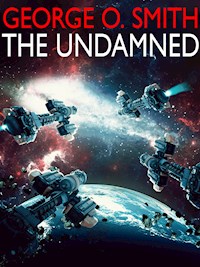
During the Third Interplanetary War, atomic bombing sprang up, died, and then continued on a very strange nuisance-value basis. It became complex, and upon the 1327th Day of the Third Interplanetary War, interplanetary robombing assumed a most dangerous aspect. The swift action of a small group averted disaster, and from that day on, the course of the Third Interplanetary War was assured.
Das E-Book können Sie in Legimi-Apps oder einer beliebigen App lesen, die das folgende Format unterstützen:
Seitenzahl: 74
Veröffentlichungsjahr: 2022
Ähnliche
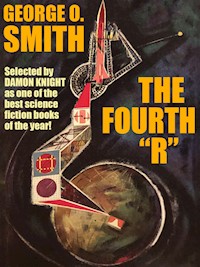















Table of Contents
COPYRIGHT INFORMATION
INTRODUCTION
THE UNDAMNED, by George O. Smith
COPYRIGHT INFORMATION
Copyright © 2022 by Wildside Press LLC.
Originally published in Astounding Science-Fiction, January 1947.
Published by Wildside Press LLC.
wildsidepress.com | bcmystery.com
INTRODUCTION
George Oliver Smith (1911–1981) was an American science fiction author. He should not to be confused with the prolific George H. Smith, another American author who also published (among other things) a significant body of science fiction work.
Smith primarily wrote work set in space, including the novels Operation Interstellar (1950), Lost in Space (1959), and Troubled Star (1957). However, he is remembered chiefly for two works: the “Venus Equilateral” series of short stories about a communications station in space, designed to relay messages between Earth and Venus, and the novel The Fourth “R” (also published as The Brain Machine), about an education device that creates a five-year-old super-boy, who must escape those who wish to capture him long enough to grow up an extract his revenge.
Most of the “Venus Equilateral” stories were collected in Venus Equilateral (1947), a small press hardcover. In 1976, the complete series was assembled in The Complete Venus Equilateral. I am currently working with Smith’s son to prepare a new edition of The Complete Venus Equilateral, which I’m sure will prove popular today. It’s an outstanding classic that holds up surprisingly well.
The title of The Fourth “R” is, of course, a play on the “3 Rs” of education—reading, ’riting, and ’rithmatic—but what that fourth “R” is, I will leave you to discover.
Smith was most active as a writer in the Golden Age of the 1940s and 1950s, with his primary market in the 1940s being the top magazine in the field—John W. Campbell’s Astounding Science Fiction. Many authors make bad career moves, and Smith was no different—in 1949, editor Campbell’s first wife, Doña, left Campbell for Smith. Of course, that affected what had been an excellent author/editor working relationship. Smith did not appear again in Astounding until 1959, after a decade has passed. In the meantime, he published fiction in other magazines, like Startling Stories and Thrilling Wonder Stories, and began writing books.
After 1960, Smith’s job began making more demands on his time, and his output dropped. He was given the First Fandom Hall of Fame award in 1980 and remained a member of the literary banqueting club the Trap Door Spiders, which served as the basis of Isaac Asimov’s fictional group of mystery-solvers, the Black Widowers.
—John Betancourt
Cabin John, Maryland
THE UNDAMNED,by George O. Smith
FOREWORD
Plutonium was an equalizer. Nations learned the art of being polite, just as individuals had learned. To lash out with Plutonium wildly would be inviting national disaster, and to behave in an antisocial manner would get any nation the combined hatred of the rest of the world—equally a national disaster.
This was surface politeness. Beneath, the work went on to find an adequate defense, for now that all nations were equal, the first capable of defending itself was to be winner. Ultimately, atomic death was licked. Nicely licked but only at the expenditure of more power than it took to develop the atomic weapon itself. It was, however, developed. And that nation then lashed out—to find that other nations of less belligerency had also licked the problem.
The war—fizzled. For the wall shield that killed the effectiveness of the atomic bomb found no difficulty in stopping a lesser weapon.
All war—fizzled. And nations looked at one another and formed the Terran Union. Then the Terran Union looked to the stars for a new world to conquer. They found Mars ready and waiting.
The Terran Union colonized Mars and exploited the Red Planet as men have always done with a new frontier. The next hundred years wrought their change,s and the Martian Combine fell away from the Terran Union because of the distance, the differences of opinion, and because of slight mutational changes.
There were interplanetary wars. The First was fought to eliminate the fact of governing Mars from Terra, the Second was fought to stop interplanetary piracy and to force both planets to respect the integrity of the other. The Third Interplanetary War was started because of sheer greed.
During the Third Interplanetary War, atomic bombing sprang up, died, and then continued on a very strange nuisance-value basis. It became complex, and upon the 1327th Day of the Third Interplanetary War, interplanetary robombing assumed a most dangerous aspect. The swift action of a small group averted disaster, and from that day on, the course of the Third Interplanetary War was assured.—I. A. Seldenov’s History of Sol, Vol. IV.
* * * *
The call bell tinged gently in a code that pierced sleep.
Colonel Ralph Lindsay reached out sleepily and nudged a button at his bedside. Equally sleepily, he donned trousers over his pajamas, slipped his feet into scuffs, and carefully headed for the door. The open door swung a shaft of light across the bed, and Lindsay opened his eyes wide enough to determine whether Jenna was still asleep.
Satisfied, Lindsay went down the corridor of the ship blinking at the ever-present light. He let himself into the scanning room and dropped into his chair. He picked up the phone and said: “Lindsay speaking, answering 3379X.”
“General Haynes, Ralph. They got one through.”
“How?” asked Lindsay, coming awake.
“Super velocity job. The finders were behind by a quarter radian, at least.”
“Jeepers,” grunted Lindsay.
“Say it again,” returned the general. “We thought we were bad when we let one out of five hundred slip through to you. This, remember, was one out of one. Period. If they use ’em in quantity—and I see no reason why the devils won’t—I can see a good record all shot to pieces.”
“Where’s it headed?”
“According to the course-calc, it should be hitting Mojave most any minute.”
“Well, I’d better get on it,” said Lindsay. “May I contact you later?”
“Do so, by all means,” said the general, signing off. “We can’t permit things like this to happen. I won’t hang my head in shame at one per cent missed, but when one hundred per cent of a shipment runs through, I’m scared.”
Lindsay mumbled an agreement and then clicked the switch to another line. That would be quicker than juggling the hook for communications central. The new line came in immediately and Lindsay dialed a number.
It rang.
Lindsay waited.
And a sleepy voice answered: “Roberts.”
“Lindsay, Jim. We’ve another one. Haynes just called. Heading for Mojave, should be arriving pretty soon.”
“Haynes just called and it is due to land?” demanded Roberts. His voice seemed to come awake and alert instantly. “High speed, huh?”
“Yup.”
“I’m shucking into clothing and I’ll be in the scanning room of your ship in a few minutes.”
* * * *
Roberts hung up, making a remark about finding things in your own backyard. It was true, reflected Lindsay. The spaceport outside of the scanning room greenhouse lay darkly quiet. A few flickers of distant lights were caused by motion of men between them and him, and on the horizon he could see the soldier-like columns of the vertical boundary marker lights piercing the sky. Lindsay fumbled in a pocket, and swore because his cigarettes were in his battle shirt on the chair beside the bed, and he was still dressed in pajama top and trousers over the pajama bottoms. He wondered whether he could steal in and get cigarettes, or whether he’d better wake Jenna anyway, and wondered where she kept them in the ship—somehow he never really knew because there was always a package available when he wanted one. He wondered—
And the door opened and Jenna entered with a bright smile. “Cigarette, darling?” she asked. Over her nightgown she wore Ralph’s battle shirt. She was holding the lighter to two of them held simultaneously between her very red lips.
He would have forgiven her anything for that. And the fact that instead of being dull with sleep, Jenna looked fresh and bright gave the woman an added charm. “Ghastly time to be up and around,” she observed with a smile. She handed him one of the cigarettes and glanced at the clock. “Oh-two-hundred,” she said idly. “Pacific War Time. Thirteen hundred and twenty-seventh day of. What’s up, Ralph?”
Lindsay puffed deeply and let the smoke trickle out with his words. “Another one—high-speed job.”
Jenna nodded. “Roberts?”
“He’s coming right over.”
“I’ve coffee brewing. It hasn’t landed yet?”
“Not yet, but we’re expecting it any minute.”
“We’ll have time for coffee.”
“We’ll take time for coffee,” said Ralph. “Roberts will do a better job for a bit of stimulant and something warm.”




