


0,49 €
Niedrigster Preis in 30 Tagen: 1,99 €
Niedrigster Preis in 30 Tagen: 1,99 €
Mehr erfahren.
- Herausgeber: DigiCat
- Kategorie: Gesellschafts- und Liebesromane
- Sprache: Englisch
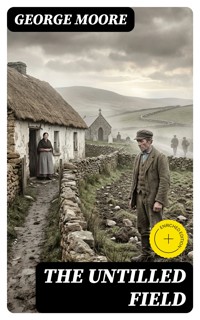
George Moore's "The Untilled Field" is a poignant exploration of Irish rural life in the late 19th century, articulated through a remarkable blend of realism and impressionism. The narrative unfolds through a series of interconnected stories that depict the struggles of peasants grappling with poverty, social constraints, and the yearning for a more meaningful existence. Moore's lyrical prose, juxtaposed with stark depictions of the harsh realities of agrarian life, creates a vivid landscape where familial bonds, love, and aspiration collide with the unyielding forces of tradition and fate. This collection not only illuminates the complexities of Irish identity but also reflects the broader literary movements of the time, including naturalism and modernism, which sought to capture the zeitgeist of contemporary society with unflinching honesty. Born in 1852 in County Mayo, George Moore was a key figure in the Irish literary renaissance. His own experiences with the tumultuous sociopolitical environment of Ireland, coupled with his exposure to the avant-garde movements in Paris, greatly influenced his literary voice. Moore's commitment to depicting the raw truths of human experience led him to challenge conventional norms, thereby positioning "The Untilled Field" as a significant work that embodies his vision for Irish literature. For readers interested in the intersection of personal narrative and social commentary, "The Untilled Field" is a must-read. Moore's intricate character studies and evocative settings offer not only a window into the life of rural Ireland but also a timeless meditation on the universal themes of love, loss, and the quest for individuality. This book will resonate with both literary scholars and casual readers alike, drawing them into a richly textured world that echoes with the voices of those forgotten by history. In this enriched edition, we have carefully created added value for your reading experience: - A succinct Introduction situates the work's timeless appeal and themes. - The Synopsis outlines the central plot, highlighting key developments without spoiling critical twists. - A detailed Historical Context immerses you in the era's events and influences that shaped the writing. - A thorough Analysis dissects symbols, motifs, and character arcs to unearth underlying meanings. - Reflection questions prompt you to engage personally with the work's messages, connecting them to modern life. - Hand‐picked Memorable Quotes shine a spotlight on moments of literary brilliance. - Interactive footnotes clarify unusual references, historical allusions, and archaic phrases for an effortless, more informed read.
Das E-Book können Sie in Legimi-Apps oder einer beliebigen App lesen, die das folgende Format unterstützen:
Veröffentlichungsjahr: 2022
Ähnliche







The Untilled Field
Table of Contents
Introduction
Balanced between the claims of home and the pull of departure, The Untilled Field traces how lives rooted in rural habit strain toward change, while the soil of custom, faith, and kinship both nourishes and binds, so that every hope for escape bears the weight of loyalty, every return carries the ache of distance, and the ordinary gestures of work, worship, and talk become charged with the quiet drama of choosing between survival and selfhood in a landscape whose beauty intensifies the costs of staying, leaving, or simply learning to endure the seasons that measure loss, compromise, and the stubborn will to go on.
George Moore’s The Untilled Field is a collection of short stories rooted in the realist tradition and set chiefly in rural Ireland, appearing in the early twentieth century amid the energies of the Irish Literary Revival. The book’s villages, farms, and parish rooms form an intimate stage where social pressures reveal themselves in everyday choices. Without relying on overt melodrama, Moore frames private conflicts against a backdrop of land, labor, and local authority. The publication belongs to a moment when questions of culture, language, and national identity sharpened, and its settings reflect communities negotiating change without abandoning the rhythms of their fields.
Readers encounter a mosaic rather than a single plot: discrete tales linked by atmosphere, recurring concerns, and the sense of an unwritten map connecting one household to the next. The voice is measured and attentive, with close but restrained narration that allows motives to unfold in small gestures and modest revelations. Dialogue carries regional inflections without heavy dialect, and description favors clarity over ornament. The tone remains compassionate yet unsentimental, so the collection invites slow reading, where the space between events matters. Moore’s style lends dignity to ordinary speech and patience to moral quandaries, producing a quietly cumulative emotional power.
The central themes are enduring and immediately legible: emigration and return, the pressure of communal expectation, the moral authority associated with church and family, and the uneasy bargain between personal freedom and social belonging. Economic constraint frames many choices, yet the stories rarely reduce lives to hardship alone; they explore pride, stubbornness, tenderness, and the practical intelligence required to keep a household. Ideas of inheritance and responsibility weigh on younger generations, while older characters reckon with time, memory, and change. Across these tensions, the collection asks what it means to keep faith with one’s place without surrendering the inner claim of desire.
Formally, The Untilled Field exemplifies the short story collection as a coherent field of observation, where each piece stands complete yet gains resonance beside its neighbors. Motifs of roads, gates, and boundaries repeat without becoming schematic, underscoring how thresholds shape choices. Moore often favors a close third-person perspective that keeps judgment at bay, so readers assemble meanings from implication and pause. Endings tend toward openness, honoring the way real decisions rarely settle cleanly. The craft’s quietness is deliberate, asking attention not for stylistic fireworks but for fidelity to experience, and in that steadiness the book builds its abiding authority.
For contemporary readers, the book’s concerns echo across borders: migration’s promise and cost, the friction between communal norms and self-determination, and the lingering influence of institutions over intimate life. Rural depopulation and the reshaping of local economies remain current, as do debates about tradition’s value and its limits. Moore’s patient realism models how literature can scrutinize power without cruelty and witness suffering without spectacle. The characters’ dilemmas resist easy judgment, offering instead an education in sympathy guided by concrete detail. In an age of quick takes, the collection rewards attention to context, reminding us how moral choices ripen over time.
Approached as a cycle of interrelated meditations, The Untilled Field offers an entry into Irish rural life at a moment of historical urgency while speaking beyond its moment. Its pages give companionship to readers who prefer the clarities of daylight to the thunderclap of plot, as modest incidents disclose their stakes through patient observation. The collection matters now because it articulates how people live inside institutions and landscapes they neither fully choose nor fully escape. To read it is to practice steadiness: to notice voices at the edge of change, to hold competing loyalties in mind, and to accept complexity.
Synopsis
The Untilled Field is a 1903 collection of short stories by George Moore, set largely in rural Ireland at the turn of the twentieth century. Through discrete yet thematically linked sketches, Moore observes how small farmers, laborers, priests, and emigrants navigate a landscape of scarcity and obligation. The book’s title evokes possibilities left uncultivated: minds, affections, and social energies constrained by custom. Rather than a single plot, the collection moves from village to village, following crises—a proposed marriage, a decision to leave, a change in vocation—whose ripples extend beyond one household. Throughout, the tone remains steady and observational, allowing competing claims to be heard.
Early stories center on departures. Youths measure dwindling prospects against tales from across the Atlantic, while parents confront the cost of losing help on the land. Farewell rituals mingle pride and dread; letters home promise opportunity yet expose distance that widens with each season. Moore tracks the practical arithmetic—passage money, remittances, the mortgage—alongside the inward calculation of what must be relinquished. The decisions rarely hinge on a single cause; economic pressure, family duty, and personal longing intersect. In tracing these dilemmas, the book establishes migration as both an escape and a wound, shaping those who go and those who must stay.
Another current follows the reach of the Church in daily affairs. Priests appear as confidants, arbiters, and sometimes obstacles, guiding confessions, approving marriages, and policing instruction. Moore’s portraits note both the pastoral intent and the social power embedded in the collar. Parishioners seek counsel yet chafe when conscience meets regulation; the lay community closes ranks around shared beliefs even as individuals strain for air. The stories do not reduce conflict to a single villain, but show how spiritual authority can shape livelihoods and intimate choices, particularly for the young and for women, whose reputations, futures, and means of survival are acutely vulnerable.
The collection also considers returns and arrivals. Emigrants come back with savings, altered manners, or new convictions, hoping to reclaim land, open a business, or revive a courtship. Outsiders, including teachers or professionals, try to introduce practices they take for progressive. Such figures test the permeability of the village’s boundaries. Moore traces the negotiations that follow: bargains over property, questions of status, the recalibration of kinship ties. Aspirations collide with economies of reputation and habit; what money can purchase and what custom withholds rarely align. The resulting friction is often quiet rather than sensational, yet it leaves lasting marks.
Domestic economies and marriage arrangements form another axis. Daughters weigh suitors against dowry expectations and the need to keep a household running; sons calculate inheritance, celibacy, or the sale of land. Moore shows how affection, prudence, and fear weave together, and how a single misstep can threaten a family’s standing. Women, in particular, face narrow paths: work in service, a marriage of convenience, or a hope that risks censure. In these negotiations, tenderness and self-interest coexist, and small kindnesses matter. The stories track how choices made under pressure reverberate, shaping futures without announcing themselves as dramatic turning points.
Cultural aspiration enters in modest ways: songs, reading, local entertainments, or plans for schooling that would broaden horizons. Such efforts prompt debate about what kinds of knowledge and diversion belong in the parish, and who gets to decide. Moore’s method is cumulative rather than climactic, linking episodes by recurring images of fields, roads, and shorelines, and by a patient attention to speech and gesture. The separateness of the tales allows multiple angles on the same pressures, while the shared setting gives them a slow-building resonance. By the end, the landscape itself feels like a ledger of choices made.
Without resolving every conflict, the collection positions private longing and communal order in sustained conversation. Its restraint, clarity, and focus on ordinary predicaments give the stories a durable poise, and its themes of migration, authority, and the uses of land remain current. Readers encounter not a thesis but a mosaic of lived situations, where sympathy and critique coexist. The Untilled Field endures for the questions it poses: what gets cultivated, who decides, and at what cost. In leaving outcomes partly open, Moore preserves the work’s aftertaste of possibility and loss, inviting reflection beyond the final page.
Historical Context
George Moore’s The Untilled Field emerged in the early twentieth century, when Ireland remained under British administration and rural life dominated the west. Written at the turn of the century and published in 1903, the collection draws on Moore’s native County Mayo and nearby districts. Moore, an Irish novelist shaped by years in Paris and London, conceived several stories for translation into Irish as part of a language-revival project. Modeled in part on Ivan Turgenev’s rural sketches, the book uses realist observation to examine social forces that framed daily existence, setting its portraits within parishes, farms, and small towns overseen by church and state.
Founded in 1893 by Douglas Hyde and Eoin MacNeill, the Gaelic League sought to revive the Irish language through classes, publications, and cultural activism. It promoted Irish as a vernacular of everyday life and encouraged writers to supply readable prose for learners. Moore offered stories that could be rendered into Irish, and several were translated under League auspices before the English collection appeared. This context matters: the revival reframed literature as an instrument of national renewal, even as many participants differed over tone and subject. Moore’s engagement aligned craft with a movement that valued rural settings, oral idioms, and local speech.
By the late nineteenth century, the Roman Catholic Church wielded decisive influence in rural Ireland. Parish networks, devotional missions, and the National School system—initiated in 1831 but largely denominational in practice—gave clergy wide sway over education and morality. Maynooth College, founded in 1795 to train priests, supplied a disciplined clergy whose authority reached into politics and family life. Many parish priests supported constitutional nationalism, and their standing at fairs, markets, and election meetings was formidable. Against this backdrop, Moore’s stories register how clerical power could shape choices about work, marriage, reading, and migration, without relying on exceptional cases to make the point.
Rural conditions were also defined by the Land Question. After the Land War of 1879–1882 and subsequent agitation, successive British governments enacted measures to transfer holdings from landlords to tenants. The Wyndham Land Purchase Act of 1903 accelerated this shift, while the Congested Districts Board, created in 1891, tried to relieve poverty in the western seaboard by reorganizing small farms and funding industry. Yet insecurity, debt, and subdivision persisted in many districts. Moore’s west-of-Ireland settings arise from this landscape of partial reform, portraying tenants and smallholders whose prospects were improving in law but often constrained by economics, custom, and community expectations.
In the decades after the Great Famine, emigration became a structural feature of Irish life, especially in the west. Between the 1870s and the First World War, hundreds of thousands departed for Britain and North America, while others engaged in seasonal migration for agricultural or industrial work. Remittances sustained households and influenced marriage patterns, land transfers, and local status. Steamship lines and railways made departures routine, even as each loss reshaped parish demography. Moore’s characters inhabit this transatlantic economy: choices about staying, leaving, or returning are informed by the lure of wages abroad and the pressure of limited opportunities at home.
At the turn of the century, Ireland was administered through Dublin Castle and the Royal Irish Constabulary, with county and rural district councils created by the Local Government (Ireland) Act of 1898. These elected bodies gave nationalists significant control over local affairs, even as ultimate authority remained imperial. Elections, public houses, and fairs served as nodes where politics, patronage, and moral authority met. In such arenas, alliances between clergy, shopkeepers, and activists shaped reputations and livelihoods. Moore situates his rural milieus within this administrative tapestry, where formal law and informal sanction operated together to influence opportunity, respectability, and the boundaries of dissent.
Moore’s artistic approach drew on continental realism and naturalism, especially Gustave Flaubert and Émile Zola, as well as the social sketch tradition associated with Turgenev. Returning to Ireland after years abroad, he entered the Irish Literary Revival then gathering momentum. He collaborated with W. B. Yeats on Diarmuid and Grania in 1901 for the Irish Literary Theatre, a precursor to the Abbey Theatre founded in 1904. The Untilled Field thus occupies a nexus where international techniques met a national program for cultural renewal, using clear prose and disciplined observation to render speech, habit, and belief without the heroic mythologizing common in revival pageantry.
Upon publication, The Untilled Field drew notice for its plain style and its scrutiny of social authority. The collection attracted clerical criticism in Ireland, while language revivalists welcomed its rural focus and suitability for translation. It has since been widely regarded as a landmark of the Irish short story, anticipating aspects of the realism found in James Joyce’s Dubliners. By depicting emigration, landholding, and parish discipline without melodrama, Moore reflects and critiques an Ireland poised between reform and tradition. The book’s measured portraits record structural change and moral regulation that characterized the decades immediately before the political upheavals of the 1910s.




