


9,59 €
Mehr erfahren.
- Herausgeber: Oldcastle Books
- Kategorie: Geisteswissenschaft
- Sprache: Englisch
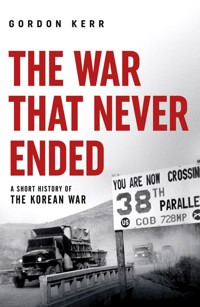
The Korean War of 1950-1953 ended in a frustrating stalemate, the echoes of which reverberate to this day. It was the only conflict of the Cold War in which forces of major nations of the two opposing systems - capitalism and communism - confronted each other on the battlefield. And yet, in the sixty years since it was fought it has been strangely neglected, perhaps because no one was able to claim the victor's spoils. The War That Never Ended details the origins, battles, politics and personalities of the Korean War - a war that has never ended, and for which no peace treaty was ever signed.
Das E-Book können Sie in Legimi-Apps oder einer beliebigen App lesen, die das folgende Format unterstützen:
Seitenzahl: 205
Veröffentlichungsjahr: 2020
Ähnliche














PRAISE FOR GORDON KERR
‘Thoroughly rewarding’ – Travelmag on A Short History of the Middle East
‘Informative, fascinating and extremely well-researched… Gordon Kerr’s book is a mini masterpiece’ – ABC Brisbane on A Short History of the Vietnam War
‘Factual and even-handed, Kerr presents a fair-minded introduction of basic Chinese history’ – Booklist on A Short History of China
For Lindsey and Sean
Glossary of Acronyms
DMZ – the Korean Demilitarised Zone (a strip of land running across the Korean peninsula that acts as a buffer zone between North Korea and South Korea)
DPRK – Democratic People’s Republic of Korea (North Korea)
ECA – Economic Cooperation Administration (the agency set up by the US Government to administer the Marshall Plan)
JCS – Joint Chiefs of Staff (a committee of senior United States armed forces leaders that advises the president of the United States on military matters)
MDL – Military Demarcation Line (the land border line between North Korea and South Korea)
NKPA – North Korean People’s Army
POW – Prisoner of War
ROK – Republic of Korea (South Korea)
UN – United Nations
UNC – United Nations Coalition
UNCOK – United Nations Commission on Korea
UNTCOK – United Nations Temporary Commission on Korea
USSR – Union of Soviet Socialist Republics (the Soviet Union)
VJ Day – Victory Over Japan Day (the day on which Japan surrendered in World War II)
Introduction
The Korean War is the war that never ended, a conflict between two parts of what was once one nation, the Republic of South Korea and the Democratic People’s Republic of Korea. But it was also more than that. It began in 1950 and was a war between two systems – the capitalism of the West and the communism of Russia, a front in the Cold War that was fought in the aftermath of the Second World War.
However, in comparison to other modern conflicts, the Korean War seems strangely neglected, probably most familiar to people through the hugely successful television comedy series M.A.S.H. And yet, it was a costly war. The United Nations force that supported South Korea after it was invaded by North Korea lost more than 178,000 troops, with 32,925 listed as missing and more than half a million wounded. North Korea suffered up to half a million dead and almost 700,000 were wounded. A staggering 2.5 million civilians lost their lives during the conflict. Three times as many British troops perished in the Korean War as in the Falklands War and the Chinese probably lost hundreds of thousands of soldiers, although the actual number remains uncertain.
It heralded a dangerous time in global relations and only the Cuban Missile Crisis of 1962 created a greater risk of nuclear warfare in the years since 1945. It was also the only conflict since 1945 in which two of the world’s superpowers confronted each other in battle.
Perhaps it is the fact that it ended in a kind of stalemate, preventing any of the participants from bathing in the glory that victory engenders, that has made us neglect it over the years. Nonetheless, it was a significant event in modern history and featured a dazzling array of political and military talent – names on the Western side such as US President Harry S Truman, Secretary of State, Dean Acheson, and Generals Marshall, MacArthur, Ridgway and Bradley. On the side of the DPRK were the North Korean leader, Kim Il-sung (1912-94), grandfather of the current leader, Kim Jong-un, the Chinese leader, Mao Zedong (1893-1976), the Chinese Prime Minister Zhou Enlai (1898-1976) and the General Secretary of the Russian Communist Party, Joseph Stalin. The war itself featured significant military events such as the defence of the Pusan (now Busan) Perimeter, the destruction of the inexperienced and inadequately supplied US force known as Task Force Smith, the surprise landing of UN troops at Inchon (now Incheon), the advance of UN forces as far as the Yalu River on the Chinese border and the surprise Chinese intervention in October 1950.
As in the disastrous Vietnam War of a decade and a half later, for which the Korean War could almost be said to have been a dress rehearsal, the difficulties of sustaining an unpopular, autocratic government and of sending a modern, Western army to fight in difficult terrain against a lightly equipped, fast-moving and committed enemy soon became apparent. Eventually, by the time the armistice was signed at Panmunjom in July 1953, the Western Allies were happy to end their involvement in a costly and fairly thankless conflict in which victory for either side was impossible.
The War That Never Ended follows the events that led to and created the conflict and then guides the reader through the political machinations, personalities and battles of this brutal war. At a moment when North Korea is a hot topic, due to the efforts of US President Donald Trump to negate its nuclear capability, this book provides a timely examination of the events in the Korean peninsula that helped to shape our world.
1
Land of the Morning Calm
The Korean Peninsula
The mountainous land of Korea, nicknamed in English ‘Land of the Morning Calm’, stretches 600 miles from north-east to south-east and measures about 150 miles across at its widest, narrowing to under 100 miles between Pyongyang in the west and Wonsan in the east. To the north, it is separated from Manchuria by the Yalu and the Tumen Rivers and there is a tiny, 11-mile border with Russia at the mouth of the Tumen. The terrain is rough and the weather extreme – temperatures range from 40 to -40 degrees Celsius – and both these factors make operations difficult for a Western mechanised army. The mountains reach 9,000 feet and the countryside consists mainly of sinuous, narrow valleys punctuated by rice paddies and terraces.
Legend has it that the god-king, Dangun, founded Gojoseon in the northern part of the Korean peninsula in 2333bc. Gojoseon endured until 108bc when it was conquered by the Chinese Han dynasty which set up four commanderies. These were annexed by the Korean kingdom of Goguryeo and, by 313bc, Goguryeo was in control of most of the peninsula and the southern and central parts of Manchuria.
The medieval Goryeo dynasty – from which Korea derives its modern name – was established in 918ad. Its capital was originally at Kaesong but was later moved to Seoul, with the country remaining a tributary state of China. Despite a series of invasions by the Mongols, Goryeo was never conquered, but swore allegiance to the invaders. Eventually, when the Yuan dynasty in Mongolia began to crumble, Goryeo was free to re-establish its independence. The Yi dynasty came to power in 1392 and ruled the country until the Japanese annexation of 1910, but the families who ruled the country constantly engaged in feuds and Korea still looked to China as its ‘elder brother nation’.
Korea existed in virtual isolation until 1876, when a Japanese military expedition arrived and, after some resistance from the Koreans, persuaded them to sign a treaty that opened Korean ports to Japanese shipping and gave rights in Korea to Japanese citizens. Thus, Korea was taken out of the Chinese sphere of influence. In 1882, the Koreans signed a treaty of ‘amity and commerce’ with the United States, infuriating the Japanese who now made efforts to become even more involved in Korean affairs. The British, meanwhile, were eager to counter Russian influence in the Far East by encouraging Korea to maintain its relationship with China. Japanese ambitions, however, were to make Korea ‘a part of the Japanese map’.
In 1894, the Japanese seized the initiative, landing an invasion force, leading the panicked Korean government to plead for help from the Chinese. By the time they did so, Japanese troops were already in the capital. By 1896, the Korean king had sought refuge in the Russian embassy, and the Japanese were in full control of the country. But, when the king issued an order that all his pro-Japanese ministers should be executed, the Japanese backed down. Only temporarily, however.
For the following seven years, Korea was a bone of contention between Moscow and Tokyo as each vied for power and influence. In February 1904, following the breakdown of negotiations, Japan launched a surprise attack on the Russian Far East Fleet in Port Arthur (now Lüshunkou District) in China, followed by staged landings in Korea. In May, Japanese ships destroyed the Russian fleet in the Tsushima Strait, forcing the Russians to sue for peace and Korea was declared a Japanese protectorate in November 1905. At the time, the British were happy to recognise Japan’s move in return for Tokyo’s support for British rule in India.
The Koreans looked on in horror as Japanese bureaucrats and officials took over their entire country. Japanese roads and railways were built and Japanese education was introduced. Resistance grew and, by 1908, a guerrilla army 70,000 strong had lined up against the occupiers. The Japanese introduced harsh repressive measures that brought mass executions and imprisonment, gradually wearing down resistance. Finally, in 1910, the last Korean emperor, Sunjong (1874-1926), was forced to abdicate and Korea was formally annexed by Japan. Military government was imposed and for the next 35 years, the Japanese ruled in Korea, using the peninsula in the 1930s as a base from which to launch operations in Manchuria. They remained hated and there was continued resistance by nationalists in the mountains, many of whom were communists. In 1919, 7,000 peaceful Korean demonstrators were killed by Japanese police and soldiers.
In 1943, at a conference of the Allies in Cairo, President Franklin D Roosevelt, Prime Minister Winston Churchill and Generalissimo Chiang Kai-shek declared their commitment to a unified and independent Korea after the hostilities ended. They sought a trusteeship by the major powers, the United States, the USSR, China and Great Britain. However, at the later Potsdam Conference, it was concluded that there should be some kind of dividing line between the operations of the Americans and the Russians. The Americans decided unilaterally that they required two ports in Korea and the line they proposed should be drawn north of Seoul, therefore including the ports of Inchon on the west coast and Pusan on the east coast.
At the end of the war, Japanese forces north of the 38th Parallel were ordered to surrender to the Russian forces and those south of the line to US forces. It is worth pointing out how arbitrary the 38th Parallel was. It cut through provinces, towns and villages, and it cut off the more heavily industrialised north from the predominantly agricultural south. Of course, it was hard for one part of the country to survive without the other. In terms of numbers, around 21 million lived south of the Parallel and the remaining 9 million lived north of it.
The Russians accepted the American plan for division of Korea at the 38th Parallel and they stopped their advance into the peninsula at that point, about a month before the Americans were able to get troops there. It is actually debatable whether the United States would have put up much of a fight if the Soviets had decided to continue past the 38th Parallel and occupy the entire peninsula because Korea appeared at the time to have no real value. But Stalin was happy to settle for just a bit of it and China, for its part, was preoccupied with its own internal struggles, ignoring what was happening to the south.
America Takes Control
Towards the end of August 1945, troops of XXIV Corps were dispatched to Korea. Little was known about their mission, although their commander, General John R Hodge (1893-1963), was informed by a superior that the occupation was to be ‘semi-friendly’. The Supreme Commander for the Allied Powers in Japan, General Douglas MacArthur, made it clear that the Koreans should be treated as a ‘liberated people’. Washington ordered Hodge to ‘create a government in harmony with US policies’. What those policies were, was a mystery to all, however. Hodge, therefore, ordered his men to treat Korea as an enemy of the United States which should be subject to the terms of the Japanese surrender. He gave himself the mandate of seizing power in Korea and controlling the country, refusing to have dealings with any Korean with a political position in order to maintain a distance between the United States and any of the various political factions in Korea. Initially, however, the Americans had to rely on the Japanese colonial officials, whom General Hodge immediately confirmed in their positions. Japanese remained the main language by which the Americans communicated with officialdom. On 11 September, however, MacArthur ordered that the Japanese had to leave immediately.
In the next four months, 70,000 Japanese bureaucrats and more than 600,000 Japanese soldiers and civilians were sent home. For the Koreans, however, it was a little too late as the initial good relations between the Americans and the Japanese had antagonised them, and they felt the Americans had treated them with contempt. This feeling was exacerbated by the fact that many of the Koreans who replaced the Japanese officials had been long-term collaborators with the Japanese and, as a result, were hated by their fellow countrymen.
Before their departure, the Japanese made it clear to the Americans that amongst Korean political parties, communism was becoming hugely influential, this at a time when the United States was becoming increasingly wary of the communist threat around the world. Hodge was anxious, therefore, to support political groupings that were anti-communist. The most obvious of these was the Korean People’s Republic Party, whose members were nationalists and part of the anti-Japanese resistance.
In March 1946, the Joint Commission, representing the USSR and the United States, met and almost immediately was deadlocked over who should govern a united Korea. The Russians would only countenance the Korean communists and the Americans, of course, opted for the parties of the right. This led to each occupying power deciding to establish Korean states in their own respective zones. The USA assembled the South Korean Interim Government, dominated by a right-wing coalition led by Syngman Rhee (1875-1965). Americans remained heavily involved in an advisory capacity and retained control over financial matters. Meanwhile, in the north, in early 1946, a national Provisional People’s Committee, with Kim Il-sung at the helm, came to power. Later in the year all the North Korean political parties were grouped into the Korean National Democratic Front and, in November, this body won 97 per cent of the votes in elections for new people’s committees which led to the creation of the Korean People’s Assembly.
The Joint Commission met once more in May 1947, and was greeted by violent protests. The Americans and the Soviets each put forward a proposal, the Americans seeking free elections for the whole peninsula, the Russians countering with a plan for an assembly with equal representation from both the American sector and their own. After each side rejected the other’s proposal, the issue of Korea was handed over to the United Nations which created the Temporary Commission on Korea – known as UNTCOK – to oversee elections. However, the nations in the Soviet sphere of influence boycotted the vote and the Russians refused to allow the Commission access to the north of the peninsula. Nonetheless, on 10 May 1948, elections – regarded as illegal by the Soviets – were held in the south, the conservatives winning most seats. Three months later, on 15 August, the Republic of Korea was proclaimed, with Syngman Rhee as its president. Meanwhile, on 3 September, a new constitution was ratified in the north by the Supreme People’s Democratic Assembly and a week later Kim Il-sung became Premier of the new Democratic People’s Republic of Korea.
In December 1948, the United Nations designated South Korea as the only Korean state based on ‘the free will of the electorate’ and established a UN Commission on Korea. The ROK was recognised by the United Kingdom, Canada, France and the United States but neither Korean state was admitted to the United Nations.
Syngman Rhee
Born in 1875, son of a genealogical scholar, Syngman Rhee converted to Christianity in 1894 and studied English before becoming a journalist while earning extra cash by teaching Korean to Americans. He became involved in anti-Japanese politics and was imprisoned in 1899 for his involvement in a plot to remove King Gojong (r.1897-1907) from power. Released in 1904, he emigrated to the United States where he became active on behalf of Korea, meeting with Secretary of State John Hay (1838-1905), and President Theodore Roosevelt (1858-1919) in an effort to persuade the United States to help the cause of Korean independence. Rhee remained in America, earning a BA from George Washington University and an MA from Harvard. He also gained a PhD from Princeton. He returned to Korea in 1910 but was implicated two years later in a plot to assassinate the Japanese Governor-General of the country and was arrested. He managed to flee to the United States shortly after.
His exile in the United States lasted 35 years, spent lobbying on behalf of his beloved country’s independence, his work paid for by donations from like-minded Koreans. Some thought that Rhee was too preoccupied with self-promotion, while some considered him to be arrogant. Others distrusted him for not participating in the armed struggle in Korea. But his determination was undeniable. Even other expatriate parties agitating, like him, for Korean independence, fell foul of him. He had a single-minded vision of the world and its future and would not be distracted from that. In 1944, when the United States still believed that it could co-exist harmoniously with Stalin’s Soviet Union in a post-war world, Rhee was arguing that, ‘the only possibility of avoiding the ultimate conflict between the United States and the Soviet Union was ‘to build up all democratic, non-communist elements wherever possible’.
Rhee’s grasp of English and his knowledge of America and American institutions gave him a real advantage over his rivals. Moreover, he was free from any suspicion of collaboration with the Japanese. He was obsessive and uncompromising in his nationalist and anti-communist sentiments and was emerging, in the minds of the American government after the war, as a possible future leader of his country.
2
Invasion
The NKPA Crosses the 38th Parallel
At 4am on the morning of 25 June 1950, the North Korean People’s Army (NKPA) launched an invasion of the Republic of Korea. An artillery barrage in a number of locations was swiftly followed by the crossing of the 38th Parallel, on a front 150 miles wide, by seven infantry divisions and an armoured brigade as well as a number of other units. Alongside this force were 150 powerful Russian-built T-34 tanks. The invading army was around 90,000 strong and it was opposed by four ROK divisions and a brigade, all poorly equipped.
The Ongjin peninsula in the north-west was quickly taken as the offensive proceeded from west to east and by 9.30 that morning, the city of Kaesong (now in North Korea) had fallen. The main force began to proceed along the Uijongbu corridor – a route taken centuries earlier by invaders from Mongolia and Manchuria – that led directly to the capital, Seoul. In the central, mountainous region, the city of Chunchon (now Chuncheon) was threatened by two divisions and on the east coast in Gangwon-do province, there were amphibious landings at Gangneung and Samcheok. Attacks by North Korean, Russian-built Yakovlev Yak-9 fighters were launched on railway stations, airfields and petrol storage tanks in Seoul.
At 11am, North Korean radio announced that the North Korean government had declared war on South Korea in retaliation for an invasion of the country by what it described as ‘the bandit traitor Syngman Rhee’. North Korean Premier, Kim Il-sung, reiterated this version of events on North Korean radio at 1.55pm and by 3pm on the first day of the conflict, North Korea was claiming that its forces had penetrated 10 to 15 miles into its southern neighbour.
It took three hours for the news of the invasion to reach the US Far East Command headquarters in Tokyo, in a message from the American Embassy military attaché in Seoul. There was great surprise in the South Korean capital, as well as in Tokyo and Washington. Of course, they were fully aware in these places that the North Koreans were entirely capable of launching an invasion, but the notion had hitherto been discounted.
Meanwhile, on 26 June, as the North Koreans continued their advance southwards, the United Nations Commission on Korea (UNCOK) passed the following conclusions to UN Secretary-General Trygve Lie (1896-1968):
‘Commission’s present view on basis this evidence is first that, judging from actual progress of operations, Northern regime is carrying out well planned, concerted and full-scale invasion of South Korea; second, that the South Korean forces were deployed on wholly defensive basis in all sectors of the parallel; and, third, that they were taken completely by surprise as they had no reason to believe from intelligence sources that invasion was imminent.’
On Monday 26 June, Kim Il-sung again took to the air:
‘Dear brothers and sisters! Great danger threatens our motherland and its people. What is needed to liquidate this menace? In this war which is being waged against the Syngman Rhee clique, the Korean people must defend the Korean Democratic People’s Republic and its constitution, they must liquidate the unpatriotic fascist puppet regime of Syngman Rhee which has been established in the southern part of the republic; they must liberate the southern part of our motherland from the domination of the Syngman Rhee clique; and they must restore the people’s committees there – the real organs of power. Under the banner of the Korean Democratic People’s Republic we must complete the unification of the motherland and create a single, independent, democratic state. The war which we are forced to wage is a just war for the unification and independence of the motherland and for freedom and democracy…’
Just a few hours later the rumble of tanks could be heard, as they rolled into Seoul, the capital of the Republic of Korea.
The Summer of Terror
Two days after the invasion by North Korea, President Rhee came down hard on communists and communist sympathisers. He had forced about 300,000 people who were communists or were suspected of being communists to enrol in a re-education movement known as the Bodo League (also known as the National Rehabilitation and Guidance League, the National Guard Alliance, the National Guidance Alliance, or Bodo Yeonmaeng). Rhee claimed that their enrolment would safeguard them against execution for their political beliefs. However, in order to bolster numbers, non-communists were also forced to enrol in the league.
On 27 June 1950, Rhee issued an order that people associated with either the Bodo League or affiliated to the South Korean Workers’ Party were to be executed. A day later, in Hoengseong in Ganwon-do, prisoners alleged to be communists and many members of the Bodo League were summarily executed by retreating South Korean troops and anti-communist groups. The chief of the Seoul Metropolitan Police later admitted to personally killing 12 people who were either communists or suspected of being communists after the start of the war. Following the recapture of Seoul in September 1950, around 30,000 South Koreans were executed by South Korean forces on suspicion of having collaborated while the North Koreans occupied the city.
Official United States documents demonstrate that US Army officers witnessed and photographed the massacre and it is known that one officer sanctioned the execution of political prisoners in order to prevent them falling into the hands of the enemy. Another document, however, shows the United States Ambassador to South Korea, John Muccio, recommending to the South Korean president and his defence minister, Shin Sung-mo (1891-1960), that the executions be stopped. When General MacArthur was informed of the massacre, he brushed it off as an ‘internal matter’.




