


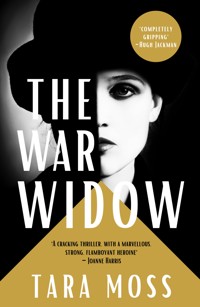
8,49 €
Mehr erfahren.
- Herausgeber: Verve Books
- Kategorie: Gesellschafts- und Liebesromane
- Sprache: Englisch
** AN INTERNATIONAL BESTSELLER **
WWII may be over, but journalist Billie Walker's search for a missing young man will plunge her right back into the danger and drama she thought she'd left behind in Europe.
It's 1946, and though war correspondent Billie Walker is happy to finally be back home in glamorous Sydney, for her the heady postwar days are tarnished by the loss of her father and the disappearance of her husband, Jack. To make matters worse, newspapers are now sidelining her reporting talents to prioritise jobs for returning soldiers.
Determined to take control of her future, she reopens her late father's private investigation agency, and, slowly, the women of Sydney come knocking.
At first, Billie's work consists of tailing cheating husbands. But when a young man goes missing, Billie finds herself on a dangerous new trail that will lead her to the highest levels of Sydney society, and down into its underworld.
As the risk mounts, Billie realises that there is much more than one man's life at stake. Though the war was won, it is far from over.
The first in a thrilling historical mystery series following straight-talking, champagne-drinking, fast-driving private investigator and former war reporter Billie Walker. Perfect for fans of Kate Morton, Lisa Scottoline and Rosalie Knecht.
PRAISE FOR THE WAR WIDOW
'Completely gripping and entertaining from beginning to end' - HUGH JACKMAN
'Just what I needed today-a blast of the escapist past. Sydney in 1946, damaged veterans, bad guys, car chases, mysteries, and a female PI up for the fight' - IAN RANKIN
'A cracking thriller, with a marvellous, strong, flamboyant heroine' - JOANNE HARRIS
'Enough page-turning suspense to keep you up reading far later than you intended!' - PETER JAMES
'A terrific read!' - LYNDA La PLANTE
Das E-Book können Sie in Legimi-Apps oder einer beliebigen App lesen, die das folgende Format unterstützen:
Veröffentlichungsjahr: 2024
Ähnliche



















Praise for The War Widow
‘Just what I needed today – a blast of the escapist past. Sydney in 1946, damaged veterans, bad guys, car chases, mysteries, and a female PI up for the fight’ – Ian Rankin
‘Completely gripping and entertaining from beginning to end’ – Hugh Jackman
‘Enough page-turning suspense to keep you up reading far later than you intended!’ – Peter James
‘A terrific read!’ – Lynda La Plante
‘A cracking thriller, with a marvelous, strong, flamboyant heroine’ – Joanne Harris
‘In Billie Walker, Moss has conjured up one kick-ass 1940s heroine: a tough-talking, glamorous feminist who’s as adept with a pistol as she is on the dance floor, haunted by a tragic past, and unafraid to take on the darkest of foes. An artful, original take on noir suspense that resonates in today’s times’ – Fiona Davis
‘Brilliantly atmospheric and completely immersive… Moss has created a cinematic and important feminist noir – dark as midnight velvet and tough as steel. Do not miss this!’ – Hank Phillippi Ryan
‘Tara Moss’s The War Widow is an excellent novel and an even better springboard for its crackerjack heroine: the indomitable Billie Walker… fun, flawed, smart, feminist, and feisty’ – Halley Sutton
‘Billie Walker is the type of heroine I’d love to befriend: resourceful, clever, adventurous, and a true fashionista. With a gripping plot and the perfect dose of history and intrigue, The War Widow has all the elements of a great page-turner’ – Ellen Keith
‘Moss’s ultra-cool prose and whip-smart plotting pull you along at cracking pace until suddenly you look up and realize with a gulp how deep you’ve gone and how very dark it is down there’ – Emily Maguire
For Oma and Opa
Prologue
The night was starless pitch, enveloping him as in the feathered wings of a giant black raven.
Everything ached: his body, his head, the stifling darkness itself, and that darkness was spinning off-kilter, moving unpredictably and leaving him nauseous. His eyes felt warm and wet, and he opened them, strained them wide, but still he could not see. He was not a fighter by nature; nonetheless, his survival instincts had been awakened and the boy struck out – once, twice – hitting nothing but air. Sharp blows came back out of that unpredictable, impenetrable inky blanket, returning his unsuccessful strikes with hard and unforgiving ones. Pain shot through him again in white-hot flashes – his cheekbone, his ribs, his gut – and then the blows stopped. He curled into a ball once more, protecting his head, and he breathed uneasily, his ears ringing. His face felt hot. Something warm and salty dripped into his mouth.
Barely past his seventeenth birthday, he’d already traveled across the seas, seen injustice and violence, but he had never been so scared in his life as he was in that moment, there in the darkness, huddled and blind. Yes, he was scared. Scared as a fly in a web. If it was shameful to feel scared he’d have to think on that another time – if there was anything after this, any time to come at all. For now there was only room for one emotion.
Fear.
‘Didn’t nobody tell you about curiosity and the cat?’ came a voice, and then the earth was moving beneath him; he was pulled by his arms, the ground scraping against his face, his shoulder. He was lifted into the air like a rag doll and dropped. The ground beneath him gave and swayed. It was not ground; it was wool. A blanket. It smelled horribly of damp and carried the metallic tang of blood.
He tried again to speak. ‘But –’
Another blow. Somewhere in the close distance, just beyond the ringing in his ears, he heard a boot close and an engine start. The dark black bird of oblivion reached for him again and he was gone.
1
Billie Walker was right back in the moment.
The sun was warming her face, a world of abstract Technicolor behind her eyes as she closed her lids against a brief gust of wind, turning the corner on Stephansplatz. Each detail was so clear, so present, even now. There was the smell of something baked in the air. A shop’s delicious daily offerings of Sachertorte and Apfelstrudel. She’d laughed at something Jack had said. She could feel his large, reassuring hand in hers as they walked, their world a bubble of new love and the excitement of foreign soil and the thrill of a story. No caution. No fear. Their leather shoes clicked on the cobblestones and she could hear voices beyond the corner, then a shouting that pulled her from her reverie. Her reporter’s notepad was in her hand in an instant, and she broke from Jack and looked down to catch the pencil that was slipping.
When she looked up, she saw it. She stopped in her tracks, as Jack already had. The world came rushing in, shattering the illusion of safety. A dozen women were on their knees in the large square, surrounded by men in uniform. They were weeping quietly as their heads were shaved. She saw blood and hair, naked skin and tears. A man was in his underthings on the street beside them, cowering, his back bloodied, his beard shaved, his yarmulke crushed on the ground beside him. A crowd watched. Some of them were shouting, their fists raised. Billie couldn’t hear what they were saying through the sound of the blood pumping in her ears. Just as the urge to run forward and intervene struck her, one of the storm troopers turned, caught her eye. She looked away in an instant, as if the gaze would burn her.
She closed her eyes.
What they saw in Vienna was always there, just waiting for her lids to close. One day in 1938 she’d opened her eyes to find it, and now it was there each time she closed them – a kind of reversal. Why those memories? Why that weekend? It was all wrapped up in Jack, in the war, in everything she had to somehow leave behind now, everything that her head told her was over but her heart still clung to.
Billie shook herself gently and gathered up her things. There was no sense in lingering on memories, even if they wouldn’t let her go just yet. She wasn’t in Europe anymore. She was back in Australia. It was 1946, a new world, and she had to make a new life in it. She had to, and she would. The tram was slowing, pulling up next to Central. She removed a small gilded compact and lipstick from her handbag and reapplied a touch of Tussy’s Fighting Red. This was her stop. It was time to rise.
▲
‘Morning, John,’ Billie called as she strode into the foyer of Daking House, moving swiftly on long, graceful legs, yet as quietly as a cat, her crepe-soled oxfords making only the softest sound on the hardwood floor. It was to here that she took the tram most days of the week, for this was where she rented an office.
On hearing Billie’s voice the lift attendant stood to attention, roused by the presence of his oft-claimed ‘favorite customer’ in the building. There was no reason to disbelieve him on that score. When Billie arrived in the morning it was always past ten, well after the delivery boys had stocked the ground-floor shops and left again in their trucks, and the silver-haired businessmen had moved through the lobby and disappeared into their various offices, frowning and shuffling, plenty of them already stinking of cigars by nine. Billie never shuffled. She preferred the smell of French perfume to cigar smoke, and if she knew anything about reading the body language of quiet men, the lift attendant did, too. Other tenants like the Roberts Dancing School, the Sydney Single Tax Club, the United Jewish Overseas Relief Fund, the players who frequented the billiards room downstairs, and the like, well, they came and went at odd hours, a bit like Billie often did, but the accountants and legal types and those men from the New South Wales Kennel Control Board kept strict schedules and at this hour were hunched at their desks in their professional chambers, applying themselves to the type of work that was simply not in her blood. Few clients in her trade could be expected to knock at nine a.m. Midnight, however – well, that was not entirely unheard of. Her trade might have a mixed reputation, but the ways of the world demanded it. As did her purse.
‘Good morning, Ms Walker… Always a pleasure,’ the lift operator said.
When he’d started at the building in August, replacing a kind-faced, gray-haired woman who had held the position during the war years, this new lift operator had insisted that she call him by his first name, John. But just what to call Billie was no small question these days. Those in his line of work customarily used formal titles and, new to his job, John Wilson was reluctant to accept her invitation to refer to her simply as ‘Billie,’ as the previous attendant had come to. Not just yet, anyway. But every time someone referred to Billie as ‘Mrs’ it reminded her of the uncertainty of her personal life. It reminded her of loss and set her on edge. ‘Miss’ wasn’t quite right, either, she felt, and she could hardly be called that after all that had gone on in the past few years, including a wartime wedding, albeit a makeshift one with no ring and few witnesses. In the end she had requested ‘Ms,’ the term sitting better. It had its roots in the old titles, as Billie understood it, and was coined at the turn of the century as a more neutral honorific for women, but was little used. She had seen it mentioned in a New York Times article some years previous and at the time of reading hadn’t any inkling how well it would later suit her. John Wilson had accepted the request without comment, and now Billie got to hear ‘Ms Walker’ every working day of the week. In the wider world, well, there was always the tripping over ‘Miss,’ ‘Mrs,’ ‘Madam,’ ‘Mademoiselle’ – the whole complicated matter of a woman of marriageable age but uncertain status. Strangely, with all that the war had taught the world about the inherent precariousness of life, such details seemed to have gained more, not less, prominence, as if the years of darkness had been prompted by a title, by a woman, rather than by Nationalsozialismus and the sinister edges of the will to power. It was part of a grasp for stability, Billie supposed, a nostalgic turning back to something simpler, more rigid and readily understood. But Billie didn’t want to turn back. That wasn’t her style. And, besides, there was no undoing what the war had done.
Wilson dutifully stepped back to usher her into the nearest of the building’s four lifts – two for passengers, two for cargo. Only one of the passenger lifts was currently running, and they’d just started operating it from the ground floor again in recent months; previously the tenants had climbed the stairs to the first level to conserve power. It still felt a touch luxurious to go up from the lobby. Billie stepped inside the cab and Wilson slid the outer and inner metal doors closed with his strong left hand, the grille unfolding like a wall of opening scissors. His right hand, once his dominant hand, had not survived the war, and neither had that full arm. His suit was pinned on the side – not so unusual a sight in Sydney these days. His hair was neat and short, but the hairline was uneven on one side. His face, once conventionally handsome, Billie guessed, was marked by burns, though both his eyes, his nose, and most of his mouth were unscathed. For more than a year now the city had filled with broken men returning from overseas. Many were shunned for the disfigurements they could not hide, and the Australian bush was filling with such men, just as it had after the Great War – men who preferred lonely solitude to the stares they were met with on city streets, the pointing of children, the constant reminders. But John had returned to a relieved family and was already well-liked by those in the building. He’d made it back, while many had not.
They rode up, the cab rattling.
‘How is June?’ Billie, as she often did, inquired after Wilson’s wife. ‘And the children?’
‘Very well. Thank you for asking,’ he said, and his mouth moved into an uneven smile, his eyes crinkling warmly. He slowed the lift at the sixth floor, jogging the lever up and down a couple of times to line it up with the hallway outside. He let go of the handle too suddenly and the elevator lurched, the dead man switch kicking in. ‘Apologies, Ms Walker. Just as well we’ve got the switch to, uh, stop us, if my hand slips,’ he said, reddening slightly beneath his scars. If you didn’t keep your hands continuously on the lift control, you could activate the mechanism – the actual death of the man operating it wasn’t necessary to set it off. Wilson was new to his certificate, but it happened to those with more experience, too. He pulled the grille doors open. ‘Watch your step.’
‘Always,’ Billie replied and flashed him a smile.
She walked along the hall, passing offices already humming with activity, until she arrived at a wooden door fitted with a frosted glass window, a simple title painted in black across it:
B. Walker, Private Inquiries
This was where her late father had spent so much of his life, where so many of the stories he’d told her at the dinner table had been born. She’d changed the space very little since taking over; the setup, furniture, and pictures were largely the same, but of necessity she’d sublet two of the office spaces he’d used to accommodate his employees. Hers was a smaller agency and she liked that just fine. Office spaces were at a premium, more than seven pounds eight shillings per week for a single, and revenue aside, there was some considerable animosity aimed at those who didn’t do their best to make room for the returned men and their needs. Keeping more of the office space than absolutely needed would not have aided her socially or professionally, and as it was, acceptance of Billie and her work was still at best uneven. After Victory in the Pacific Day women were expected to walk out of the aviation plants and munitions factories and news offices and hospitals they’d run successfully during the war and abandon the independence of a wage to return to their kitchens, but Billie had never been one of those women, hadn’t been raised that way, and she certainly wasn’t going to bow to the pressure now.
The door was unlocked, her secretary already seated in the outer office, where clients sometimes waited. Billie unbelted her double-breasted trench coat and cast a glance at the line of four neat walnut chairs placed before the low table she kept stocked with an assortment of respectable, somewhat bland magazines and a couple of the more fashionable women’s journals. The chairs were distinctly unoccupied. The magazines were neatly spread out, untouched. There was no one waiting today, no appointments set. Hadn’t been for more than a week. This was another solid reason to sublet the two office spaces.
‘Good morning, Ms Walker. Your mail is on your desk,’ Samuel Baker informed her, standing as if at attention.
She slid out of her coat and he took it and hung it on the coat rack. She removed her round sunglasses, adjusted the hatpin in the small green topper that sat over her left ear, smoothed down the lines of her fitted summer-weight skirt suit, thanked her secretary-cum-assistant, and strode into the inner office, settling down behind her desk and leaving the communicating door open. Her office had a rust-red carpet, a couple of fading hunter-green filing cabinets, a globe of the world, and a wide wooden desk, blotter, pen set, and telephone that had belonged to her father and had graced the room for at least two decades. On the wall was a large map of Sydney in a slightly battered wooden frame. It had been there for as long as she’d known the office and she suspected that if it was ever moved, the wall beneath would likely be a startlingly different color. It wasn’t a fancy space. It didn’t need to be. Clients didn’t come to her for interior decorating tips.
Her father’s ashtray sat on the far edge of Billie’s desk, positioned for clients’ convenience. Most women now smoked, but Billie had never liked it as a daily habit. There were smoking days, yes, indeed, but this wasn’t one of them. The ashtray was cleaned out and empty. The daily newspapers sat on her desk – The Sydney Morning Herald, the scandal sheet the Truth, and the most recently available Paris Herald Tribune – all neatly folded. It paid to know what was being said in the world. Two framed pictures faced Billie. One was a formal portrait of her mother and father on their wedding day, her father in tails with white tie and a black shining top hat tucked under his arm (probably the only time he’d ever touched one) and her mother in a glittering headpiece, a waved bob hairstyle she hadn’t changed since, and a scandalously short gown that showed her ankles above low-heeled shoes tied with glossy ribbons. Ella held a bouquet that trailed to the floor, and on her dark lips was the grin of the cat that got the cream. The other frame was smaller and held a more recent image, one of Jack Rake, taken by Billie in Vienna. It was mostly in focus and it caught him smiling that weekend before the world crashed in around them. That weekend they’d fallen in love.
Billie’s breath caught in her throat. Jack was just as he looked in those flashes that haunted her each time she closed her eyes. That smile. And the seriousness that followed. Those earnest, searching hazel eyes. ‘Blast,’ she murmured, and looked away. She needed work to keep her occupied.
Her ivory blouse had been tied in a pussy bow at her throat but had begun to loosen, and with neatly kept, unvarnished fingers Billie fixed the knot, then picked up the top envelope on her wide wooden desktop. Her eyes narrowed. It was addressed to Mr B. Walker, and not for the first time. This might be mail for her late father, but well over a year after his death that was unlikely to be the case. Billie Walker was not what many people expected. Perhaps foremost, Billie was not a Mr. But then, what was the fun in doing or being what was expected? She slit open the envelope and glanced through a solicitor’s dull note about a previous case involving marital disharmony. The day’s mail brought little to be excited about and she soon turned to the newspapers, flicking through them before committing to a more thorough reading with a fresh cup of tea on the way. A shipyard lockout was causing havoc at the Sydney docks. A series of pictures showed Prime Minister Chifley with the governor-general, Prince Henry, Duke of Gloucester, at an official function. Sydney auction houses were busy moving valuables, some of which appeared to be major estate pieces. In world news, two-piece swimming costumes were being modeled in Paris. There was a large-scale withdrawal of Russian troops from Germany. Belgium, the Netherlands, and Luxembourg agreed to repatriate German war prisoners as soon as possible. France had still not signed any agreement.
Billie looked up from the papers as Samuel came in with the tea tray, a morning routine that was always a pleasant distraction. Broad-shouldered and lanky, wearing a lightly pinstriped suit and a pleasing burgundy and sky-blue tie of the current style, he sprawled out in one of the two chairs opposite Billie’s desk and dropped a sugar cube into her tea, most of his professional formality evaporating when he left the outer office that was his guard post. His tea making was surprisingly good, something he’d mastered either in the army or at the urging of a mother with good English sensibilities. He pushed her teacup across to her.
‘What’s doing?’ he asked, absentmindedly rubbing some irritation under the glove that covered his left hand.
‘Very little, Sam, I have to say,’ Billie responded. She pushed her deep brunette curls back behind her ear and sipped her tea.
Sam was one of those earnest Aussie lads who had enrolled in the army young and had worked in a secretarial role for some time before war broke out and he was needed for more exciting work in the 2/23rd Battalion – exciting work in the war being the kind that set you up as cannon fodder if you didn’t have the right connections. Sam wasn’t a connected bloke, and had he been rich, he likely wouldn’t be working as a second to a PI now. He had many skills as a secretary, but truthfully he wasn’t a great typist. Anyone could see why, and clients had good-naturedly joked about it more than once. In Tobruk an Italian thermos bomb had finished off many of his comrades-in-arms and he’d come away with a few less fingers and some terrible scarring on his hands – defensive wounds, Billie had surmised. His left hand was wrapped in a leather glove, filled in the necessary places with wooden prosthetic fingers. His right, though scarred, was whole and as steady as you could want on a trigger hand.
Typing aside, Sam’s role was varied. Sometimes it paid for Billie to have a strong arm around. Sometimes it paid to have a tall man in the outer office to run interference if a disgruntled husband came in, angry that she’d helped his wife divorce him. And sometimes it simply paid to have a man for added cover when Billie was in the field, or to compensate for the fact that she was a woman working in a predominantly male business. It helped matters that Sam looked passingly like Alan Ladd, though much taller, which made him easy on the eyes, and realistic as a partner for Billie when such a masquerade was required during an investigation. Most of the grizzled gents in her profession wouldn’t pass convincingly as a match for her, but she and Sam made an attractive pair, and that went a long way in certain circumstances. He didn’t know much about detective work yet, having been on the job only a few months, but he was great with orders, and unlike some other men he didn’t mind taking them from a woman – decent work being rather scarce even for able-bodied men, after all. And by some measure, working as a secretary for Billie was probably more exciting than being in the forces, or at least that’s what Sam claimed. It wasn’t all filing cabinets and administrative work. He was getting to know all the bars, hotels, doss-houses, and back alleys in the city. Not glamorous, exactly, but not dull, either. And if he couldn’t type with ten fingers, well, that was just fine.
‘How was The Overlanders last night?’ Billie asked him. She hadn’t seen a lot of pictures lately, but it was something Sam enjoyed spending his paychecks on. ‘Did Eunice like it?’ she added. He’d only just started dating Eunice, though he didn’t talk about her much.
Sam was expounding upon Chips Rafferty’s portrayal of a Western Australian drover when the telephone rang. He put down his cup, cleared his throat, and answered in a professional tone. ‘B. Walker, Private Inquiries, how may I…’
Sam trailed off and Billie raised an eyebrow, watching.
‘They hung up,’ he said, puzzled, and replaced the receiver in its cradle. ‘Or they were cut off.’
‘You didn’t hear anything?’
He shook his head. ‘The street, perhaps.’
▲
It was just past three in the afternoon, only minutes after Billie had suggested Sam might leave early, when she heard a polite knock on the door of the outer office and the sound of him letting someone in.
‘I… I understood it was a lady detective,’ said a small, panicked voice in the next room, emphasizing the word ‘lady’ as if it were terribly important. Not everyone knocked on that outer door. In fact, most people came walking straight in with their troubles and needs, so Billie deduced that this was someone either especially polite or especially nervous. She rose swiftly from her desk and made her way to the open doorway of her inner office before Sam could explain. No sense in losing a customer who might skedaddle through nervousness, especially when business was a little too slow for comfort.
A tense woman in her late thirties or early forties stood in the outer office, giving the impression of a spooked deer, her feet planted slightly apart as if she might bolt at any moment. Billie took her appearance in quickly: she stood roughly five foot three and wore an impressive chocolate-brown fur stole clasped at the bust, probably mink or musquash, and fine quality at that. Beneath that was a brown suit of a light summer weight, a little drab and conservative in its design. Probably tailor-made, but not recently. Her Peter Pan hat was prewar in style, not the latest fashion. It was a slightly lighter brown than the suit and was finished with a chocolate-brown feather. The woman wore very little makeup, and a pair of round, plain cheaters made her brown eyes seem huge, adding to the impression of a startled doe. Like her attire, the woman’s hair was brown. Her shoes were good-quality reptile skin to match her handbag, but not flashy. The heels were low, sensible. A little worn, but nicely kept. Her gloved hands were clasped tightly over the handle of her small handbag, and both seemed as sealed shut as her mouth, which looked to have lately sucked a lemon.
Billie imagined her wearing a darker, heavier suit of similar utilitarian cut and color in autumn and winter and this one throughout spring and summer, but her fur… now, that was special, almost out of place on a person like this. For an antipodean November, Sydney wasn’t too hot yet, but this accessory was by no means worn to ward off the cold. The hairs on the stole were gleaming and brushed down evenly. It seemed new and Billie wondered about the story behind it.
‘I’m Ms Walker, the principal here. This is my secretary and assistant, Mr Baker,’ Billie explained with a wave of her hand, and the woman’s eyes widened for a moment. ‘Would you like to come into my office, Mrs… ?’ The woman did not complete the question with a name. Nonetheless, Billie stepped smoothly back into her office and pulled a chair out for the woman before making her way around the wide wooden desk and waiting by her seat.
It took a moment for the woman to follow her from the outer office. Sam offered to take the woman’s stole, but she mumbled a thank-you and refused. After an awkward silence, during which it seemed even odds whether the woman would sit down or bolt, she finally entered and took the offered seat across from Billie.
‘Please, make yourself comfortable,’ Billie said gently. ‘Samuel, would you please bring some tea?’ Billie hoped it might help settle her flighty companion.
Sam tactfully closed the inner office door.
‘How may I be of service to you?’ Billie asked, watching as the woman’s eyes went to the floor, then the globe on the filing cabinet, before finally settling on the big map of Sydney on the wall. Her lips remained sealed throughout.
Billie was used to this initial process sometimes taking a while. She was patient and she didn’t press for names or personal information before it was necessary. Many people who came to see her were upset by their circumstances, and for some the mere prospect of dealing with a private inquiry agent about any matter was distressing enough on its own. As Billie well knew, PIs had a mixed reputation. This fact hadn’t escaped her, growing up with a PI dad, and little had changed on that score. She suspected that the American detective pictures that were currently popular did not help – they were full of ultramasculine shady types, handy with their fists, who said ‘sweetheart’ while their eyes said something else. Some female clients intentionally sought out private inquiry agents of their own sex, particularly if their problem was a domestic matter that they would find awkward to discuss with a man, or perhaps simply because the prospect of dealing with a Sam Spade type did little to comfort them. This was the bread-and-butter work of a woman like Billie Walker, and she wondered what story the potential client before her would tell. Cheating husband?
The Bakelite wall clock above the doorway ticked away the minutes until eventually Sam returned with a tray assembled with a teapot, milk jug, two cups, sugar, and spoons. He slipped away again without a sound, and the door closed with a soft click. For a big man, he knew how to achieve strategic invisibility. After several more ticks of the clock, her tea sitting untouched, the stranger finally spoke.
‘I wanted to see you because…’ She was finding something difficult to say. ‘I need… a woman’s intuition.’
Billie let that one lie. She didn’t believe in what was often called ‘women’s intuition,’ even if it was what some people came to her for. Men’s intuition was simply called knowledge, or at the very least an informed and rational guess. When the little woman in her stomach told her something was wrong, it was informed by a thousand tiny signals and observations of human behavior. It was deduction at work – some of it conscious, some subconscious, though no less rational than a man’s reasoning. Billie did believe in paying attention to the knowledge in that lifesaving gut of hers, but not because she thought it was some mysterious and almost mystical feminine ability. Listening to her gut had been vital in getting her through the war, and it was put to good use in her business. It was something her father, Barry, had done before her. Such instincts were about being observant, about listening – something many women happened to do very well, which was probably where the term had come from. But there was no sense in breaking down the notion of women’s intuition now. In fact, for the moment there was no sense in speaking at all. The stranger in her office was now wringing her hands. Billie watched and waited for her to open up. She was like a kettle building up steam.
‘My son… is missing,’ the woman finally said. The words sounded heavy and hard to say. Billie noted a light accent slipping in – was it European?
Not a divorce number, then, Billie thought. She’d only just wrapped a rather unfortunate case that had required her to hop four fences to chase a man down, ripping a good pair of silk trousers. She was tempted to swear off divorce cases for however long she could – which likely wouldn’t be long at all if she wanted any paying business before 1947 rolled around.
‘I see,’ Billie responded in a level tone. ‘How old is your boy?’
‘He turned seventeen in August.’
The jury was out on whether his age was in his favor or against it, but Billie was secretly relieved she wouldn’t be looking for a toddler. ‘Has anything like this happened before?’
‘No.’ The woman shook her head adamantly. ‘Adin is a good boy. He’s just… gone. He had dinner, went to bed as usual, but then he was gone. His bed hadn’t been slept in.’
No one was ever just gone. There was always a story. He went to bed, but his bed wasn’t slept in. It was unlikely to be abduction, though of course that wasn’t completely out of the question. Had he climbed out a window, gone out on the town, and decided not to come back? Or could he have walked out the front door without being detected, perhaps?
‘How long ago was this?’ Billie asked.
‘Two days ago. Well, I knew on Thursday morning that he was gone.’
Billie nodded. It was Friday now, so if he went missing on Wednesday after dinner, that was almost two days. A lot could have happened in that time, but it wasn’t terrible odds. ‘Have you spoken to anyone else about this? The police, perhaps?’
The woman nodded, and her mouth cracked a little, turning down. ‘Yes. I checked with his friends and when they hadn’t seen him I went to see the police. They were not helpful…’ Again the voice strained a touch. There was something there. ‘I was at the police station yesterday, and when I was leaving, a Miss Primrose recommended I see you.’
Constable Primrose. She was good like that. Billie had connections all over Sydney. She passed the woman, now quietly crying, a handkerchief embroidered with the initials BW. It was received with a murmured thank-you. The woman dabbed the corners of her eyes and then placed it on the desk, took off her gloves, and put them in her lap, her pale hands kneading and turning. She wore a gold ring on her left hand, Billie noted. The spooked impression had not left her entirely, but she was opening up now, easing herself into Billie’s care. Still, Billie gave her time. Finally the woman took a sip of her tea with a not-so-steady hand, added a lump of sugar, and took another sip. After a minute some color came back into her face and her shoulders dropped an inch.
‘So you would characterize this situation as unusual?’ Billie asked. Teenagers did have a habit of running away.
The woman nodded adamantly again, her eyes still wet. ‘Yes.’ Her tone implied a degree of personal offense.
‘I’m sorry to have to ask you these questions,’ Billie said soothingly, ‘but it is important to get as much of the story as possible in order for me to help you. If we are to find your son promptly, I can make no assumptions.’ She didn’t know what it was like to be a mother, but she imagined losing a child or having one unaccounted for would be very nearly unbearable. It was bad enough with a missing adult, as she knew too well. ‘Where do you think your son might be, if you had to guess? Does he have a girlfriend perhaps?’ Billie’s even-featured face was a picture of care and restraint. A good, compassionate listening face, but there was a veneer of professional composure as well. She’d learned from the best.
‘There is no girlfriend. He’s a good boy. None of his friends have seen him.’
Not when his mother is asking, anyway, Billie thought. She considered things. Missing about two days. No girlfriend the mother knew about. Friends claiming not to have seen him. ‘If I accept this case,’ she said, ‘perhaps you could write down their details for me just the same. I’d like to speak with them myself.’
The ‘if’ hung in the air. ‘Oh, of course.’ The woman fiddled with her reptile bag for a moment, then opened a small fabric purse and pushed a folded ten-pound note across the desk toward Billie. ‘Will this be enough for a retainer?’
‘If you like I can begin inquiries today. The retainer is suitable. I charge ten pounds a day plus expenses.’
The woman didn’t seem sure what to make of that. The sucked-lemon look returned. She sat with her knees pressed together, unmoving. ‘That’s a lot,’ she protested.
Billie had heard that before, more than once. She leaned back in her chair, crossed one leg over the other, and let the tension in the office sit for a while before responding. Once the air was so still it could almost have suffocated a small bird, she gave a tight-lipped smile and said, ‘Frankly, no, it isn’t a lot. I give cases my full attention, full-time and at all hours, and I need to pay a decent wage to my assistant, who is also worth every shilling, I assure you. My day is not nine-to-five. In fact, I may get furthest from nine at night to daybreak. Sometimes the work becomes dangerous.’ When the woman opened her mouth to object, Billie cut her off, not finished yet. ‘I can’t know whether cases will turn that way until I am further in, and neither can my clients. There are frequently disgruntled husbands and jilted lovers and betrayed friends or business colleagues to contend with – and sometimes far worse. People come to me with things they can’t do or don’t want to do themselves, and often for good reason. And perhaps you haven’t employed a private inquiry agent recently, but you’ll find a lot in my trade who’d happily charge you one hundred pounds or more if they thought they could get it out of you, for a simple case that could be resolved in just a couple of days.’ She crossed her legs the other way and gave the woman a level look. ‘No, ten pounds a day is not a lot,’ she concluded, and waited.
One PI Billie knew of had taken a client for a staggering five hundred pounds, but you couldn’t get that kind of cash out of many clients, and Billie had no interest in working like that in any event. Attempts to regulate the industry had thus far been unsuccessful, though Billie was not totally unsympathetic to the idea, despite the red tape it would doubtless bring. For every one of them who left a client disgruntled and without a shilling to their name, the same shilling-less condition caught two investigators like a virus. Shonky investigators were bad for the industry, bad for Billie. And though she was no angel, it also made Billie sick to think of robbing people in their most vulnerable moments.
At least, the ones who didn’t deserve it.
The woman’s face had softened slightly, the sucked-lemon look vanishing and the hands on the reptile handbag loosening a touch. The monologue had worked. ‘What kind of expenses?’ she ventured, now trying even to smile a little as if to appease the investigator across from her.
‘Anything extra that comes up, travel, for example, if required, but you’ll be informed first and can give your approval. I like everything on the level and up front.’ Billie still hadn’t touched the ten pounds, and it sat there between them, a symbol of uncertainty. ‘Do you have a clear photograph of your son? If I am to proceed I would need an up-to-date photograph and his full name.’
The woman took an envelope from her handbag and passed it over. She seemed to have accepted the terms. Inside was a photograph, bent slightly in the upper corner. ‘His name is Adin Brown. This was taken about a year ago.’
Billie studied the picture. Adin was a good-looking boy, and certainly a healthy enough lad to get into trouble, by the looks of it. His hair was distinctive and curly, with a bit of height at the front. He wore his cotton shirt open a touch, just enough to suggest there were a couple of hairs he wanted to show off. There might be a girlfriend. But then, the mother could be right, too.
The woman, still not having given her name, let out a long sigh, seeming unaware she was even doing it. ‘I never thought I’d hire a lady detective,’ she remarked.
Billie shifted forward in her chair again. ‘Well… Mrs Brown, I presume?’ Her visitor nodded. ‘Mrs Brown, life takes us to interesting places. You’ve done the right thing if the police aren’t showing any initiative. When a person goes missing, every hour counts. Though I must stress that I am not a detective.’
The woman looked panicked again for a moment, shoulders high, mouth tight, and those dark brown eyes showing their whites. ‘You’re not… ?’
‘Oh, don’t worry, you’ve come to the right place,’ Billie assured her. ‘It’s just that private inquiry agents in this country are prevented by law from using the word “detective” regarding their work.’ It was, in fact, practically the only legislation pertaining particularly to the trade. The Australian police were more protective of the term than their North American counterparts evidently were. ‘If you could write me that list, that would be a good start. May I ask, does Adin have a place of work?’
‘He works for the fur company, yes.’ She pushed a business card across the table and Billie leaned forward and picked it up:
Mrs Netanya Brown
Brown & Co. Fine Furs
Strand Arcade, Sydney
Billie turned the card over a couple of times. That explained the fur all right. The Strand Arcade was north of Billie’s office, but not far. She recognized the company name, though she had never been inside the shop. It was downstairs at the Strand, from memory. There were a handful of successful fur companies in Sydney, the largest of which was a shop on George Street. She wondered how business was after the war. Had the restrictions been fully lifted?
‘It’s a family company,’ Mrs Brown added. ‘Adin works the floor, sometimes does stocktake, looks after the odd jobs.’
‘Do you have a lot of staff on this time of year?’ Though winter sales would probably be more substantial, considering the goods, it was likely to be getting busy not so long before Christmas.
‘Around Christmas we sometimes get one or two temporary salespersons, part-time, but we can’t afford any extra staff at the moment. There is just myself, my husband, and Adin.’
‘And where is your husband today?’
‘At the shop.’ She looked at the thin watch on her wrist. ‘He’ll be closing soon. Oh, it’s been such a distressing couple of days.’
‘I understand. Mrs Brown, I’d like to drop into the shop this weekend, if that is acceptable. Perhaps tomorrow in the late morning? I can be discreet.’
She nodded and Billie got her to describe her son’s appearance in detail, run through his usual routines, and write down the names and addresses of his close friends.
‘Would I be able to speak with your husband also?’
Mrs Brown hesitated a little but nodded. Billie took a mental note.
‘Does your son own a passport?’
Mrs Brown’s eyebrows shot up. ‘No. Are you suggesting he might have left the country?’
‘I’m not suggesting anything; I’m narrowing our search. Does he have access to any money, Mrs Brown? His own, or someone else’s he might use?’
‘Well… no. He’s a good boy, I told you.’ Billie noticed she was now gripping the bag in her lap like a woman on a roller coaster. When it came to these initial meetings, clients were an even split in Billie’s experience – half of them loved pouring out every sordid detail of their lives and their traumas, and the other half were something like this, finding every detail painful or embarrassing to share with a total stranger, paid or otherwise. Mrs Brown didn’t like this conversation.
Billie ignored the constant reinforcement of Adin Brown’s high moral standards. People did not come in just two kinds – good and bad – and in any event Billie wasn’t there to judge. ‘How much would he keep on him, normally?’ she asked.
‘Only a few pounds for snacks and the tram.’
You couldn’t get far on that. Billie leaned back in her chair again. The woman had barely touched her tea. ‘Is there anything else you think I ought to know?’ she asked.
‘What do you mean?’ The tone was almost accusing.
‘I don’t mean anything by it. The more I have to go on, the better,’ she explained.
‘He’s a good boy, Miss Walker. I…’ She trailed off, unable to finish her sentence, and looked down, her brow creased. The large brown eyes looked wet again.
‘I’ll do my best to find your son for you, Mrs Brown, and quickly. We’ll start right away.’
‘Tonight?’ It was now after four.
Billie nodded. ‘Yes. Normal business hours don’t apply to this work. And we’ll work through the weekend.’
Mrs Brown’s features perked up a little, her mouth relaxing, the sense of immediacy seeming to put her more at ease. Or perhaps it was that Billie had accepted the retainer and something was being done. Billie stood and opened the communicating door for her, and bade her new client good day. Sam was sitting at his desk, pretending he hadn’t been doing his best to listen through the door. He opened the office door and stepped back to allow Mrs Brown into the hallway.
‘Thank you, Miss Walker,’ Netanya Brown said again, and disappeared toward the lift as they watched, that fur stole having never left her shoulders.
Sam shut the door gently. ‘Nervy one,’ he commented.
Billie nodded thoughtfully and wondered if she was the one who had called that morning. She was just nervy enough to hang up on Sam when she heard a male voice.
‘She is quite anxious. Not without reason, perhaps,’ she mused. ‘How much of that didn’t you catch?’
He smiled. ‘The amount of the retainer.’
Billie laughed out loud. ‘Ten pounds, Sam. Ten. We won’t have to close up shop just yet. I could have pressed her for more, but that will do for now. There isn’t exactly a stampede rushing the door today.
‘I want you to head to the hospitals as soon as you’re ready,’ she continued. He was good with the nurses, she’d noticed, and it wasn’t necessary for her to go with him. He knew that drill well enough by now. ‘Take this photograph with you. We’re looking for an Adin Brown, age seventeen. Five foot nine, slim build, no tattoos or identifying scars.’ She handed over the photo. ‘Check out the main city hospitals: Sydney, RPA, Prince of Wales, Prince Henry, and St. Vinnie’s. Royal South Sydney, too. Have a good chat and find out about any male patient who came in during the past two days – since Wednesday night – and might vaguely fit the description of our boy. Don’t bother heading across the bridge yet, but I might send you out there tomorrow, and to the smaller hospitals if we must, though a ring around might suffice for some of them. I’ll make a visit to some of his friends, and tonight I’ll drop in to see if he’s –’
‘In the death house,’ he said, completing her sentence.
She nodded. ‘Yes. Let’s hope not.’
The first ports of call for missing persons were always the places you hoped you wouldn’t find them. Billie would make a visit to the Sydney City Morgue, but not until well after dark, when she knew she would be welcomed by the man at the desk. It was all about who was on the shift, and if she was right, the best timing would be after eleven, when everyone else was gone. But if Adin was lucky he’d be with one of his friends, or perhaps being harbored by a ladylove his mother wouldn’t approve of. If Netanya Brown was right – there was no girlfriend, his friends hadn’t seen him, and he only had a few pounds to his name – that did indeed spell trouble.
‘You’re sure you don’t want me to tag along?’ Sam asked.
Billie looked at the list of friends. ‘I can handle these boys,’ she said. ‘Much as I like having a case to pay our rent, time is of the essence with something like this.’ Stretching it out was no good. Billie glanced at the clock again. ‘When you’re finished I want you to have a good meal, but give me a call at eight o’clock sharp – try the office and then my flat – and tell me what you’ve found. Hopefully then you’ll be able to knock off, but I can’t promise you’ll have much time off this weekend. If there’s no dice tonight, we’ll be visiting the fur company tomorrow.’
She grabbed her trench coat off the rack. ‘You’ve enough petrol coupons for your motorcar?’ she asked. The rationing allowance was around fifteen gallons each month. They could share coupons normally, but Billie was out for the month.
He nodded, not seeming overly disappointed that his workday had not ended early after all, or that his weekend would be busy. An hour’s wage was an hour’s wage. They locked up and set off.
2
Billie stepped off the tram on Parramatta Road in Stanmore and took in the sounds of the summer evening: cicadas singing, dogs barking, children playing.
Her trench coat was over her arm. The breeze was refreshing, and she stood for a moment as it gently lifted her wavy hair from her neckline, wondering if Sam had already found the missing boy, Adin Brown, laid up in one of the city hospitals. This was her last stop before a reheated dinner and a date with the death house. It might sound grim on paper, but in fact she felt quite buoyed untangling the pieces of this new puzzle. She liked puzzles. Particularly the paid kind.
Since Netanya Brown walked out of her office some hours earlier, she’d been working through the list of Adin’s close friends. So far the work had been singularly uneventful, yet Billie was rarely happier than when embarking on a new investigation, hunting down the answers to a mystery or the hidden details of some story she knew she could break open. It was true that her cases were often frustratingly small, involving domestic and sometimes depressing issues, but she was her own boss and that counted for a lot. The banality of much of the work did not dampen her spirits. And as for returning to work as a reporter – something she’d given considerable thought to before taking over her father’s inquiry agency – the Sydney newspapers had dismissed most of their women reporters home once the men started to return from the war, or else confined them to the social pages, or covering the Easter Show, which was a bit too steep a downgrade for Billie after she’d chased Nazi activity across Europe, built a good portfolio of published articles, and worked alongside the likes of Lee Miller and Clare Hollingworth. No, she wouldn’t last in that kind of work. It was an imperfect world, and her chosen profession was decidedly imperfect, but for now she had a hint of that spark again, that sense of doing something that mattered to someone. In these moments she felt that answers could be just around the next corner. This had been true whenever she’d been assigned a new story in Europe, and it was true now that she was funneling those skills into her work as a private investigator in the city of her birth. Perhaps it was something in the blood, but launching into a case excited her more than any ticket to the pictures. In that respect she was her father’s daughter.
Let’shope this kid knows something.
In the past two hours Billie had ticked off the first two friends on the list Mrs Brown had given her. One boy had convincingly sworn that he hadn’t seen Adin in more than a week, and the other friend hadn’t seen him since Saturday. Neither had thought anything was amiss until Adin’s mother had rung them and asked if they’d seen him. With Billie’s arrival, they seemed genuinely concerned. Having a PI on the case made it more real, more pressing. So far, everything she’d learned had confirmed what Mrs Brown had told her, and that left this third friend, Maurice, who she hoped would have something helpful to say and would not already be out on the town this early Friday evening.
She turned a corner, then checked the leather-bound notebook in her hand. Yes, this was it – a narrow two-story brick terrace just a couple of blocks from the tramline on the main road. The homes on this stretch of Corunna Road were crammed together, as if they had been constructed in the middle of space-poor London. Still, the overall effect was charming. As Billie approached the house where Adin’s friend Maurice lived, she could see that plenty of work went into keeping the small front garden neat, sweeping the steps, and keeping up the potted plants by the door, but the exterior was in dire need of a fresh coat of white paint, and the balcony railings looked unstable. She moved slowly up the little path and knocked on the front door with a gloved hand. A dog barked somewhere, and Billie adjusted a hairpin, listening for movement inside the house.
After a moment, she heard footsteps. It was a young man who opened the door. He was no more than twenty, long-lashed, and lean, almost skinny, and he wore his trousers rolled at the cuff to show white socks above his loafers. His single-pocket shirt was unbuttoned at the top. Billie guessed that he’d spent a fair bit of time on his hair, which was side-parted in the standard way, but a bit wavy and long on top, while short at the back and sides. It was the latest style for a certain kind of Sydney boy, some of whom liked the top to sit up even higher. The style was no good for wearing hats, and Billie imagined he didn’t don one often. Doubtless he had a comb in his back pocket, because he’d need it.
‘Maurice?’ He looked her up and down, surprised that she wanted him. ‘I’m Billie Walker.’ She flashed him a business card. ‘Glad to know you. I’d like to speak to you about your friend Adin Brown,’ she explained, pushing the card into his palm.
He looked panicked for a moment, his deep brown eyes wide, and he drifted back from the door a touch and then read her card and nodded, as if having decided something. ‘Mum, I’m heading out to the shop. Be back shortly,’ he called loudly and stepped outside onto the path, shutting the door behind him.
‘I don’t want any trouble. My ma’s a bit deaf but she’s not stupid.’




