


3,49 €
Mehr erfahren.
- Herausgeber: Panda Books Australia
- Kategorie: Fantasy und Science-Fiction
- Serie: The Velvet Paw of Asquith Novels
- Sprache: Englisch
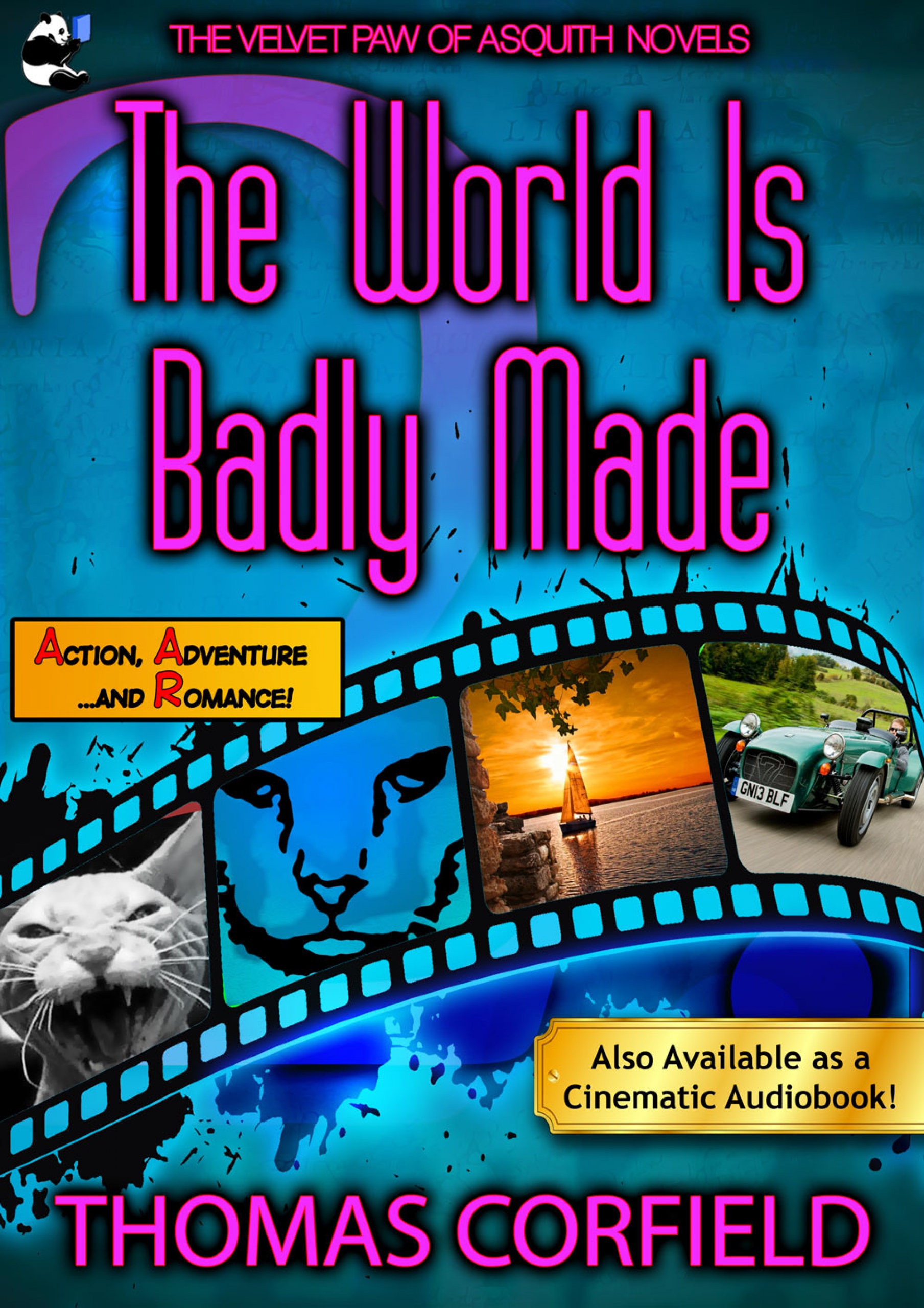
In which bedlam threatens to envelope the world, unless Oscar can do something about it, which he's willing to consider, providing it involves an enormous breakfast first.
Das E-Book können Sie in Legimi-Apps oder einer beliebigen App lesen, die das folgende Format unterstützen:
Seitenzahl: 751
Veröffentlichungsjahr: 2016
Ähnliche














THE VELVET PAW OF ASQUITH NOVELS
THE WORLD IS BADLY MADE
THOMAS CORFIELD
Panda Books Australia
“When all else fails, these books are bound to be the culprits.”
—Tyrone Yedanik, Engraver, UCL Hospital, London.
“The Dooven Books make the world seem brighter.
But only because I set fire to them.”
—Fernando Coghill, Impacted.
“Makes one wish the alphabet had far fewer letters.”
—Alan Allensoni, Suitably Unimpressed.
VELVETPAWOFASQUITH.COM
Licence Notes
____________________
All rights reserved. No part of this publication may be reproduced, distributed, or transmitted in any form or by any means, including photocopying, recording, or other electronic or mechanical methods, without the prior written permission of the publisher, except in the case of brief quotations embodied in critical reviews and certain other non-commercial uses permitted by copyright law.
Written in Australian English.
Thank you for purchasing this ebook. If you didn’t, and it’s pirated, then a pox upon you. I don’t do this for fun, you know. This is work. And it’s quite hard too. Especially some of the spelling. This book must not be reproduced, copied or distributed, nor can it be printed out to write shopping lists on. If you enjoyed this book, please return to ThomasCorfield.com to discover further books. If you didn’t enjoy it, then I suggest you re-read it paying closer attention.
Consider visiting velvetpawofasquith.com for music, dancing and much merriment.
Copyright Thomas Corfield.
Contents
____________________
Title Page
Licence
Excerpt
Important Note
The Morigan Trilogy
Cinematic Audiobooks
Opening Chapter
From the Next Book
About the Publisher
About the Author
Other Titles
Don’t miss out!
Excerpt
____________________
OSCAR slid to a stop by the hearse and hesitated, its state of disrepair making it hard to tell which end was which. Having pulled off a door, he pushed Meesha into the driver’s seat. “Get this thing started!” he said, before hurrying around to the other side.
The animals beside it stopped staring after the red car and stared at him instead.
“Sorry about this,” he said to them, poised to pull off another door, before realising it was already on the ground. “But we have to borrow your car. My friend’s been stolen, you see, and because I don’t have many, I’m rather keen to get him back!”
He tumbled inside and urged Meesha to hurry, but she cursed when the engine made an obscene gesture via its radiator.
“Let’s go!” he cried. “What are you waiting for?”
“It’s making stupid noises!” she swore. “Why is it making stupid noises?”
“You’ll be making stupid noises in a minute!” he said, craning to see the absconding car. “Let’s get after them!”
They were interrupted by the dog, who leant in through the window, and said, “Er, you don’t need to start it, the engine’s already running. We tend leave it that way in case it doesn’t start again.”
“Oh?” said Oscar. “Thank you. And I’m sorry about this. We’ll bring it back. Well, most of it. Probably.”
“If you could bring the corpse back, we’d be grateful.”
“Corpse?”
“The one that just went past.”
“Oh. That’s yours, is it?”
“It was until it began hitch-hiking.”
“I see.”
Meesha fought with gears, which ground like a mortar and pestle that hated each other.
“They won’t work either,” the dog said. “It’s only got one gear.”
“The corpse?” said Oscar.
“No, the hearse.”
“That’s just as well,” said Meesha, finding it, “considering the carnage we’ve managed with three.”
From Chapter 21
Important Note
____________________
The Velvet Paw of Asquith Novels are international jet-setting adventures with large casts of characters. As examples of New Fable genre fiction, they do not have individual protagonists and antagonists, but instead have character couples known as protagona and antagona.
These character couples afford greater immersion into the books’ expansive cinematic atmosphere through carefully constructed shifts in character point-of-view. It is hoped that this cultivates greater vibrancy and depth to the books’ cinematic ludicrousness.
Get ready for the Morigan Trilogy!
____________________
More cats and dogs and high adventure and romance and espionage and food fights and hotels and explosions and car chases!
Darker, fluffier, and much more dangerous.
Cinematic Audiobooks
____________________
The Velvet Paw of Asquith Novels are available as award-winning audiobooks, with lush orchestrations and immersive cinematics. Find them at all good online retailers, and some less reputable ones.
Dedication
____________________
For
Oliver and Jeremy, Tabitha and Natalie
1
_________________
Lest marble spill from dark pit to bright height,
Rupturing stone as bone and earth as marrow,
And its magma its deepest heat of blood,
All churn in oldest years.
– The Tome of Cadre.
THEY looked bored.
They looked angry.
And what’s more, they were looking at him.
Even the stewardess glowered, which was not, Oscar Teabag-Dooven imagined, something stewardesses were encouraged to do. He tried a smile. It was not returned. In fact, the passengers’ scowls deepened.
When the stewardess arrived, her paws gripped a drinks trolley in a manner suggesting she either hated flying, hated Oscar, or both.
“Would you like a nice mug of hot-fin, sir?” she growled from behind teeth refusing to separate.
“No, thank you,” said Oscar, tugging at his collar, “as I had one on your previous flight, and it was so lumpy that I’m still trying to swallow it.”
“Are you quite sure?”
“Oh, yes. It was dreadful.”
“No, I mean about you having a nice mug of hot-fin?”
Oscar leant forward. “I think we’re both aware that would not be a good idea.”
She leaned in also. “Having you aboard is not a good idea.”
“Oh, I agree. So could you ask the pilot to hurry up? It’s getting decidedly cramped back here.”
“Oh, dear. You’re feeling a little uncomfortable, are you?”
“Only because you and your drinks trolley seem intent on sharing my seat.”
“I wouldn’t share anything with you!”
“Except for a nice mug of hot-fin, it seems.”
The stewardess seethed and tightened her grip on the trolley. “You will have your mug of hot-fin,” she hissed. “And you will have it now.”
“Really? Well, that sounds remarkably like sharing to me.”
With a growl, she slammed the trolley into his paw. While he nursed it with expletives, passengers deepened their glowers upon him.
“You will have this mug of hot-fin, cat,” she said, “or I will make you ingest it involuntarily.”
Clutching his paw, he said, “Considering its lumps, I doubt it could be consumed any other way.”
She poured some lumps into a mug and shoved the thing at him. “Drink it, before I physically damage you.”
“I would have thought that sort of thing would be discouraged at altitude,” he said, taking the mug reluctantly.
“Not if it’s you, cat.”
With the same contempt as her arrival, the stewardess left, storming down the aisle as though keen to flatten things at the end of it. Oscar stared at passengers until they grumbled and looked away. Uncertain what to do with the mug, he swilled its lumps. Drinking it was out of the question. Even the verb was inappropriate. Chewing might be more apt. Regardless, he didn’t have any cutlery. In the end, he poured the stuff into the pocket behind the seat in front.
There was an in-flight magazine on his lap, the same one browsed during his previous two flights, which was even less appealing than he’d found it the first time, and which he used to dry the mug.
The animal sitting beside him was not impressed by any of this, and glowered. With whiskers raised, Oscar offered him the magazine, complete with smeared lumps, until the dog tutted and looked away. The animal’s disdain was understandable. The passengers had, after all, been manacled together on three flights already today, so their initial enthusiasm had long since withered. It was just unfortunate their withering had spread to the entire flight crew.
Through a little window, Oscar peered to determine how high they were. But it was night, so he couldn’t. This was fortunate considering Oscar hated heights only marginally more than he hated flying. Settling into his seat, he fluffed his pantaloons and tucked his tail in beside him, a bit like a seatbelt, before purring loudly to counter further scowls thrown his way.
There was, however, one animal aboard whose enthusiasm remained.
The pilot.
It was fortunate that the animal in charge harboured none of the indignation seething throughout the rest of the aeroplane. Ironically, his joviality remained because he was looking forward to dying horribly; an enthusiasm he tried sharing with the flight engineer and navigator.
In the dim light of cockpit, the navigator doodled on a clipboard, while the flight engineer, his chin propped up on one paw, played absentmindedly with an on-off button. The pilot’s paws, however, were doing nothing of the sort, and played upon the instrument panel as though it were a piano demanding huge technical flourishes.
Until he caught a claw upon it.
Nursing his paw, he turned to enquire of his counterparts, “What time is it?”
While the navigator continued doodling, the engineer sighed heavily, reflecting how enthralling he’d found his button pressing.
“Late,” he said.
The button remained on, glowing red. He pressed it off again.
“And where exactly are we?” the pilot asked, with an eagerness a teacher might offer bored students.
“I neither know nor care,” the engineer said, pressing his button again. “But we should have been home hours ago.”
Smiling, the pilot turned back to his controls. “Patience, my dear flight-thingy. For patience is a virtue we’re trained to embrace.”
“Rubbish. Patience is no more than excuse for idleness.”
The pilot shrugged. “As you wish.”
And with that, he began dying.
He clutched his chest, drew a sharp breath before releasing blunt one and lunged at the engineer. Receiving no more than indifference, he convulsed in gurgle over the navigator’s clipboard. Still ignored, he collapsed upon the floor in a spasm of chokes and burps.
His doodle irretrievably smudged, the navigator pushed his clipboard away in irritation and glanced at the still twitching pilot. “If he’d taken much longer, I would have fluffing-well killed him myself.”
The engineer, having returned to his on-offing, humphed in agreement.
There was a knock at the cockpit door, before the stewardess entered. “Excuse me, I—”
She stopped when noticing the dead pilot, whom she nudged with a paw.
The animal spasmed again and sat up with a groan. Getting to his paws, he lurched around the confines of cabin a second time, flailing and moaning as though clinically allergic to it. While all three stared, he burped and dribbled, before draping himself in a final stupor across the controls, from which he slid like syrup to the floor.
The stewardess looked at the remaining crew, and then at the animal crumpled between them. “Is that it then?”
After more nudging, followed by a solid kick, the engineer nodded that it was.
“Right,” she said, her role of stewardess now one of commandant. “You two take over here, and I’ll start things moving with that lot.” She indicated the passengers with a stab of paw.
When they nodded, she left the cockpit and marched through a kitchenette, before bursting from a curtain, where she stood in the passenger aisle with paws on hips. A large swathe of passengers blinked at her, as did two cabin staff beside a drinks trolley.
“Can either of you fly a passenger airliner?” she asked them.
Both shook their heads. “Is there a problem?” one enquired, holding a drill in one paw while the other steadied a saucepan of lumpy hot-fin.
“No, there’s no problem,” she said, before asking the same of the passengers. “Are there any animals on this aeroplane who can, in fact, fly a fully-laden passenger airliner?”
A murmur arose suggesting there wasn’t.
“All right, land one, then?”
“Are you quite certain there’s nothing to worry about?” a middle-aged dog asked, rising from a seat.
“Everything is fine,” she said. “And there’s nothing to worry about whatsoever. But having said that, it would, nevertheless, be most fortuitous if there was an animal present with prior experience in flying fully-laden passenger airliners at night.”
There was a veritable swathe of blinks.
“And landing them.”
The blinks were unabated.
“Even if the landing wasn’t particularly successful.”
More blinks followed by worried glances among many.
“Anyone?” she asked. “Come on! There must be one of you! What about someone who’s flown a kite with a hamster attached?”
Blinks and worried glances collapsed into a vigorous hubbub of cries, until all eyes turned to Oscar Teabag-Dooven.
Being asleep, Oscar was oblivious to their concerns until the stewardess threw a passenger’s shoe at him. Startled, he awoke and blinked at it, before looking up at the luggage rack to see if a second one might follow. His curiosity waned when noticing the aeroplane’s contents staring at him again.
Other than whirring engines, there was silence.
“Yes?” he asked generically. “Can I help you?”
The stewardess marched toward him as she had earlier, and several passengers relinquished their stares to watch her instead. Her stride was concise and determined, and left Oscar with a horrid feeling she was about to do something he wouldn’t like at all.
Upon arrival, she bent close. “Can you land a passenger airliner?” she growled, suggesting only one answer would suffice.
Passengers looked from her to him, their prior contempt having become a desperate hope, though one animal raised a paw and asked whether he could have his shoe back.
Oscar swallowed. “Oughtn’t that be the job of the pilot?”
“Yes,” she said, wringing patience from seethe. “That is certainly the traditional arrangement. However, at this moment, we are in a situation requiring innovation in the pilot department.”
“I thought you said there was nothing to worry about,” an animal said.
“Silence!”
It arrived and fell heavily.
She bent closer. Her eyes were big and brown, and Oscar could see his reflection in her pupils. He looked small, round and fluffy, and not capable of landing anything—unless it was already on the ground and parked.
“Can you,” she asked again, her pretty face so close it could have been his, “land a fully-laden passenger airliner?”
He swallowed again, which made a squelchy sound he hoped might be considered a thinking sort of swallow; one that portrayed merit rather than fear. “I’ve never actually flown an aeroplane before,” he said. “I mean I have tried. But I wasn’t overly successful.”
To this, she stood aside for him to have another go. When he didn’t move, she picked up the shoe and warned she’d happily shove it where his fifth paw resided.
Reluctantly, he stood and followed her down the aisle. “I got the thing on the ground, of course,” he said. “I mean, it’s easy to get the thing on the ground. It’s more the rate at which one does that complicates matters.”
She ignored this and disappeared through the curtain. He turned to an audience no longer angry, but despairing.
He sighed. “I’ll do my best,” he said, before yelping when she grabbed his ear and pulled.
In the cockpit, Oscar failed to see what all the fuss was about. Things appeared normal—if one discounted the unconscious animal on the floor. There was a dog scribbling on a clipboard, while another battled wits with a button, and the aeroplane appeared to be pointing forwards and not downwards.
With paws folded, the stewardess regarded him with even more contempt than she had earlier. He looked around blankly. There were a myriad of levers and buttons. Some were flashing, some were not. Those doing so looked as though they ought to, while those that didn’t seemed as though they shouldn’t.
“What happened to him?” he asked, bending to the pilot.
“He died,” the navigator said.
“Well, yes, I can see that. But how?”
“Far too slowly.”
Oscar stood, not certain what he could offer any of them. “Well, I think first, we should remove the body.”
The engineer looked at the stewardess with despair. “Remove it?” he cried. “Where in fluff do you suggest we put him? Under a drinks trolley?”
“No. That’s silly.”
“Silly?”
“Yes. It could kill him.”
“What?”
“Because of turbulence,” Oscar said. “If there’s turbulence with those sized lumps swilling above him, any spillage could put him in hospital.”
“He’s dead, Dooven!”
“Yes, but we don’t want to make his situation any worse than it is.”
The navigator despaired at the stewardess again, before growling, “Don’t you think it might be advisable to report our predicament?”
“Oh, I don’t think there’s any need to unduly worry the passengers,” said Oscar. “I mean , no more than the stewardess has already.”
She snarled at him.
Ignoring her, he peered at the pilot. “No, I think it’s best if they are left in the dark at this stage—which will also make it harder for them to see any rapidly approaching ground.”
The navigator took a tired breath, and said, “Not the passengers, Dooven. Report our predicament to the nearest airport.” He poked Oscar’s fluffiness. “Because you are going to get us there in one piece!”
Oscar scoffed. “Oh, I don’t think that’s very likely at all! And anyway, you’re the navigator, so you’d be more capable of getting this thing on the ground than me. I mean, I’d probably only manage doing so vertically. Look, you have a clipboard. I don’t have a clipboard.”
The stewardess inserted herself between them in a manner Oscar didn’t like at all. Her stance required more room than the cockpit’s confines permitted, forcing the engineer and navigator to squeeze against panelling.
Her beautiful eyes flashed. “Do not,” she hissed, “play the imbecile with me, Dooven. You will firstly contact the airport, and then land this thing so that we can all fluffing-well,” She took a deep breath for the finale, “GO HOME!”
Although she was no bigger than he, at that moment she seemed much taller. Muttering, he squeezed past her and sat in the pilot’s seat. After putting on some headphones, he tapped a microphone. “Hello,” he said into it. “I’m in an aeroplane with no pilot. Can we land please? Oh, and we don’t want to crash.”
There was a crackle and a hiss, which he suspected was the stewardess.
“What is your position, please, flight?”
Oscar shrugged and looked around at the others. “Up,” he said, to unamused rolls of eyes. “Well, for the moment, at least. It’s quite dark though, so it’s hard to be sure. But I think the assumption’s fair.” He peered out a window. “I can’t see any cloud if that helps. There’s no moon either. But the stars are quite beautiful.”
“What is your call-sign, please, flight?”
One of the lights that looked safer not blinking, began blinking above a label that read ‘catastrophic left engine failure’. It was accompanied by an annoying buzzing that could only help if the flight crew were blind, which, despite being an unlikely situation, would probably fare better than this one.
Oscar turned to the stewardess when the aeroplane lurched horribly. “I would like you to know,” he said, “that I attribute a great deal of this predicament to you.”
Muffled screams of passengers added to the ambience of impending bedlam, and all four grabbed bits of cockpit to prevent themselves throwing up in it.
While bracing against panelling, the stewardess cried, “Are you suggesting this is my fault? What in fluff has this got to do with me?”
The clipboard flew across the cabin when the navigator was thrown from his seat.
“You ought to be a little nicer,” Oscar growled, dodging it, “a bit more polite and not so aggressive all the time. Because it really—” He struggled with his own balance, “—because it really gets me down!”
“Gets you down? That’s rich! You couldn’t get down a flight of stairs if you were at the bottom of one, Dooven!”
While console lights lit to indicate the sequential failure of important bits of aeroplane, Oscar swore and wrestled with the control stick in an attempt at prying the aeroplane upright. “And stop calling me Dooven!”
“Why? Is that not your name? Perhaps we should call you fluffball?”
“My name,” Oscar growled through clenched teeth, “is Oscar Teabag-Dooven, which isn’t pronounced like something best avoided on a pavement!”
One of the windows began shaking and some panelling joined in. When the latter gave way, wires sparked. Something went bang and smoke followed.
“Put that out!” she snarled.
The engineer and navigator rummaged through a cupboard before waving the contents of a small extinguisher at it. The resulting steam was worse than the smoke, and left all of them coughing and waving paws to no avail.
“Well, Dooven,” she sneered through it, “I suggest that if you don’t wish to be associated with something nasty on a pavement—”
She was forced to yell when the window popped open and blasted the cabin in screaming, bitterly cold wind.
“—THEN YOU OUGHT TO ACT A LITTLE LESS LIKE ONE!”
The engineer leapt at it and hammered the thing with the extinguisher until it wedged shut, while the navigator stumbled forward to help Oscar in his battle to level the aeroplane.
“Why is it so wobbly?” growled Oscar.
The engineer joined in as more lights flashed. Oscar locked a hind paw against the stick and fought with the radio again.
“This is Oscar Teabag-Dooven!” he yelled into the headset. “I need some help trying to land an aeroplane! Can you hear me?”
“What is your call-sign, please flight?”
“I don’t know! But it’s likely to be four letters shortly!”
“What is your position, please, flight?”
“Probably upside down! It’s hard to tell; the controls have lit up like an epileptic fireflies’ convention! We’re completely blind, and there’s a lot of smoke and buzzing—and that’s just from the stewardess.” He clutched the headset when the aeroplane shook violently. “Also, we’re rather wobbly!”
“What is your heading—can you tell me your heading at least?”
“What do you think? It’s downwards! It’s downwards and wobbly!”
“We have you on radar, flight.”
There was a pause—and not a good one.
“For goodness sake, you’re losing height rapidly! Get some altitude! Get some fluffing altitude!”
“Oh, brilliant!” Oscar yelled. “That’s very helpful, I must say. And where do you suggest I look? Should I perhaps ask around?” He turned to the stewardess. “Perhaps you could ask the passengers if they’ve got some spare altitude on them? If not, check under the drinks trolley—and if that fails, you can chuck your disgusting hot-fin overboard to lighten this thing!”
She glared, despite the cabin filling with screaming night.
The window popped again, and freezing wind barrelled through the cockpit as the aeroplane began shaking to pieces. Oscar grabbed the stick with all his paws and the engineer moved aside to let the navigator help.
But it was no use, because a wing fell off.
A moment later the aeroplane slammed into a mountainside, burst like a firecracker and turned a jagged peak into an enormous candle that for an hour or more, displaced the cold, dark night.
2
____________________
IN a little apartment, an elderly dog propped his walking stick against a sink and fumbled with a saucepan. He shuffled to a stove, placed the saucepan upon it and began brewing hot-fin. Outside, Asquith was busy beneath a spring morning. Scent of breakfast, damp stone and dispersing dawn rose to his kitchen through a window, along with a view of old buildings across the street. Elder Bradel Friskins-Plume stirred at the saucepan, years of scholastics leaving him content with even this most menial task. When the brew was ready, he poured it into a mug, retrieved his walking stick and shuffled to a table heavy with papers. Although his apartment was small, his reputation was not. Nevertheless, he had no inclination to find an abode more befitting his status. He was not interested in accolade. For Bradel, success was immaterial and did little more than prove to others the strength of one’s own conviction. He needed only the day to peruse his passion and the night to sleep upon it.
He’d become an Elder through his work on the lost language of Bedlam Speak, a language which, despite the efforts of many, still remained un-deciphered. It had disappeared a thousand years ago when an appalling period of hostility, known as the Era of Bedlam, had come to an end.
A very abrupt end.
Overnight, in fact.
From bedlam to amity in the thrash of a tail.
The reason for its disappearance was unknown and had fascinated the world ever since. Many, like Bradel, had dedicated their lives to finding out why, and deciphering Bedlam Speak was a prerequisite to doing so.
This morning, Bradel would make a breakthrough.
By lunchtime, he’d have an alphabet.
And by evening, he’d discover that the world is badly made.
He sat at the table and rested his stick against its wood. Years of having done so had worn its polish, which he buffed with a paw while sipping at his mug. He liked to see things age; the change that time brought. Scruffiness was evidence of use. What is the point, he’d often ask his friend and colleague, Paffin-Blimsy, of a neat and tidy abode if it refutes one’s existence?
Putting down his mug, he lifted a loose board from the tabletop and reached beneath for papers he’d perused the day before, along with a magnifying glass. Many examples of Bedlam Speak had been unearthed across the lands. Tablets and inscriptions were littered across Arabesque, scribed a thousand years ago by those suffering beneath Bedlam. Elders studied them in earnest, hoping they’d discover not only what it was like, but why it ended so abruptly.
To do so, however, required them to be translated first.
Most attempts at doing so focussed on one famous text, the Tome of Cadre, inscribed upon a huge monolith discovered in the bowels of the palace of Par Beguine, the capital of Arabesque. Because it appeared to be written in verse, the Tome gave Elders of Bedlam a starting point structurally, at least. Moreover, its inscriptions were far more legible that other texts, most of which were haphazard scrawl, presumably because they’d been written under Bedlam’s duress. Several experiments had been conducted to test this theory, and had concluded that it is particularly difficult to write legibly while being repeatedly hit in the face with a saucepan.
The Tome’s stanzas were thought to have been written by animals immune to Bedlam’s chaos, a cohort known as the Cadre of Bedlam. Their immunity arose, it was believed, because they were responsible for instigating Bedlam in the first place. Moreover, it was also believed that they still existed, and were secretly biding their time to return Bedlam in order to conquer the lands that would disintegrate beneath it. This Legend of the Cadre fascinated animals young and old, and Elders of Bedlam vied for translation of the Tome to earn a fame on par with it.
Bradel, however, was not interested in the Tome of Cadre.
He preferred looking for clues in inscriptions his colleagues ignored: in lines forgotten. In words illegible. Bradel found satisfaction in the process, rather than result, which cultivated a patience that would afford his breakthrough.
In some ways, he’d be content never to find answers at all.
After another sip of hot-fin, he trawled through text others considered banal. With the magnifying glass in one paw, he traced meaningless scribbles with the other, stopping occasionally so he could sip from his mug. It was presumed Bedlam Speak’s scribbles and scrawls could not resemble modern words because Bedlam and its language disappeared so abruptly. Bradel thought otherwise; that similarities would exist precisely because of such rapid transition. Violence might disappear overnight, but not the relieved expletives arising in its wake. They’d be needed the next morning, for example, so survivors could ask each other what in fluff had happened, and to get their saucepans back.
The largest of these ignored inscriptions was called the Carousel Pledge, which consisted of an immeasurable amount of script arranged in peculiar wheel-like arcs. Its discovery had been overshadowed by the unearthing of the Tome shortly afterwards. For Bradel, the Pledge’s scrawls provided a fascinating quagmire to wade through, and the derision of his colleagues in doing so only encouraged him.
Hunched over inscriptions, he studied forgotten lines.
Lost words.
Hapless scrawl.
After some time, he stopped, feeling to have brushed against a coin in the dark.
Peering through his magnifying glass, he tapped a word with a claw. On its own, the word meant little. He’d come across it many times. Rather, it was another associated with it that was suggestive; a word that could be extrapolated to mean water. Were it so, then the one prior might be the verb to drink, which suggested that the one following could be the verb to eat.
Astonished, he put down the magnifying glass and reached for his mug. He glanced at the window as birds darted across the view.
Water. Drink. Eat.
After a lifetime of knowing not a word of Bedlam Speak, it seemed he suddenly knew three. If he was on the brink of translation, however, he had no desire to clamour for it. Instead, he felt a need for reverence. Taking his walking stick, he leveraged himself upon it and took his mug back to the sink. He washed it carefully and dried it, before hobbling to his window to ponder the sounds of Asquith awakening. A rattle of truck. A clank of garbage bins hit by it. Some shouts, and a diesel idling that flared away up the street. The sounds wouldn’t be much different from those a thousand years ago—except for the truck, perhaps. And the clattering bins. And the language, for that matter. But the argument would be familiar. Bedlam had been an era of such violence, that there was speculation the majority of Bedlam Speak was profanity. After all, convivial discourse regarding the weather is difficult while belting each other with saucepans. Indeed, there were those who suspected that the Carousel Pledge was the most extensive insult ever created.
Bradel smiled.
Water. Drink. Eat.
It seemed not to be the case, after all.
He hobbled back to the table and rested the stick against it. He sat and rubbed its worn polish again. It seemed appropriate that after a thousand years, Bedlam’s secrets might be revealed from words so humble. Retrieving a scrap of blank paper, he began jotting down his assumption. He swapped letters and tried juxtaposition until confirmation was irrefutable. With a sigh of astonishment, he put the pen and magnifying glass down, picked up the piece of paper and stared at it, realising he was the first animal in a thousand years to comprehend a line of Bedlam Speak.
The sentence was mundane, but its discovery would permit an extrapolation of alphabet.
It was fitting that the sentence be so unassuming; Take water and drink, take fish and eat.
It was almost a recipe.
The first comprehension of Bedlam Speak in a thousand years, was a Bedlam recipe.
And it had nothing to do with throwing saucepans at all.
3
____________________
MOST of the aeroplane’s passengers were relieved it had crashed and burnt. It meant that after twelve hours of getting nowhere, they could finally go home. They trudged across a smoking and ruined stage toward dressing rooms. When they passed Oscar, they glared and muttered the sort of obscenities understandable after being repeatedly incinerated. Oscar ignored their sneers. They were supposed to be actors, but it seemed an indulgent title if their attitude when not acting was exactly the same as when they were. Although he’d destroyed three fully-laden passenger airliners, he hoped some merit might be found in his consistency. He stood awkwardly, keen to go home also, but remained behind on his instructor’s orders.
When a passenger snarled, he turned to watch animals mopping down the stage instead. In the rigging above it, one cried out a warning as the enormous tube of cabin was righted from its vertical stance to a more horizontal one. Those sweeping up charcoal and scrubbing down smouldering plastic eyed Oscar with the same animosity as the cast, and one even threw a hammer. With a sigh, he turned away from them also. On the stage’s far side, the stewardess was giving her account of his performance to their instructor. When she covered her face with paws and began shaking with sobs, the navigator, who waited with them, gave her a commiserative hug and offered a tissue.
Their instructor was a tall sinewy cat named Masterful Posh, who glared at Oscar with the sort of fury that was on par with being pummelled into the theatre’s orchestra pit and being crushed by a dropped cello. When the glare became a threesome, Oscar looked at the ceiling and wondered how he might apply to become one.
He was startled by a paw upon his shoulder.
“Brilliant!” the pilot said, hoisting a bag upon his own. “This has been a splendid day! I’m extremely grateful, sir! Death scenes afford the most wonderful opportunities for wanton overacting. And you provided opportunity for three! I must say I’ve enjoyed myself immensely!”
“Well, I’m glad someone has,” Oscar said, ignoring more passing leers.
“Oh, don’t worry about them,” the dog said. “Some animals have no appreciation for artistic licence!”
“Yes, but the problem is that I wasn’t issued one.”
“Artistic licences aren’t issued!” the dog said. “They’re earnt! And I, for one, think you did marvellously!”
A passenger spat when passing.
“Even if others don’t,” he added.
“Yes,” said Oscar, wiping his face, “but it wasn’t really supposed to be that sort of performance, was it?”
“Life isn’t meant to be that sort of performance!”
“Well, I don’t think I have a licence for that, either.”
“Look, it’s all about the drama. As an actor you should know that well enough!”
“But I’m not an actor.”
The pilot stared. “You’re not?”
“No.”
“What about all that then?” he said, pointing at the tangled mess of burnt rigging, part of which had spontaneously burst back into flame.
“That wasn’t intentional. That was me being tested.”
“Tested?”
“Yes. It’s a Catacombs thing.”
The pilot’s smile waned. “You mean you’re training to be a Velvet Paw?”
“Yes,” said Oscar. “Look, could I possibly have your praise in writing? It’s just that it might go some way to counter my massive failure.”
The dog stared.
“I could write it out,” Oscar said, “I remember most of it. Particularly the bit about licences. I could write it and you’d just have to sign it. I’m sure there’s some paper around here that isn’t on fire.”
Still the dog stared.
“You weren’t aware it was for the Catacombs?”
“No. They don’t tell us to ensure our acting remains unbiased,” the dog said, his stare unabated. “I must confess that I’ve never been involved in Catacombs training that’s ended quite so dreadfully. I thought it was for an insurance commercial.”
“Yes. It must be quite a shock.”
“I mean, three times?”
Oscar shrugged.
“Perhaps they’ll give you marks for consistency.”
“That’s more or less what I’m counting on. That, and a signed affidavit from animals such as yourself.”
The pilot was about to say something more, before realising any further association would impact detrimentally on his career. He left, muttering something about insurance premiums and his agent.
Oscar glanced at cleaners who worked their mops and buckets across the singed stage of Asquith’s most esteemed theatre. Having cleaned the place twice already, they were exhausted and stabbed at their buckets as though wishing Oscar was in them. No Velvet Paw of Asquith had slaughtered an entire cast before, let alone three times in a row, and they wanted him to know it.
With another sigh, he stared at the ceiling again. He liked ceilings because they weren’t accountable for the theatrics playing out beneath them, and wondered again what was involved in becoming one. If he failed as a Velvet Paw, he might have to. Ceilings were something to aspire to. They afforded a sort of anonymity in populous: a means of being involved without having to be, which was his preferred method of socialising. There was nothing more agreeable than feeling to be part of the world without actually having to be.
Masterful Posh stormed across the stage toward him, his stride broad and disciplined. Oscar smoothed his pantaloons. He would have fluffed them, but they were so singed and tattered that they were in no state to do anything other than fall to pieces.
He felt the same.
Masterful Posh’s growl could be heard before his arrival.
Oscar did not get along with him. He found Posh’s training left so much to be desired that it bordered on larceny. It could be improved with far less shouting, for a start, and more watercolour painting classes. But whenever he’d suggested this, he was screamed at. Where Posh demanded obedience, discipline and subservience, Oscar considered poetry, butterflies and small choral groups more constructive. Today’s failure, however, provided so much evidence to the contrary, that Oscar’s argument was not only humiliated, but left cowering in a puddle of its own making.
Masterful Posh arrived and stood before him with paws folded, chest out and tail thrashing. Although it was a stance meant to intimidate, Oscar always thought he appeared to be straining over a nasty bout of constipation. Posh said nothing, but glared with a mixture of disbelief and disgust—as he might after passing said constipation.
The cat narrowed his eyes. “Why are you even here, Dooven?” he hissed.
“You told me not to move if I knew what was good for me.”
“Oh, is that right?”
“Yes. I’m surprised you don’t remember. It wasn’t long ago.”
“And tell me, Dooven: what is good for you?”
“Well, ironically, going home.”
Posh’s eyes narrowed further. “I could think of something far better for all of us—”
“Does it involve orchestra pits and cellos?”
“What?”
“Or anything to do with stringed instruments?”
“Stringed what?”
“Instruments. I had a nasty thought earlier about being pummelled by some in the theatre’s orchestra pit.”
Posh blinked. “Are you daring—after everything that’s happened—to show insolence?”
“Not at all,” Oscar said. “If anything, I’m trying to find reprieve.”
“Reprieve? You think you can find reprieve after today?”
“Well, not particularly. It’s why I mentioned the pummelling thing.”
Posh prodded him. “You are a hopeless waste of space, Dooven. You have wasted my time, the Catacomb’s time and the time of one hundred and eighty-three charred corpses three times over!”
Oscar sighed at hearing his name again associated with something best avoided on a pavement.
“I cannot fathom how you even got this far!” Posh growled. “In fact, I do not understand why you are bothering to turn up at all.”
Oscar said nothing, being a question he often asked himself.
“Do you think this is a game or something?” Posh snarled. “Do you think these animals are present merely for your entertainment? Or that perhaps the Catacombs of Asquith exists solely to provide opportunity for you to play?”
Oscar offered some more blinks, but nothing else.
“Well?”
“I didn’t think rhetorical questions required answers,” Oscar said. “And if yours do, then I have none for you because I don’t know myself.”
His eyes narrowed again when hunting the reply for sarcasm. “I don’t understand you, Dooven,” he sneered. “I don’t understand whether you are intentionally not trying, or whether you are just stupendously useless. I have never—in all my years training Velvet Paws—known an animal as worthless as you. As incompetent as you. As pointless as you. I have never known an animal so incapable of grappling the basics of becoming a Velvet Paw of Asquith!”
The torrent of admonishment did not surprise Oscar. He’d heard it all before. Why he remained in the Catacombs was beyond him as much as it was beyond Masterful Posh. He muddled through training with indignation rather than enthusiasm, and indifference instead of focus. He’d failed everything and learnt nothing, other than some vague things about Extensible Sleeping Skills, Interpretive Paw-Painting and Theatrical Role-Playing—although even the latter was questionable after today. Yet despite all this, he remained.
He wasn’t intentionally disruptive, but was instead too sensitive. He liked the notion of being a Velvet Paw. There’d be opportunity to travel, for example, and he’d probably be given monogrammed suitcases. But he didn’t like what was involved in becoming one. There was too much shouting and it was too competitive—even the shouting. There was too much running and not enough sleeping. Too much punching and not enough painting. Too much arguing and not enough singing. And for some bizarre reason, lots of boiled eggs and clotheslines. On numerous occasions he’d suggested there ought to be less fighting and more poetry. He’d even suggested weekly choir practice. Ideally with a choir. These suggestions had been met with such a tide of ridicule that he’d drowned in it. Consequently, he’d been ostracised by teacher and student.
A shallow, conceited and heartless animal, Masterful Posh excelled in administering the harsh, military-esque training required by the Catacombs. Such traits rendered him unable to view the world from any perspective other than his remarkably narrow one. His role as High Instructor was to cultivate obedience, instinct and ruthlessness, which left him with no capacity for artistic sensitivity, let alone to understand it.
Oscar waited beneath another torrent of abuse best described as generous, and wondered what it might be like for the animal to live a life so blinkered that the world becomes dulled to little more than black and white.
When the torrent of abuse ceased, Oscar held out a paw to be certain. He hadn’t paid any attention to its content, assuming it to be along the lines of previous downpours.
He’d failed spectacularly.
Everyone knew it.
There was nothing more to be said.
As a consequence, he’d surely be expelled.
He was never going to be obedient or ruthless, regardless of how much he was shouted at. In as much, he was never going to be a Velvet Paw.
He was a poet, and poets hardly ever shouted.
Although they often sang in choirs.
“It’s not that I wish to irritate you intentionally, Masterful Posh,” Oscar said, “it’s just that I don’t agree with you. Velvet Paws are talented animals, which is why I know that I’ll never become one. I suspect any talents I have lie in another direction entirely.”
Posh exploded with laughter. “You have little talent for anything, Dooven! You have nothing to offer any animal, other than a pretence for—” His expression soured with words tasting bitter, “being all considerate and courteous!”
Oscar shrugged. “Well, actually, I suspect if there was more of both in the world there’d be less need for Velvet Paws.”
“Don’t you dare offer opinions on things you have no idea about! Your perception of the world is nothing more than naive fairy tale!”
“But surely fairy tales teach considerable—”
“Do you want my paw across your face?”
Oscar swallowed and shook his head.
“Then do not blaspheme with your ignorance!”
“I’m just saying that curiosa could be approached more sensitively, ideally with less shouting and punching—”
“The only animal who’ll get punched around here, cat, is you! Do not rile me, for you know your bones would not stand my strike!”
Despite the threat, Oscar found indignation. “You see, I think this is where the problem lies; there’s just too much aggression here. Surely there ought to be more kindness shown and then perhaps other animals would—”
“Oh yes, that’s right! More courtesy and poetry and niceness! I’ve heard it all before and still hate it now! Your naivety makes my whiskers shrivel! Let me tell you something: your stupidity would have the world eat you alive before you were even aware of being on its menu! So keep that ridiculous gospel to yourself and don’t force those with talent to tow your deadened, useless weight.” He leant close. “Because you, Dooven, are nothing. You have nothing and you will never amount to nothing!”
“You mean anything.”
“What?”
“I will never amount to anything,” Oscar said. “I can’t not amount to nothing, unless you’re implying I will amount to something, which negates your preceding sentences and leaves the entire paragraph nonsensical.”
“What are you babbling about?”
“Well, that’s my point, it’s not me who’s—”
Masterful Posh bent so close that Oscar could smell his singed fur. “Fancy words mean little when you’re broken with pain, and I would readily break you here and now!”
Oscar swallowed.
“Just remember, Dooven: you are nothing. And I shall ensure it stays that way!”
He turned and stormed back across the stage, his tail thrashing like a propeller.
The cat’s threats left Oscar with a tummy wishing to be elsewhere. The stewardess still glowered, a look that worsened when Posh gave her a disgusted appraisal of his own. After another communal glare, they left.
Alone, Oscar’s resolve faltered. Posh was right: he had no talent. He was useless. Spontaneous composition of imagist verse would not right the ills of the world, and as far as landing fully-laden passenger airliners were concerned, a predisposition for rhyming and being polite hardly mattered.
The theatre’s lights went out, a door slammed somewhere and Oscar sank to the floor.
He wouldn’t become a Velvet Paw, and any predisposition to compose the odd stanza of verse amounted to an insignificant pile of nothing.
No animal would care for his imagist poetry.
Not least because he didn’t write it down.
Even if he did, verse would never help turn the world.
He hung his head. As much as Posh’s words hurt, he could only agree.
4
____________________
“DO you perhaps own this pavement?” a dog asked, irritated when Bradel pushed past.
Bradel ignored him, too worried to care.
“If you’re in such a hurry,” the dog called after him, “then why don’t you try catching a bus? Ideally without waiting for it to stop first!”
Bustle was unfamiliar to Bradel, his work habits had secluded him from the closing routine of day. With a cane in one paw and briefcase in the other, he hurried through the city, pushing past animals who knew it far better.
Beneath evening, Asquith was painted purple-bronze, and bustled with animals eager to return home after a day elsewhere. Intersections clamoured with pedestrians and cars, as did pavements, cars included. Trams dinged their way between both, fighting buses determined to do the same. Ornate lamp-posts burnt with bulb, though were dulled beneath the red of the world’s growing shadow. Peering up at one, he made certain of the street name. Despite the bustle, he felt alone. He clutched his briefcase and pushed past pedestrians, bumping a dog who lunged for a bus which had halted to battle wits with a tram.
After a day of frantic deciphering, he’d made a telephone call to his colleague, Elder Paffin-Blimsy, who’d agreed to meet him in a favourite café. Until this evening, Bradel had never hurried anywhere, his routine dictated by two hours only; those of night and those of day. Now, however, it had been turned upside-down and shaken, and resulted in the sort of mess that’s exhausting just to look at. It wasn’t the discovery that had him hurrying, but what it had revealed.
Brakes squeaked when a bus pulled up beside him. Several animals alighted, before others piled on.
The driver leant from his seat. “Are you wanting to get on, sir?” he asked.
Bradel stared up at him.
“Are you wanting to get on this bus?”
“I don’t know,” Bradel said. “Where are you going?”
“With this traffic, probably nowhere. Where are you going?”
“A café. I’m meeting a colleague.”
“What’s its name?”
“Paffin.”
He frowned. “I don’t know that one”
“No. Paffin is the name of my colleague.”
“Oh, I see. Which café are you wanting?”
“My favourite one.”
“Yes, but what’s it called?”
Bradel thought. “I’m not certain. I don’t think I’ve ever taken notice, which is odd considering I’ve been going there for over twenty years.”
“You’ve been going to a café for over twenty years and you don’t know what it’s called?”
“That’s right. They do marvellous hot-fin, which is the only detail I’ve been concerned with.”
Passengers were growing indignant, but the driver ignored them. “Look,” he said. “Tell me where it is, and I’ll see if I’m going that way.”
“Here,” Bradel said. “In Asquith.”
“Yes, but where specifically?”
“Somewhere over there,” Bradel said, pointing with his cane across the clogged street.
The driver looked at the throng of traffic. “Well, in that case, there’s not much I can do for you, I’m afraid. I intend to go straight ahead. Once this traffic lets me.”
A passenger shouted that he could walk faster at this rate, which had the driver turn and suggest he do so.
“It’s quite all right,” Bradel said. “I don’t think it’s going to be a problem much longer.”
“What, the traffic?”
“No, everything.”
“Why’s that then?”
“Because I’ve just discovered that the world is going to end.”
After a concerned stare, the driver closed the door and waited for traffic to move.
Bradel peered up at the lamp post again.
His briefcase felt heavy, the translation a weighty burden. Having discovered the prize, he now wished to know nothing of it.
It was the darkest of enlightenments.
He hobbled through the street’s maze of traffic to the opposite pavement, before hurrying down a narrower one flanked by terraced buildings. He shuffled past shop fronts gilded with gold lettering upon black sill, their glass frosted with age, and glanced into cafés he’d never had inclination to visit.
At a door he knew well, he pushed and entered familiar scented air. Although it was his favourite café, he hadn’t previously visited at such an hour, and was indignant to finding it crowded with animals deciding it was their favourite also. He peered past patrons, looking for his colleague or a table, were one spare, but saw neither. When Paffin waved from a far corner, Bradel returned it with a lift of cane, which bumped a nearby table and spilt some drinks.
Paffin stood and Bradel weaved through a throng of crowded tables. When he arrived, they shook paws and sat. Bradel glanced around, finding the café’s frivolity trivial in the light of his translation. He deliberated over sharing it, wondering whether it would be prudent to burn his briefcase and notes, and pretend he still struggled along with the rest of his colleagues.
He couldn’t, however.
Cowardice wasn’t an option.
The Tome of Cadre demanded he take heed.
Paffin-Blimsy was an Elder of Bedlam also. Being slender and dark, he had nothing of Bradel’s fluffy, round greyness. Nor had he any of his colleague’s patience.
“My dear Bradel,” he said, “am I quite right in understanding your earlier advice?”
Bradel nodded and rested his cane against the table.
“And?”
Some mugs of hot-fin arrived. Paffin didn’t notice, but Bradel did. He took a sip. It was excellent, and courage returned.
“One sentence,” Bradel answered to the inevitable question of how. “Or to be more accurate, one word.” He reached into his briefcase and retrieved a paper. After glancing at it, he offered it to Paffin.
“From where?” the dog asked, his eyes all over the page, wanting to know everything while not knowing where to begin.
Bradel tapped the top of the page with a fluffy paw. “Tablet eighteen of the Carousel pledge. Line two thousand and seventy.”
Paffin scanned the page. “I see nothing here other than Bedlam.”
“The third word upon that line.”
“Still, I see nothing other than words we don’t know. The third means little to me.”
Bradel smiled. “The mistake so many make, Paffin, is to assume that Bedlam Speak is far from the way we speak.” He tapped the paper again. “The third word: what is it?”
A blink, frown and a shake of head. “I have no idea, Bradel. It’s all Bedlam to me.”
“From that one word, I anticipated the next. And from that, a verb.”
Paffin looked up, bewildered.
“Water,” Bradel said, before showing him how.
Paffin stared at the page, stunned at its simplicity hidden in complexity.
“From that,” Bradel said, “I found five letters. And from those, an entire alphabet.
“You have an alphabet?”
“Yes.”
“Here?”
Bradel shook his head.
“Somewhere safe then?”
A nod.
Paffin stared at the page again. “But if you have found an alphabet, surely you’ve attempted deciphering a certain famous text?” He looked up. “To prove such alphabet was accurate, surely you tried—”
Bradel nodded. “It is true, Paffin. I have a tentative translation of the Tome of Cadre.”
Paffin’s eyes became huge and he looked away in astonishment.
“I must warn you, my friend,” said Bradel, as concerns grew again, “that although it appears that I have a translation of the Tome, I do not understand it. In fact, all I can discern is that it speaks of an ill I cannot fathom.” He reached into his bag again and pulled out another paper. While staring at it, he deliberated further. “There is a coherence to its words, certainly, which proves the alphabet’s credence. But it still makes little sense. Its imagery, however, chills my very marrow.”
Eagerly, Paffin took the paper. He read deliberately, savouring the privilege of glimpsing a thousand years past. His eagerness soon became confusion, however, and he placed the paper upon the table and frowned. “In the Name of Bedlam, Bradel, if this is an accurate translation, then you are quite right: it is worrying indeed.” He looked up. “Moreover, it appears to suggest that the legend of the Cadre is true!”
He read from the paper.
“Lest marble spill from dark pit to bright height,
Rupturing stone as bone and earth as marrow,
And its magma being the deepest heat of blood,
All churn in oldest years.
"While red storms rain coppered blood and bile of mead,
And awaken turmoil that turns at times in slumber,
To rise again that Cadre of broken and most badly made world.
’Til all beneath seep with ache, far beyond feeble mortal days.”
He looked at his friend. “Are these words quite right, do you think?”
“I have no idea, other than heavy concern at such graphic foreboding. Were it the words alone, I might dismiss them as the flowery rantings of an age long past. But its mention of the Cadre gives them a credence I’d rather it was without.”
Paffin returned to the words and shook his head. “If anything, rather than sating curiosity, it appears you have piled fresh concern upon existing frustration.”
“Indeed,” Bradel agreed. “I fear to have done no more than translate from one language to another, without knowing the meaning of either.”
5
____________________
IT was late when Oscar neared home. Apartment buildings slept in supper-scented air, and crickets chirped in hedges, hinting at things far simpler than the politics of world. His despondence left him dawdling, and he’d taken a detour via Asquith’s Inner Cover. Although Asquith was his home, he no longer felt worthy of it. If he didn’t belong in its Catacombs, then he didn’t belong in Asquith either. He wondered about moving to a little cottage by the sea, somewhere north, where he could write poems no one would read and paint pictures no one would see.
Either that, or become a ceiling.
His musings were interrupted when noticing an elderly dog on the pavement ahead. The animal paced in a peculiar holding pattern of deliberation, as though indecisive about indecision.
When Oscar approached, the animal paid him no attention.
“Excuse me,” said Oscar, “but are you all right?”
The animal muttered something that didn’t suffice as a reply. When Oscar placed a paw upon his, the dog halted, and he asked the question again.
“I am not certain,” Bradel said. “I am not certain at all.” He patted himself down while glancing up at the building they stood outside. “You see, I suspect I have been burgled.”
“Burgled? Are you sure?”
Bradel shook his head, admitting he wasn’t certain about that, either.
“You live here?” asked Oscar.
“Yes. Of that much I am quite certain. My key works in the front door, so I must do. But my apartment is very messy, and I don’t remember leaving it that way. Perhaps I did?” He looked at Oscar lest he knew.
“Did you see anyone?”
“My friend, Paffin-Blimsy.”
“Is he still here?”
Bradel frowned. “No. I think he’s still at the café.”
Wondering if the animal’s confusion was contagious, Oscar said, “Right, well, you can’t stay out here.” He took the dog’s paw. “Let’s go up and see. I can ring for the police if necessary.”
They climbed up steps into the place. Bradel led him up a stairwell to the fourth floor and then across a landing to a door. Seeing it was ajar, he was again indecisive, so Oscar edged closer and peered inside. A light was on. When he went in, Bradel remained on the landing.
“I had been out to visit Paffin,” he said from it. “And upon my return, found my door unlocked and the light on.”
He didn’t say anything further, as the place spoke for itself.
Papers and books were strewn everywhere, and furniture was best described as inverted. The floor was littered with contents of drawers, bookshelves and wardrobe. Oscar tried treading on the few areas of exposed carpet, but gave up when there weren’t enough. Bradel followed, before staring in dismay at the bedlam.
Having waded to a chair, Oscar turned it upright and worked its legs through debris to flooring. “I know it’s a mess,” he said, “but do you notice if anything’s missing?”
After struggling through a tide of papers, Bradel looked around the room, his confusion lessening. “Actually, I think I know precisely what they were after, and the state of the place suggests they didn’t find it.”
“They were after something in particular?” Oscar asked, dismayed to see a ceiling-high bookcase supported by books, rather than its more traditional arrangement.
The dog nodded and waded to the kitchen, which demonstrated similar disarray, albeit with cutlery and plates, rather than paper and books. At a table only marginally less cluttered than the floor, Bradel fiddled with its wood and lifted a board. From beneath it, he retrieved a pawful of papers and waved them triumphantly.
“See?” he said. “What did I tell you! These are what they were after!”
“Perhaps you ought to sit down,” Oscar said, concerned at the dog's delight after such an invasion. “I’ll make you a nice mug of hot-fin and then call the police.”
“No! You mustn’t do that!”
Having already been admonished once this evening, Oscar was disappointed to having his hot beverage skills criticised as well. “I’m really rather good at hot-fin,” he said, treading on a spoon. “And I think it would be a good idea, considering.”
“I didn’t mean the hot-fin, as that would be welcome. Rather, I was referring to calling the police. You must not do that!”
Oscar looked at the floor, or at least the mess that hid it. “You don’t want to call the police about all this?”
Bradel blew a raspberry and hobbled back through the path he’d scribed. “It’s only mess,” he said, “which I can easily live with. But this—” He shook the papers again. “This, young cat, makes everything else pale into insignificance!”
When he wobbled upon his cane, Oscar inverted another chair and helped the dog back to the table.
“What could warrant such ransacking?” Oscar asked, wading to the sink and foraging for things to make a mug of hot-fin, all of which he retrieved from the floor.




