


1,99 €
Niedrigster Preis in 30 Tagen: 1,99 €
Niedrigster Preis in 30 Tagen: 1,99 €
Mehr erfahren.
- Herausgeber: DigiCat
- Kategorie: Fantasy und Science-Fiction
- Sprache: Englisch
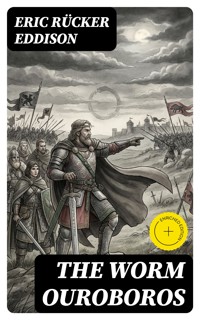
Eric Rücker Eddison's "The Worm Ouroboros" is a rich tapestry of high fantasy that weaves epic adventures into a profound meditation on fate, honor, and the cyclical nature of existence. Set in the mythical realm of Demonland, the narrative is characterized by eloquent prose and intricate poetry, drawing on a diverse array of sources, from Norse mythology to Elizabethan literature. Eddison's sophisticated style reflects the romance of chivalric quests, presenting a tale of warring realms where the heroism of characters such as Lord Juss and his companions embodies timeless archetypes, suggesting a complex interplay between destiny and individual agency within a vast, allegorical context. Eddison was not only a writer but also a scholar and a businessman, fascinated by languages, literature, and ancient traditions. His experiences in international trade and his deep appreciation for classical mythology and epic narratives shaped his perspective, allowing him to create a fantastical world steeped in a rich historical sense. The author's passion for history is evident in how he meticulously constructs a world reminiscent of ancient cultures, evoking an extraordinary depth of creativity that was largely ahead of its time. I highly recommend "The Worm Ouroboros" for enthusiasts of classic fantasy and readers seeking a profound exploration of moral themes. Its intricate narrative and elaborate world-building will resonate with those who cherish literary depth, making it a seminal work that invites readers to reflect on their own myths and legends. In this enriched edition, we have carefully created added value for your reading experience: - A succinct Introduction situates the work's timeless appeal and themes. - The Synopsis outlines the central plot, highlighting key developments without spoiling critical twists. - A detailed Historical Context immerses you in the era's events and influences that shaped the writing. - A thorough Analysis dissects symbols, motifs, and character arcs to unearth underlying meanings. - Reflection questions prompt you to engage personally with the work's messages, connecting them to modern life. - Hand‐picked Memorable Quotes shine a spotlight on moments of literary brilliance. - Interactive footnotes clarify unusual references, historical allusions, and archaic phrases for an effortless, more informed read.
Das E-Book können Sie in Legimi-Apps oder einer beliebigen App lesen, die das folgende Format unterstützen:
Veröffentlichungsjahr: 2022
Ähnliche












The Worm Ouroboros
Table of Contents
Introduction
At the heart of The Worm Ouroboros lies the intoxicating cycle of glory-seeking and rivalry, a ceaseless turning of desire, courage, cruelty, and splendor that binds champions and kingdoms alike to a wheel whose motion is as exhilarating as it is inexorable, promising triumph even as it murmurs of return, repetition, and the irresistible summons of new adventures that resemble the old yet demand renewed will, renewed daring, and renewed willingness to confront both the magnificence and the cost of heroic ambition, where desire itself becomes the map and the destination.
The book is a work of high fantasy and heroic romance by Eric Rücker Eddison, first published in 1922, when modern fantasy as a distinct tradition was still taking shape. Its action unfolds in a fully imagined secondary world presented, through a framing conceit, as a tale set upon the planet Mercury, though its geographies, cultures, and magics belong to the realm of romance rather than astronomy. The atmosphere evokes chronicles and sagas, yet the narrative is independent of any single mythic system, creating a stage where grand households, rival courts, and perilous wildernesses provide the theater for contest, alliance, and wonder.
At the outset, a demand for supremacy from the rulers of Witchland challenges the proud lords of Demonland, and the refusal to yield lights the fuse for embassies, duels, voyages, stratagems, and pitched battles that range across seas and mountains. Eddison narrates in a stately yet vigorous voice, coupling pageantry with sudden ferocity and a sly, sometimes sardonic humor. The tone is elevated without stiffness, often lyrical, and alive to the tactile pleasures of feasts, armor, ships, and storm-lit landscapes. Readers encounter sorcery and prophecy, but the book's true magic is the intensity of will animating its heroes and adversaries.
One of the abiding pleasures of the book is its language, an archaising idiom shaped into long, musical periods that recall Renaissance drama and chronicle while remaining unmistakably the author's own. The sentences swing like banners, then tighten into terse commands; speeches bloom with pride, irony, and ceremonial courtesy. Descriptions dwell on light and texture, making seas shine and mountains brood, and the narrative cadence invites both savoring and momentum. The reading experience alternates between meticulous tapestry and headlong charge, producing a sensation of grandeur that never forgets physical detail, from the weight of a sword to the hush of a council.
Eddison organises his epic around themes of honor, rivalry, appetite, and fate, exploring how the pursuit of preeminence defines persons as surely as it defines polities. The title's emblem signals a fascination with recurrence: victories breed fresh contests; reconciliations sharpen future divisions; the wish for consummation begets the wish to begin again. Heroism here is luminous and perilous at once, its grandeur interlaced with pride, cruelty, loyalty, and love of place. Even magic obeys temperament and will more than abstract systems, emphasizing character as destiny. The book contemplates the allure of mastery while questioning what is gained, and what is lost.
For contemporary readers, the novel's value lies partly in its mirror to cycles that still govern public life: the churn of rivalry, the magnetism of charismatic power, and the uneasy marriage of spectacle and violence. It also offers a countercurrent to pared-down modern prose, reminding us that style itself can be an engine of meaning and delight. The worldview is aristocratic and martial, and its gender roles are largely traditional; approaching it critically enriches the encounter without diminishing its imaginative force. In an era of serial conflict and restless desire, its meditation on ambition's self-renewing fire remains bracing and pertinent.
Standing as a landmark of early twentieth-century fantasy, The Worm Ouroboros shows how expansive, self-contained worlds could support epic narratives before later codifications of the genre. Its independence from medievalism as system, its insistence on personal will as the prime mover, and its sumptuous prose offer a distinct path that complements, rather than duplicates, later traditions. Readers coming to it now will find a tale at once strange and exacting, hospitable to wonder yet rigorous in its vision of cost. To step into its pages is to test one's appetite for greatness, and to consider the circle that greatness draws.
Synopsis
The Worm Ouroboros (1922) by Eric Rücker Eddison presents a grand heroic romance set on an imagined Mercury, introduced by a brief dreamlike frame before yielding to an epic chronicle. Two great houses, Demonland and Witchland, contend for mastery, their rivalry cast in the idiom of archaic chivalry, sea-roving, and sorcery. The narrative centers on the lords of Demonland: Juss, Goldry Bluszco, Spitfire, and their brilliant ally Brandoch Daha, whose pride and prowess meet the iron statecraft of Witchland's king, Gorice, and his captains. From the outset the book establishes its concerns: honor, magnificence, and the exhilaration and cost of unending contention.
An early embassy from Witchland demands submission from the Demons, provoking defiance and settling the terms of open war. Ceremony quickly hardens into ordeal when a trial by combat pits Goldry Bluszco against King Gorice, a confrontation whose outcome reshapes the balance of power. Witchland answers with continuity and menace: a successor king of the same name ascends, bringing a colder intelligence and mastery of forbidden arts. The episode defines the moral theater of the book: rituals of honor masking contests of will, and victories that summon fresh perils. Personal enmities sharpen into national campaigns as fleets and hosts take the field.
The Demons' fellowship tightens when a stroke of sorcery removes Goldry from their company, casting him beyond ordinary reach and turning resistance into rescue. Lord Juss and his companions launch a long sea-journey, venturing to far coasts, strange kingdoms, and waste places where myth and geopolitics converge. Their quest stitches exploration to strategy: every port, cape, and mountain pass promises either a clue to their comrade or an advantage against Witchland. Eddison lingers on perilous hospitality, monstrous landscapes, and tests of endurance that bind or break alliances. The enterprise becomes both a search for a friend and an assertion of identity.
At home and abroad, Witchland presses its cause through formidable captains. Corund leads with brawn and tactical rigor; Corsus and his son Corinius pursue conquest with ambition and a taste for command; the subtle counselor Lord Gro moves between factions with uneasy brilliance. Demonland suffers reversals and stages audacious ripostes, with Brandoch Daha's flair and seamanship often deciding narrow margins. Eddison balances set-piece battles with duels, banquets, and councils where pride meets policy. The see-saw of advantage underscores a world where sovereignty is provisional, reputations are weapons, and victory must be won anew with each voyage, ruse, or sword-stroke.
The outward journey to recover Goldry acquires the gravity of pilgrimage. The Demons traverse desolate marches and high countries bordered by fear and wonder, confronting ordeals that demand oaths, self-command, and imaginative courage more than brute force. Guides of doubtful reliability offer passage as often as traps; glimpses of high enchantment complicate the stark calculus of war. The group's loyalty is clarified by deprivations and by the tempting ease of turning back. In these chapters, landscapes act as moral weather: caverns, snows, and perilous waters reflect the cost of fidelity while hinting that the world's secrets answer only to endurance.
As Demonland's questers press onward, the larger war crests toward showdowns that test character as much as arms. Carcë, Witchland's grim stronghold, looms as the emblem of power consolidated by sorcery and policy; Demonland's halls and harbors stand for a freer, if equally proud, vitality. Duels between star captains, stratagems at sea, and hazardous embassies advance the plot while casting contrasting ideals into relief. Lord Gro's reflective misgivings complicate simple notions of villainy and loyalty, even as Corinius pursues glory with reckless brilliance. The struggle squeezes private desire and public duty together, moving both sides closer to irrevocable choices.
Eddison's romance is notable for its sumptuous, quasi-Elizabethan diction and for a heroic ethic that exults in beauty, boldness, and mastery while exposing their costs. The title's emblem suggests cycles of appetite and achievement, and the book courts that paradox without dissolving it into doctrine. As a precursor to later modern fantasy, it influenced tastes for secondary worlds, invented histories, and martial pageantry, yet remains singular in its patrician tone and ecstatic prose. The Worm Ouroboros endures as a study in will and wonder, its battles and voyages resonating beyond plot toward questions of what grandeur demands and finally gives.
Historical Context
Eric Rücker Eddison’s The Worm Ouroboros was first published in London in 1922, at the outset of Britain’s interwar period. Eddison (1882–1945) was a British civil servant educated at Eton and Trinity College, Oxford, who pursued literature alongside a career in the Board of Trade. The novel’s composition and release belonged to a milieu shaped by elite classical schooling, a professionalized civil service, and a resilient metropolitan publishing industry. Britain was adjusting to peace after the First World War, with institutions balancing tradition and reform. The book’s archaic diction and heroic preoccupations emerge from this environment, steeped in classical and early modern models.
1922 is often called an annus mirabilis of modernism, the year of James Joyce’s Ulysses and T. S. Eliot’s The Waste Land. British periodicals, small presses, and salons advanced experimental forms, while postwar readers contended with loss and dislocation. Yet a countercurrent of romance and myth persisted, visible in the continuing popularity of H. Rider Haggard and the acclaim for Lord Dunsany’s fantasies. Eddison’s romance, though contemporary with high modernism, deliberately turned to preindustrial ideals of valor and statecraft. The book enters this debate by offering a grand, stylized alternative to urban, fragmented modernity, speaking to audiences divided between innovation and the comforts of tradition.
Late Victorian and Edwardian medievalism nourished Eddison’s tastes. William Morris’s prose romances and his translations (with Eiríkr Magnússon) of Icelandic sagas had popularized northern myth for English readers. Scholarship and clubs promoted Old Norse literature, and Icelandic texts became accessible through affordable series. Eddison admired these sources and studied Old Norse; his later historical novel Styrbiorn the Strong (1926) shows sustained engagement with saga materials. The Worm Ouroboros inherits this culture’s admiration for feud, oaths, and lordship. Its courts, embassies, and duels reflect a world familiar to readers tempered by decades of medieval revival and the northern turn in late nineteenth-century English letters.
Eddison’s prose consciously echoes Elizabethan and Jacobean idioms, a register cultivated by generations whose schooling emphasized rhetoric, classical translation, and the Authorized Version of the Bible. Early twentieth-century antiquarianism and admiration for Renaissance travel narratives encouraged such stylistic pastiche. Contemporary reviewers often compared his sentences to the rolling cadences of older English, a literary choice that set him apart from pared, imagist contemporaries. The novel’s ceremonious speeches, formal challenges, and elaborate inventories align with historical models from chronicle and epic. That stylistic decision links the book to earlier English literary institutions while marking it as an outlier within its immediate modernist context.
Placing its action upon Mercury situates the book within early twentieth-century planetary romance, a mode already popularized by Edgar Rice Burroughs’s Barsoom tales. Unlike scientific romances that speculated from astronomy, Eddison uses Mercury as a purely fantastical stage, dispensing with physics or realistic cosmography. This approach drew on long-standing traditions of voyage literature and dream-visions that relocated chivalric adventure to remote realms. Readers of the time were accustomed to imperial travelogues and exoticized geographies; a planetary label provided distance without scientific obligation. The novel thus participates in, yet also distinguishes itself from, contemporaneous speculative narratives by abstaining from technological or evolutionary explanations.
The book emerged from a robust British print ecosystem of the 1920s: general publishers, circulating libraries, and review journals that mediated middle-class taste. Lending libraries and reprint series broadened access to genre fiction alongside experimental work. Eddison wrote while serving in the British civil service, an institution expanded and rationalized during and after the war. The dual identity of civil servant and man of letters was not unusual for the era, especially among Oxford-educated professionals. Such structures facilitated the production of ambitious, noncommercial projects that nevertheless found readers, enabling The Worm Ouroboros to reach an audience for heroic romance in a marketplace dominated by novelty.
Initial reception recognized the book’s bravura style and unusual setting, and it acquired a durable, if specialised, readership. C. S. Lewis publicly admired Eddison, praising his power of invention and echoing his importance for modern romance. J. R. R. Tolkien noted Eddison’s achievement while differing from his ethic, a testimony to the work’s visibility among later makers of secondary worlds. Mid-century reprints, and inclusion in the 1960s–1970s revival of classic fantasy paperbacks, extended its reach to new generations. These trajectories position the novel as a formative text in the English-language high-fantasy tradition preceding the postwar popular explosion of the genre.
The title invokes the ouroboros, an ancient emblem of cyclicality found in classical and Hermetic sources and familiar to early twentieth-century readers through renewed interest in esoteric symbols. While the book is not an allegory, its celebration of aristocratic courage, ritualized conflict, and elaborate courtesy contrasts with the mechanized mass warfare that had reshaped Europe. By reviving premodern speech and pageantry, it offers a historical counter-image to contemporary disillusion without denying the gravity of loss behind its age. The Worm Ouroboros thus reflects, and implicitly critiques, its moment by recasting the interwar search for meaning as heroic romance and cyclical myth.
The Worm Ouroboros
Dedication
To W. G. E. and to my friends K. H. and G. C. L. M. I dedicate this book
It is neither allegory nor fable but a Story to be read for its own sake.
The proper names I have tried to spell simply. The e in Carcë is long, like that in Phryne, the o in Krothering short and the accent on that syllable: Corund is accented on the first syllable, Prezmyra on the second, Brandoch Daha on the first and fourth, Gorice on the last syllable, rhyming with thrice: Corinius rhymes with Flaminius, Galing with sailing, La Fireez with desire ease: ch is always guttural, as in loch.
E. R. E.
9th January 1922
Thomas the Rhymer
TRUE Thomas lay on Huntlie bank, A ferlie he spied wi his ee; And there he saw a Lady bright Come riding down by the Eildon Tree. Her skirt was o the grass-green silk, Her mantle o the velvet fyne, At ilka tett of her horse's mane Hung fifty siller bells and nine. True Thomas he pulld aff his cap, And louted low down on his knee: "Hail to thee, Mary, Queen of Heaven! For thy peer on earth could never be." "O no, O no, Thomas," she says, "That name does not belong to me; I'm but the Queen of fair Elfland, That am hither come to visit thee. "Harp and carp, Thomas," she says, "Harp and carp alang wi me. And if ye dare to kiss my lips, Sure of your bodie I will be." "Betide me weal, betide me woe, That weird shall never daunton me." Syne he has kissed her rosy lips, All underneath the Eildon Tree. THOMAS THE RHYMER
Introduction
p. xix
THE Worm Ouroboros, no worm, but the Serpent itself, is a wonderful book. As a story or as prose it is wonderful, and, there being a cause for every effect, the reason for writing it should be as marvellous again.
Shelley had to write the Prometheus Unbound[1], he was under compulsion; for a superhuman energy had come upon him, and he was forced to create a matter that would permit him to imagine, and think, and speak like a god. It was so with Blake, who willed to appear as a man but existed like a mountain; and, at their best, the work of these poets is inhuman and sacred. It does not greatly matter that they had or had not a message. It does not matter at all that either can be charged with nonsense or that both have been called madmen—the same charge might be laid against a volcano or a thunderbolt—or this book. It does not matter that they could transcend human endurance, and could move tranquilly in realms where lightning is the norm of speed. The work of such poets is sacred because it outpaces man, and, in a realm of their own, wins even above Shakespeare.
An energy such as came on the poets has visited the author of this book, and his dedicatory statement, that "it is neither allegory nor fable but a story to be read for p. xx its own sake," puts us off with the assured arrogance for of the poet who is too busy creating to have time for school-mastering. But, waking or in dream, this author has been in strange regions and has supped at a torrent which only the greatest know of.
The story is a long one—this reader would have—liked it twice as long. The place of action is indicated, casually, as the planet Mercury, and the story tells of the, wars between two great kingdoms of that planet, and the final overthrow of one.
Mr. Eddison is a vast man. He needed a whole cosmos to play in, and created one; and he forged a prose to tell of it that is as gigantic as his tale. In reading this book the reader must a little break his way in, and must surrender prejudices that are not allowed for. He may think that the language is more rotund than is needed for a tale, but, as he proceeds, he will see that only such a tongue could be spoken by these colossi; and, soon, he will delight in a prose that is as life-giving as it is magnificent.
Mr. Eddison's prose never plays him false; it rises and falls with his subject, and is tender, humorous, sour, precipitate and terrific as the occasion warrants. How nicely the Kaga danced for the Red Foliot.
"Foxy-red above, but with black bellies, round furry faces, innocent amber eyes and great soft paws. … On a sudden the music ceased, and the dancers were still, and standing side by side, paw in furry paw, they bowed shyly to the company, and the Red Foliot called them to, him, and kissed them on the mouth, and sent them to their seats."
"Corund leaned on the parapet and shaded his eyes with his hand, that was broad as a smoked haddock, and covered on the back with yellow hairs growing somewhat sparsely as the hairs on the skin of a young elephant."
"A dismal tempest suddenly surprised them. For forty days it swept them in hail and sleet over wide wallowing ocean, without a star, without a course."
p. xxi
"Night came down on the hills. A great wind moaning out of the hueless west tore the clouds as a ragged garment, revealing the lonely moon that fled naked betwixt them."
"Dawn came like a lily, saffron-hued, smirked with smoke-gray streaks, that slanted from the north."
"He was naked to the waist, his hair, breast and arms to the armpits clotted and adrop with blood and in his hands two bloody daggers."
Quotations can give some idea of the rhythm of his sentences, but it can give none of the massive sweep and intensity of his narrative. Milton fell in love with the devil because the dramatic action lay with him, and, in this book, Mr. Eddison trounces his devils for being naughty (the word "bad" has not significance here), but he trounces the Wizard King and his kingdom with affection and delight. What gorgeous monsters are Gorice the Twelfth and Corund and Corinius. The reader will not easily forget them; nor Gorice's great antagonist Lord Juss; nor the marvellous traitor, Lord Gro, with whom the author was certainly in love; nor the great fights and the terrible fighters Lords Brandoch Daha and Goldry Bluszco, and a world of others and their wives; nor will he forget the mountain Koshtra Pivrarcha, that had to be climbed, and was climbed—as dizzying a feat as literature can tell of.
"So huge he was that even here at six miles distance the eye might not at a glance behold him, but must sweep back and forth as over a broad landscape, from the ponderous roots of the mountain, where they sprang black and sheer from the glacier up the vast face, where buttress was piled upon buttress, and tower upon tower, in a blinding radiance of ice-hung precipice and snow-filled gully, to the lone heights where, like spears menacing high heaven, the white teeth of the summit-ridge cleft the sky."
Mr. Eddison's prose does not derive from the English Bible. His mind has more affinities with Celtic imaginings and method, and his work is Celtic in that it is inspired p. xxii by beauty and daring rather than by thoughts and moralities. He might be Scotch or Irish: scarcely the former, for, while Scotland loves full-mouthed verse, she, like England, is prose-shy. But, from whatever heaven Mr. Eddison come, he has added a masterpiece to English literature.
JAMES STEPHENS
The Induction
p. 1
THERE was a man named Lessingham dwelt in an old low house in Wastdale, set in a gray old garden where yew-trees flourished that had seen Vikings in Copeland in their seedling time. Lily and rose and larkspur bloomed in the borders, and begonias with blossoms big as saucers, red and white and pink and lemon-colour, in the beds before the porch. Climbing roses, honeysuckle, clematis, and the scarlet flame-flower scrambled up the walls. Thick woods were on every side without the garden, with a gap north-eastward opening on the desolate lake and the great fells beyond it: Gable rearing his crag-bound head against the sky from behind the straight clean outline of the Screes.
Cool long shadows stole across the tennis lawn. The air was golden. Doves murmured in the trees; two chaffinches played on the near post of the net; a little water-wagtail scurried along the path. A French window stood open to the garden, showing darkly a dining-room panelled with old oak, its Jacobean table bright with flowers and silver and cut glass and Wedgwood dishes heaped with fruit: greengages, peaches, and green muscat grapes. Lessingham lay back in a hammock-chair watching through the blue smoke of an after-dinner cigar p. 2 the warm light on the Gloire de Dijon roses that clustered about the bedroom window overhead. He had her hand in his. This was their House.
"Should we finish that chapter of Njal[2]?" she said.
She took the heavy volume with its faded green cover, and read: "He went out on the night of the Lord's day, when nine weeks were still to winter; he heard a great crash, so that he thought both heaven and earth shook. Then he looked into the west airt, and he thought he saw hereabouts a ring of fiery hue, and within the ring a man on a gray horse. He passed quickly by him, and rode hard. He had a flaming firebrand in his hand, and he rode so close to him that he could see him plainly. He was black as pitch, and he sung this song with a mighty voice—
Here I ride swift steed, His flank flecked with rime, Rain from his mane drips, Horse mighty for harm; Flames flare at each end, Gall glows in the midst, So fares it with Flosi's redes As this flaming brand flies; And so fares it with Flosi's redes As this flaming brand flies.
"Then he thought he hurled the firebrand east towards the fells before him, and such a blaze of fire leapt up to meet it that he could not see the fells for the blaze. It seemed as though that man rode east among the flames and vanished there.
"After that he went to his bed, and was senseless for a long time, but at last he came to himself. He bore in mind all that had happened, and told his father, but he bade him tell it to Hjallti Skeggi's son. So he went and told Hjallti, but he said he had seen 'the Wolf's Ride, and that comes ever before great tidings.'"
They were silent awhile; then Lessingham. said suddenly, p. 3 "Do you mind if we sleep in the east wing to-night?"
"What, in the Lotus Room?"
"Yes."
"I'm too much of a lazy-bones to-night, dear," she answered.
"Do you mind if I go alone, then? I shall be back to breakfast. I like my lady with me; still, we can go again when next moon wanes. My pet is not frightened, is she?"
"No!" she said, laughing. But her eyes were a little big. Her fingers played with his watch-chain. "I'd rather," she said presently, "you went later on and took me. All this is so odd still: the House, and that; and I love it so. And after all, it is a long way and several years too, sometimes, in the Lotus Room, even though it is all over next morning. I'd rather we went together. If anything happened then, well, we'd both be done in, and it wouldn't matter so much, would it?"
"Both be what?" said Lessingham. "I'm afraid your language is not all that might be wished."
"Well, you taught me!" said she; and they laughed.
They sat there till the shadows crept over the lawn and up the trees, and the high rocks of the mountain shoulder beyond burned red in the evening rays. He said, "If you like to stroll a bit of way up the fell-side, Mercury is visible to-night. We might get a glimpse of him just after sunset."
A little later, standing on the open hillside below the hawking bats, they watched for the dim planet that showed at last low down in the west between the sunset and the dark.
He said, "It is as if Mercury had a finger on me tonight, Mary. It's no good my trying to sleep to-night except in the Lotus Room."
Her arm tightened in his. "Mercury?" she said. "It is another world. It is too far."
But he laughed and said, "Nothing is too far."
They turned back as the shadows deepened. As they stood in the dark of the arched gate leading from the p. 4 open fell into the garden, the soft clear notes of a spinet sounded from the house. She put up a finger. "Hark," she said. "Your daughter playing Les Barricades."
They stood listening. "She loves playing," he whispered. "I'm glad we taught her to play." Presently he whispered again, "Les Barricades Mystérieuses. What inspired Couperin with that enchanted name? And only you and I know what it really means. Les Barricades Mystérieuses."
That night Lessingham lay alone in the Lotus Room. Its casements opened eastward on the sleeping woods and the sleeping bare slopes of Illgill Head. He slept soft and deep; for that was the House of Postmeridian, and the House of Peace.
In the deep and dead time of the night, when the waning moon peered over the mountain shoulder, he woke suddenly. The silver beams shone through the open window on a form perched at the foot of the bed: a little bird, black, round-headed, short-beaked, with long sharp wings, and eyes like two stars shining. It spoke and said, "Time is."
So Lessingham got up and muffled himself in a great cloak that lay on a chair beside the bed. He said, "I am ready, my little martlet." For that was the House of Heart's Desire.
Surely the martlet's eyes filled all the room with starlight. It was an old room with lotuses carved on the panels and on the bed and chairs and roof-beams; and in the glamour the carved flowers swayed like water-lilies in a lazy stream. He went to the window, and the little martlet sat on his shoulder. A chariot coloured like the halo about the moon waited by the window, poised in air, harnessed to a strange steed. A horse it seemed, but winged like an eagle, and its fore-legs feathered and armed with eagle's claws instead of hooves. He entered the chariot, and that little martlet sat on his knee.
With a whirr of wings the wild courser sprang skyward. The night about them was like the tumult of bubbles p. 5 about a diver's ears diving in a deep pool under a smooth steep rock in a mountain cataract. Time was swallowed up in speed; the world reeled; and it was but as the space between two deep breaths till that strange courser spread wide his rainbow wings and slanted down the night over a great island that slumbered on a slumbering sea, with lesser isles about it: a country of rock mountains and hill pastures and many waters, all a-glimmer in the moonshine.
They landed within a gate crowned with golden lions. Lessingham came down from the chariot, and the little black martlet circled about his head, showing him a yew avenue leading from the gates. As in a dream, he followed her.
I. The Castle of Lord Juss
p. 7 THE eastern stars were paling to the dawn as Lessingham followed his conductor along the grass walk between the shadowy ranks of Irish yews, that stood like soldiers mysterious and expectant in the darkness. The grass was bathed in night-dew, and great white lilies sleeping in the shadows of the yews loaded the air of that garden with fragrance. Lessingham felt no touch of the ground beneath his feet, and when he stretched out his hand to touch a tree his hand passed through branch and leaves as though they were unsubstantial as a moonbeam.
The little martlet[3], alighting on his shoulder, laughed in his ear. "Child of earth," she said, "dost think we are here in dreamland?"
He answered nothing, and she said, "This is no dream[1q]. p. 8 Thou, first of the children of men, art come to Mercury, where thou and I will journey up and down for a season to show thee the lands and oceans, the forests, plains, and ancient mountains, cities and palaces of this world, Mercury, and the doings of them that dwell therein. But here thou canst not handle aught, neither make the folk ware of thee, not though thou shout thy throat hoarse. For thou and I walk here impalpable and invisible, as it were two dreams walking."
They were now on the marble steps which led from the yew walk to the terrace opposite the great gate of the castle. "No need to unbar gates to thee and me," said the martlet, as they passed beneath the darkness of that ancient portal, carved with strange devices, and clean through the massy timbers of the bolted gate thickly riveted with silver, into the inner court. "Go we into the lofty presence chamber and there tarry awhile. Morning is kindling the upper air, and folk will soon be stirring in the castle, for they lie not long abed when day begins in Demonland. For be it known to thee, O earth-born, that this land is Demonland, and this castle the castle of Lord Juss, and this day now dawning his birthday, when the Demons hold high festival in Juss's castle to do honour unto him and to his brethren, Spitfire and Goldry Bluszco; and these and their fathers before them bear rule from time immemorial in Demonland, and have the lordship over all the Demons."
She spoke, and the first low beams of the sun smote javelin-like through the eastern windows, and the freshness of morning breathed and shimmered in that lofty chamber, chasing the blue and dusky shades of departed night to the corners and recesses, and to the rafters of the vaulted roof. Surely no potentate of earth, not Croesus, not the great King, not Minos in his royal palace in Crete, not all the Pharaohs, not Queen Semiramis, nor all the Kings of Babylon and Nineveh had ever a throne room to compare in glory with that high presence chamber of the lords of Demonland. Its walls and pillars were of snow-white marble, every vein whereof was set with p. 9 small gems: rubies, corals, garnets, and pink topaz. Seven pillars on either side bore up the shadowy vault of the roof; the roof-tree and the beams were of gold, curiously carved, the roof itself of mother-of-pearl. A side aisle ran behind each row of pillars, and seven paintings on the western side faced seven spacious windows on the east. At the end of the hall upon a dais stood three high seats, the arms of each composed of two hippogriffs wrought in gold, with wings spread, and the legs of the seats the legs of the hippogriffs; but the body of each high seat was a single jewel of monstrous size: the left-hand seat a black opal, asparkle with steel-blue fire, the next a fire-opal, as it were a burning coal, the third seat an alexandrite, purple like wine by night but deep sea-green by day. Ten more pillars stood in semicircle behind the high seats, bearing up above them and the dais a canopy of gold. The benches that ran from end to end of the lofty chamber were of cedar, inlaid with coral and ivory, and so were the tables that stood before the benches. The floor of the chamber was tessellated, of marble and green tourmaline, and on every square of tourmaline was carven the image of a fish: as the dolphin, the conger, the cat-fish, the salmon, the tunny, the squid, and other wonders of the deep. Hangings of tapestry were behind the high seats, worked with flowers, snake's-head, snapdragon, dragon-mouth, and their kind; and on the dado below the windows were sculptures of birds and beasts and creeping things.
But a great wonder of this chamber, and a marvel to behold, was how the capital of every one of the four-and-twenty pillars was hewn from a single precious stone, carved by the hand of some sculptor of long ago into the living form of a monster: here was a harpy with screaming mouth, so wondrously cut in ochre-tinted jade it was a marvel to hear no scream from her: here in wine-yellow topaz a flying fire-drake: there a cockatrice made of a single ruby: there a star sapphire the colour of moonlight, cut for a cyclops, so that the rays of the star trembled from his single eye: salamanders, mermaids, p. 10 chimaeras, wild men o' the woods, leviathans, all hewn from faultless gems, thrice the bulk of a big man's body, velvet-dark sapphires, crystolite, beryl, amethyst, and the yellow zircon that is like transparent gold.
To give light to the presence chamber were seven escarbuncles[4], great as pumpkins, hung in order down the length of it, and nine fair moonstones standing in order on silver pedestals between the pillars on the dais. These jewels, drinking in the sunshine by day, gave it forth during the hours of darkness in a radiance of pink light and a soft effulgence as of moonbeams. And yet another marvel, the nether side of the canopy over the high seats was encrusted with lapis lazuli, and in that feigned dome of heaven burned the twelve signs of the zodiac, every star a diamond that shone with its own light.
Folk now began to be astir in the castle, and there came a score of serving men into the presence chamber with brooms and brushes, cloths and leathers, to sweep and garnish it, and burnish the gold and jewels of the chamber. Lissome they were and sprightly of gait, of fresh complexion and fair-haired. Horns grew on their heads. When their tasks were accomplished they departed, and the presence began to fill with guests. A joy it was to see such a shifting maze of velvets, furs, curious needleworks and cloth of tissue, tiffanies, laces, ruffs, goodly chains and carcanets of gold: such glitter of jewels and weapons: such nodding of the plumes the Demons wore in their hair, half veiling the horns that grew upon their heads. Some were sitting on the benches or leaning on the polished tables, some walking forth and back upon the shining floor. Here and there were women among them, women so fair one had said: it is surely white-armed Helen this one; this, Arcadian Atalanta; this, Phryne that stood to Praxiteles for Aphrodite's picture; this, Thaïs, for whom great Alexander to pleasure her fantasy did burn Persepolis like a candle; this, she that was rapt by the Dark God from the flowering fields of Enna, to be Queen for ever among the dead that be departed. p. 11 Now came a stir near the stately doorway, and Lessingham beheld a Demon of burly frame and noble port, richly attired. His face was ruddy and somewhat freckled, his forehead wide, his eyes calm and blue like the sea. His beard, thick and tawny, was parted and brushed back and upwards on either side.
"Tell me, my little martlet," said Lessingham, "is this Lord Juss?"
"This is not Lord Juss," answered the martlet, "nor aught so worshipful as he. The lord thou seest is Volle, who dwelleth under Kartadza, by the salt sea. A great sea-captain is he, and one that did service to the cause of Demonland, and of the whole world besides, in the late wars against the Ghouls.
"But cast thine eyes again towards the door, where one standeth amid a knot of friends, tall and somewhat stooping, in a corselet of silver, and a cloak of old brocaded silk coloured like tarnished gold; something like to Volle in feature, but swarthy, and with bristling black moustachios."
"I see him," said Lessingham. "This then is Lord Juss!"
"Not so," said martlet. "'Tis but Vizz, brother to Volle. He is wealthiest in goods of all the Demons, save the three brethren only and Lord Brandoch Daha."
"And who is this?" asked Lessingham, pointing to one of light and brisk step and humorous eye, who in that moment met Volle and engaged him in converse apart. Handsome of face he was, albeit somewhat long-nosed and sharp-nosed: keen and hard and filled with life and the joy of it.
"Here thou beholdest," answered she, "Lord Zigg, the far-famed tamer of horses. Well loved is he among the Demons, for he is merry of mood, and a mighty man of his hands withal when he leadeth his horsemen against the enemy."
Volle threw up his beard and laughed a great laugh at some jest that Zigg whispered in his ear, and Lessingham leaned forward into the hall if haply he might catch p. 12 what was said. The hum of talk drowned the words, but leaning forward Lessingham saw where the arras curtains behind the dais parted for a moment, and one of princely bearing advanced past the high seats down the body of the hall. His gait was delicate, as of some lithe beast of prey newly wakened out of slumber, and he greeted with lazy grace the many friends who hailed his entrance. Very tall was that lord, and slender of build, like a girl. His tunic was of silk coloured like the wild rose, and embroidered in gold with representations of flowers and thunderbolts. Jewels glittered on his left hand and on the golden bracelets on his arms, and on the fillet twined among the golden curls of his hair, set with plumes of the king-bird of Paradise. His horns were dyed with saffron, and inlaid with filigree work of gold. His buskins were laced with gold, and from his belt hung a sword, narrow of blade and keen, the hilt rough with beryls and black diamonds. Strangely light and delicate was his frame and seeming, yet with a sense of slumbering power beneath, as the delicate peak of a snow mountain seen afar in the low red rays of morning. His face was beautiful to look upon, and softly coloured like a girl's face, and his expression one of gentle melancholy, mixed with some disdain; but fiery glints awoke at intervals in his eyes, and the lines of swift determination hovered round the mouth below his curled moustachios.
"At last," murmured Lessingham, "at last, Lord Juss!" "Little art thou to blame," said the martlet, "for this misprision, for scarce could a lordlier sight have joyed thine eyes. Yet is this not Juss, but Lord Brandoch Daha, to whom all Demonland west of Shalgreth and Stropardon oweth allegiance: the rich vineyards of Krothering, the broad pasture lands of Failze, and all the western islands and their cragbound fastnesses. Think not, because he affecteth silks and jewels like a queen, and carrieth himself light and dainty as a silver birch tree on the mountain, that his hand is light or his courage doubtful in war. For years was he held for the third best man-at-arms in all Mercury, along with these, Goldry p. 13 Bluszco and Gorice X. of Witchland. And Gorice he slew, nine summers back, in single combat, when the Witches harried in Goblinland and Brandoch Daha led five hundred and fourscore Demons to succour Gaslark, the king of that country. And now can none surpass Lord Brandoch Daha in feats of arms, save perchance Goldry alone.
"Yet, lo," she said, as a sweet and wild music stole on the ear, and the guests turned towards the dais, and the hangings parted, "at last, the triple lordship of Demonland! Strike softly, music: smile, Fates, on this festal day! Joy and safe days shine for this world and Demonland! Turn thy gaze first on him who walks in majesty in the midst, his tunic of olive-green velvet ornamented with devices of hidden meaning in thread of gold and beads of chrysolite. Mark how the buskins, clasping his stalwart calves, glitter with gold and amber. Mark the dusky cloak streamed with gold and lined with blood-red silk: a charmed cloak, made by the sylphs in forgotten days, bringing good hap to the wearer, so he be true of heart and no dastard. Mark him that weareth it, his sweet dark countenance, the violet fire in his eyes, the sombre warmth of his smile, like autumn woods in late sunshine. This is Lord Juss, lord of this age-remembering castle, than whom none hath more worship in wide Demonland. Somewhat he knoweth of art magical, yet useth not that art; for it sappeth the life and strength, nor is it held worthy that a Demon should put trust in that art, but rather in his own might and main.
"Now turn thine eyes to him that leaneth on Juss's left arm, shorter but mayhap sturdier than he, apparelled in black silk that shimmers with gold as he moveth, and crowned with black eagle's feathers among his horns and yellow hair. His face is wild and keen like a sea-eagle's, and from his bristling brows the eyes dart glances sharp as a glancing spear. A faint flame, pallid like the fire of a Will-o'-the-Wisp, breathes ever and anon from his distended nostrils. This is Lord Spitfire, impetuous in war. p. 14 "Last, behold on Juss's right hand, yon lord that bulks mighty as Hercules yet steppeth lightly as a heifer. The thews and sinews of his great limbs ripple as he moves beneath a skin whiter than ivory; his cloak of cloth of gold is heavy with jewels, his tunic of black sendaline hath great hearts worked thereon in rubies and red silk thread. Slung from his shoulders clanks a two-handed sword, the pommel a huge star-ruby carven in the image of a heart, for the heart is his sign and symbol. This is that sword forged by the elves, wherewith he slew the sea-monster, as thou mayest see in the painting on the wall. Noble is he of countenance, most like to his brother Juss, but darker brown of hair and ruddier of hue and bigger of cheekbone. Look well on him, for never shall thine eyes behold a greater champion than the Lord Goldry Bluszco, captain of the hosts of Demonland."
Now when the greetings were done and the strains of the lutes and recorders sighed and lost themselves in the shadowy vault of the roof, the cup-bearers did fill great gems made in form of cups with ancient wine, and the Demons caroused to Lord Juss deep draughts in honour of this day of his nativity. And now they were ready to set forth by twos and threes into the parks and pleasaunces, some to take their pleasure about the fair gardens and fishponds, some to hunt wild game among the wooded hills, some to disport themselves at quoits or tennis or riding at the ring or martial exercises; that so they might spend the livelong day as befitteth high holiday, in pleasure and action without care, and thereafter revel in the lofty presence chamber till night grew old with eating and drinking and all delight.
But as they were upon going forth, a trumpet was sounded without, three strident blasts.
"What kill-joy have we here?" said Spitfire. "The trumpet soundeth only for travellers from the outlands. I feel it in my bones some rascal is come to Galing, one that bringeth ill hap in his pocket and a shadow athwart the sun on this our day of festival." p. 15 "Speak no word of ill omen," answered Juss. "Whosoe'er it be, we will straight dispatch his business and so fall to pleasure indeed. Some, run to the gate and bring him in."
The serving man hastened and returned, saying, "Lord, it is an Ambassador from Witchland and his train. Their ship made land at Lookinghaven-ness at nightfall. They slept on board, and your soldiers gave them escort to Galing at break of day. He craveth present audience."
"From Witchland, ha?" said Juss. "Such smokes use ever to go before the fire."
"Shall's bid the fellow," said Spitfire, "wait on our pleasure? It is pity such should poison our gladness."
Goldry laughed and said, "Whom hath he sent us? Laxus, think you? to make his peace with us again for that vile part of his practised against us off Kartadza, detestably falsifying his word he had given us?"
Juss said to the serving man, "Thou sawest the Ambassador. Who is he?"
"Lord," answered he, "His face was strange to me. He is little of stature and, by your highness' leave, the most unlike to a great lord of Witchland that ever I saw. And, by your leave, for all the marvellous rich and sumptuous coat a weareth, he is very like a false jewel in a rich casing."
"Well," said Juss, "a sour draught sweetens not in the waiting. Call we in the Ambassador."
Lord Juss sat in the high seat midmost of the dais, with Goldry on his right in the seat of black opal, and on his left Spitfire, throned on the alexandrite. On the dais sat likewise those other lords of Demonland, and the guests of lower degree thronged the benches and the polished tables as the wide doors opened on their silver hinges, and the Ambassador with pomp and ceremony paced up the shining floor of marble and green tourmaline.
"Why, what a beastly fellow is this?" said Lord Goldry in his brother's ear. "His hairy hands reach down to his knees. A shuffleth in his walk like a hobbled jackass."
p. 17 "I like not the dirty face of the Ambassador," said Lord Zigg. "His nose sitteth flat on the face of him as it were a dab of clay, and I can see pat up his nostrils a summer day's journey into his head. If's upper lip bespeak him not a rare spouter of rank fustian, perdition catch me. Were it a finger's breadth longer, a might tuck it into his collar to keep his chin warm of a winter's night."
"I like not the smell of the Ambassador," said Lord Brandoch Daha. And he called for censers and sprinklers of lavender and rose water to purify the chamber, and let open the crystal windows that the breezes of heaven might enter and make all sweet.
So the Ambassador walked up the shining floor and stood before the lords of Demonland that sat upon the high seats between the golden hippogriffs. He was robed in a long mantle of scarlet lined with ermine, with crabs, woodlice, and centipedes worked thereon in golden thread. His head was covered with a black velvet cap with a peacock's feather fastened with a brooch of silver. Supported by his trainbearers and attendants, and leaning on his golden staff, he with raucous accent delivered his mission:
"Juss, Goldry, and Spitfire, and ye other Demons, I come before you as the Ambassador of Gorice XI., most glorious King of Witchland, Lord and great Duke of Buteny and Estremerine, Commander of Shulan, Thramnë, Mingos, and Permio, and High Warden of the Esamocian Marches, Great Duke of Trace, King Paramount of Beshtria and Nevria and Prince of Ar, Great Lord over the country of Ojedia, Maltraëny, and of Baltary and Toribia, and Lord of many other countries, most glorious and most great, whose power and glory is over all the world and whose name shall endure for all generations. And first I bid you be bound by that reverence for my sacred office of envoy from the King, which is accorded by all people and potentates, save such as be utterly barbarous, to ambassadors and envoys."
"Speak and fear not," answered Juss. "Thou hast mine p. 18 oath. And that hath never been forsworn, to Witch or other barbarian."
The Ambassador shot out his lips in an O, and threatened with his head; then grinned, laying bare his sharp and misshapen teeth, and proceeded:
"Thus saith King Gorice, great and glorious, and he chargeth me to deliver it to you, neither adding any word nor taking away: 'I have it in mind that no ceremony of homage or fealty hath been performed before me by the dwellers in my province of Demonland———'"
As the rustling of dry leaves strewn in a flagged court when a sudden wind striketh them, there went a stir among the guests. Nor might the Lord Spitfire contain his wrath, but springing up and clapping hand to sword-hilt, as minded to do a hurt to the Ambassador, "Province?" he cried. "Are not the Demons a free people? And is it to be endured that Witchland should commission this slave to cast insults in our teeth, and this in our own castle?"
A murmur went about the hall, and here and there folk rose from their seats. The Ambassador drew down his head between his shoulders like a tortoise, baring his teeth and blinking with his small eyes. But Lord Brandoch Daha, lightly laying his hand on Spitfire's arm, said: "The Ambassador hath not ended his message, cousin, and thou hast frightened him. Have patience and spoil not the comedy. We shall not lack words to answer King Gorice: no, nor swords, if he must have them. But it shall not be said of us of Demonland that it needeth but a boorish message to turn us from our ancient courtesy toward ambassadors and heralds."
So spake Lord Brandoch Daha, in lazy half-mocking tone, as one who but idly returneth the ball of conversation; yet clearly, so that all might hear. And therewith the murmurs died down, and Spitfire said, 'I am tame. Say thine errand freely, and imagine not that we shall hold thee answerable for aught thou sayest, but him that sent thee."
"Whose humble mouthpiece I only am," said the Ambassador, p. 19 somewhat gathering courage; "and who, saving your reverence, lacketh not the will nor the power to take revenge for any outrage done upon his servants. Thus saith the King: 'I therefore summon and command you, Juss, Spitfire, and Goldry Bluszco, to make haste and come to me in Witchland in my fortress of Carcë, and there dutifully kiss my toe, in witness before all the world that I am your Lord and King, and rightful overlord of all Demonland.'"
Gravely and without gesture Lord Juss harkened to the Ambassador, leaning back in his high seat with either arm thrown athwart the arched neck of the hippogriff. Goldry, smiling scornfully, toyed with the hilt of his great sword. Spitfire sat strained and glowering, the sparks crackling at his nostrils.
"Thou hast delivered all?" said Juss.
"All," answered the Ambassador.
"Thou shalt have thine answer," said Juss. "While we take rede thereon, eat and drink"; and he beckoned the cupbearer to pour out bright wine for the Ambassador. But the Ambassador excused himself, saying that he was not athirst, and that he had store of food and wine aboard of his ship, which should suffice his needs and those of his following.
Then said Lord Spitfire, "No marvel though the spawn of Witchland fear venom in the cup. They who work commonly such villany against their enemies, as witness Recedor of Goblinland whom Corsus murthered with a poisonous draught, shake still in the knees lest themselves be so entertained to their destruction;" and snatching the cup he quaffed it to the dregs, and dashed it on the marble floor before the Ambassador, so that it was shivered into pieces.
And the lords of Demonland rose up and withdrew behind the flowery hangings into a chamber apart, to determine of their answer to the message sent unto them by King Gorice of Witchland.
When they were private together, Spitfire spake and said, "Is it to be borne that the King should put such p. 20 shame and mockery upon us? Could a not at the least have made a son of Corund or of Corsus his Ambassador to bring us his defiance, 'stead of this filthiest of his domestics, a gibbering dwarf fit only to make them gab and game at their tippling bouts when they be three parts senseless with boosing?"
Lord Juss smiled somewhat scornfully. "With wisdom," he said, "and with foresight hath Witchland made choice of his time to move against us, knowing that thirty and three of our well-built ships are sunken in Kartadza Sound in the battle with the Ghouls, and but fourteen remain to us. Now that the Ghouls are slain, every soul, and utterly abolished from this world, and so the great curse and peril of all this world ended by the sword and great valour of Demonland alone, now seemeth the happy moment unto these late mouth-friends to fall upon us. For have not the Witches a strong fleet of ships, since their whole fleet fled at the beginning of their fight with us against the Ghouls, leaving us to bear the burden? And now are they minded for this new treason, to set upon us traitorously and suddenly in this disadvantage. For the King well judgeth we can carry no army to Witchland nor do aught in his despite, but must be long months a-shipbuilding. And doubt not he holdeth an armament ready aboard at Tenemos to sad hither if he get the answer he knoweth we shall send him."
"Sit we at ease then," said Goldry, "sharpening our swords; and let him ship his armies across the salt sea. Not a Witch shall land in Demonland but shall leave here his blood and bones to make fat our cornfields and our vineyards."
"Rather," said Spitfire, "apprehend this rascal, and put to sea to-day with the fourteen ships left us. We can surprise Witchland in his strong place of Carcë, sack it, and give him to the crows to peck at, or ever he is well awake to the swiftness of our answer. That is my counsel."
"Nay." said Juss, "We shall not take him sleeping. Be p. 21 certain that his ships are ready and watching in the Witchland seas, prepared against any rash onset. It were folly to set our neck in the noose; and little glory to Demonland to await his coming. This, then, is my rede: I will bid Gorice to the duello, and make offer to him to let lie on the fortune thereof the decision of this quarrel."
"A good rede, if it might be fulfilled," said Goldry. "But never will he dare to stand with weapons in single combat 'gainst thee or 'gainst any of us. Nevertheless the thing shall be brought about. Is not Gorice a mighty wrastle[5]r, and hath he not in his palace in Carcë the skulls and bones of ninety and nine great champions whom he hath vanquished and slain in that exercise? Puffed up beyond measure is he in his own conceit, and folk say it is a grief to him that none hath been found this long while that durst wrastle with him, and wofully he pineth for the hundredth. He shall wrastle a fall with me!"
Now this seemed good to them all. So when they had talked on it awhile and concluded what they would do, glad of heart the lords of Demonland turned them back to the lofty presence chamber. And there Lord Juss spake and said: "Demons, ye have heard the words which the King of Witchland in the Overweening pride and shamelessness of his heart hath spoken unto us by the mouth of this Ambassador. Now this is our answer which my brother shall give, the Lord Goldry Bluszco; and we charge thee, O Ambassador, to deliver it truly, neither adding any word nor taking away."
And the Lord Goldry spake: "We, the lords of Demonland, do utterly scorn thee, Gorice XI., for the greatest of dastards, in that thou basely fleddest and forsookest us, thy sworn confederates, in the sea battle against the Ghouls. Our swords, which in that battle ended so great a curse and peril to all this world, are not bent nor broken. They shall be sheathed in the bowels of thee and thy minions, Corsus to wit, and Corund, and their sons, and Corinius, and what other evildoers harbour in waterish p. 22




