


Erhalten Sie Zugang zu diesem und mehr als 300000 Büchern ab EUR 5,99 monatlich.
- Herausgeber: Eye Press
- Kategorie: Gesellschafts- und Liebesromane
- Serie: Eye Classics
- Sprache: Englisch
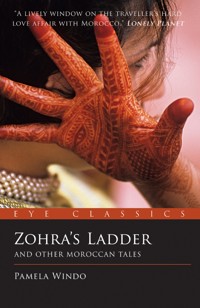
Pamela Windo lived in Morocco for many years, falling in love with the country and its people. In Zohra's Ladder she recalls her most memorable encounters. Her stories peel back layers of history and the finely embroidered fabric of daily life, discovering the mysterious and exotic. Her writing describes the colours, flavours, sounds and textures of an almost dream-like place: a world of fleeting affairs, warmth and subtle moments. Experience Morocco as it comes alive in this entrancing book.
Sie lesen das E-Book in den Legimi-Apps auf:
Seitenzahl: 218
Veröffentlichungsjahr: 2010
Das E-Book (TTS) können Sie hören im Abo „Legimi Premium” in Legimi-Apps auf:
Ähnliche



















This Eye Classics edition first published in Great Britain in 2011, by:
29 Barrow Street
Much Wenlock
Shropshire
TF13 6EN
www.eye-books.com
First published in Great Britain in 2005
Copyright © Pamela Windo
Cover design by Emily Atkins/Jim Shannon
Cover photo by Simon Russell
Text layout by Helen Steer
The moral right of the Author to be identified as the author of the work has been asserted.
All rights reserved. No part of this publication may be reproduced, stored in a retrieval system or transmitted in any form or by any means without the prior written permission of the publisher nor be otherwise circulated in any form of binding or cover other than that in which it is published and without a similar condition being imposed on the subsequent purchaser.
British Library Cataloguing in Publication Data
A catalogue record for this book is available from the British Library
The paperback edition of this book is printed in Poland.
ISBN: 978-1-903070-68-0
In memory of my parents, who always let me go.
CONTENTS
PROLOGUE
AN AFTERNOON AT THE HAMMAM
RABIAH’S HOUSE
PILGRIMAGES TO THE POST OFFICE
THE ADVENTUROUS FRENCHMAN
A BEACH ENCOUNTER
THE DESERT SKY
THE COLONEL & THE JUDGE
AN EVENING WITH THE GENERAL’S WIFE
THE NIGHT OF THE FIFTIETH BIRTHDAY
A FATEFUL MEETING
THE NIGHT I THOUGHT I WOULD DIE BEFORE MORNING
AN UNFORGETTABLE CUP OF COFFEE
ZOHRA’S LADDER
THE STREET CLEANER’S CLOTHES
OBSERVING PROCESSIONS
MR. IDRISSI’S ADVANCES
A DAY IN THE COURTHOUSE
ABDELSLAM: THE FASSI
A NEIGHBOURHOOD EXORCISM
A SESSION WITH THE SHIWOFA
HEALING MY FOOT
THE DAYS OF RAMADAN
A MARRIAGE PROPOSAL IN THE KASBAH
RIDING LOW IN A COUNTRY BUS
A LITRE OF OLIVE OIL
GAMES WITH THE TOURISTS
VODKA WITH THE CAID
IN SEARCH OF THE ARGAN TREE
LUNCH WITH THE SHEIKH
BABA HALOU
LEAVING
PROLOGUE
Landscape, or its absence, is the setting for our lives. I was born and lived my first years in the rolling green country of southern England. These days, I live among the grey concrete forests of New York City. At the two most poignant moments of my life – at seventeen and at fifty – it was North Africa that claimed me. In spite of being a child who my mother said was born asking why, I have never dwelled on the reason my path took me there for such epiphanies. I accepted that it was too mysterious a concept to be answered rationally. Some have said it is my spiritual home.
Between Tunisia and Morocco, I spent more than ten years, by my own choice, living among people of different races, faiths, traditions and thoughts. My life in both countries was linked to a man. I went to Tunisia at the invitation of a young student I met in London and lived with him and his family for three years. Morocco happened seemingly by accident: it was to be my escape from love, somewhere to be alone and write. It was while living there that I met a man who changed the course of my life. How much did I take in of my life and travels; how much did I forget or reject? We live mostly oblivious of the changes in ourselves. Perhaps only now can I finally feel those changes.
When I began to write about Morocco, I realized that the more I tried to describe it, the more facts and explanations could not capture the country’s essence. Mystery and mysticism lie beyond what the eye can see, in the deeper reaches of the heart. Our habit of analysing everything has left us an un-mysterious people fearful of, yet still searching for, mystery. And so, I simply allowed those moments that wanted to be written to jump out at me.
The resulting stories are fragments in a kaleidoscope. Some of the moments I describe are light, others dark. As we love blue sky and sunshine, green fields, wide rivers and oceans, we also love dark night with its endless star-filled firmament. We love unforgiving mountains that reach up to heaven like cathedrals, and we love the emptiness and silence of the desert. The light and dark, the full and empty, both feed our souls.
Speaking of Morocco immediately conjures thoughts of mystery and intrigue, of sunlight and sensuality, of exotic handicrafts to decorate our homes, and of a refined and aromatic cuisine. All these are true, in abundance.
I first stepped foot in North Africa, in Tunis, when I was eighteen and, although my experiences stayed with me, they always felt more like a dream than reality. Half a lifetime later, I found myself back in North Africa, this time in Morocco. I had been living in New York, a British expatriate, and had begun to write. In my search for the ideal place, an escape from the familiar and from mundane distractions, I first chose a Greek island. But then I met two Moroccan brothers, Mustapha and Abdellah, who, with a mixture of pride and homesickness, urged me to visit their country instead. They even offered me the use of a small villa owned by their elder brother, Najib, that stood on the seawall of a fishing village called Asilah, not far from Tangiers.
I set off firmly believing I would stay put for three months and write. I had no plans to travel, had read nothing about the country and had no guidebook. On arriving by ferry, Najib greeted me with the news that the villa was no longer available – a sick friend was convalescing there. Instead, he took me first to his family’s home in Casablanca and then on to Marrakesh, to stay in his mother-in-law’s house. Fatima took me in as one of the family so that I began my life in Morocco on the inside, not as a tourist. The month I spent with her set me on the right course, initiating me into many aspects of the culture and giving me the courage to travel and live on my own. In doing so, I came face-to-face with people from all walks of life and experienced many vivid and unforgettable moments. By the time the three months ended, I had decided I would live in Marrakesh.
During the seven years I stayed, I came to understand why the experiences of my youth had seemed like a dream. In North Africa, life is lived in a sensuous now, in which the past cohabits indivisibly with the present, and the future holds little significance. The opposites of life go hand in hand at every turn: poverty and opulence, beauty and ugliness, clarity and ambiguity, light and shadow, the ancient and the modern. The traveller finds himself in a vivid yet dreamlike present. In yielding to this, life finds us. This is the mystery of Morocco.
AN AFTERNOON AT THE HAMMAM
It was March, the end of my first week in Morocco. The air was damp, and I was chilled to the bone because after the first few days of hot sunshine, the spring rains had come and hadn’t stopped for four whole days. Disappointed that I couldn’t go out to explore Marrakesh, I lay curled up under a blanket in my little room off the courtyard, listening to the monotonous rhythmic splashing on the ceramic tiles. Fatima had offered me a larger room with stained-glass windows on the upper floor, but I’d preferred to stay in the courtyard, in the heart of the house, to observe the comings and goings.
Fatima lived deep within the massive ramparts, in the labyrinth of the Medina. Najib had accompanied me, as he doubted I’d ever find the house on my own. A ‘petit taxi’ dropped us as close as it could get to a narrow sandy alley, lined on either side with high, salmon-pink, windowless walls. It was hard to imagine that homes lay behind them; the only signs of this were the doors, low and solid, with great iron hinges, knockers and bolts. The walls protect the inner life as veils protect the features of the face. We wove our way along the teeming thoroughfare among women in rainbow-coloured djellabas, men in sombre turbans, boisterous children, mopeds, mules and bicycles. The sun beat down, intensifying everything, casting dark shadows beside brilliant bursts of sunlight, and the heady scents of musk, amber and incense mingled with the stench of animal and vegetable waste.
We stopped at a door, and Najib rapped loudly. A young girl about ten years old wearing an apron led us through a cool, dark passageway that brought us suddenly into a wide, sun-drenched courtyard. At its centre stood a marble fountain surrounded by bitter orange and lemon trees, and above it was a broad square of dazzling blue sky, framed by luminous sea-green roof tiles. It was an elegant old house – perhaps a hundred years old or more – and in need of repair, but the electric-blue doors, arabesque window grilles, whitewashed walls and colourful ceramic tiles shone with freshness and gave it an aura of timelessness. I had stepped out of reality into a dream. I fell in love with Morocco in that moment.
Fatima had been widowed some ten years before and had two sons and two daughters, all of them grown up and living away from home. She lived alone now, with a young orphan girl she’d taken in to train as a maid. An Arab from Fès, known for its fair-skinned people, Fatima was a small and delicate woman with short, wavy chestnut hair. She wore layers of pink gauze and reminded me of Bette Davis, having a similar petulant look about her eyes and mouth.
Now, suddenly, the door of my room opened wide. It was Fatima. “Toi veux aller hammam?” she asked in broken French, grinning shyly at me. She was offering to take me to the communal baths. Not only did the house have no heating, there was no hot water either. The thought of steaming and soaking for hours sounded like heaven. Poor heat- and air-conditioned brat, I admitted to myself, sitting up quickly and nodding to my thoughtful host.
While I got dressed, Fatima busied herself with gathering buckets, pots, towels and sundry items from a storeroom in the courtyard, and before we left the house, she handed me a djellaba to wear, arranging the hood deeply over my forehead, like her own. We scurried along the crowded kerbs, muddy and waterlogged from all the rain, looking like monks in our all-concealing habits. We passed the local mosque, tucked between two grocers’ stalls; a Muslim has to eat to live and be clean to pray. Passage interdit aux non-Musulmans, a sign read: entry forbidden to non-Muslims. This was the result of French soldiers’ misuse of the baths during the Protection. And then we came to the neighbourhood hammam, with its two blue-tiled doorways set in rough ochre walls. Above them, two caricatured faces, primitively painted like graffiti, signalled the separate entrances for men and women – a veiled woman with black, slanting eyes and a turbaned man with a pointed black beard. I followed Fatima through a low door, swishing a striped curtain aside, into a bare, dimly lit changing room. A clutch of women wearing headscarves squatted as they brewed mint tea over a charcoal burner that gave off warm woody fumes. Fatima told me the women are called tayebas, which means cooks, because they fetch and carry water and scrub the pregnant, the rich or the lazy. I immediately felt their sharp eyes scrutinizing me and imagined their sharp tongues discussing me too, as they gossiped in their singsong medley of Berber and Arabic, perhaps laying odds on how long I’d last in the heat.
Fatima and I undressed down to our panties. It was a shock to see all the other women lolling about in various stages of undress, before or after bathing – unashamed and unselfconscious compared to the extreme modesty of their clothes and behaviour in the street. We left our belongings in open cubby-holes and picked up our buckets. A heavy wooden door, sodden with years of steam, led into the hammam rooms. Inside, it was swelteringly hot, and the first glimpse was a bit daunting. In the ghostly steam and half-light, all I could see was bare flesh, dark faces with dark eyes, and dark, wet hair. Why in an unfamiliar situation do we fear the worst? For me, it was the shock of such uninhibited physical intimacy, as well as the thought of all that communal dirt.
When I had grown accustomed to the semi-darkness, I noticed naked women coating their bodies with saboon bildi, a thick, dark-brown jelly-like soap that looked suspiciously like engine grease but was made from olive-pressing residue. Others had red masks on their faces, a skin tonic that dripped blood-like streaks down their shoulders into the streams of swirling water. Frothing soapsuds floated everywhere, and the peel from oranges eaten as snacks littered the floor. We stepped arch by arch through the steam-filled rooms, each one darker and steamier than the one before. The only light came from a small, round skylight in the central room’s domed ceiling. I slipped once or twice on the hot and wet tiled floor as I picked my way through voluptuously curved ladies, pendant-breasted matrons, sleek young women and brown-limbed children yelling their indignation at being so thoroughly scrubbed and soaped. A sea of inscrutable dark eyes registered my presence: I was the only woman with blond hair and blue eyes, and my otherwise fashionable thinness seemed suddenly boyish and unwomanly. I wondered if they resented my invasion of their private territory, but when I smiled, they smiled back and I understood it was up to me, the outsider, to bridge the gap.
In the third and last room, the hottest and steamiest, Fatima stopped to fill one of our buckets. She rinsed an area of tiles, threw down a rubber mat and pointed at it. I sat down obediently. The women in this room were plying to and fro, filling buckets at the gushing water taps, and the pleasant smell of olive and lemon soap hung in the steam-drenched air. There was so much hot water flowing everywhere, I forgot my fears about the hammam’s cleanliness and leaned back against the tiled wall to soak up the steam and let my pores open. Everything was slow and methodical, with a meditative concentration on getting your body clean. The woman next to me was going through a precise set of motions that Fatima explained was the Muslim’s ritual ablution before prayer. It was Thursday; everyone was getting clean for Friday, Holy Day.
After a while, we got up and set our four buckets in the line by the taps. When we had filled them, we returned to our spot and set them all around us: three with near-boiling water and one with cold, for mixing. Fatima handed me a blob of the brown soap with a gesture that meant I should spread it all over me. We left it for a quarter of an hour, and then rinsed it off. Fatima pressed her hand against my shoulder and motioned me to lie down. I stretched out on the baking-hot tiles, my head resting against her thighs, while she slowly scrubbed me with a coarse black mitt called a keess, limb by limb, over and over, until my skin was almost sore, flushed pink and tingling. Rolls of dead skin littered my body; it was hard to believe how dirty I’d been. When she had finished scrubbing, she poured water all over me to swill away the grey debris.
While Fatima turned her efforts on herself, I became aware of a little boy about three years old standing motionless a few feet away. He was staring at me with wide brown eyes, as if mesmerized, his little penis pointing stiffly upwards. He must have seen many naked women in the hammam, and I wondered what effect that would have on him; as he grew up, would he be more, or less, fascinated by the female of the species? Thinking it would probably be more, I turned my body aside. As I did so, a wrinkled old woman tapped my arm; her chin was dotted with a faded, inky tattoo, her smile decorated with a set of pink, almost toothless gums. She waved one mitted hand in the air, placed the other firmly on my back and began to scrub. For a moment, I felt affronted by her impudence, but when her twinkling eyes met mine she reminded me of my grandmother, so I let her carry on scrubbing. I had never been naked with my mother or my sister, let alone my grandmother, yet here I was, comfortable with complete strangers.
The last part of the bathing ritual was the application of sludgy clay paste to my hair. To rinse it off required me to bend my head between my open legs, a job another old matron gleefully assigned herself to. The washing of the thin, pale foreigner had become the afternoon’s entertainment. She gave me a wide-toothed comb, and as I worked through the long strands, she poured pot after pot of water that streamed from my crown over my shoulders and down my back and felt like a healing river. I was by then utterly lost in sensuality; my body felt transparent and my hair like silk.
I had lost all sense of time when I tipped the last bowl of water over my head. I wasn’t looking forward to leaving this warm, intimate world of women and returning to the muddy streets, the rain, and the cold house. We took our time in the changing room, where I sat on a slatted bench with a towel wound round my steaming body. I’d never been so clean. When I stood up to dress, I caught sight of myself in a small cracked mirror and barely recognized my face: I was a glowing brilliant pink with eyes that shone like beacons. When I told Fatima I felt like a new person, she laughed with delight and told the ladies of the hammam who were busy inspecting me. They laughed loudly too, waving their hennaed hands at me in approval. But I was more interested in what Fatima was thinking about me. How could she know how much this initiation had touched me? It had felt like a long-lost celebration I had deeply missed.
The hammam was a communal baptism, washing away more than dirt. There’d been helping hands in the darkness, limbs touching and eyes meeting, and I understood why the women spent hours there in each other’s company. I felt regret for what we more ‘liberated’ women seem to have lost, in doing and thinking like men. Unlike us, the women I saw were together asserting and rejoicing in their difference from men, and in that I saw their strength.
RABIAH’S HOUSE
When Rabiah and I left her apartment in Casablanca and set off for the bus station, she was dressed in her deepest travelling disguise: a steel-grey, ankle-length djellaba, its hood folded severely across her forehead, and a matching grey muslin ngeb that stretched across her face and left only a slit for her deep-set, kohl-lined eyes. My travelling outfit was more practical: blue jeans and a leather jacket, and my hair was loose.
Rabiah was Najib’s mother, a Soussi Berber from the south of Morocco. Like Fatima, she was widowed young, but in her case, she had been left with eight children – four sons and four daughters – to bring up alone. To better educate her brood, she had moved from her mud house in the Anti Atlas Mountains to an apartment in cosmopolitan Casablanca. Sturdily built with broad shoulders, she had a strong, sculpted face and shiny tawny-olive complexion. From the moment I met her, between her stoical expression and austere clothes, I found her quite frightening.
After I had been living with Fatima in Marrakesh for about a month, Rabiah had offered me the use of a small family house in Agadir, on Morocco’s southern Atlantic coast. I had accepted immediately, eager to see more of the country and to live alone, anonymously, among its people. At the last minute, Rabiah insisted on accompanying me to prepare the house for my stay, although I rather got the impression it was an excuse to take a well-deserved break.
The bus left around ten o’clock in the evening with me the only foreigner on board and would arrive in Agadir, Insh’allah, around six the next morning. We were making the trip at night because it was Ramadan – the month when Muslims fast from dawn to sunset – so Rabiah could eat and drink on the way. We sat side by side in silence, getting a good deal of stares from the other passengers. From time to time, Rabiah cast an authoritative glance my way that made me feel like her ward, although there could only have been a few years’ difference in our age. “Toi fait harira demain,” she said quite suddenly, breaking her icy countenance with the hint of a grin: your turn to cook the soup tomorrow. She meant the traditional soup of Ramadan. I laughed in surprise but answered the challenge by reciting a list of the ingredients I’d seen Fatima use, hesitating for the last item.
From the seat behind me, a young man’s voice cued me: “Hummus” – chick-peas. As I turned round to thank the owner of the voice, I noticed that Rabiah’s eyes were twinkling and her white teeth were glinting beneath the ngeb; she was shaking with silent laughter. After years of being camouflaged by veils and djellabas, she had become expert in expressing herself with her dark eyes and hennaed hands, the only parts of her body left visible and free. When I turned around again to ask the man if he knew how to cook the soup, to be friendly, I felt a sharp pinch on my thigh. I jumped and looked at Rabiah. She simply shook her head at me, and with that, I began to understand what it was like to have a strict Muslim mother.
The bus passed through the noisy, brightly illuminated metropolis and the interminable sprawling suburbs, and then the darkened countryside took over, and we were scuttling across the Chaouia plains with only the faint lights of a small village here and there to relieve the darkness. At one point, noticing my purse on my knees, Rabiah secured its straps around the armrest, in case of ‘voleurs,’ she warned, as if I had been careless. Satisfied everything was shipshape, she produced a jar of orange juice from her bulging travelling bag. “Tiens, Madame,” she said, offering me a cup and maintaining the formality.
“Chokran,” I answered. Communication between us amounted to very few words; hand signals and facial gestures were our vocabulary. Sometimes I thought I detected a spark of adventure in her eyes. Travel has a way of bringing things out in people you might not otherwise see, and I wondered if she found me as interesting to watch as I found her.
As the night grew rapidly colder, I covered myself with my coat. One of the male passengers had an interminable, ear-shattering fit of sneezes, and then finally darkness and silence reigned as everyone fell asleep. Before dozing off, it occurred to me to check where the bus toilet was. I looked to the back but there was no sign of one. When I whispered this to Rabiah, she simply muttered, “Agadir.” It seemed impossible that she could wait until we arrived, so I assumed we’d stop somewhere on the way.
Around one o’clock, I awoke with a start as the bus pulled out of the blackness and stopped at a roadside café. It was bustling with life, all lit up by dozens of flickering gas and kerosene lamps. Outside, vendors with carts of oranges, apples and midget bananas barked their prices, but tables and warmth drew the passengers inside. As I stepped down from the bus, the hot smells of roasting meat roused me as they wafted across in the clouds of smoke billowing from a series of charcoal braziers lined with skewers of beef and lamb. Next to these were cauldrons of oil filled with sizzling pommes frites, and blackened kettles spewing steam.
Rabiah refused to go inside the café because it was full of men, so I went on in alone, keen to eat and drink and get warm. I found myself among a throng of swarthy countrymen dressed in threadbare burnooses, haggard from the day’s hard labour and fasting. I noticed their eyes flash in my direction – a quick sizing-up that contained no trace of hostility – but after that, they paid me no more attention, returning to their hearty eating, smoking and talking. I wondered which man had a wife at home, which did his duty and which one cherished his wife? I thought that, unlike us, their concept of love must be a fleeting dream, and I felt a moment’s shameful privilege. There was no sign of beer or alcohol; I’d not seen or drunk a drop since I’d arrived in Morocco. Poverty, dirt and dust, and the endless fight against them were evident and palpable. But in spite of the harsh edge of life, I felt celebration in the air.
I bought some ‘frites’ served in a paper cone with a dollop of mustard, and a glass of sweet dark-brewed tea crammed full of fresh mint leaves. Together, they came to the equivalent of fifty cents.




