


95,99 €
Mehr erfahren.
- Herausgeber: John Wiley & Sons
- Kategorie: Wissenschaft und neue Technologien
- Sprache: Englisch
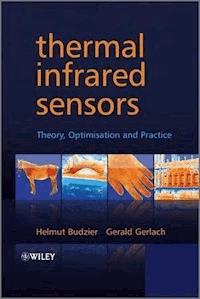
The problems involved in designing optimal infrared (IR) measuring systems under given conditions are commensurately complex. The optical set-up and radiation conditions, the interaction between sensor and irradiation and the sensor itself, determine the operation of the sensor system. Simple calculations for solving these problems without any understanding of the causal relationships are not possible.
Thermal Infrared Sensors offers a concise explanation of the basic physical and photometric fundamentals needed for the consideration of these interactions. It depicts the basics of thermal IR sensor systems and explains the manifold causal relationships between the most important effects and influences, describing the relationships between sensor parameters such as thermal and special resolution, and application conditions.
This book covers:
- various types of thermal sensors, like thermoelectric sensor, pyroelectric sensors, microbolometers, micro-Golay cells and bimorphous sensors;
- basic applications for thermal sensors;
- noise - a limiting factor for thermal resolution and detectivity - including an outline of the mathematics and noise sources in thermal infrared sensors;
- the properties of IR sensor systems in conjunction with the measurement environment and application conditions;
- 60 examples showing calculations of real problems with real numbers, as they occur in many practical applications.
This is an essential reference for practicing design and optical engineers and users of infrared sensors and infrared cameras. With this book they will be able to transform the demonstrated solutions to their own problems, find ways to match their commercial IR sensors and cameras to their measurement conditions, and to tailor and optimise sensors and set-ups to particular IR measurement problems. The basic knowledge outlined in this book will give advanced undergraduate and graduate students a thorough grounding in this technology.
Sie lesen das E-Book in den Legimi-Apps auf:
Seitenzahl: 322
Veröffentlichungsjahr: 2011
Ähnliche


















Contents
Cover
Title Page
Copyright
Dedication
Preface
List of Examples
List of Symbols
Indices
Abbreviations
Chapter 1: Introduction
1.1 Infrared Radiation
1.2 Historical Development
1.3 Advantages of Infrared Measuring Technology
1.4 Comparison of Thermal and Photonic Infrared Sensors
1.5 Temperature and Spatial Resolution of Infrared Sensors
1.6 Single-Element Sensors Versus Array Sensors
References
Chapter 2: Radiometric Basics
2.1 Effect of Electromagnetic Radiation on Solid-State Bodies
2.2 Radiation Variables
2.3 Radiation Laws
References
Chapter 3: Photometric Basics
3.1 Solid Angle
3.2 Basic Law of Photometry
References
Chapter 4: Noise
4.1 Mathematical Basics
4.2 Noise Source in Thermal Infrared Sensors
References
Chapter 5: Sensor Parameters
5.1 Responsivity
5.2 Noise-Equivalent Power NEP
5.3 Detectivity
5.4 Noise-Equivalent Temperature Difference
5.5 Optical Parameters
5.6 Modulation Transfer Function
References
Chapter 6: Thermal Infrared Sensors
6.1 Operating Principles
6.2 Thermal Models
6.3 Network Models for Thermal Sensors
6.4 Thermoelectric Radiation Sensors
6.5 Pyroelectric Sensors
6.6 Microbolometers
6.7 Other Thermal Infrared Sensors
6.8 Comparison of Thermal Sensors
References
Chapter 7: Applications of Thermal Infrared Sensors
7.1 General Considerations
7.2 Pyrometry
7.3 Thermal Imaging Cameras
7.4 Passive Infrared Motion Detector
7.5 Infrared Spectrometry
7.6 Gas Analysis
References
Appendix A: Constants
Appendix B: Planck's Law of Radiation and Derived Laws
Appendix C: Calculation of the Solid Angle of a Rectangular Area
Further Reading and Sources
Index
This edition first published 2011
© 2011, John Wiley & Sons, Ltd
Registered office
John Wiley & Sons Ltd, The Atrium, Southern Gate, Chichester, West Sussex, PO19 8SQ, United Kingdom
For details of our global editorial offices, for customer services and for information about how to apply for permission
to reuse the copyright material in this book please see our website at www.wiley.com.
The right of the author to be identified as the author of this work has been asserted in accordance with the Copyright, Designs and Patents Act 1988.
All rights reserved. No part of this publication may be reproduced, stored in a retrieval system, or transmitted, in any form or by any means, electronic, mechanical, photocopying, recording or otherwise, except as permitted by the UK Copyright, Designs and Patents Act 1988, without the prior permission of the publisher.
Wiley also publishes its books in a variety of electronic formats. Some content that appears in print may not be available in electronic books.
Designations used by companies to distinguish their products are often claimed as trademarks. All brand names and product names used in this book are trade names, service marks, trademarks or registered trademarks of their respective owners. The publisher is not associated with any product or vendor mentioned in this book. This publication is designed to provide accurate and authoritative information in regard to the subject matter covered. It is sold on the understanding that the publisher is not engaged in rendering professional services. If professional advice or other expert assistance is required, the services of a competent professional should be sought.
Library of Congress Cataloguing-in-Publication Data
Budzier, Helmut.
[Thermische Infrarotsensoren. German]
Thermal infrared sensors : theory, optimisation, and practice / Helmut Budzier, Gerald Gerlach; translated by Dörte Müller.
p. cm.
Includes bibliographical references and index.
ISBN 978-0-470-87192-8 (cloth)
1. Infrared detectors. I. Gerlach, Gerald. II. Title.
TA1570.B83 2010
621.36'2–dc22
2010035043
A catalogue record for this book is available from the British Library.
Print ISBN: 9780470871928
E-PDF ISBN: 9780470976906
O-book ISBN: 9780470976913
E-Pub ISBN: 9780470976753
For Prof. Dr. Ludwig Walther, founder of the Dresden Infrared School
Preface
Until only a few decades ago, infrared technology was mainly the domain of military technology. In recent times, though, it has invaded an increasing number of new applications in our everyday lives. Examples are motion and fire detectors, ear thermometers, sensors that register the degree of browning in toasters, hand pyrometers for the contactless measuring of temperatures and thermal imaging devices. Infrared sensors are even the basis for new areas of application such as technical diagnosis, non-destructive evalution methods, environmental monitoring, gas sensors and remote sensing.
The technical interest in infrared radiation is due to the fact that it can be used both to determine the temperature without contact and thus the presence of bodies as well as the characteristics of bodies themselves including their structures:
At room temperature, the maximum specific spectral radiation of blackbodies amounts to an approximate wavelength of 10 μm. This radiation wavelength range is therefore of fundamental importance for detecting real objects and determining their characteristics.The bond between the atoms of organic and anorganic molecules show resonance frequencies that almost always correspond to wavelengths in the infrared spectral range. If we can determine the frequency – or wavelength-related reflecting, transmitting and absorbing characteristics of substances and mixtures of substances – we can also determine the atomic or molecular structure of materials.The increasing technical utilisation of infrared radiation in the mentioned areas of application is also related to central development trends in infrared measuring technology:
Improved characteristics of infrared detectors. Research focuses particularly on increasing detectivity and improving the temperature resolution of such sensors as well as the transition to uncooled sensor principles.Development of highly integrated sensor arrays. Large pixel numbers of detector arrays require the miniaturisation of components and thus also the transition to semiconductor technology and the integration of sensor element and evaluation electronics. Thin layers on silicon substrates, the use of standard circuitry for evaluation electronics and the development of improved circuit technologies are of particular importance.Optimisation of infrared measuring systems. Here, the research focus is on the improvement of all system components and the optimisation of the characteristics of the total system.Analysis and development of new applications: contactless, emissivity-independent temperature measurements, spectroscopic applications, miniaturised spectroscopy, multicolour sensors, recognition systems and many more.Thermal infrared sensors, in particular, are very important for civil applications as they can be used – as opposed to quantum detectors – in a non-cooled state and are therefore suitable for small and cost-efficient solutions and thus for large quantities.
Today, we do not only have a vast number of applications of thermal infrared sensors, but also the technological requirements regarding size, design, optical conditions, thermal and spatial resolution and many other framework conditions have diversified. This has resulted in very complex issues that users have to solve when trying to design optimum measuring arrangements or conditions. Each individual part of the measuring chain affects the relation between the source of the infrared radiation and the output signal of the measuring system. For this reason there are no simple rules and the problems cannot be solved without a basic understanding of the correlations.
There is a very limited number of textbook-like presentations available that summarise these issues. The present book intends to fill this gap by providing explanations of the essential basics of thermal infrared sensors and the correlation between the diverse effects. Using a large number of examples we will systematically show how this basic knowledge can be applied to the solution of specific tasks. Although the authors start with introducing the physical basics, they will only develop them to the point where they are necessary for real-life, recalculable ups with specific characteristics.
The goal of this book is to create a basic manual for users. It is intended to provide engineers, technicians, technical management, purchasers, and equipment suppliers with practical knowledge regarding the usage of modern infrared sensors and measuring systems. The book focuses on thermal infrared sensors. This way, we want to avoid exceeding the scope and keep it handy. The authors agreed that this would not constitute any serious restriction. On the one hand, it is mainly the uncooled, thermal sensors that represent the largest increases in commercial sales and determine the major part of new applications. On the other hand, it is possible to transfer major parts of the information to quantum detectors.
The present book is based on lectures on infrared measuring technology that the authors have held during many years at the Technische Universitlsquät Dresden, Germany. This book, however, was designed in a completely different way in order to turn the information into a basic user manual. This means this publication has been a new experience for us, too. We are aware that it will not be complete right away, and would therefore appreciate corrections, ideas, and suggestions for improvements ([email protected]; [email protected]).
The authors would like to express their thankfulness to Volker Krause, Ilonka Pfahl and the publisher, in particular Simone Taylor and Nicky Skinner who provided the necessary support for a fast and uncomplicated publishing process.
We would like to express our appreciation to Dörte Müller who did a great job in translating the manuscript from German into English.
We would also like to thank Volkmar Norkus (TU Dresden/Germany), Norbert Neumann (InfraTec GmbH Dresden/Germany), Günter Hofmann (DIAS Infrared GmbH Dresden/Germany), Jörg Schieferdecker (Heimann Sensor GmbH Dresden/Germany) and Jean-Luc Tissot (ULIS France) for their support, discussions and for providing materials.
Dresden, June 2009
Helmut Budzier, Gerald Gerlach
List of Examples
Example 1.1 Responsivity and Detectivity of Thermal Sensors and Photon Sensors
Example 2.1 Power Dissipation in Dielectrics
Example 2.2 Absorption in a Microbolometer Bridge
Example 2.3 Blackbody
Example 2.4 Exitance Curve
Example 3.1 Solid Angle of a Triangular Area
Example 3.2 Angle-Related Responsivity of Infrared Sensors
Example 3.3 Ideal Diffuse Reflection
Example 3.4 Radiance of a Blackbody
Example 3.5 Irradiance of a Sensor Element
Example 3.6 Projected Solid Angle of the Pixel of a Bolometer Array
Example 3.7 Projected Solid Angle of a Square and a Circular Aperture Stop
Example 3.8 Projected Solid Angle of Two Parallel Circular Areas
Example 4.1 Time and Ensemble Average
Example 4.2 Noise of an Electric Current
Example 4.3 ACF of a Stochastic Signal
Example 4.4 Autocorrelation Function of White Noise
Example 4.5 Noise Power of Bandwidth-Limited White Noise
Example 4.6 Equivalent Noise Bandwidth of a First-Order Low-Pass
Example 4.7 Spectral Noise Power Density of a First-Order Low-Pass
Example 4.8 Output Noise of an Infrared Bolometer
Example 4.9 Noise of a Lossy Capacitor
Example 4.10 1/f Noise of a Semiconductor Resistor
Example 4.11 Signal-to-Noise Ratio of the Total Radiation of a Blackbody
Example 4.12 Noise Flux in a Microbolometer Due to Heat Conduction and Heat Radiation
Example 5.1 Measuring the Responsivity of a Microbolometer Array
Example 5.2 Measuring the Responsivity of a Pyroelectric Sensor
Example 5.3 Radiant Flux between Blackbody and Sensor Pixel
Example 5.4 Differential Exitance
Example 5.5 Presentation of Uniformity
Example 5.6 BLIP-NEP
Example 5.7 BLIP Detectivity
Example 5.8 BLIP-NETD
Example 5.9 Measuring NETD
Example 5.10 Radiant Flux to a Sensor
Example 5.11 Gain Effect of an Optics
Example 5.12 MTF of a Diffraction-Limited Optics
Example 5.13 Transfer of a Rectangle Signal
Example 5.14 Thermal MTF of a Pyroelectric Line Sensor
Example 5.15 Measuring MTF Using a Knife-Edge Image
Example 6.1 Temperature Change of a Sensor
Example 6.2 Normalised Temperature Responsivity of a Microbolometer Bridge
Example 6.3 Rectangular Modulation of the Radiant Flux
Example 6.4 Influence of the Gas Layer on the Normalised Temperature Responsivity
Example 6.5 Thermal MTF for Rectangular Chopping
Example 6.6 Two-Port Parameters of a Microbolometer
Example 6.7 Thermoelectric Voltage at Doped Silicon
Example 6.8 Dimensioning of Thermopiles
Example 6.9 Electric Characteristics of a Pyroelectric Detector Element
Example 6.10 Noise Current of a Pyroelectric Detector Element
Example 6.11 Noise in Current Mode
Example 6.12 Noise in Voltage Mode
Example 6.13 Acceleration Responsivity of Pyroelectric Sensors
Example 6.14 Responsivity of a Pyroelectric Sensor
Example 6.15 Specific Detectivity and NETD of a Pyroelectric Sensor
Example 6.16 Responsivity of a Pyroelectric Sensor with Integrated FET
Example 6.17 Voltage Responsivity of a Bolometer
Example 6.18 Current–Voltage Curve of Bolometers
Example 6.19 Noise of a Microbolometer Pixel
Example 6.20 Temperature Resolution of a Microbolometer
Example 6.21 Thermal Parameters of a Microbolometer Pixel
Example 6.22 Temperature Change of a Bolometer Due to the Bias Current
Example 6.23 Sensor Capacity for a Tilted Electrode
Example 6.24 Temperature Resolution of a Cantilever
Example 6.25 Temperature Coefficient of a Micro-Golay Cell
Example 6.26 Thermal Resolution of a Micro-Golay Sensor
Example 7.1 Systematic Deviation ΔT of a Total Radiation Measurement for an Incorrectly Assumed Emissivity ε
Example 7.2 Temperature Deviation of a Quotient Pyrometer
Example 7.3 Influence of the Camera's Self-Radiation on the Thermal Image
Example 7.4 Spiral Choppers
Example 7.5 Inhomogeneity-Equivalent Temperature Difference
List of Symbols
adimension; acceleration; pulse amplitude; thermal diffusivitybdimensioncheat capacityddistance; diameterdPpiezoelectric coefficienteunit vector; elementary chargeenatural numberffrequency; function; focal lengthgacceleration of gravityhheight; PLANCK constantinumeration index; electric currenteffective or rms value of the noise currentjimaginary unit; numeration indexkfactor; coefficient; direction component; wave number; wave vector; numeration index; discrete statekBBOLTZMANN constantllength; direction componentmdimension of an array; coefficient; mass; direction component; numeration indexnnumber; refractive index; dimension of an array; charge carrier density; direction component; numeration indexppressure; hole density; probabilityqcharge; heat flux densityrnumber; curvature radius; position vectorsmodulus of elasticity; complex frequency; layer thickness; standard uncertainty; pathtduration; timeunumeration indexvvelocityeffective or rms value of the noise voltagewprobability densityxcoordinateycoordinatezcoordinatezABquality factorAarea; cross-sectionBbandwidth; width; magnetic flux densityCcapacitance; constantDdielectric displacement; diameter; detectivityEirradiance; modulus of elasticity; electric field strength; energy; expectation valueEaactivation energyEgenergy of the band gapFforce; form factor; focal planeFOMFigure of MeritHirradiation; magnetic field strength; transfer function; principal planeIelectric current; radiant intensityJcurrent densityKparameterLradiance; scene sizeMexitance mass; molar massNnumberNAAVOGADRO constantPpower; polarisation; probabilityQcharge; radiation energyRdistance; responsivity; universal gas constant; resistance; ratioSstrain; power density; POINTING vectorTstress; temperature; periodeffective value of signal voltageVvoltage; volumeWenergy; distribution functionXdriving variable; input variableaverage or mean value of Xcomplex value of XYoutput variableZimpedanceαabsorbance; coefficient of linear thermal expansion; angle; parameterαBtemperature coefficient of resistanceαSSEEBECK coefficientβparameter; angle; complex wave numberχsusceptibilityδDIRAC delta functionγangleεdielectric constant; emissivity; permittivityπLUDOLPHine number (3.14159…)ηefficiencyκconductivityλwavelength; thermal conductivity; event rate;θangleμpermeability; chemical potentialνfrequency; pulse rateπPpyroelectric coefficientρdensity; charge density; reflectance; resistivityσSTEFAN–BOLTZMANN-constant; distributionτlifetime of charged particles; transmittance; time constantϕangleωangular frequency; projected solid angleΔdeviation; change; difference; path differenceΦradiant flux; radiant powerϑtemperature in ° C (absolute temperature T –273.15 K)ΠproductΣsumΩsolid angleΩ0solid angle unit (= sr)Indices
aambient, accelerationbwidthChChopperdthicknesseqequivalentffrequency-specificggeometricaliinnerllength; idlemmechanical; meanmaxmaximumminminimumnelectrone; normalizedononoffoffpholernoise, randomrectrectangularrnnormalized noiseththermalxcoordinate directionycoordinate directionzcoordinate directionAabsorption; numeration indexBbolometer; band; numeration indexBBblackbodyBLIPbackground limited infrared performanceCcapacitatorCCcircular coneEelectric; electric field strength; edge; environmentFFermiHShalf-spaceIcurrentLload; conduction bandOobject, observationPpyroelectricQchargeRradiation, randomSsensor; surface; surroundingsSisiliconTtemperatureVvoltage; valence band; volumeλwavelength-specific; spectralνfrequency-specific0amplitude; output value; reference; resonance; ambient1, 2, 3coordinate direction; parameterAbbreviations
acalternating currentACFautocorrelation functionBBblackbodyBLIPbackground limited infrared performanceCCFcross-correlation functiondcdirect currentESFknife-edge spread functionFOVfield of viewFPAfocal plane arrayIFOVinstantaneous field of view: FOV of one pixel of an arrayLSFline spread functionMTFmodulation transfer functionNEPnoise-equivalent powerNETDnoise-equivalent temperature differenceOTFoptical transfer functionPSFpoint spread functionPTFphase modulation functionSiTFsignal transfer functionSNRsignal-to-noise ratioLesen Sie weiter in der vollständigen Ausgabe!
Lesen Sie weiter in der vollständigen Ausgabe!
Lesen Sie weiter in der vollständigen Ausgabe!
Lesen Sie weiter in der vollständigen Ausgabe!
Lesen Sie weiter in der vollständigen Ausgabe!
Lesen Sie weiter in der vollständigen Ausgabe!
Lesen Sie weiter in der vollständigen Ausgabe!
Lesen Sie weiter in der vollständigen Ausgabe!
Lesen Sie weiter in der vollständigen Ausgabe!
Lesen Sie weiter in der vollständigen Ausgabe!
Lesen Sie weiter in der vollständigen Ausgabe!




