


19,99 €
Mehr erfahren.
- Herausgeber: novum pro Verlag
- Kategorie: Gesellschafts- und Liebesromane
- Sprache: Englisch
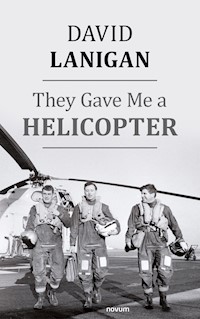
David Lanigan first flew in an aeroplane at the age of 12 at a local civilian flying training school. This sparked a love for flying in the young man, prompting him to learn to fly and join the RAF at age 18; what followed was a long and exceptional career in flying, both with the RAF and with private companies. Follow along as this young man from Dorset sees the world, builds a family, and saves lives, all the while learning more and more about helicopters and life. Front cover photo: Team work is key. SAR crew of pilot, navigator and winchman returning from rescue training in Bridlington Bay, Yorkshire, 1970. In the background is a Westland Whirlwind Mk.10, which equipped UK based RAF SAR squadrons. Back cover photo: Sikorsky S61N in UN colours, taking off from the UN base at Knin, during operations in Croatia, in 1995.
Das E-Book können Sie in Legimi-Apps oder einer beliebigen App lesen, die das folgende Format unterstützen:
Seitenzahl: 642
Veröffentlichungsjahr: 2023
Ähnliche




















Imprint
All rights of distribution, also through movies, radio and television, photomechanical reproduction, sound carrier, electronic medium and reprinting in excerpts are reserved.
© 2023 novum publishing
ISBN print edition: 978-3-99131-494-3
ISBN e-book: 978-3-99131-495-0
Editor: Ashleigh Brassfield
Cover images: David Lanigan
Cover design, layout & typesetting: novum publishing
Images:
pictures 1-8, 10-11, 15-24, 26-37 © David Lanigan,
pictures 9, 12-14, 25 © Ministry of Defence
www.novum-publishing.co.uk
Dedication
I doubt I could have had a career in flying without the support of my wife Ann and without my family putting up with me and taking on someone besotted with flying. They say the first 60 years of marriage to a pilot are the most difficult; so all power to your elbow, Ann, still being there in support after all these years.
Preface
Now that I am fully retired and still just about in full control of my brain and its associated memories, I have decided to put on record, more or less, the story of my life in aviation, mainly as a helicopter pilot, which started in 1953, aged 12, and lasted some 45 years.
It has spanned vast changes in aviation and has given me a very fulfilled and happy career, for which I am very grateful. Had I put this story on record when I was younger, people would have labelled me as a ‘line-shooter,’ so bear with me as I give the story in the first person singular and in the present tense as it gently unfolds. Hopefully this will give you a feel of what it was like growing up and becoming involved in aviation in the post-war era, with all its challenges and opportunities.
Chapter 1: Growing Up
1945 – Age 4
My first memories are of walking along Archery Grove in Woolston, Southampton with my older brothers, John and Peter, pausing at the bombed-out houses; piles of bricks, staircases to nowhere, and wires sticking out of walls. It looks to me like an adventure playground. At the end of the road is the corner shop, which is stacked with glass jars full of sweets, tins, blocks of cheese, lard, loaves of bread, and a pair of balancing scales. The walls are covered in posters from the war: Dig for Victory, Waste Not Want Not; also for products: Bistow Gravy, Cadbury’s Chocolate, Camp Coffee, and Oxo. To me it is an Aladdin’s Cave, full of wonder – all this food, all these sweets, and a big kindly man behind the counter. The doorbell jingles as we leave to return home. I will be coming back, for sure.
Like most families, four boys and one girl, we are struggling to cope with shortages after the war. Food is rationed, including bread and sweets (¼ pound per week). Clothing, too, is rationed. Everything we have is darned to keep it going. Anything that can be knitted, is –scarves, socks, and jumpers, Mum is constantly at it. Balaclavas to keep our heads warm appear in the winter months. Fuel, too, is scarce, and we have one fire in the parlour where we eat at the table and listen to the big radio in the corner with its long wave and medium wave stations. Because it has valves, it takes several seconds to warm up before the programme comes through. One favourite, the BBC Home Service, is the source of all our news and current affairs. For light entertainment, we tune in to shows like ITMA (It’s That Man Again) with Tommy Handley and Much Binding in the Marsh. Close by on the dial is Radio Luxembourg, with popular music.
Above the coal fire is the mantlepiece, where candles are stationed with a box of swan matches, ready for the regular evening power cuts. Dad is often sitting in the big chair near the fire, smoking his Player’s Navy Cut – full strength, one after another. His right hand is stained with yellow nicotine right up to his wrist. As a chain smoker, if he thinks he has run out there is shouting, and we children scatter about the house until word comes that he has found another pack. During the war, like many others doing war work on damaged ships in Portland Harbour, he is given tins of 50 cigarettes a day to calm the nerves. I grow up to accept people smoking around me, though fortunately I don’t take up the habit, despite trying it out with friends one day, perched up a tree for privacy. We feel sick and throw the half-smoked cigarettes away. That experiment saves my health and a small fortune.
Make do and mend is common. I become aware that Mum saves everything that can be reused. Brown paper parcels tied up with string are carefully unravelled. Food parcels from Uncle Joe in New Zealand come wrapped in metal bands to hold the cardboard boxes together; tins of Spam, tins of meat, tins of stew, and tins of fruit such as Bartlett pears or half peaches in juice. They are welcomed along with the tins that Dad brings home from working at the docks. Some cargo is damaged in transit and are sold off cheaply to get rid of it. The larder from time to time fills with big dented tins with their labels washed off. Sometimes potatoes, sometimes beans, sometimes meat, each one a surprise. Each empty jam jar is washed and stacked at the back of the always cold larder. Milk is delivered to the doorstep by a man in a white coat on his milk float. The metal foil tops are collected along with newspapers – the Southampton Daily Echo and the Daily Express appear regularly in the house. As children we have sufficient food to give us the energy to rush around and explore. We grow up fit without an ounce of fat and play outside in all weathers without feeling cold. Every morning we are lined up and given in turn, a spoonful of cod liver oil, orange juice, and malt, all from little bottles issued by the Ministry of Food. From time to time on a Saturday, the milkman lets me help with delivering milk to various doorsteps, with varying responses, sometimes a happy wave, sometimes cheerfully ignored. I am getting to know the local area very well and at the end of the milk round I get a free orange juice, and then walk home a mile from where I am dropped off.
Outside the house is a garden, backing onto a large copse of trees with a stream running through it. Most days my brothers take me out, exploring the paths, climbing over fallen trees, jumping over the stream, making dens with small branches. If we cross over the stream, we can make it up an incline to Mayfield Park with its obelisk and football fields. We return home, often mud-splattered, with scratches, bruises, and torn clothing, where we are sorted out and given yet another lecture by our harried mum and sent upstairs to the bedroom until we were called down for tea of bread and jam and perhaps a piece of cake.
Outside the house and family, world events pass me by. I understand the war, which I was not aware of at the time, is over and things will only get better. Dad mutters about atomic bombs and the tests going on in the Pacific Ocean, with the papers displaying mushroom shaped clouds of atomic debris. As children, we thankfully don’t understand the significance.
After a year of mum taking me to the corner shop and beyond on her shopping trips, I am trusted with the housekeeping purse, some money, and a list for the shopkeeper. I hand it all over to him and watch in awe as he uses a wire to cut cheese, butter, and lard, ladles out loose biscuits, and uses a whirling machine to cut bacon. All are carefully weighed and wrapped in greaseproof paper and put into brown paper bags. He takes the ration books and cuts out the required coupons. He then writes down on the list the amounts, takes the money, puts the change in the purse along with the list, and puts it all in my shopping bag. I am amazed by the whole process, and hurry home as if on a mission. Mum checks everything and I get a pat on the head if all is well.
As children out playing, we met up with other children roaming around, sometimes going to each other’s houses, sometimes playing games in the copse. Mum instructs us that if we were offered a plate of cakes or biscuits by a neighbour, to only take the one nearest to us and not reach across for the biggest one; also, listen and be polite to every adult, using please and thank you where appropriate. In other people’s houses we are to be on our best behaviour.
Eventually it becomes time to go to primary school. Luckily, my elder brother John is still there, and we set off to walk a mile along a new street, with a view of a large ship being built at Woolston shipyard looming at the end. We pass a small park with children’s swings and roundabouts. I resolve to try them out later. The school is of Victorian design, with an asphalt playground, surrounded by a wall with the school gate. In the classroom, seating about 30, we sit at desks with inkwells. In the corner there is a stove where the crates of milk (1/3rdpint each) are sometimes stacked to thaw out. We take some sandwiches for lunch in our little satchels. On the blackboard are our letters – a, b, c, in small and in capitals. We have our writing books to practice our handwriting, first with pencils and then with ink, with much ink blots and scraping of nibs as we work away. Most of our teachers are women; some are kind, some are sharp. At playtime we all rush outside and run around playing tag, sometimes playing hopscotch. We fall over frequently, dust ourselves down and carry on playing. Eventually a teacher appears with a big hand bell, and its ringing makes us rush back to the classroom. Over the blackboard easel we have rollover charts of the world, with the many red areas denoting the British Empire; maps of Europe with its capital cities; and maps of Great Britain, with mountains, rivers, and the complex coastline. Sometimes, when the classroom is noisy with activity, the teacher has to calm us all down. Despite the stove it is often cold in the classroom, and we wear our outdoor coats at our desks; sometimes our gloves as well. Released from school by the bell, we all rush out and set off home, stamping in any puddles we find and scaring any cats relaxing on top of walls or fences. There is little road traffic and just the occasional sit up and beg bicycle. We take home our exercise books to show mum what we are doing; she is very keen on education and encourages us to make progress. At Christmas time the class makes paper chains and they are draped around the classroom. We do this at home as well, saving our efforts for the following year in a cardboard box under the stairs.
As 1946 ends, we hit a cold snap across the country that lasts well into 1947. For children, the snow means throwing snowballs, building snowmen, creating slides along pavements, and stamping on frozen puddles to break the ice. Where icicles hang down, we pull them off or use sticks to break them. At home, coal is short and as children we are sent out into the copse to gather firewood – essentially, fallen branches – and after chopping them up with small machetes, bring them back home. Our war-time Anderson shelter is dug out of the ground and now serves as a garden shed in the back garden. Our pieces of branches are sawn into logs and then join the store of coal we keep under the house. Going to school means wellingtons, coats, balaclavas, and woollen gloves, as well as a satchel. The pavements are covered in snow, so we make slides, not worrying about the adults who pick their way through the snow to the shops. At home the freeze is causing problems: pipes are frozen, then burst, with water everywhere; coal is short; vegetables are short; the house is cold; at night we have coats on the beds and in the morning the bedroom windows have frost patterns all over. As children it is a new experience and therefore exciting. The news across the nation is full of doom and gloom: railways and roads blocked, everywhere food and fuel shortages. As a family we come together, coping with a common problem and accepting lengthy power cuts stoically, gathered in one room with only the light of candles and a coal fire and, of course, no mains-powered radio. We talk and, being the youngest, I listen to people’s experiences. Mr Shinwell, the government Minister for Fuel, is apparently the man to blame. In some ways it is quite chummy, although for our parents, hoping for better times after the war, it probably is quite a big worry, as even potatoes now become rationed. At school our children’s milk arrives frozen, with the cream pushing open the silver foil. The milkcrates are stacked around the stove to thaw out. One day at school we receive a shipment of large red apples from Canada. Each of us is given one to take home for our mothers.
“Don’t eat them on the way home”, comes the stern instruction, which I obey, and Mum is pleased. That evening we all share a segment, which is much appreciated. Mum increasingly looks at my exercise books and my copperplate handwriting, sloping to the right and not very round. Throughout life my handwriting is rarely legible to other people, but I can read it well enough. Perhaps I will become a doctor, writing prescriptions.
As I learn to read, I am told about the local library. On joining I am directed to the children’s section. Soon I am into the Enid Blyton books, the Famous Five and all their adventures. When I have read all of those, I find books by Arthur Ransome, featuring children who sail little boats. I am truly jealous of the fictional children in “Swallow & Amazons”, having adventures with their sailing dinghy on Lake Windermere. Soon I am reading up to three books a week, lapping up the nautical knowledge and a sense of adventure. Inevitably, I find “Biggles”, by Captain W.E. Johns, and all his flying adventures. We are all encouraged to read at home; there was often little else to do in the evening except listen to the BBC Home Service on the big radio or on a crystal set, supplied by my brother Peter.
About this time, I join my brothers in attending Sunday school, which entails a walk through the copse and across the Mayfield Recreation Field. It is a lovely little church, and I learn the Bible stories and the Ten Commandments. I learn to tell the truth rather than lies, though I do later learn some diplomacy. Over my flying career I learnt to distinguish between the facts as they were and the facts as portrayed by people with vested interests. Little did I know that, many years later when I am being positively vetted to receive state secrets, my Sunday school teacher and all other head teachers are formally approached and questioned as to my character. I am apparently a normal, mischievous, and active boy in every way, and therefore acceptable to be trusted.
Eventually it is time for junior school, about a mile from home and in a different direction, involving crossing the busy Portsmouth Road. The crossing code – look right, look left, and right again, and cross if clear – keeps me safe, and I often make the journey alone. This is a stricter school, with the cane for bad behaviour in class. I remember a number of sessions – no doubt fully deserved. One day, after a caning administered by the headmaster for talking in class, he utters the prophetic words: “David, you will either go a long way in this life or end up in jail.”
The emphasis changes from reading and writing to rote-learning the times tables up to twelve.
The class chants in unison day after day. Those tables stick in the memory ever after. We began mental arithmetic; adding and subtracting are straight forward, while long division and multiplication require concentration. We start taking some work home to be given in the next day. I am lucky in that my elder brothers check over my calculations and frequently correct my work. Mum looks at my handwriting and spelling, and again there is room for improvement. However, our joint efforts sometimes earn a gold-star rating, which we all appreciate. Meanwhile, as boys, we become interested in comics, especially American ones featuring Superman flying around the place, always saving the world from the bad guys. We swap comics at break time, along with cigarette cards featuring famous sportsmen, famous cars, ships, and aircraft. Another good feature of the school is swimming lessons in the Lido, near Southampton’s town centre. I learn to swim in the shallow end of the 25-metre indoor pool, using the breaststroke and keeping my mouth shut, as the water is full of chlorine. Within a few sessions I am diving in from the side and swimming underwater for several strokes, eventually completing lengths under water. After an hour the class climb out of the pool, have a shower, change, and go back to school by bus. En-route we compare our crumpled hands and fingers, where the chlorine had extracted the natural oils. Our eyes are often a little red as well, but we were all buoyed up as we were making progress. We can swim, and in the summer, if we behave ourselves, we will be allowed in the outdoor pool.
The outdoor pool, to a little boy, is huge, with a deep end twelve feet deep with a staged diving platform above it. As I grow in confidence with my diving, I look at the challenge of the highest board at 20 feet and contemplate how I could dive straight in with my arms forward and not do a belly flop. One section of the pool has lanes, where I can swim up and down, turning underwater at the ends. A length is 50 yards and every visit I clock up more and more, using a combination of the breaststroke, the crawl, and backstroke. I think I get up to half a mile eventually. Diving in from the side, bombing, and swimming underwater builds up my confidence in being in water, which proves to be useful later on. Eventually I come on my own to the Lido and swim up and down the lanes to my heart’s content. During the school lessons we learn lifesaving, again very useful.
It is a mile from the house to the junior school and I walk it in all weathers, taking care when crossing roads, but looking out for specific vehicles as listed in my “I Spy” handbook. A rare motor car is worth 50 points, so it’s worth checking vehicles as they go by. Soon I am ‘I-Spying’ aircraft, trains, ships, and trees. I learn to observe my surroundings, not just see them in passing. On my various train journeys with the family on a day out to Bournemouth, I look out for locomotives and various types of wagons, the shock absorbing one with three vertical white stripes taking several years before the first one is spotted in a siding. My elder brother Peter, 4 years older, suggests one summer holiday that we buy runabout railway tickets that give us free railway travel within the local area for a week. We go out exploring; Lymington, Christchurch, Winchester and the New Forest, with maps supplied by brother Michael, 8 years my senior, who works at Ordnance Survey in Southampton. Michael is the only one of us boys to do compulsory military service, in his case the Army. He has a mix-up with other soldiers crossing an assault course, ending up with a boot in his stomach area. Three weeks later he is diagnosed with diabetes, and invalided out of the Army, told to have an office job but to get as much fresh air as possible with an outdoor hobby such as sailing. He takes up dinghy sailing and assembles a Mirror dinghy from a kit of parts. Later he buys a 16-foot open-deck sailing boat named Falcon, on which, over a few years, he builds a small cabin and joins the Netley Sailing Club on Southampton Water. He sails with me as crew from May to September then brings the boat ashore for winter maintenance, basically rubbing down and re-varnishing the hull with “Spinnaker” varnish. I learn a lot from him and from the other yachtsmen. Southampton Water is relatively sheltered, with reasonable waves and tidal currents, and clearly marked with red and green buoys are the shipping channels, which are dredged continually. My experience of sailing and the outdoor world builds up and without the intervention of my mother, looking at my schoolwork, I would cheerfully consider going to sea at the earliest opportunity, knowing that the Maritime Training School was close by at Warsash, on the River Hamble. Michael applies for the Royal Naval Auxiliary Service and eventually becomes a skipper of a 60-foot plastic-hulled minesweeper based at Hythe, which was designed to operate in shallow water. However, with 6 crew it is large enough, usefully, to visit the Chanel Isles and the Ports of Northern France.
Michael at the helm of Falcon, Southampton Water.
In my last year at junior school, I become aware of the 11+ selection due in the spring. My brother Peter has passed his and is doing well at Taunton’s Grammar School, a 5-mile bus ride away from home. Now it is going to be my turn. Mum is very keen on education, so I receive some coaching for the exam, in various subjects: English comprehension, problem solving, times tables, spelling, and geometric puzzles. With all this encouragement I do very well, passing the 11+ exam and going to the same school as Peter. I am put into Class 1A1, the top class of 4 for the year, each of which is 30 schoolboys keen to get going. That first morning, the Headmaster, in his flowing black gown, goes around all the new classes outlining the purpose of the school – essentially a stepping stone in our career of our own choosing. In those days you could pick your lifetime-career, whether academic, medicine, law, commerce, or the Armed Services. The school would ensure you had the right mix of O levels and A levels to get into the college, university or any training of our own choosing. Just like that!
Unusually, after the first year the class is split into a science or arts stream, starting A levels in year four without first taking those subjects at O level. The science stream concentrates on pure and applied maths, physics, and chemistry, taking some O level subjects for balance, such as Latin, French, English, English Literature and History along with a little sport. Interesting subjects like Woodworking and Art are dropped, as there was no space for them in the timetable. Sport and athletics find a niche for the first few years before they, too, are squeezed out of the programme. Homework is soon stepped up, initially to two hours a night with extra at the weekend. The one-hour bus journey to and from school sees boys with their heads in the textbooks the whole way.
By chance, one day in August, having achieved the age of twelve, my friend and I cycle down to Hamble to look at the yachts moored on the river. On the way home we pass the grass covered Hamble airfield and, seeing the aircraft take off and land from a distance, wonder if we can get closer. We draw up at the main gate of Air Service Training and, undaunted, go up to the man at the gate.
“Please, sir, can we go inside to look at your aircraft?”
“I don’t know about that, I had better ring the chief instructor.”
After a few minutes we are allowed in and told to report to Squadron Leader Webb in the Air Traffic Control Tower, a white square shaped building amongst the hangars. We find the building, find his office, and knock on his door. “Come in,” booms a voice.
We explain who we are, and he decides to give us a short tour of the facilities, starting at the wooden marshaller’s hut, complete with yellow batons and tea making facilities. He shows us the big hangar where the training aircraft were kept overnight, then the dispersal where there were many small single aircraft and a few large twin-engine machines, all lined up in neat rows. He takes us upstairs to the top of the tower, where through sloping green glass windows we can see the whole airfield, with the active runway marked out with white boards. We stay there a few minutes, watching the controllers directing the aircraft on the ground and in the air.
“I’ll leave you in the capable hands of Mr Cummings, who will explain everything. Knock on my door when you want to leave.” So saying, he goes downstairs and Mr Cummings takes over.
Between controlling aircraft, he explains the layout of the airfield, the signal square outside the tower, and the meaning of the coloured signal lamps that he is using. Aircraft are coming and going all the time and Mr Cummings names them: “That one taxiing out with the wing at the top is an Auster; that one which has just landed is an Airspeed Oxford, just returning from a cross country. In dispersal you can see several sleek shiny aircraft, they are Chipmunks belonging to the University Air Squadron.”
My friend and I sit there for an hour absorbing every detail – absolutely spellbound.
Eventually it is time to go, so we knock on the Chief Instructor’s door. “Come in,” booms his voice. We say our farewells and ask if we could come to see the aircraft again. “Check in at the Entrance Guardroom first.” As we are leaving, I ask if there was any chance we could fly – as ballast – in some of the aircraft in the future. “You can fly if your parents sign an indemnity form, which I will give to you both. They will have to sign over a half crown stamp.”
Clutching the forms, we head for our bikes, check out at the guardroom and race the three miles back home. Much to my surprise, Mum reads the form and says, “You go and buy a stamp and I will sign the form when you come back.” Within an hour the form is signed and after a quick glance through two pages of long legal words, I fold it up, ready for our return to the airfield the next day. Mid-morning saw us again at the main gates being checked in and cleared to proceed to Air Traffic Control. There we present ourselves to the Chief Instructor and flourish our completed forms. He checks them and puts them away in a filing cabinet. “Right, that’s fine, you will be able to fly today. I will take you to the Marshaller’s hut, where you can stay until I come down and collect you prior to your flight.”
We follow him down the steps, out onto the dispersal and into a wooden hut, where we met the aircraft marshallers in their bright clothing. We stay for an hour as aircraft are guided into their required positions on the tarmac. Eventually the Chief Instructor appears and, pointing to me, says, “Right, David, we are going spinning in an Auster. Follow us out to the aircraft. I will strap you in, give you a sick bag in case, and you can sit there in the back while we go up to four thousand feet and prepare for spinning. You will feel the aircraft shaking as we pull the nose up and go into a spin. On recovery the nose will be pointing down quite steeply before we climb up for the next one. We will do three in each direction and then return to the airfield to do some circuits and landings.”
I sit in the aircraft transfixed, noting every detail as the engine is started and magnetos checked. All is well and the chocks are waved away and with a flashing green light from the tower we taxi out onto the grass airfield towards the marked-out runway. More checks, then a steady green light from the tower, and we move out onto the grass runway and take off towards some hangers in the distance. After a few seconds of bumping over the grass we are airborne, and the ground drops away. We are flying above the hangers, the cars, and people on bicycles. Wow!
Ahead is the broad expanse of Southampton Water, the Fawley Oil Refinery, and beyond that the Isle of Wight. We turn left, bringing the Hamble River into view, with lines of yachts; and in the mid-distance, Calshot, with many moored flying boats. As we continue to turn, Portsmouth comes into view, with grey-painted vessels moored up in the upper harbour. Soon we are at the height of large white cumulus clouds. Some checks, then the nose comes up, the engine dies, and then we are spinning. Then it all stops, and we are in a steep dive. The engine comes back to life, and we climb up again. This time we enter the spin in the other direction and, after recovery, we climb up again.
Four more times we enter a deliberate spin and then recover; then we return back to the airfield, which we circle. Looking down, I can see the white runway markings on the grass airfield and the signal square by the white air traffic control tower. The arrow in the square indicates a left-hand circuit; I had learnt that the previous day. Now were approaching the airfield to land. We are descending over the River Hamble with all its yachts, big houses, and a double-decker bus. The engine increases power as I become aware that the flaps are lowered. We cross the hedge at the airfield boundary, the engine dies, and then we are down, rumbling along before the engine increases power, and then we are airborne again. Climbing up, we turn left towards Southampton Water and the then left again so we can see the whole of the airfield. Once again, we turn onto final approach, cross the River Hamble and, still losing height, cross the hedge at the airfield boundary to touch down. This time we come to a stop at the end of the runway, turning left between two white wooden markers before coming to a halt. Some checks are carried out and flaps retracted, then we are on our way back towards the tower, the nose swinging from side to side, allowing us to see where we are going. My friend the marshaller is standing amongst the parked aircraft holding his batons above his head. This is where we are going to end up, choosing our own path to get there. He crosses the batons above his head, and we stop, do some engine checks, and then it splutters to a stop.
The whole world goes quiet, and I am helped out from the back, still clutching my unused sick bag. The marshaller takes me back to his hut and makes me a cup of tea. He listens patiently as I told him what we had done. My companion was also flying, but in the twin engine Oxford. Later, as we cycle home, we work out what to tell our mums. We want to fly again, so nothing too exciting or we will be grounded. I am learning diplomacy at an early age! None of us realise at the time that this is the first day of a lifelong adventure in flying that will take me around the world at somebody else’s expense! Not only were mums to be kept in the dark, but also our mates at school; we do not want any other enthusiastic chaps muscling in on the action.
Squadron Leader Webb who I have to thank for starting my flying career.
Come holiday time, my friend and I cycle down to Hamble, spending our days either in Air Traffic Control or in the Marshaller’s hut. We are learning all about flying, and about the role of Air Service Training (AST) in training up pilots, mainly university graduates, from the Commonwealth and from the Middle East. Before each flight that we are allocated, we listen to the pre-flight briefing by the instructor and after the flight listen to the debrief. We get to understand aviation maps, especially the half million scale map of the South of England, with its airways, control zones, and danger areas. We beg for old copies on their way to the wastepaper basket, which we treasure and take on every flight, identifying towns and cities as we fly around. With flights in the twin engine Airspeed Oxford, sitting in the back as passengers, we need a parachute. The chief instructor rings the parachute store to brief the chief packer of our imminent arrival. On presenting ourselves we sit down on a back parachute, the harness is adjusted around our small frames, and we are shown where the “D” handle is, which we were to pull only when clear of the aircraft. Although it seems to weigh a ton, we proudly carry our “chutes” back to the hut, where we are issued with headphones prior to each flight so we can be on the intercom and hear everything that is being said. We are learning fast, admiring the disciplined way in which flying is organised, on the ground and in the air. We also pick up weather lore, types of clouds, the importance of wind speed and direction on the ground and in the air. You took off and landed with the nose pointing into the wind for good reason. Most of the trainee pilots are training for their National Airline and have to complete a lot of flying and pass ground exams on air law, aerodynamics, and engine handling, as well as carry out instrument let-downs in a procedure trainer, an early form of flight simulator.
The trainee pilots are always smartly dressed and turn up in sports cars; they are not paying for their courses, after all. After they achieved their Air Transport pilot licences they would become first officers (co-pilots) for several years before they would be considered for captaincy. It will be a long slog, but they all seem happy with their prospective futures; after all, this was their chosen career. The instructors are all ex-RAF, some with handlebar moustaches, lots of grey hair, quietly spoken and very self-controlled. Some, like Tony Farrell, DFC, AFC, had flown on Pathfinder operations using Mosquitos during the war, but he would not talk about it, unless politely asked.
The situation as regards access to the airfield remains the same for a year or so, and other boys from Hamble turn up from time to time. Then one day when I was not there, an instructor and trainee pilot start up a twin-engine Oxford. As the engine starts, the undercarriage retracts, damaging the propeller, the engine and the underside of the fuselage. The cause of the accident is that the undercarriage lever is in the “Retract” position and when the engine started, the hydraulic pump provided power to retract the wheels. Notwithstanding the fact that the position of the undercarriage lever is part of the start-up checks, which the crew somehow missed, it was felt that little boys around the dispersal were a liability. They were to be banned unless they had a clear connection with flying, such as the Air Training Corps. This is a big disappointment for me, only to be overcome if I joined the Air Training Corps. I made inquiries at school and am told that the joining age is 14 and the Southampton 424 Squadron HQ is in some huts next to the Civic Centre. They meet in the evening on Tuesday and Thursday at 7pm for 2 hours. I could get there from home by No 5 bus, half an hour ride, so no problem. I duly report and express a wish to join and am accepted, even if slightly underage. I said that I had been flying at AST, Hamble, and I am issued with a uniform including a beret and little notebook which showed when I had joined and what courses I had attended, all in all a record of service and a form of ID. Duly qualified, I report back to AST, proudly wearing my uniform and carrying my flying maps. I am accepted back into the fold and continue to have access to all aircraft types and am now allowed to fly with solo trainee pilots on their cross-country flights.
The first one is a four-hour flight from Hamble to Exeter, north to Llandudno, east to Felixstowe, south to Brighton and then back along the south coast to Hamble. My job is to hold the maps, keep a good lookout and monitor the instruments. After take-off my pilot climbs to 2000 feet and sets off west along the coast. I call out the names of the places, speak about aircraft I can see around us, and check that the engines and systems instruments are reading sensibly. After half an hour, the trainee pilot explains that he had had a good time in London the day before and therefore he is going to relax and let me fly the machine to Exeter, where I am to alert him if he is asleep! As Exeter rolls up, I alert him; he turns the aircraft towards Llandudno, and hands over control to me, gently slumping and pulling down the visor on his cap. Some 50 minutes later the town came in view, and we turn right towards Felixstowe. The flight continues in similar mode, luckily with good visibility. We see military aircraft, mainly Meteors, flying around, some in formation. The countryside unrolls like a carpet, and we stay on track all the way.
Eventually, as we approach Portsmouth, my pilot takes over and we gently descend to 1000 feet. We circle Hamble airfield, looking around for other aircraft and noting the information in the signal square. Left hand circuit, as expected, runway direction as expected. We do checks, lowering the undercarriage and getting the green lights. As we turn onto final approach we get a long green light signal from the tower, so clear to land. The engines are hot after a long flight and begin popping as the throttles came back. The flaps go down, the power increases, and my pilot is using the flying controls quite a lot as we come down the final 500 feet. Over the hedge, throttle back, rumble, rumble from the wheels, pull back on the stick and some gentle braking. We turn off the runway quite close to the end, stop, and do some more checks. Another light signal from the tower, and we taxi back, looking for our marshaller. He is there with his batons above his head, indicating the spot for shutdown. More checks, then, with the throttles fully back, my pilot selects weak mixture for the engines, and they splutter to a stop. Then he switches off the magnetos and closes the fuel cocks. He opens the window to let in some fresh air and indicates to me to leave the cockpit first.
I cannot believe how stiff I am as I climb out of the seat and made my way down the fuselage to open the door. My ears are singing, my muscles are weak, my eyes ache. Slowly we walk across dispersal, looking out for other aircraft moving. I thank my pilot for the trip, find the marshaller’s hut and flop into a chair, exhausted. Half an hour later I cycle home, thinking how much to tell Mum; not a lot, I figure, as I want to repeat the experience and not get grounded.
Ready for a flight in an Airspeed Oxford at AST Hamble.
At school, a few of us boys talk about the upcoming Farnborough Air Show and the latest aircraft that would be on display. One of our dads says he will take a carload of us up if we behave ourselves.
We arrive early but still join the queue for the car park. The tented enclosure is full of salesmen talking about their latest engines, radars, and electronic equipment. Surprisingly, when not talking to potential customers they converse with us boys about the capabilities of their equipment, even giving us brochures to take home and study.
Outside in the static display are a range of jet fighters and bombers with some crews alongside, the RAF pilots in slate grey flying suits, carrying silver-painted bone domes. The latest jets have swept-back wings, designed to delay the effects of shock waves when travelling close to the speed of sound. As the start of the flying show approaches, we boys find ourselves a good open area where we could see the aircraft taking off and landing. We are not disappointed with the flying show, with a range of jet and propeller driven aircraft taking off, displaying, and then landing. There are a few helicopters, but we were only interested in the jets and the daring test pilots who fly them. There is a lot of interest in the press about aircraft trying to break the sound barrier and the problems with control reversal and loss of control due to formation of shock waves over the wings. Eventually it is the turn of Lieutenant Commander Mike Lithgow to display the Supermarine Swift swept wing jet fighter. He roars down the runway, flames coming out of the jet pipe, and disappears quickly out to the West. A few minutes later the public address tells us to look out for him coming in from the left on a supersonic run. Sure enough, a loud double bang and then a small aircraft streaks down the runway, pulling up into a steep climb and disappearing from sight in a few seconds. Wow! That is impressive. A minute later he comes into land from the east, with smoke coming off the tyres as he touches down and taking the whole runway to stop.
Now it is the turn of the rival fighter, the Hawker Hunter, flown by Squadron Leader Neville Duke, a wartime fighter pi1ot with the RAF. He also takes off to the west and the public address says he is climbing up to 30,000 feet before pointing his aircraft towards the airfield, putting it into a steep dive and selecting full throttle on the engine. Sure enough, the double bang and the small aircraft streaking down the runway to disappear in near vertical climb. Sounds of clapping from the audience all round us. A moment to remember. A few minutes later he comes into land, undercarriage and big flaps clearly down, nose up attitude on touch down, rolls to the end of the runway and ends with a slow taxi back to the parking area on the other side of the runway.
Show over, back to the car and the queue to get out, but no worries for us boys, swapping brochures and impressions in the back of the car. That was it. This would be the life for me. I would tell my parents and my headmaster that I was going to join the RAF and fly its latest jet aircraft. At 14, you know, nothing is impossible, just ask for it and people will give it to you!
Who to tackle first – Headmaster or Mum? Problem resolved on Monday at school. It is lunchtime, and I am passing the Headmaster’s room for the canteen. Now is the time, so plucking up courage I knock on his big wooden door.
“Come in,” booms Mr Chalacombe. As I enter he says, “How can I help you, David?”
“I have decided that I want a career as a jet pilot in the RAF and would appreciate your guidance how to achieve this.”
There is a dull pause – clearly not the normal career path for one of his boys. “The Air Force is very technical these days, so like your brother Peter you will need A levels in all your four science subjects plus say six O levels for balance, in fact the same qualifications you would need to go to university. Follow your elder brother, and get good A Level grades in Pure and Applied Maths, Physics and Chemistry. As regards to O levels, you will need History, English, French, Latin, and English Literature. To achieve that in the timetable of lessons you will have to drop Geography.” (A shame, as I enjoy it). He does not try to make me change my mind, and I now have something to aim at.
“Thank you Headmaster, I will get those results that you suggest.” So saying, I leave his study, suddenly hungry for lunch and talking with my aviation-minded friends. Clearly it would have to be tonight that I tackle Mum.
It goes better than expected. If the School’s Headmaster is giving his blessing and points the way in terms of subjects and required grades, effectively University entrance requirements, that is OK. She is keen on my going to university, like my elder brother Peter, and RAF Cranwell is spoken about as the University of the Air. Perhaps I might get in there at 18, if I tried.
So, next night at Air Training Corps I ask to talk to the Commanding Officer, a Squadron Leader in the RAF Reserve, and I outline my aspirations. He gives me the address of the RAF recruiting office in Southampton and suggests writing a letter outlining my plans and what I had achieved so far in terms of flying. I write and I am invited for an interview the following Saturday morning. I suggest to my mum that she comes along but she says, “No, its your life, but see what you can find out.”
I mount the steps of the grand looking building on the Avenue in central Southampton, check in with the Secretary and am taken to the office of the Officer Commanding, a Squadron Leader, a tall grey-haired gentleman with medal ribbons under his RAF wings. He welcomes me and asks what information I am looking for. I outline my desire to become a jet pilot in today’s modern Air Force. I run through my experience of flying with AST at Hamble, my joining No 424 Squadron Air Training Corps and the expectation that I would be able to go gliding at Christchurch in the near future. Finally, I tell him of my interview with my Headmaster and his advice.
“I don’t see any problem with what you want to do. You are doing all the right things at the moment. With the phasing out of National Service shortly, the Services will need full career regular officers and no doubt jet propulsion will be the future for most new aircraft. I think the best thing we can do is to give you a range of leaflets about what the RAF does and some application forms for you and your parents to look at. Come back in six months if you are still keen.”
I follow him into the adjacent room with shelving around the walls. He starts in one corner and picks up appropriate leaflets as he goes round, finally placing them in a big OHMS envelope, writes my name in large capitals on the front and finally stamps the address of his office.
As he hands me the envelope, he shakes my hand. “We get a lot of applications for RAF pilot training, which is long and expensive, and trainees have to reach a very high standard. We can afford to be very choosy when we select pilots for training. Good luck, see you in six months.” I make my way out of the building, clutching my envelope, and head for the bus stop. At home I lay out the leaflets and begin to learn what the RAF is all about. I am being taken seriously, but clearly there are going to be a lot of hoops to jump through before qualifying as a jet pilot in today’s RAF.
Back at school I see my Geography teacher and explain that concentrating on my science course meant dropping geography, a subject I enjoy. “Well, David, you can still study the subject in your own time. I will give you the syllabus, the textbooks, and some past exam papers. The school will put you forward for the O Level exam when you feel ready. I was looking at the list of subjects for our Examination Board and saw that Elementary Aeronautics was also on the list. If you would like, I will get you the syllabus and some past papers to study and you can take that as well. Your experience flying with AST and the courses you receive at the ATC will cover the subject, I am sure.”The next four years are going to be a busy time, I think. Luckily, in my brother Peter I had someone who had been in the science stream, so if I had any problems, he would put me right.
Holiday time and I check in at AST, but there is a problem and I have to see the Chief-Instructor. “Sit down, David, and I will explain the situation. One of our Middle Eastern trainee pilots took a light aircraft away and flew to London and landed in Hyde Park and then took a taxi into the city. We were contacted by the Metropolitan Police and we sent an instructor up with some fuel in cans and he brought the aircraft back. We now have to account for the whereabouts of everyone on the flying side, including visitors like you. If you wish to go anywhere, like the hangar, the factory, or just look into an aircraft cockpit, you will need to be escorted. Understood?”
“Yes, understood. You mentioned the factory – what is being produced there?”
“During the War it was Spitfires, now it’s producing wings for the Javelin all weather fighter. Do you want to have a quick visit? I can arrange it now if you like.”
Five minutes later I am taken across to the big hangars and as we open the door, I can hear the high-speed drills zinging away. I am introduced to the manager, and he takes me round the production line. The internal structure of the wings looks very chunky, and the metal aluminium alloy skin looks half an inch thick as it is bent around and secured to the frames. The wing root looks three feet deep, apparently good for fuel tanks and retractable undercarriage. I spot the ailerons on the trailing edge of the wing, and they are squared off – apparently to stabilise where any shock waves might form at high speed. I am told that the aircraft has powered flying controls, again not affected by any shock waves or prone to flutter. At the end of the line the completed wings are being loaded onto an open lorry with the wing tips pointing up at least twenty feet and covered over. A special route is required to the final assembly plant at Gloucester, avoiding low bridges. I make a mental note of how big the finished delta winged aircraft will be and that it will be replacing the Meteor NF 14 Night Fighters based on the east coast. I could be flying it eventually, so from then I take an interest in all things fighter and air to air missiles, which are replacing cannons as armament.
I am amazed at the Air Training Corps. We parade at 7pm and ex-RAF Warrant Officer Brading takes us for parade drill with and without rifles – 303 Brownings, single shot with a bolt action. Thrown around, it makes a lot of noise. The cadets come from a wide variety of backgrounds, some already skilled in motor mechanics, others electrics, and others already into building. We meld together on parade, during lectures and in taking apart engines, radios and our guns.
I get particularly fond of looking after an ex-Bomber Command Marconi Type 1155 radio receiver. It is a sophisticated “Superhet” design with magic cat’s eye tuning so you can pick up the faintest signal. Because the receiver is so accurate, the matching transmitter (Type 1154), normally in a stowage rack above, can be tuned accurately to the required frequency on the receiver, before transmitting. Not only can you hear voices and music but also you could receive morse code and I quickly get up to the required four words a minute after a few lessons with a morse key. What I appreciate is seeing the blueprint of the wiring diagram, complete with valves, variable capacitors, and colour coded resistors. I like it so much I get one at home, modified to run off the mains, with headphones to keep the noise down in the bedroom. Broadcasts from around the world are available; some from abroad fade in and out, depending on atmospheric conditions. Most nights I listen in to my favourite stations, hearing news and music from everywhere.
The lectures are on aviation-based subjects, meteorology, theory of flight, avionics, aircraft recognition, navigation, and types of aero engines. Also, aspects of the RAF are being taught: ranks, RAF history with films of WW 11, decorations, and command structures. Comprehensive handbooks are available on most subjects, and you can take them home. What I learn with the ATC chimes with what I am experiencing with flying with AST. All this information just soaks in and is retained until needed. As aircraft fly over, I strive to identify them and, if new, to describe them to my friends, i.e. twin piston prop, fixed undercarriage, colour blue heading for Southampton airport.
With my goal of flying with the RAF ahead of me, I just proceed through every exam, every piece of work, every encounter. Every day one more step, one more experience, some new knowledge to tuck away. Every day a new adventure. Time flies when you are busy. I begin a friendship with another ATC cadet, Alan Jones, whose elder brother, Ernie, is a pilot on a Hunter jet squadron. Later he would fly Javelins and be part of the Red Arrows team. Alan is interested in joining the RAF as a pilot, too, and we swap information about how to go about it. Alan is also interested in building a car from scrap parts, an Austin 7, so that when we are old enough, we can learn to drive. We save our pocket money and the money we earn from doing Sunday paper rounds. Eventually we club together and with £5 go to a scrap yard and buy an old pre-war example. A friend tows it to a little grass field out of view of the public. Then Alan and I begin work, dismantling it and working out what can be refurbished and what must be replaced. Luckily, Alan has the knowledge and flair. I provide some manpower and moral support. With a simple A-frame chassis, the body is secured on top and is easily removed by freeing up the nuts and bolts holding it all together. With liberal application of light oil and waiting a few hours for it to soak in, the nuts become easy to undo, and soon the body is off and lying in the field alongside the chassis. There is rust everywhere and we agree the body is too far gone to be repaired, so at some stage we need another body. Undaunted, we carry on cleaning up the chassis with a wire brush and lots of elbow grease. The wiring, unsurprisingly, just falls apart, so new wiring eventually. Now to get the engine out for Alan to take apart, clean and reassemble. He seems confident enough and has the required tools and other friends who will help him put it all back together. He has a handbook for the car, complete with colour-coded wiring diagram; invaluable when we put the new wiring harness together. I look at the page on mpg versus speed: best at 30 mph and the graph stops at 50 mph, looks sensible to me. The project takes years, but eventually a serviceable, hand-painted black car is ready to drive. A friend who drives has offered to demonstrate it on some nearby rough ground. It starts up. Wow! I climb in the back, Alan in the front next to young driver Ian, and off we go in first gear, nice and slow. Ian gains confidence and we proceed along a bit of track, picking up speed, with Ian changing gear into top and now up to 30 mph. We come to a bend with a bank on the left. For whatever reason, Ian heads up the bank and then yanks the steering to the right. We roll over with a crash, some windows smash. Without seat belts we are thrown around and the newly painted car is lying on its side. We get out through the left-hand door with bodies not too bruised. While standing there, we hear a trickling sound and eventually locate the battery, where its contents of sulphuric acid are pouring into the car. We have to right the car and get it back home, so with the help of the many onlookers we roll it over onto its wheels again and push it back home. Alan says he can fix everything, which he does. It will be not until I am 21 that I get my first driving licence, and my first car, an Austin Minivan, all in Anglesey, and that six months after I have gone supersonic in a two-seat jet Hawker Hunter Trainer of No 56 Squadron with Ernie Jones over the North Sea, flying from RAF Coltishall in Norfolk.
Back at No 424 (Southampton) Squadron ATC, parades, classes, aircraft recognition, and socialising continue two nights a week. Every year in the summer holidays the Squadron goes to an RAF Station so those cadets considering a career in the RAF will see for themselves what the modern Service is all about. My first camp, in August 1955, is to RAF Wittering, near Stamford Lincs. The main aircraft on the station are the swept-wing Vickers Valiant bombers. Close up, they are huge, and painted white. I notice that the two-wheel undercarriage retracts outwards, and the leading edge of the wing has compound sweep from the root to the tip, where there is a long pitot tube. The five-man crew enter the cockpit via a ladder on the port side. The two pilots have ejection seats. The three rear-crew – Nav Radar, Nav Plotter, and Air Electronics Officer – have seats and normal parachutes and are considered at risk if a bail out is necessary below 2000 feet. They face backwards apart from when the visual bomb aimer position in the nose is being used. The cockpit is in a pressurised cabin, enabling the aircraft to fly to very high altitude. The navigator has access to a periscopic sextant in the cabin ceiling to take shots of the sun and the stars so he can navigate in any part of the world without ground facilities. As cadets we get to fly in an Avro Anson, looking down on a big station with a 9000-foot runway. On the ground I notice one Valiant with bulges underneath the engines. The liaison officer explains that they are De Haviland Sprite booster rockets, used to enable overweight take-offs. Once airborne they are dropped. In talking to the young pilot conducting the trials, he explains that only 60 seconds of extra thrust is available and his job during trials is to work out the optimum time for them to be fired up during the take-off run. He feels that 20 seconds after brake release is about right, so that the extra thrust is there for a while after the aircraft leaves the ground (many years later I learn that the trials are abandoned because of the satisfactory performance on normal engines without booster). I notice a red sports car nearby that I don’t recognise. He takes me across to it and explains he is building it from a kit of parts. He is not happy with the recommended positions of the speedometer and rev counter. I suggest changing them over. Three days later, as we board the coach to leave, our liaison officer tells me the pilot did just that and is pleased with the result, and would I like to see the car in action during a test drive?! Another day, perhaps.




