



0,49 €
Niedrigster Preis in 30 Tagen: 1,99 €
Niedrigster Preis in 30 Tagen: 1,99 €
Mehr erfahren.
- Herausgeber: Booksell-Verlag
- Kategorie: Sachliteratur, Reportagen, Biografien
- Sprache: Englisch
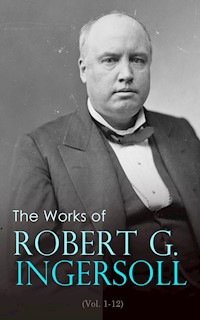
In "Thomas Paine," Robert Green Ingersoll presents a compelling homage to one of the Enlightenment's most influential thinkers. Through a blend of impassioned rhetoric and incisive analysis, Ingersoll explores Paine's revolutionary ideas, particularly his advocacy for reason, individual rights, and the critique of religious dogma. This work stands as both a biography and a philosophical treatise, reflecting the literary context of the late 19th century, an era marked by burgeoning skepticism towards tradition and authority. Ingersoll's eloquent prose not only encapsulates Paine's legacy but also serves as a rallying cry for contemporary intellectual freedom and reform. Ingersoll, a leading orator and agnostic of his time, was profoundly influenced by the principles of rationalism and humanism, both of which were prevalent in Paine's writings. His own experiences as a public speaker and reformer in a post-Civil War America fueled his desire to underscore the importance of free thought and enlightenment ideals. Ingersoll's admiration for Paine's courage in challenging societal norms and his polemical stance against organized religion showcases the continuity of revolutionary thought from Paine's era to his own. Readers who cherish critical engagement with history and philosophy will find Ingersoll's "Thomas Paine" an enlightening exploration. This work not only honors Paine's contributions but also encourages modern readers to reflect on the principles of liberty and reason. As current societal questions echo those of the past, Ingersoll's text emerges as both timely and timeless, urging a deep dive into the foundations of democratic thought. In this enriched edition, we have carefully created added value for your reading experience: - A succinct Introduction situates the work's timeless appeal and themes. - The Synopsis outlines the central plot, highlighting key developments without spoiling critical twists. - A detailed Historical Context immerses you in the era's events and influences that shaped the writing. - A thorough Analysis dissects symbols, motifs, and character arcs to unearth underlying meanings. - Reflection questions prompt you to engage personally with the work's messages, connecting them to modern life. - Hand‐picked Memorable Quotes shine a spotlight on moments of literary brilliance. - Interactive footnotes clarify unusual references, historical allusions, and archaic phrases for an effortless, more informed read.
Das E-Book können Sie in Legimi-Apps oder einer beliebigen App lesen, die das folgende Format unterstützen:
Veröffentlichungsjahr: 2021
Ähnliche











Thomas Paine
Table of Contents
Introduction
Here, a passionate defense of a revolutionary’s character and contributions collides with the enduring power of slander, superstition, and historical amnesia, asking whether a people who owe their liberties to an audacious critic of orthodoxy can face, without evasion or fear, the uncomfortable fact that progress often marches under the banner of heresy and that gratitude, when tempered by piety or party, easily mutates into silence, distortion, and the convenient forgetting of the very mind that helped summon a new nation into being, and still challenges complacency in every generation.
Thomas Paine by Robert Green Ingersoll is a biographical oration and polemical essay first delivered as a public lecture in the United States in the late nineteenth century, then circulated in print in collected editions of Ingersoll’s writings. Its genre straddles tribute, history, and courtroom summation, reflecting the freethought culture that flourished in that period. Instead of narrating events as a conventional biography might, Ingersoll addresses an audience, invoking the civic stage as his setting. The publication context underscores its purpose: to intervene in public memory and to contest clerical and partisan narratives that had long overshadowed Paine’s legacy.
The premise is straightforward yet provocative: restore Thomas Paine to a place of honor by weighing his ideas and public service against the accusations that diminished his name. Readers encounter an orator’s voice—measured, rhythmic, and insistent—guiding them through biographical sketches, historical references, and ethical claims. The experience is not archival immersion but moral argument sharpened by wit, irony, and indignant clarity. Ingersoll’s prose invites the listener-turned-reader to participate, supplying judgment as a juror would. Without pedantry, he offers connections among political courage, literary craft, and civic gratitude, shaping a reading that feels both ceremonious and conversational.
Key themes surface with immediacy: freedom of conscience; the cost of dissent; the difference between reverence for truth and reverence for authority; and the fragility of reputation in the court of public opinion. The essay examines how democratic societies inherit their freedoms from startling, sometimes abrasive voices, then struggle to honor those voices without sanitizing them. It also charts the recurring conflict between reasoned inquiry and dogmatic certainty, pressing readers to consider what fairness demands when judging the past. Underneath the argument runs a humanist impulse—an insistence that courage, honesty, and sympathy are civic as well as personal virtues.
Ingersoll’s method blends capsule biography with forensic rebuttal. He recounts formative labors, situates controversies in their historical moment, and exposes the mechanics of reputation—how insinuation travels faster than evidence, and how hostility can harden into tradition. The style is emphatically oral: sentences build by cadence, parallelism, and cumulative emphasis, designed to move a hall as much as to inform a page. Yet the eloquence supports, rather than substitutes for, reasoning. Readers will find a lucid throughline, steady transitions, and a deliberate refusal to reduce complexity to caricature. The result is an accessible, persuasive performance of historical criticism in motion.
For contemporary readers, the work’s relevance lies in its exploration of memory and dissent. It asks how communities decide whom to celebrate, what evidence they trust, and how to reconcile gratitude with disagreement. In an age alert to misinformation and polarized narratives, the essay’s call for proportion, context, and intellectual hospitality feels timely. It encourages readers to question inherited judgments, to distinguish between moral discomfort and moral indictment, and to see skepticism not as disloyalty but as a form of civic care. By modeling fearless yet fair appraisal, Ingersoll offers an ethics of remembrance suited to public life today.
To approach Thomas Paine through Ingersoll is to encounter a spirited defense that doubles as an invitation: reconsider a much-maligned figure and the ideals he helped to advance, and reconsider also the habits of mind that either honor or betray such figures. The book offers a brisk, impassioned passage through history’s courtroom, combining warmth with rigor and celebration with scrutiny. It will appeal to readers drawn to political thought, intellectual history, and the craft of oratory. Above all, it proposes that honest gratitude is itself a radical act, and that clear judgment is a public responsibility.




