



0,49 €
Niedrigster Preis in 30 Tagen: 1,99 €
Niedrigster Preis in 30 Tagen: 1,99 €
Mehr erfahren.
- Herausgeber: Booksell-Verlag
- Kategorie: Geisteswissenschaft
- Sprache: Englisch
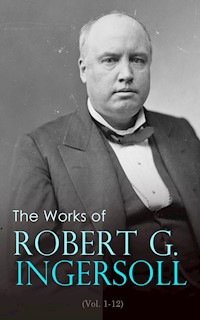
In "Walt Whitman: An Address," Robert Green Ingersoll offers a profound tribute to one of America's most influential poets. This eloquent oration captures the essence of Whitman's revolutionary spirit, his embrace of individuality, and his deep connections to humanity. Ingersoll's rhetorical style is both lyrical and impassioned, reflecting the transcendental and Romantic literary movements that shaped Whitman's work. Through a careful examination of Whitman's poetry, Ingersoll elucidates the themes of democracy, freedom, and the celebration of the self that permeate Whitman's oeuvre, establishing a context for appreciating the poet's contributions to American literature and culture. Robert Green Ingersoll, often heralded as the "Great Agnostic," was a prominent orator and advocate for secularism, human rights, and free thought in the late 19th century. His admiration for Whitman was rooted not only in their shared belief in the intrinsic value of the individual but also in their mutual commitments to social reform and the questioning of rigid norms. Ingersoll's address is a culmination of his philosophical inquiries and his desire to inspire others to embrace Whitman's vision of humanity. This book is an essential read for anyone seeking to understand the intersection of poetry and philosophy in American literature. Ingersoll's articulate celebration of Whitman invites readers to reflect on their own existence and challenges them to embrace the democratic ideals that Whitman championed. It stands as a timeless reminder of the power of poetry to evoke change and inspire the human spirit.
Das E-Book können Sie in Legimi-Apps oder einer beliebigen App lesen, die das folgende Format unterstützen:
Veröffentlichungsjahr: 2021
Ähnliche


Walt Whitman: An Address
Table of Contents
Of all the placid hours in his peaceful life, those that Walt Whitman spent on the stage of Horticultural Hall last night must have been among the most gratifying, says the Philadelphia Press of October 22, 1890. To a testimonial, intended to cheer his declining years, not only in a complimentary sense, came some eighteen hundred or more people to listen to a tribute to the aged poet by Col. Robert G. Ingersoll, such as seldom falls to the lot of living man to hear about himself.
On the stage sat many admirers of the venerable torch-bearer of modern poetic thought, as Colonel Ingersoll described him, young and old, men and women. There were white beards, but none were so white as that of the author of "Leaves of Grass." He sat calm and sedate in his easy wheeled chair, with his usual garb of gray, with his cloudy white hair falling over his white, turned-down collar that must have been three inches wide. No burst of eloquence from the orator's lips disturbed that equanimity; no tribute of applause moved him from his habitual calm.
And when the lecturer, having concluded, said, "We have met to-night to honor ourselves by honoring the author of 'Leaves of Grass,'" and the audience started to leave the hall, the man they had honored reached forward with his cane and attracted Colonel Ingersoll's attention.
"Do not leave yet," said Colonel Ingersoll, "Mr. Whitman has a word to say."
This is what he said, and no more characteristic thing ever fell from the poet's lips or flowed from his pen:
"After all, my friends, the main factors being the curious testimony called personal presence and face to face meeting, I have come here to be among you and show myself, and thank you with my living voice for coming, and Robert Ingersoll for speaking. And so with such brief testimony of showing myself, and such good will and gratitude, I bid you hail and farewell."
THE ADDRESS.
Let us Put Wreaths on the Brows of the Living.
I.
In the year 1855 the American people knew but little of books. Their ideals, their models, were English. Young and Pollok, Addison and Watts were regarded as great poets. Some of the more reckless read Thomson's "Seasons" and the poems and novels of Sir Walter Scott. A few, not quite orthodox, delighted in the mechanical monotony of Pope, and the really wicked—those lost to all religious shame—were worshipers of Shakespeare. The really orthodox Protestant, untroubled by doubts, considered Milton the greatest poet of them all. Byron and Shelley were hardly respectable—not to be read by young persons. It was admitted on all hands that Burns was a child of nature of whom his mother was ashamed and proud.
In the blessed year aforesaid, candor, free and sincere speech, were under the ban. Creeds at that time were entrenched behind statutes, prejudice, custom, ignorance, stupidity, Puritanism and slavery; that is to say, slavery of mind and body.
Of course it always has been, and forever will be, impossible for slavery, or any kind or form of injustice, to produce a great poet. There are hundreds of verse makers and writers on the side of wrong—enemies of progress—but they are not poets, they are not men of genius.
At this time a young man—he to whom this testimonial is given—he upon whose head have fallen the snows of more than seventy winters—this man, born within the sound of the sea, gave to the world a book, "Leaves of Grass." This book was, and is, the true transcript of a soul. The man is unmasked. No drapery of hypocrisy, no pretense, no fear. The book was as original in form as in thought. All customs were forgotten or disregarded, all rules broken—nothing mechanical—no imitation—spontaneous, running and winding like a river, multitudinous in its thoughts as the waves of the sea—nothing mathematical or measured. In everything a touch of chaos—lacking what is called form as clouds lack form, but not lacking the splendor of sunrise or the glory of sunset. It was a marvelous collection and aggregation of fragments, hints, suggestions, memories, and prophecies, weeds and flowers, clouds and clods, sights and sounds, emotions and passions, waves, shadows and constellations.
His book was received by many with disdain, with horror, with indignation and protest—by the few as a marvelous, almost miraculous, message to the world—full of thought, philosophy, poetry and music.
In the republic of mediocrity genius is dangerous. A great soul appears and fills the world with new and marvelous harmonies. In his words is the old Promethean flame. The heart of nature beats and throbs in his line. The respectable prudes and pedagogues sound the alarm, and cry, or rather screech: "Is this a book for a young person?"
A poem true to life as a Greek statue—candid as nature—fills these barren souls with fear.
They forget that drapery about the perfect was suggested by immodesty.




