


6,99 €
Mehr erfahren.
- Herausgeber: Corvus
- Kategorie: Gesellschafts- und Liebesromane
- Sprache: Englisch
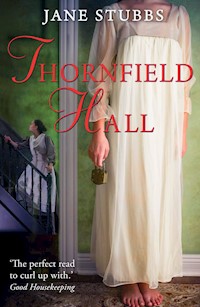
The Rochesters are very good at keeping secrets... Thornfield Hall, 1821. Alice Fairfax takes up her role as housekeeper of the estate. But when Mr Rochester presents her with a woman who is to be hidden on the third floor, she finds herself responsible for much more than the house. This is the story Jane Eyre never knew - a narrative played out on the third floor and beneath the stairs, as the servants kept their master's secret safe and sound.
Das E-Book können Sie in Legimi-Apps oder einer beliebigen App lesen, die das folgende Format unterstützen:
Veröffentlichungsjahr: 2014
Ähnliche




















Jane Stubbs studied English at London University. She went on to teach the subject to a variety of ages in colleges and schools. As well as raising a family, she has worked for various charities, has written a weekly column for a Scottish newspaper, and has won prizes for her short stories.
Published in paperback in Great Britain in 2014 by Corvus, an imprint of Atlantic Books Ltd.
Copyright © Jane Stubbs, 2014
The moral right of Jane Stubbs to be identified as the author of this work has been asserted by her in accordance with the Copyright, Designs and Patents Act of 1988.
All rights reserved. No part of this publication may be reproduced, stored in a retrieval system, or transmitted in any form or by any means, electronic, mechanical, photocopying, recording, or otherwise, without the prior permission of both the copyright owner and the above publisher of this book.
This novel is entirely a work of fiction. The names, characters and incidents portrayed in it are the work of the author’s imagination. Any resemblance to actual persons, living or dead, events or localities, is entirely coincidental.
10 9 8 7 6 5 4 3 2 1
A CIP catalogue record for this book is available from the British Library.
Paperback ISBN: 978 1 782 39524 9
E-book ISBN: 978 1 7823 9523 2
Printed in Great Britain.
Corvus
An imprint of Atlantic Books Ltd
Ormond House
26–27 Boswell Street
London
WC1N 3JZ
www.corvus-books.co.uk
To Alan who understood
CONTENTS
Acknowledgements
My First Mr Rochester: 1821
My Third Mr Rochester: 1822
Grace: 1823
The Lady: 1823
Monsieur Alphonse: 1824–5
The Incident in the Library: 1826
The Honourable Blanche Ingram: 1827
Adele: 1831
A Year of Tumultuous Events: 1832
The House Party: 1832
Bertha’s Story: 1832
Summer: 1832
Calling the Banns: 1832
A Country Wedding: 1832
An Eventful Day in July: 1832
My Mad Mr Rochester: 1832
The Harvest: 1832
Martha and I Join the Gentry: 1832
Postscript: 1833
Q&A with Author Jane Stubbs
Reading Group Questions
Other Characters from the Classics that Could Have their Story Told
ACKNOWLEDGEMENTS
Thanks are due to many people. Here are some of them:
First and foremost to Charlotte Brontë for writing a novel so full of vivid life that it is possible to walk about her creation and look behind the scenes.
To Teresa Chris for finding a publisher.
To Atlantic for bringing my infant to full term.
To the late Maggie Batteson, Pat Hadler, Mary Sharratt and Cath Staincliffe for their patient reading and helpful comments on my apprentice pieces.
Last but not least to A G de C Smale, she of the elegant initials who first introduced me to the glories of the English language and to all the others who followed in her footsteps.
MY FIRST MR ROCHESTER
1821
IT WAS AFTER I’D GONE TO MY FIRST MR ROCHESTER that my hair turned white. They do say it can happen overnight through disease or grief. In my case it was not so dramatic. Day by day the gold in my hair gently faded away until it was a pure snowy white. There I was, not yet forty and I had the hair of an old woman. I cannot blame illness for my transformation but I do think grief played its part. There had been many bereavements in my life, and in going to Thornfield Hall as housekeeper I said farewell to something that I had been raised from a child to regard as precious beyond rubies. According to my mother its preservation was as vital to an unmarried girl as her virginity. Like a maidenhead it was something to be treasured, not disposed of carelessly in an idle moment, for once lost it could never be recovered. I refer not to my virginity, which is long gone, but to my place in society. By being employed as a paid servant I was cast out from that privileged class of beings – the gentry.
My mother was gentry. As the daughter of a gentleman and the widow of a clergyman she claimed it as her birthright. She clung desperately to this status. It seemed to console her for the poverty and the meagreness of her life. Throughout my rather miserable childhood she drummed into me the importance of this mystical privilege that a gentlewoman must at all costs cherish and preserve. Never mind that we dined on crusts and scraps and had no fire before six o’clock of an evening; we were gentry and we had a servant to prove it, some poor unfortunate twelve-year-old village girl cozened into washing our dishes for a few pennies a week. If my mother ever discovered that I had swapped genteel poverty and semi-starvation for the good food and warmth enjoyed by the servants of a wealthy man she would turn in her grave.
For that is where she is. She left this world early but not before she contrived to see me suitably settled in life. Marriage was the only path open to me; my mother’s constant lectures made that clear. I sleep-walked to my wedding. I woke one day to find I was married to the parson of the church in the village of Hay. Now a parson, no matter how poor he is, always counts as gentry. He will be invited to the big house for lunch during the week or supper on a Sunday. He will go to the front door and a servant will take his hat. The parson’s wife, therefore, counts as gentry. And so my mother died happy that she had done right by me.
I was not with my parson for long. Just time enough to have and to lose one beautiful baby girl. Then the coughing sickness took my parson the next winter and by spring the new incumbent was knocking on the door of the parsonage. Mr Wood, the replacement for my husband, had a pack of children and he was anxious to introduce them to their new home and to see the back of me. I was at a loss as to what to do.
My late husband was a sweet-tempered and mild-mannered man. He was very much a follower of the New Testament; he trusted in the Lord to provide. Consider the lilies of the field. Lay not treasures up for yourself on earth. That sort of thing. I am more of an Old Testament person myself. I like the drama of it: the feuds, the plots and the adultery. Perhaps that’s why the Lord did not see fit to provide for me when I became a widow.
With no home and no income I became that most uncomfortable thing, a distant relative in need. My late husband was a Fairfax so I applied to his family. They sighed and held up their hands to show they were empty. They shuffled me about from house to house whenever there was extra work to be done. I sat up nights with the dying. I nursed the sick. While the family went away to the seaside I stayed to supervise the spring cleaning. They derived much satisfaction from being such exemplary Christians as to feed me and give me a roof over my head. They conveniently forgot that unlike a servant I received no wages.
It was an interesting if precarious life. A second cousin summoned me to help when her third baby was due. Her two lovely boys were soon joined by a baby girl. Such a pleasant time I had. I grew very fond of the children and began to hope I might make a real home with the family. One morning I was in the nursery supervising the children at their breakfast. The baby wriggled on my knee as I spooned porridge into her. Their mother arrived in her dressing gown with a letter in her hand. She waved it at me as she gave me the news. The wife of old Mr Rochester of Thornfield Hall had died; she too had been a Fairfax. To my second cousin the news was not all bad; she saw an opportunity to move me on.
‘I’m sure Mr Rochester would be grateful for some help at this sad time, Alice. Especially from a female relation. Someone he could trust to deal with all those things his wife always dealt with. Men know nothing about running a house. You know what I mean: keep the housemaids in order, tell cook the soup was salty. I’ll be sorry to see you go,’ she said, ‘but I won’t need so much help soon. The boys will be away to school in the autumn.’
I could see her mind working. She was thinking, Thornfield Hall is a large house. There must be a room somewhere that a parson’s widow could occupy. She could do a little light needlework. She does not eat much. A bit of a fire in the winter. Old Mr Rochester is a man of property and wealth; he would not let a connection of his wife’s starve. He would lend her back to me if, God forbid, I have another baby.
I was angry. And I was jealous. She had everything I had been denied. She had a husband with an income while I was a penniless widow. She had three healthy children while I had lain to rest my one baby girl who had scarcely drawn a breath. The rage churned about in my bosom all day. I hammered it down while I smiled and played with the boys and stroked the baby’s soft hair. I knew I would be saying farewell to them soon.
My late husband always said his prayers before he lay down to sleep. In the morning he frequently claimed that his prayers had been answered. That night I berated God. I gave it to him hot and strong, told him that he had been unreasonably harsh in his dealings with me. I put it to him fair and square. I do not think my long and bitter diatribe could be regarded as a proper prayer but to my surprise I awoke with my mind clear and with a settled plan for determined action. You could say that my prayers had been answered.
I wrote to old Mr Rochester, with whom I was already acquainted. I reminded him that not only was I a Fairfax, I was also the widow of the parson at Hay whose church was close to the gates of Thornfield Hall. I included a suggestion that would have shocked my second cousin if I had been so foolish as to reveal it to her. I received an encouraging response. Some haggling followed but in the end I struck a bargain with the senior Mr Rochester that suited both of us. I knew how to run a house with economy and he could trust me not to steal the spoons. I became the paid housekeeper at Thornfield Hall.
Suddenly I wasn’t gentry anymore. I was a servant, an upper servant to be sure, but a servant nonetheless. My second cousin went through a range of emotions. She was shocked that I had chosen to lose caste, angry that she could no longer call upon my unpaid services and finally relieved that the Fairfaxes could with clear consciences wash their hands of me. This they did with alacrity. I was on my own. It was frightening but also exhilarating. I squashed the flutterings of doubt that beat in my breast and set off to take up my new duties.
Mr Merryman, the butler, greeted me on my arrival at Thornfield Hall. I never saw anyone so unsuited to his name; his lugubrious face with its hanging jowls reminded me of the dogs they use for hunting hares and rabbits. Mr Merryman took it upon himself to ensure that I learnt how to do things properly. He would dine with me in the housekeeper’s room. Our meals would be brought on a tray by one of the lower servants.
‘We,’ he informed me, ‘are senior servants. Sometimes we are known as “pugs” because we wear a serious expression with our mouths turned down like the pug dogs.’ He gestured to his own face with its drooping mouth. ‘Sometimes,’ he sighed, ‘I think it’s permanent; I’ve done it for so long.’ As he showed me round the house Mr Merryman explained various other matters that he thought it important for me to know about my new position. As a mark of respect I would be called Mrs Fairfax by both the staff and the family, rather than just ‘Fairfax’ as if I were a chambermaid.
Only two members of the family lived at the Hall. They were old Mr Rochester and his elder son Rowland. I remembered a younger son, Mr Edward, from my time at the parsonage in Hay. He was an open-faced friendly lad, usually whistling as he rode his horse about the countryside, but he had gone to live abroad somewhere.
As housekeeper I would wear my own clothes rather than a uniform. I promptly ordered a black silk dress to celebrate my new status as a woman who earned her own income. Mr Merryman explained to me that visitors sometimes came when the family was away. These callers might ask to be shown round the house. I was free to oblige them, as long as they were gentry of course. Mr Merryman tapped the side of his nose and for a moment his eyes twinkled in his sad face. ‘Tips!’ He gave me a knowing look. ‘Good tips and all yours.’
My bedroom was to be near the master’s bedroom. As I was closely connected to the family it was thought more suitable. Mr Merryman had his own room on the next floor, close to where the servants slept. He liked to keep an eye on the young footmen, who could be quite frisky. All in all, Mr Merryman felt Thornfield Hall was a good house to work in. To be sure the wages were modest as old Mr Rochester was very near with his money, as we say in Yorkshire, but he kept a good table and there were enough staff to carry out the work of running a large house.
I soon got to know the staff. Leah, the under housemaid, quickly became a favourite of mine. There was Sam, officially a footman but really a Jack of all trades. He had been in the navy and had seen more of the world than any of us. There was a new footman, called John, though his given name was Timothy. It was the custom among the gentry to refer to footmen as John; it saved them having to remember their real names. The head coachman, who had been christened John, was usually called Old John to distinguish him from the footman. His wife Mary was the cook. These five formed the backbone of the staff. I soon discovered they were all fine honest people who knew their duties and carried them out well. There was a sprinkling of scullery maids, laundry maids, kitchen and stable boys who came and went as they learned their trade and moved on in the world. The only thorn in my flesh was Martha, the upper housemaid.
She was the most unbiddable girl I have ever come across. A great clumsy galumphing thing. She laid the breakfast table as if she was dealing cards. There was always a reason why she couldn’t do as she was asked. If I told her to take the coal to the dining room she would do it later – she was on her way to answer the bell in the drawing room. Ask her to dust the hall and she would have to go and change her apron and would not be seen again until tea time. She was lazy and sharp-tongued with a neat way of passing the blame to the other servants. When Martha broke a vase it was Leah who was found sweeping up the shards of porcelain.
By searching out these and other examples of her bad behaviour I quickly found abundant reasons to justify my dislike of Martha. The real reason was deeper and more shameful. When Mr Rochester gave me a bedroom near his I had wondered if he might be minded to inflict some indignities on me. Innocent parson’s wife I might be but even I knew such things happened. Sometimes in the mornings as I left my room to go about my duties old Mr Rochester would call to me from his bedroom. At first I hovered in the doorway to listen to his complaints. He had not slept well. The joints of his fingers were swollen and painful. Soon I was entering his room and rubbing his hands. Then it was his shoulders. Matters did not progress much further. To be honest I took no offence at giving him these small attentions. He was an old man who had lost his wife and who missed the touch of a woman’s hand.
Martha was never punctual in her duties. For her the clock was just a tiresome picture on the wall. She arrived very early one morning with the hot water and caught me leaving Mr Rochester’s room. I wore my nightgown under my dressing gown, and my hair, still golden then, hung loose about my shoulders. I told Martha sharply that the master had called me in as he felt unwell. To give the master his due, he played up to the fiction nicely by staying in bed for the rest of the morning. He drew the line at sending for Carter, the surgeon. That would have cost him money.
I was never sure that Martha believed me.
In spite of this minor worry, for a year or so I was able to enjoy a very pleasant existence, until the course of my life was upset by the cold hand of death. His icy fingers were not laid upon old Mr Rochester as you might expect but upon Mr Rowland, the elder son. Mr Rowland was not my favourite person. He was a whey-faced lanky creature, always indoors doing his calculations or peering through his magnifying glass. He was the kind of boy who pulled the wings off flies, or captured harmless insects as they were going about their lawful business and stuck pins in them. Science he called it. Well, science didn’t do him much good. He went gallivanting off to visit a coal mine in the north where they had one of those new-fangled steam engines. In the interest of science, no doubt, he went too close to the machine and got himself crushed by the metal monster. He died of his injuries before they could carry him home.
Old Mr Rochester took it very hard. The lawyers came with long faces and talked to him about the future and advised him to call his younger son, Mr Edward, home. He wouldn’t hear of it, just shook his head and poured out more port. The only comfort he could find was at the table. I’ve lost count of the roast dinners he ate without adding an ounce of fat to his skinny frame. We servants tip-toed round the house and shared our fears in whispers. Our master was a broken man and his lawful heir was in exile. Our futures looked very insecure.
One evening Mr Rochester rose from the table having dined on roast duck with green peas. He had drunk with it a bottle of claret. Afterwards he sluiced down a bowl of Bavarian cream and demolished half a pound of Wensleydale cheese. ‘Damn fine—’ he began. His compliment was interrupted as he clutched at his throat and fell backwards against the sideboard. I will never know whether it was the duck, the pudding or the cheese that had taken his fancy.
The footmen helped him to his bed. Old John sat up with him that night. In the morning old Mr Rochester was dead. Mr Carter, the surgeon, scratched his head as he felt for the pulse that was not to be found. ‘Don’t understand it. He was fit as a flea.’ Not one to worry overmuch about minor details Mr Carter declared, ‘I suppose I should call it a Visitation of God but I hate to give Parson Wood any excuse to be more self-important than he already is. I’ll call it an apoplexy. We don’t want to be bothering the coroner. You were here when he died, Mrs Fairfax, so you can register the death. Tell the parson to arrange the funeral.’ With that he picked up his hat and his riding crop and took his leave briskly; the hunt was meeting that day.
And so I bid farewell to a second Mr Rochester. I was sad to see him go but it was the threat to my livelihood that caused me the greater anguish. And this time there would be no help from the Fairfaxes. I had crossed the line that divided relations from servants. Relatives could not be left to starve. Servants could – and did.
The lawyers came again but this time with smiling faces. Old Mr Rochester had died without making arrangements for the estate. The lawyers scented dispute and conflict; there would be claims and counter-claims, special pleadings, counsels’ opinions and judges’ rulings. All such complications were not misfortunes for them, but opportunities for endless work and massive bills. While the lawyers rubbed their hands we servants at Thornfield Hall suffered much uncertainty. At last it was arranged that we should be put on board wages. The amount was generous compared with many other households but our fare would be plain with no leftovers from the dining table to enjoy. There would be no more finishing off a baron of roast beef with the remains of a bottle of good claret.
Mr Merryman left immediately to take up a position with a rich manufacturer of wool in Bradford. His new master was trade rather than the gentry he was used to, but as he said, beggars can’t be choosers. He had lost two masters in quick succession and could not afford to be fussy. Some might think it carelessness on his part and be reluctant to employ him.
Our number dwindled as those who could found other employment. Grooms and kitchen maids soon found new masters in the neighbourhood. Without Mr Merryman to insist on my following the conventions I decided to stop having my meals in the housekeeper’s room and to eat with the others in the servants’ hall. I explained the change as a way of saving Mary and Leah from extra work. It was not a time to maintain the artificial divisions between us and I was glad of the friendship and company of the other servants. We huddled together for comfort and reassurance and asked each other questions we could not answer. Who will employ us? Will the days of hard work and good food ever return? Who will pay our wages?
I spent time persuading Martha, the housemaid, that she should follow the example of Mr Merryman. The deaths in the family could, I suggested to her, be seen as an opportunity for her to improve herself by seeking better employment. I confess Martha’s welfare was not uppermost in my mind. She had a way of looking at me that said she had not forgotten seeing me come out of the old master’s bedroom with my hair in disarray. It gave her power over me. I did not like it and I wanted to be rid of her.
The deed still sits uneasily on my conscience. I can hear my voice and the exact weasel words I used to persuade her. ‘An intelligent girl like you, Martha, you should be more ambitious. You’ve been at Thornfield Hall longer than me. It’s not too soon to look for a new position. We’ve lost two masters. Heaven only knows who the next one will be. You could find work in a house with a mistress, a fine lady to take an interest in you and train you up. You could become a lady’s maid. A lady of title perhaps.’ May I be forgiven. I did not know how things would work out in the end. Sometimes I wake with a start, my body damp with sweat and my head filled with a dreadful roaring sound. Sometimes the palm of my right hand tingles with the memory of the slap I gave to stop her screams.
To help Martha on her way out of Thornfield Hall I drafted letters to possible employers for her to copy and gave her a glowing reference. Some evil spirit must have eavesdropped on our conversation, for the vision of the rosy future that I painted for Martha came true. Lady Ingram, wife of a baron and one of our more exalted neighbours, offered her employment. It was a lowly position, as housemaid, but Lady Ingram hinted that in time Martha might become a personal maid for one of her daughters. She had two young daughters, the Honourable Blanche and the Honourable Mary.
Poor naive Martha believed the vague promises of the baroness! She did not realize that no lady would endure her clumsy ministrations. To have her dress your hair would be a form of torture. Her huge rough hands were more suited to shearing sheep than arranging a lady’s coiffure. A lady’s maid has to be prompt and cheerful in answering the bell. She has to sit up till late at night while her mistress attends parties. In the small hours of the morning she must smile and listen to her mistress as she unfastens the satin gown and brushes out the dressed hair. The triumphs of her mistress in the ballroom must appear to be a real pleasure to her maid. Martha with her sour face and her love of grumbling had shown no talent in this direction at all. And the damage she could do with a sewing needle had to be seen to be believed.
We had to endure Martha’s airs for two weeks until she worked her notice; I let her off working the full month. If I had liked her I might have warned her not to put too much faith in the promises of the landed classes but she annoyed me with her boasting and I held my tongue. At the end of the fortnight I wished her God speed and good riddance and made a note to increase young Leah’s wages when the opportunity arose. Leah was a bright, hardworking girl and very quick to learn. What a treasure she proved to be!
Those of us who remained at Thornfield Hall waited with fearful hearts to hear what our future would be. We might dislike our masters at times and think them unjust but there is nothing in the world that a servant fears more devoutly than being without a master. It is a cold and cruel world out there unless you have a place or savings. Over us all hovered the shadow of the workhouse.
Soon the lawyer came from Millcote and summoned us all to the library so he could explain to us what was happening. Old Mr Rochester’s younger son, who was living in Jamaica, was to inherit the estate by default. Neither old Mr Rochester nor Mr Rowland had left wills so the laws of inheritance prevailed. There were no other claimants. The lawyer must have been disappointed at the smoothness of the process; the lack of conflict had left him with nothing to do. He could not resist telling us the extent of the property involved. His eyes glowed with avarice as he listed all that Mr Edward would inherit; not just all the land that the Rochesters owned but also a coal mine, two cotton mills on the other side of the Pennines and some property in Liverpool. The Rochesters had some kind of business there that the lawyer was vague and mysterious about. Old John, the coachman, whistled through his teeth when he heard about all these other sources of income. It was news to him and he had been with the family longer than any of us.
The lawyer had reassuring words for us. He announced that our wages and the household bills would be paid. There were some technicalities about grants of probate and funds in escrow – whatever that is – but he promised us that we would not go short of bread or meat or coal over the winter. Word had been sent to Mr Edward in Jamaica of his father’s death. Young Mr Edward, the lawyer stressed, was the sole legal heir to the whole estate. This was good news for us; we had been dreading that the Hall would be sold to some stranger. Better the devil you know, as they say.
We were to wait for Mr Edward’s instructions. The ships to Jamaica had to sail against the wind so the news might not yet have reached him. Even if young Mr Edward decided to come immediately to claim his inheritance it would be many a long month before he arrived. We should be prepared for a delay. In the meantime we were to go about our duties and keep Thornfield Hall in good condition and ready for our new master.
We were a joyful band that night as we ate our meal in the servants’ hall. We had much to talk about.
‘Begging your pardon, Mrs Fairfax, but did you know about those mills in Manchester? I always thought that a gentleman never soiled his hands with business. And the Rochesters are definitely gentry.’ John, the new young footman, was puzzled by the elaborate layers that society had woven itself into. He had come from a farm where life was more basic and such distinctions did not apply. He was learning what every good servant has to master, the fine gradations of rank. We soon learn to adjust our behaviour accordingly.
‘O! They are certainly gentry. They have owned all the land round here time out of mind. I did not know about the mills. Mr Rowland was very interested in the machinery. I knew the Rochesters had business interests. That seems to be very different from trade. The gentry turn their noses up at trade.’
‘A grocer is trade. Is a lawyer?’ wondered young John.
‘No. That is a profession.’
‘How about a mill owner?’
‘A rich mill owner can hover on the edges of the gentry. If he has a daughter with a large enough dowry to attract a suitable husband, she has a chance of being accepted. She may marry a younger son, perhaps of a titled family. Someone with a good pedigree but no fortune. If they have children, their children will count as gentry. I think there was talk of finding such an heiress for Mr Edward. But nothing came of it. Old Mr Rochester kept things very close. I am beginning to realize, John, that the Rochesters kept many secrets.’
He persisted. ‘But servants know everything. You know who’s not paying their bills and who’s carrying on with whose wife.’
‘Let em carry on with other men’s wives, long as they leave our lassies alone.’ It was Old John, the coachman, who was normally taciturn to the point of rudeness. He stabbed a grubby finger in my direction. ‘I hope you warned that young Martha, Mrs Fairfax. Told her not to let that old goat Lord Ingram get between her and the door. Poor girl had no mother to make her wise to the world.’ His words gave my conscience a nasty tweak. I had not thought to warn Martha that in some households the men took advantage of the housemaids. I’d assumed she knew that mistresses took a very hard line with any young girl who found herself in the family way. It was common knowledge that the girl would be put out the door to avoid the master or the son of the house coming under suspicion. I reflected that because a fact was well-known it did not follow that Martha knew it. She was a very ignorant girl who had scarcely mastered setting the forks on the left.
Since I was caught out being in the wrong, I promptly went on to commit a further offence. It is a bad habit of mine. I think I must do it in the hope that a second crime will distract me from thinking about the first. ‘It is the pretty girls that need the warnings, Old John. You know that.’ The men sniggered. Martha was not what you might call a pretty girl. They then all turned to look at the sweet face of Leah, who blushed like a rose. The new John couldn’t keep his eyes off her.
To change the uncomfortable subject I turned back to Old John. ‘Tell us about Mr Edward. You’ve known him for years. I only saw him briefly. He left to go abroad soon after I came to live at Hay.’ I complimented myself on a successful diversion. The young servants were keen to know what Mr Edward was like and full of hope that when he came to claim his inheritance he would bring some life and society to the hall.
Old John scratched his head as he sifted through his memories. It was some time before he picked one out. ‘He were always fond of riding,’ he told us. I might have guessed horses would be Old John’s preferred choice of subject! I had hoped for some insight into Mr Edward’s character, but Old John had found his voice and there was no stopping him. ‘Happen he’ll buy some decent horses instead of those old nags that can scarcely pull the gig to the gates. He might even take up hunting.’ His eyes went misty with remembrance of past glory days. ‘You’ve never seen the hunt meet at Thornfield Hall,’ he told his awestruck audience. ‘A winter’s morning with a weak sun and a flop of dew on the grass. You can’t beat it. It’s a grand sight.’
His audience was dreamy-eyed with visions of Thornfield Hall bustling with life. The clatter of horses’ hooves and the crunch of carriage wheels on the gravel path. The women’s dresses rustling through the corridors and the high commanding voices of the county aristocrats echoing in the panelled hall. There would be hunt balls, grand dinners and picnics on the lawn.
The servants were not alone in their hopes. The whole neighbourhood was twitching in anticipation, especially those houses where there were unmarried daughters. Letters of condolence with their black borders kept arriving for Mr Rochester and the gentry started calling and leaving cards, secure in the knowledge that the new owner when he arrived would have to return the compliment. Mr Rochester on his tropical island was still in ignorance of his father’s death. He was unaware of his sudden transformation from black sheep of the family, whose existence was never mentioned, into a wealthy, young and eligible bachelor.
Mr Edward had been a fine spirited youth, not handsome but strong-featured with wavy black hair. He was shipped off abroad when he came of age. Very sudden it was. The family was tight-lipped about it. A duel or gambling debts, I guessed. Perhaps even some trouble with a married lady. No worse than many a young fellow had got up to, a minor blot on his copybook, a scandal that would soon blow over. It was not to be. At first old Mr Rochester and Mr Rowland would wave his letters about and say he was doing well in Jamaica but they never read them out or let others read them. Questions about their contents were discouraged. When I arrived as housekeeper the letters were infrequent and soon ceased altogether. The silence about Mr Edward thickened and solidified. As I said, the Rochesters are very good at keeping secrets.
MY THIRD MR ROCHESTER
1822
AND SO I CAME TO MY THIRD MR ROCHESTER.
The first words from my new master came in the form of a letter. It was written on the thinnest paper I have ever seen. It was so fine you could see through it. What it said was so bizarre and unusual, so far from the normal duties of a housekeeper, that I kept the letter – as evidence I suppose. The task he set me was not one I relished. I folded the letter, fine as a cobweb, and placed it between the pages of the bible I carry in my pocket. By some miracle of good fortune I have both the letter and the bible still.
Spanish Town, Jamaica.
Mrs Fairfax,
Little news of Thornfield Hall has reached me for some years. My father and brother were not good correspondents. I am sorry to hear of the death of your husband. He was a kind and upright clergyman. It is a matter of satisfaction to me that someone with a connection to my family is looking after Thornfield Hall. I am assured by the lawyers that you do so with great competence.
Preparations for my departure are almost complete. I intend to set sail from this benighted island in time to catch the prevailing westerlies. With good weather I will be in Liverpool in about forty days. From there I will come straight to Thornfield Hall. There is much business to be done.
I will have with me a companion who comes to take up residence at Thornfield. She is an unfortunate invalid who suffers from great weakness of mind. Indeed there are times when she loses her wits completely. Alert the local physician that his services will be needed for the new arrival. Remind him that his profession imposes secrecy upon him. Not discretion but absolute secrecy. I will make it worth his while.
Prepare a suite of rooms for her so she can live independent of the rest of the household; she will not be mixing in society. My memory of Thornfield Hall tells me the third floor might provide suitably sized accommodation. Furnish the rooms so that her everyday needs are provided for. All should be clean and comfortable, but not luxurious.
In Liverpool I will hire an attendant who will take charge of her, someone skilled in this kind of work. The patient is not one of my kin. She is merely a connection of my father’s from his business in Jamaica. I rely on you to keep gossip to a minimum and ensure the family name remains free from any hint of the taint of madness.
Edward Fairfax Rochester
What a family for secrets! It was shrewd of him to use his middle name and to stress my connection to him; it sealed my lips most effectively. People love a scandal. Once the neighbours got hold of this we would all be tarnished by speculation and slander.
With the help of Leah, I set about preparing the rooms for this lady – invalid – lunatic. I knew not what to call her.
‘I have never been in this part of the house before,’ Leah called out in excitement as she scampered up the last flight of steps. ‘It’s an awful lot of stairs for carrying the coal in the winter and the hot water.’ We had arrived at the third-floor corridor with its row of black doors.
‘You sound like Martha,’ I told her. ‘She was always good at grumbling.’ For a moment Leah thought I was serious. I gave her a knowing look. ‘I expect John will give you a hand if you ask.’ I waited until she finished giggling and blushing before I went on. ‘It was Mr Rochester’s suggestion that the lady live up here. We can turn that to our own benefit. We can tell him that with so many stairs we need an extra pair of hands. You’ve been after a place for your young brother, haven’t you?’
I unlocked the door to the first chamber and revealed a good-size room with windows that looked out over the drive. Stray pieces of furniture were scattered haphazardly about. It was large enough to contain an ugly old cabinet and a big old-fashioned bed with dusty hangings.
‘O look, here’s another door,’ cried Leah in excitement. She wrenched it open and ran through laughing into the next room. There she exclaimed in delight as she found another door. ‘It opens into the next room. And the next one! And the next one!’ Her voice grew fainter as she ran through the tunnel of rooms until she reached the end. ‘I’ve never seen such a thing,’ she panted after running back. ‘The rooms are nice though. Bigger than ours at the back.’
‘The servants always have the smallest rooms, Leah. You know that.’
We checked the other side of the corridor but the rooms on that side were smaller. Being on the north side they were dark and cheerless.
‘Where do those stairs lead?’ Leah pointed to a narrow staircase.
‘Up to the attic. Shall we go?’
When we had climbed to the attic we found the ladder that led to the roof. I opened the trap door and beckoned Leah up. She was nervous at first. ‘I’ve never been this high before.’
We walked carefully on the roof leads for the wind was buffeting in from the east. Leah leant against the battlements and took in the view, the patchwork of fields, the toy cows and the miniature sheep. This, I reflected, would be a splendid place for an invalid who lived secluded from society to come and take exercise and enjoy the fresh air, though a lady who had lived on a tropical island might find the Yorkshire air bracing. Indeed I was finding it chilly myself. I wrapped my shawl round me and summoned Leah to descend the ladder. My mind was made up. The lady would live on the third floor. I would have the walls of the rooms white-washed and I would scour the rest of the house for more suitable furniture. Some wall hangings would make the room seem warm and welcoming.
When all that was in hand I would visit Mr Carter, the surgeon, to seek his services and tactfully put a price on his silence. I had my doubts about his suitability as physician to a weak-witted lady. A splendid man for a dramatic accident on the hunting field, our Mr Carter. There’s no one you’d rather see striding towards you if you lay crushed under a wagon wheel or if you’d fallen from your horse and broken your leg. Carter would have you tied to a hurdle and carried away with a splint on your leg in no time. He’d have you back home ready to share your dinner with him and drink a brandy or two as soon as wink at you. Solitary brooding or women’s tears were a different matter. I could not envisage that his bluff hearty confidence would be much help to a lady with a fragile mind who sometimes lost her wits completely.
To have the Hall thoroughly cleaned and ready for the new master I had to hire in extra staff from The George at Millcote, as was the custom. When everything was done to my satisfaction I paid them their wages and sent them back to their regular business with a hint that they might be needed again in the future. I pictured the Hall full of life and bustle, with guests coming and going. We stocked up the store cupboards with preserves and pickles. I helped Mary make jellies and desserts. The butcher’s boy called more often to be ready for the moment we would give orders for meat for our new master. At last word came that we could expect him to arrive the next day.
We sent a boy to the gates to keep watch for the coach. From there you can see for miles down the road to Millcote. It is the custom for the upper servants to line up to greet family members or important guests. I have Mr Merryman to thank for that piece of servants’ lore. Old John came to the entrance hall to be ready to help drive the horses round to the stables and unload the coach. He only came to the front of the house on special occasions. We had warned him to air out in the garden for a couple of hours first; the smell of horse can be very strong. Even after this precaution it was preferable for him to stand close to an open door or window. Mary came up to join the reception party with John, the new footman, and Sam. I asked Leah to make up the numbers though strictly speaking a housemaid is not one of the upper servants. Even with Leah, we looked a paltry number for such a house.
All day we had kept an anxious eye on the weather. True to form, when word came that the coach had been sighted the rain decided to lash down and the wind scythed it across the drive in great waves. I gave the look-out boy two pennies and sent him straight to the kitchen to get warm and dry next to the Kitchener range. As we hovered in the entrance hall, dithering whether to stay in or venture out, Mr Carter appeared from the library; he had been summoned to look after the invalid. He asked for brandy and hot water and went back to warm his backside in front of the fire.
When the hired post chaise bringing Mr Edward arrived at the entrance Carter pushed through to be first to greet the new arrivals and, being Carter, his concern was not for Mr Edward but for the horses. He rushed about ordering that the chaise should be driven round to the stables and demanding to know where in blazes those lazy bloody grooms were. There was much noise and confusion. This was not the welcome I had planned for Mr Edward.
When he stepped from the coach I could see that this was not the gangly youth I remembered. His physique had developed into that of a strong and powerful man. His carriage was erect and his movements athletic. He was swift and light on his feet even after being confined in a chaise for hours bumping along on uneven roads. As he came towards me I saw that his black hair was thick and glossy and his eyes were alert and intelligent. His face still had its craggy attractiveness but it seemed careworn for a man in the prime of life. I felt that the tropics had not agreed with him.
His first words when he arrived in the entrance hall reassured me. ‘Mrs Fairfax, it is good to be back in England.’ I bid him welcome and introduced him to my fellow servants. By the time these brief formalities were completed Carter had returned and was busy dripping rainwater on the marble floor.
‘All in good order,’ he announced and gave Mr Rochester a significant nod. ‘Dry stable and some clean hay. All safely stowed.’
‘I am glad that is over, Carter.’ Mr Rochester passed his hand across his face to smooth out the lines etched on his brow and down his cheeks. ‘The journey was a nightmare. A living hell.’
Carter put his hands in his pockets, looked into a distant corner of the entrance hall and whistled through his teeth. It was clear he was sending Mr Rochester some kind of signal, a message warning him to watch his words. ‘You are not a good traveller then? Do you suffer from seasickness?’ he asked cheerily.
‘Yes. I suffer dreadfully from mal de mer. In future I shall cross no water wider than the Channel – and I shall travel alone.’
It was then I realized that I had seen no sign of his travelling companion, the mysterious invalid for whom the suite of rooms had been prepared. Carter must have whisked her up the back stairs. I found I was starting to ask my master about arrangements for his companion but I quickly thought better of it. I swallowed my words, snapped my jaw shut and pulled on my pug face. The master would give his instructions when he was ready.
‘More brandy and hot water for your master. Send someone to build up the fire in the library. And get me a towel. My pesky breeches are sodden.’ Mr Carter was back to his usual rumbustious self. He put his arm round Mr Edward’s shoulders and led him towards the library. ‘Come along, Rochester. You and I will have a bit of a chinwag.’




