


5,56 €
Mehr erfahren.
- Herausgeber: Wildside Press
- Kategorie: Gesellschafts- und Liebesromane
- Sprache: Englisch
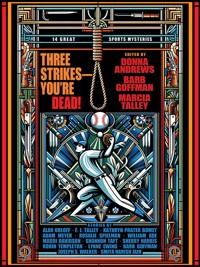
This original collection of sports-themed mystery stories features felonies and foul play across a range of athletics. Readers will find riveting stories involving baseball, biathlon, boxing, cycling, figure skating, swimming, tennis, and more. These clever tales—some penned by award-winning authors—offer something for everyone. From traditional whodunits to historical mysteries from noir tales to cozies, Three Strikes, You’re Dead! is the collection both mystery and sports fans have been waiting for!
Included is work by: Alan Orloff, F. J. Talley, Kathryn Prater Bomey, Adam Meyer, Rosalie Spielman, William Ade, Maddi Davidson, Shannon Taft, Sherry Harris, Robin Templeton, Lynne Ewing, Barb Goffman, Joseph S. Walker, and Smita Harish Jain.
Das E-Book können Sie in Legimi-Apps oder einer beliebigen App lesen, die das folgende Format unterstützen:
Seitenzahl: 375
Veröffentlichungsjahr: 2024
Ähnliche



















Table of Contents
THREE STRIKES—YOU’RE DEAD!
FROM THE SAME EDITORS
COPYRIGHT INFORMATION
INTRODUCTION, by SJ Rozan
MURDER AT HOME, by Alan Orloff
RUN FOR YOUR LIFE, by Smita Harish Jain
THE ULTIMATE BOUNTY HUNTER, by Sherry Harris
PUNCH-DRUNK, by William Ade
RUNNING INTERFERENCE, by Kathryn Prater Bomey
DOUBLE FAULT, by Adam Meyer
OF MICE AND (MURDERED) MEN, by Rosalie Spielman
EIGHT SECONDS TO LIVE, by Robin Templeton
OFF THE BEATEN TRAIL, by Maddi Davidson
RACE TO THE BOTTOM, by Shannon Taft
CUI BONO, by F. J. Talley
THE LAST LAP GOODBYE, by Lynne Ewing
A MATTER OF TRUST, by Barb Goffman
AND NOW, AN INSPIRING STORY OF TRAGEDY OVERCOME, by Joseph S. Walker
ABOUT THE AUTHORS
ABOUT THE EDITORS AND THE SUBMISSION JUDGES
THREE STRIKES—YOU’RE DEAD!
Edited byDonna Andrews, Barb Goffman,and Marcia Talley
Submission Judges
Lucy Burdette, Dan Hale, and Naomi Hirahara
FROM THE SAME EDITORS
Chesapeake Crimes
Chesapeake Crimes 2
Chesapeake Crimes 3
Chesapeake Crimes: They Had It Comin’
Chesapeake Crimes: This Job Is Murder
Chesapeake Crimes: Homicidal Holidays
Chesapeake Crimes: Storm Warning
Chesapeake Crimes: Fur, Feathers, and Felonies
Chesapeake Crimes: Invitation to Murder
Chesapeake Crimes: Magic Is Murder
COPYRIGHT INFORMATION
Collection copyright © 2024 by
Donna Andrews, Barb Goffman, and Marcia Talley.
Copyright © of each individual story is held by the author.
Cover design by John Betancourt.
All rights reserved.
This book is a work of fiction. Names, characters, businesses, organizations, places, events, and incidents either are the product of the author’s imagination or are used fictitiously. Any resemblance to actual persons, living or dead, events, business establishments, or locales, is entirely coincidental.
This edition was published in 2024 by Wildside Press, LLC.
wildsidepress.com
INTRODUCTION,by SJ Rozan
Sport and crime: two of my favorite subjects.
The first, of course, being an allegory of the second.
Crime is behavior not sanctioned in its time and place by a society that deems that behavior destructive. Wearing your pajamas to walk your dog isn’t sanctioned in most places, and will get you funny looks, but it’s not considered destructive. Walking your dog nude—you; dogs are pretty generally nude—would in most places be regarded as offensive to, and thus potentially undermining of, public morals and would get you a ticket and maybe a newspaper to cover your privates as the ticket-writing cop escorted you home, or to the hoosegow to sober up. Throwing a baby out a window would be a shocking attempt at infanticide, except if you’d run into a burning house to save the baby and were lofting it into its mother’s arms. Then it’s heroism.
So it is with sports.
Punching a stranger in the face is assault, apart from in the boxing ring, where it’s the sweet science.
Throwing someone to the ground and piling onto him with a half-dozen other people could be construed as a mugging, except on the rugby field, where it’s a scrum.
Stealing a valuable item from someone who clearly had possession of it is theft; but on the basketball court it’s great defense.
Athletics were invented to channel aggression. In ancient Greece, where modern sports began, there was no concept of training. Athletes competed against each other not to prove who was fastest or strongest, but to prove whom the gods favored. If you won, QED. In ancient Mongolia, warring tribes would call a truce every couple of years and set up camp on a huge field, where they’d compete in the arts of war. Archers would shoot at targets, not each other. Wrestlers would throw one another to the ground but permit the loser to rise again. The Mayans had a ball game, and occasionally enemy cities would play it instead of going to war. The losing side would send tribute to the winners, who would become their default rulers. (No, the losing side wasn’t sacrificed; that’s a misreading of pictorial narrative. Makes a good story, though…)
As actual war-fighting became more dependent on technology, and as peace, however troubled, began to stretch for extended periods of time, sport burgeoned. As a species we’re made for physical exertion, and aggression’s part of our nature. Sport allows us to battle, if we’re on the field; to scream and yell for our heroes, if we’re in the stands. It allows —it calls for—behavior not sanctioned in our time and place, outside the arena. In that sense, sport is transgressive.
In every sense, crime is transgressive. Behavior allowed in one time or place may be criminal in another—polygamy, say, or criticizing the government. Some behavior, like housebreaking or premeditated murder, is criminal almost everywhere, unless carried out by the state. In the real world, crime is frightening—unpredictable, often dangerous. But in fiction it’s different. Our interest in fictional crime parallels our interest in sports. We can indulge our desire to break free of restraint, to disobey, to sin, without the need to deal with the consequences.
Small wonder, then, that sport and crime go together so well.
In this collection, from baseball to boxing—but not, alas, my own aggression-sublimation of choice, basketball—and from ultimate Frisbee to marching band—doubters beware!—sport and crime interweave, satisfying, as they so often do, the same itch.
Having collected my thoughts during my workout, I write this at the gym. I urge you all to read the stories here, and then go work out yourselves. The exercise might give you enough of a release to keep you from committing a crime.
If not, the increased blood flow to your brain might help you get away with it.
SJ Rozan
Sept 26, 2023
McBurney YMCA
MURDER AT HOME,by Alan Orloff
Two outs, bottom of the fourteenth inning, score knotted at five, game seven of the National League Championship Series. Winner of this game gets their ticket punched to the World Series.
P.J. “Bulldog” Johnson took a short lead off first base and watched as the Cardinals’ sixth hurler of the game wound up and delivered his pitch to the Mets’ clean-up batter, Alfonso Cabrera.
Cabrera swung, and at the crack of the bat, Bulldog took off, begging his old legs to move. He glanced over his shoulder and saw the right fielder take a bad angle, letting the ball squirt past him into the gap, on its way to the wall.
Ahead, the third base coach yelled at him to “run, run, run.”
So Bulldog ran, building up a head of steam, though he was indeed more bulldog than greyhound. He’d been in the league seventeen years now, played catcher for every single one of them, to which his aching knees could loudly testify.
He rounded second as his third base coach was screaming at him to “dig, dig, dig.”
So Bulldog dug. Down deep. Shifted into a gear he hadn’t used for a decade. If he scored, he’d be the hero. After an awful year, after he’d been demoted to third string, suffered neck and shoulder injuries, got into an altercation with a teammate, and found himself in the manager’s doghouse—so to speak—it would be the perfect time to score the winning run and send his team to the Series.
Redemption, so near.
Maybe the guys in the clubhouse would even talk to him again.
He chugged toward third, where the base coach was windmilling his arms, shouting, “go, go, go.”
So Bulldog went. He rounded the base, momentum carrying him wide of the basepath, closer to the fans in the stands, where he could almost feel their collective energy propelling him forward, their roars and prayers fueling his charge toward the plate.
Bulldog barreled on.
Seventy feet to go.
Sixty feet.
Fifty.
Then a cleat caught the ground wrong, just a slight misstep, but he lost his balance, stumbling, stumbling, stumbling, every muscle straining to regain equilibrium, arms flailing, knees buckling, threatening to do a face-plant thirty feet before his goal. Before victory. Before becoming a hero.
The hero. If he scored, all would be forgotten. He’d be anointed. If he tumbled now, he’d be the goat, forever known as the guy who fell on his ass and cost the Mets a chance at the title. His entire career boiled down to this singular moment. Hero or goat, nothing in-between.
That thought gathered him, brought a laser focus back to his attempt to right the ship. Somehow he willed his forty-year-old body to obey, to corral those misbehaving limbs and regain his balance, so he could continue his sprint home.
Victory was fifteen feet away.
Miraculously, his coach’s voice pierced the crowd’s thunderous roar: “slide, slide, slide.”
So Bulldog slid.
He feinted a headfirst dive, then arched his back, flung his legs around the catcher in a wild, old-school-style hook slide, toe searching for the plate. The catcher caught the ball, spun around, slapped the tag on Bulldog’s calf. A bang-bang play. Every single fan in the crowd held their breath, awaiting the call.
Safe?
Or out?
The ump screamed, “Safe.”
And the stadium erupted. The home team had won. It was on to the Series, courtesy of Old Man Johnson scoring from first on forty-year-old legs.
Bulldog lay there, right on home plate, soaking it all in. He figured he had about seven seconds before his entire team emptied onto the field and onto him, in the most glorious celebratory dogpile in the history of dogpiles.
Bulldog basked in glory as the entire mass of teammates piled on top of him. He was truly the hero, for the first time in his long, rocky, underwhelming career.
And for the last.
* * * *
Mets General Manager George Wellingham stopped the video playback on his iPad. A still picture of Bulldog Johnson’s lifeless body lying across home plate appeared frozen on the screen. “Forty-two thousand witnesses, in person. Another six million witnesses on TV. The game’s star, dead at home! And nobody saw what really happened!”
“What happened? I thought it was a heart attack,” Rick Baines said. He’d been shocked when the GM called him late last night, summoning him to an eight a.m. meeting. He could count on zero fingers the number of times Wellingham had asked him to come to his office for a chat. After all, he was only one of the team’s assistant hitting coaches. And now, the morning after one of the most tragic—and bizarre—occurrences in professional sports? Something was up, and Baines was pretty sure he wanted no part of it.
Wellingham set the iPad down on his desk. “I wish it was a heart attack. Officially, the cause of death has not yet been determined. But Mr. Petrone, our esteemed owner and String-Puller-in-Chief, yanked on a few well-placed strings—at the ME’s office—and learned that the preliminary findings indicate Johnson had been poisoned, injected with something lethal. And they’re pretty sure it happened at the bottom of that dogpile.”
“Poisoned?” Baines had been right there when it had happened, watching the action from the dugout steps. After Johnson had scored, though, Baines hadn’t stormed the field with the rest of the team. He’d stayed in the dugout to keep an eye on the equipment in case some exuberant—and drunken—fans wanted souvenirs. He knew how much the players’ lucky bats meant to them, and he also knew it was the responsibility of someone low on the totem pole to keep watch.
From his vantage point, Baines had seen pretty much what the video showed. Bulldog Johnson scoring the winning run, getting mobbed by his teammates, and not getting up after everyone else had. Death was terrible, but if you had to die, that was a pretty dramatic way to exit. As a Mets hero.
“Who would want to kill Bulldog?”
“Only about every person he’d ever met,” Wellingham said. “In case you hadn’t noticed, he rubbed people the wrong way. Hard and often.”
Wellingham wasn’t wrong; Bulldog was an asshole.
“Right now, I wish he hadn’t even been in the game. It would have been better for all involved if he’d been poisoned elsewhere.” Wellingham’s face turned red. “Well, I guess it wouldn’t have been better for Johnson.”
Despite his callousness, Wellingham was correct. Ordinarily Bulldog wouldn’t have been in the game. It had been months since he’d played, spending much of that time in the minors rehabbing his shoulder. He’d been placed on the expanded playoff roster only because the team’s regular backup catcher broke his thumb in the last regular season game. And he was only on the field because Tommy Evans had sprained his ankle beating out a grounder, and every single other capable runner—including two of the rotation’s starting pitchers—had already been pressed into duty. The manager had no choice but to send Bulldog into the game to pinch run for Evans.
“Do the police have any leads?” Baines asked.
“First of all, there is no official investigation. Not yet. Something else Mr. Petrone arranged with his buddy, the district attorney. Neither of them wants to do anything that might tarnish this city’s time in the spotlight while we’re in the Series. So somehow, Mr. Petrone persuaded the powers that be to keep things on the down-low until the Series is over. Hopefully, we’ll sweep, and they can get to it quickly.”
“Yes, sir.” Baines sat there quietly, admiring all the shiny hardware in a display case behind Wellingham’s enormous desk, still wondering why he was called in.
Wellingham seemed to read his mind. “I bet you’d like to know why you’re here, wouldn’t you, Barnes?”
“As a matter of fact, I would. And it’s, uh, Baines, sir. Rick Baines.”
“Baines. Right. Sorry.” He waved his hand in the air, gaffe dismissed. “I need you to do me a favor.”
Baines had heard those words before, from various friends and acquaintances, and about half of the time, things went south. He had the strong feeling this would be one of those times. But he sure did like working for the Mets, and helping the head cheese was a good way to get noticed.
“Absolutely,” he said, adding quickly, “if I can, of course.”
“Of course.” Wellingham leaned back in his chair, picked up a baseball from his desk, and gripped it as if he were about to throw a slider. “I understand you’re pretty tight with the players. Well liked in the clubhouse. And you’re barely older than most of them. Speak their language.”
“I guess that’s a fair statement. I’ve gotten to know most of them pretty well.”
“Good, good. Then I have an assignment for you.”
“Okay.” A few goose bumps prickled Baines’s forearm.
Wellingham set the ball down and made a grand gesture in the air, both arms held wide. “This is our home, son. Our home. And I’ll be damned if I’m going to stand back and wait for someone else to clean it up.” Wellingham flashed a toothy grin, and in that moment, Baines knew exactly how Little Red Riding Hood felt. “I need you to get involved with this.”
“Involved?”
“Here’s what I want you to do. First, be polite and cooperate with the police, but keep in mind that there’s cooperation and there’s cooperation, capisce? Just answer their questions as succinctly as possible. Don’t offer anything extra.”
“Okay.”
“But what I really want is for you to use your rapport with the players to ferret out what happened.”
The bottom dropped out of Baines’s stomach. “Sir?”
“I need you to find Johnson’s killer, and quick. We’re not going to be able to keep the police—and the press—out of here for more than a few days. And who knows what other stuff they might find if they really muck around?” Wellingham slapped the desk with his palms. “We’ve got a World Series to win! We can’t waste time on all this foolishness, now can we?”
“No, sir.” Baines felt the pressure mount, as if he’d been the one on the bottom of the dogpile. “But here’s the thing. I’m not sure the players will open up to me, especially about something like this. I mean, I’m just a staff assistant, and they’re major-league stars.”
“Let me clue you in on something, son. If you have confidence in your abilities, if you believe in yourself, really believe in yourself, then others will believe in you too. Get my drift?”
Baines didn’t, not entirely. “I still think they may be hesitant to talk to me.”
Wellingham exhaled. “Fine. I’ll send a memo around to the players telling them they’ll be starting off next year in Triple A unless they answer your questions. Think that’ll help?”
“Thank you, sir.”
Wellingham picked up his phone, looked pointedly at the door. “That’ll be all, Barnes.”
* * * *
In light of what had happened, management had given the players the day off. But this being big-money professional sports, most of the players drifted into the park anyway, no doubt wanting to process their grief as a team. And once they got there, they gravitated toward those activities that provided a sense of normalcy.
Some tossed the ball around or took a few swings in the batting cage. Others lifted weights, stretched, or got treatments for their wide assortment of aches and pains. At the end of the long season, there was always a wide assortment of aches and pains.
Baines caught up with Alfonso Cabrera in the weight room. “Great clutch hit, man. You saved the season.”
Cabrera beamed. “Thanks. Feels good going to the Series.”
“For sure.” Baines glanced around. “You got a minute, Al? There’s something I need to talk to you about.”
“Sure.”
“Let’s go someplace a little more private, okay?”
Baines and Cabrera found a quiet spot in the corner of the main equipment room.
“Helluva thing, ain’t it?” Cabrera said. “Bulldog, I mean.”
“Yeah. A shame.” Baines paused for what he thought was an appropriate amount of time to show respect for a fallen teammate. Then he dove in. “Just between you and me, do you know anyone who would want to kill him?”
Cabrera’s eyes went wide. “Kill him? I thought it was a heart thing.”
“Nothing’s been determined yet. I’m just asking.” Baines offered a tentative smile. “So, do you?”
Cabrera pressed his lips together and knitted his brow in an exaggerated show of thinking. “Nope.”
“It’s only the two of us here, Al. We both know that everything wasn’t always rosy in the locker room. And we both know how Bulldog could be.” Baines quit talking, letting Cabrera mull things over.
“Well, between you and me…” Now it was Cabrera’s turn to glance around. He lowered his voice. “Nobody liked that prick. Loud. Obnoxious. Not much of a team player. I imagine a lot of guys would want him gone. But murder? I don’t know. Maybe…” He lowered his voice even more, just barely a whisper. “I were you, I’d talk with Ray-Ray.”
Ray-Ray Foster was the team’s big-hitting first baseman who’d clobbered fifty-nine homers this year, a Mets record. “Yeah? Why do you say that?”
“Heard he found some creative way to beat the drug tests. You see Ray-Ray’s guns this year? No ordinary human can do that, you know? Not without a little chemical assistance. Something’s fishy, and I heard through the grapevine that Bulldog was maybe thinking about blowing the whistle. I don’t know any details, though. Maybe Ray-Ray got scared and blew Johnson’s whistle for good, know what I mean?”
* * * *
“So Ray-Ray, do you have any idea who wanted to kill Bulldog?” Baines and Ray-Ray Foster were alone on the center field grass, where Foster was going through his off-day stretching routine. Cabrera was right; Foster’s gigantic biceps stretched the arm of his T-shirt almost to the ripping point.
Foster lay on his back, working his hamstrings. “Well, I never had a beef with him, but I know plenty of people who did. How much time you got?”
“Hit me with the highlights.”
“Oh, where to start?” He put his right leg down, then grasped the left one behind his knee, drawing it toward his nose. Grunted. “A lot of the guys thought he was phoning it in most of the year. I thought he was doing okay—given that he had limited skills and was an old guy anyway. He didn’t always fall in line, did he? What do you think, he ever listen to any of the batting advice you gave him?”
“Not a lot of it.” Baines had dealt with stubborn players before, those who always thought they knew what was best for their own swings, but Bulldog had been the worst, and it wasn’t even close.
“Terrible, what happened. I just hope his death doesn’t mess up our chances. If it does, I might have to dig up his body and kill him again.”
Baines tried not to picture that. “I, uh, heard something about you.”
“Oh?” Foster stopped stretching.
“Something about beating the drug tests?”
Foster’s eyes flashed. “Who told you that?”
Baines remained silent.
Foster glared at him a moment, then shook his head. “Ah, screw it. Always goin’ to be haters. I built these muscles the old-fashioned way, hard work, lots of reps, lots of weight. I take the tests—legally—and I pass. Every. Single. Time. If somebody has some concrete evidence, tell them to step forward. If not, tell them to shut their goddamn piehole.” His jaw tensed. “If you don’t believe me, talk to Jaime. I’ve been following his regimen to the letter. He’ll vouch for me.”
Jaime Hernandez was the team’s trainer, and he was good at his job, taking numerous players to physical levels they’d never be able to achieve on their own. Baines exhaled. “I believe you, but still, I heard Bulldog was going to turn you in.”
“You think I killed him?” Foster growled. “Why would I? I told you, I don’t use performance-enhancing drugs.”
“Okay then. Let’s move on. Have you noticed any friction between Bulldog and anyone in particular lately?”
Foster rolled onto his stomach and grabbed both of his ankles in a quad stretch. “About a month ago, he got into a heated argument with Clay in the training room. Wound up with them choking each other, until I broke it up. I thought for sure it would go viral on social media, but luckily no one had the balls to whip out their cell phones and take video of it.”
Clay Robinson was the team’s number-one pitcher, a two-time Cy Young winner. “What started the fight?”
“The worst-kept secret around. Bulldog had been pounding Clay’s wife, and Clay finally took exception.”
“Ah.” Baines had heard rumors, of course. Anytime you had dozens of hard-playing professional athletes in close quarters and constant competition, sometimes the competition spilled from the playing field into extracurricular activities. “Were Bulldog and Clay’s wife still, uh, seeing each other?”
Foster sat up. “I don’t know, Coach. Maybe you should go have a talk with Clay yourself. Another dude sleeping with your wife might be enough to lead some guys to murder. Just promise me one thing: don’t get him riled up, okay? It wouldn’t be good for our chances if our ace lost his shit over this. And if that happens, I’m coming for you, understand?” Foster flexed, and his T-shirt ripped at the seams.
Baines gulped. He understood. Completely.
* * * *
Baines corralled Clay Robinson after the star pitcher’s arm-loosening session in the bullpen. Robinson was lanky, with extra-long arms and movie-star looks. An ace pitcher and ace product pitchman in one neatly groomedpackage. Even when it seemed as if he was casually tossing the ball around, his velocity hovered around one hundred miles per hour—and he looked great doing it. “Got a minute?”
“Sure. What can I do for you?” Robinson hit Baines with a megawatt smile, and it was obvious why a leading toothpaste company hired Robinson to hawk their product.
“Just have a few questions.”
“Okay, but make it quick. There’s a whirlpool with my name on it. Then a quick trim at the barber. After that, I’ve got a dozen TV interviews to do. What can I say? If people want to hear what I think about things, I’ll tell ’em!”
Clay Robinson could talk the ear off an elephant. If the ump didn’t get involved, some of Robinson’s pitcher’s-mound conferences would likely go on for an hour. “Do you know anyone who wanted to harm Bulldog?”
“What?” Robinson seemed taken aback. “I thought his heart gave out on him, which makes perfect sense, seeing how he took care of himself. You ever see what that dude ate? And how much? But you’re telling me someone killed him? How? During our home-plate celebration?”
“The medical examiner isn’t exactly sure what happened. Management asked me to nose around a little.”
“Oh? What? Like Sherlock Holmes? You looking to see what kind of dirt you can dig up?”
“I wouldn’t exactly put it that way.” An uncomfortable moment passed. “Any ideas about who could have done this?”
Robinson was about to answer when his handsome features tightened. “Are you asking everyone about this or only me? Because of the fight we got into? You don’t think I had anything to do with Bulldog’s death, do you?” Robinson clenched and unclenched his fists at his side.
Baines was tempted to ask him flat out if he killed Bulldog, but figured if he did, this conversation would be over, no matter how much Robinson liked to gab. “Not at all. I’m talking to a lot of people, hoping that maybe someone noticed something. Someone looking to settle an old score, perhaps?”
Robinson sucked in a breath, seeming to calm down. “Okay. Sure. Makes sense.” He thought a minute. “Nope. Don’t remember anything out of the ordinary. And by that I mean, most of the guys didn’t like Bulldog, but I didn’t notice anyone not liking him worse than usual. Maybe it was some crazy stalker fan?”
Baines had briefly considered that, but it didn’t fit. “Some of the fans certainly seem unhinged, but none of them would have had access to Bulldog at the time of death.”
Robinson stroked his freshly shaved chin, and Baines was reminded of the shaving cream commercial Robinson appeared in, the one with the gorgeous model going gaga over the athlete’s smooth face. “You have a point.”
“Just because I know someone will ask, can you tell me why you and Bulldog got into that fight?” Baines asked.
Robinson stared at Baines. “We worked it all out. Man-to-man. Just a little disagreement.”
A little disagreement? Not what Baines had heard. “Seemed like more than that.”
“Water under the bridge.”
“Come on, Clay. If you don’t tell me, I’m going to assume the worst. That maybe whatever you guys were arguing about might have led you to do something drastic.” Baines leaned closer. “I heard it had something to do with your wife.”
“Don’t believe all you hear.”
“I don’t. But some people do. Might be nice to put all the gossip to rest, huh?”
Robinson glanced around. Licked his lips. Exhaled. “Okay. Fine. Yes, Bulldog and my wife were, well, you know. But it’s been over for a while. And me and Bulldog settled things. Just a gigantic, misfortunate, terrible one-time drunken incident. But me and him had come to an understanding. I didn’t kill him over it. Not my style.”
“Which brings us back to: anybody you think might have had it in for Bulldog?”
Robinson ran a hand through his hair, and Baines couldn’t help but notice how thick and lustrous it was, which made perfect sense given that he was a spokesperson for a popular shampoo. “I hate to speak ill of a teammate, but, well, I heard that Cabrera owed Bulldog some serious scratch after one of their marathon poker games. When I heard them talking about it, I excused myself. No way did I need to witness anything illegal going on. I’m not a fool. I have my brand to think about, you know. Hey, if you got everything you need, I gotta bounce.”
Robinson donned a pair of sleek designer sunglasses, and Baines wondered how much Robinson got paid to endorse them.
* * * *
That afternoon, Baines spoke to Cabrera again, asked him about the money he supposedly owed Bulldog. Cabrera confessed that he had, in fact, lost a lot of dough to Bulldog during their last poker game, but that only erased a portion of the debt Bulldog had owed to Cabrera after the previous poker game. Besides, Cabrera said, he would never kill someone over money—or anything else. That wasn’t how he rolled.
Thus far, Baines was batting zero in his investigation, and he didn’t have much confidence his luck would change. He wanted to march into Wellingham’s office and admit defeat, but he figured if he did that, it would be his last official act as a Mets employee.
And that would be too much to bear.
So Baines soldiered on, talking to a handful of other players, coaches, trainers, and support staff, quizzing each person, but he didn’t come away with any useful information that might help him identify Bulldog’s killer. Everywhere he turned, Baines struck out.
He went back to the office he shared with the other two assistant hitting coaches, but his cohorts were working with the players on the field, in the cages, so he had the place to himself. Normally, he would have relished the peace and quiet, but now it unnerved him. His team had just won the National League pennant, but instead of a week-long raucous celebration, a deathly pall hung over the entire organization.
Baines flopped into his chair. Thought about the situation. According to Wellingham, the medical examiner was sure Bulldog had been poisoned, injected with something. And almost to a man, no one could believe Bulldog’s death was anything but a heart attack. Because while a lot of people disliked the man intensely, and while Baines had discovered a few people with possible motives, murder just seemed out of the realm of possibility. This was a baseball team on its way to the World Series. Teammates and coaches banding together to contend for the world championship. A salacious murder like this was fodder for cheesy tabloids and straight-to-streaming movies. Stuff like this just didn’t happen in real life.
Yet…
Someone had killed Bulldog. On home plate. After he’d scored the winning run. Right in front of millions of people.
Baines rehashed the conversations he had with the players. Something tickled the back of his mind. Something that wasn’t so much said, as…not said.
Baines closed his eyes, went over things again. And again. And again.
A theory slowly tumbled around in his head, shifting, dividing, reforming, rearranging, coalescing.
Almost to a man…
* * * *
Baines sat on the floor in the corner of the locker room behind a giant rolling laundry cart. He’d been waiting there for almost seven hours, since right after dinner, only leaving his hiding place twice to hit the head. He had his phone ready to take video if someone showed up.
If his plan worked.
Right before he began his stakeout, he’d texted the man at the top of his list of suspects. Told him he was giving all the players a heads-up that the police would be in the locker room early tomorrow morning. The lead detective had gotten a tip that Bulldog had hidden some very incriminating evidence there—in a secret, custom-built “bling” compartment in his locker—that was sure to point to his killer.
Now, hours later, Baines waited.
If his top suspect didn’t take the bait, Baines would try again with the next name on his list, but for the sake of the entire team, and the entire Mets Nation, he hoped he’d snare his prey tonight.
At ten minutes past three a.m., Baines heard noise from the hallway outside the locker room. Footsteps, then the beep of a keycard being swiped. The locker-room door opened, and a shadowy figure tiptoed across the room, heading directly for Bulldog’s locker, using a phone for illumination.
Baines hit his phone’s recording button and tracked the suspect’s progress. The man wore a loose-fitting hoodie, so Baines wasn’t positive yet who it was.
But he’d only texted one person.
Slowly the man in the hoodie opened Bulldog’s locker. He glanced around, then pointed his phone into the locker and began feeling around.
Baines heard the man cursing under his breath as he searched in vain for the nonexistent hidey-hole. A minute passed and then another.
Baines was about to reveal himself and expose the killer when he heard someone else coming in from the hall. The newcomer wasn’t nearly as quiet. “Hey, what’s taking so long?”
The man in the hoodie answered, “You’re supposed to stay outside.”
“Screw that. Trust me, there’s nobody else in the building. Besides, I’m more likely to be spotted out there keeping watch than in here with you.” The second man spoke in a harsh whisper, but Baines recognized the voice.
Baines rose and shoved the laundry cart across the room, where it smacked into a row of lockers. Both men jumped at the noise, and Baines flipped the nearby light switches, turning on the overhead lights.
Ray-Ray Foster and the team’s trainer, Jaime Hernandez, stood there, frozen, like two scared deer caught in the proverbial headlights.
“Fancy meeting you here,” Baines said, addressing Foster. “So the PED story was true. You found a way to beat the drug tests. Let me guess, Bulldog was blackmailing you and you figured it would be easier to take him out than pay his price. So the trainer here gave you a hypo loaded with poison, and you took advantage of the chaos during the celebration to inject Bulldog with it.”
Hernandez opened his mouth, then closed it without speaking, clearly realizing the futility of offering up an excuse after being caught red-handed. Foster, however, gave it the old college try. “I don’t know what you’re talking about. I forgot my wallet and called Hernandez to help me look for it.”
“In Bulldog’s locker?”
“We were searching around the whole park, in fact.”
“Then why were you ‘keeping watch,’ in your own words?”
Foster’s prodigious neck muscles flexed. “You can’t prove that I killed him.”
“That’s not much of a denial. In fact, that sounds more like a confession. And you were the only one—the only one—who wasn’t surprised when I told you that it was very likely Bulldog didn’t die from a heart attack. As if you already knew he’d been murdered,” Baines said.
“What do you want from us?” Hernandez asked. “If we admit—”
Foster shoved Hernandez aside. “If you think I’m going to let some no-talent hitting coach ruin my career, you’re sorely mistaken.” Foster flashed Baines a look that was nearly lethal. Reddened face, clenched jaws. Baines wasn’t sure if it was ’roid rage causing the big man to spiral out of control, but he appeared ready to burst. “I’m gonna kill you too!”
Ray-Ray Foster charged Baines, much as he charged the mound after getting beaned by an opposing pitcher a few weeks ago. That hadn’t ended well for Foster—a two-game suspension—or for the pitcher—a broken jaw—but this had the potential to be even more disastrous, especially for Baines.
Baines grabbed Bulldog’s favorite bat from where it leaned against the wall—he’d brought it with him, just in case. He gripped the handle, rows of knuckles aligned, and took a short stride, eyes glued to the incoming target. His compact yet powerful swing connected squarely with Foster’s left hip. The sound—and impact—of maple on bone was enough to make a grown man whimper. And collapse.
Foster crumpled to the floor in agony.
Baines might not have possessed major-league talent, but he did know how to swing a bat. He turned to Hernandez. “You want a turn? Go ahead. I’d love to keep my hitting streak alive.”
* * * *
Two weeks later, after the Mets swept the Series in four, members of the entire organization gathered on the stage to address the crowd after their victory parade. As they waited for the festivities to start, GM George Wellingham sidled up to Baines. Gave him a smile, one full of warmth and gratitude.
“You did it, my boy. You did it. You cleaned up our house in short order. Very impressive. By the way, now that we’ve won the championship, your boss is retiring, and I’m looking for a new hitting coach. If you want the job, it’s yours.” Wellingham clapped Baines on the shoulder. “Be proud of yourself, kid. Without you, I don’t think we would’ve won the World Series—too much finger-pointing and distraction. You’re a hero, Barnes. A real American hero.”
RUN FOR YOUR LIFE,by Smita Harish Jain
It was the third Monday in April, and crowds of people holding signs lined up along one side of the quarter-mile stretch that marked the halfway point for the Boston Marathon. The first wave of runners had left Hopkinton at 9:32 a.m. I checked my watch. Mitchell was in Wave Three, which meant he would come through around 12:35 p.m. If all went according to plan, he would die on Heartbreak Hill around 1:30 p.m.
* * * *
The Cheer Tunnel has been a Concord College tradition since the race started 125 years ago. The school sits at almost exactly the halfway point of the 26.2-mile race, and students and townspeople alike come out to cheer on the marathoners before they get to the most challenging part of the course—the Newton hills that have felled many a runner.
I got to the Cheer Tunnel early so I could get a spot in the front row, where fans could give the runners a piece of cut fruit, a hug, or a drink to keep them going. I found an opening about two-thirds of the way in, at the ribbon that separated spectators from athletes. From my vantage point, I’d be able to see Mitchell in plenty of time to have his drink ready to hand to him.
Almost every marathoner ran alongside the line of people assembled on Central Street, hungry for the boost they got from our shouts. By the time they reached the halfway point, they were no longer in one big cluster and could enjoy their individual moment with the fans—a sea of people waving a storm of signs, all designed to motivate them.
“Kiss Me, I’m from Cameroon.”
“Kiss Me Before You Go.”
“Kiss Me, I’m a Marathon Virgin.”
The convention of asking the race participants for kisses had grown over time—from runners saluting the fans, to giving them high fives, and, ultimately, getting close enough to kiss them. Custom had it that the girl who gets the most smooches in the Tunnel wins bragging rights until the following year, when the signs become more provocative and eye-catching. Last year, first place in the contest went to a group of naked girls holding one large sign that read, “If you give us a kiss, we’ll drop the sign.” I held a sign that read, “Kiss Me, I’m a Chemistry Major,” and got more drug references than kisses.
* * * *
Mitchell and I had met at a mixer at Beta Tau, one of the handful of societies at Concord, and I was instantly smitten. He was tall and lean and totally into me. We hooked up that night and then, six months later, he invited me on our third walk around Cabot Lake. I knew what that meant.
“OMG! He’s going to propose! Can you believe it?” Steff sounded as excited about what was going to happen as I was.
“We have to find the perfect outfit,” Lisa said. “You don’t want to look too eager.”
“Yeah. Make him work for it,” Moira said.
We picked an outfit that was demure but pretty—a plaid wool skirt with wool tights, a Fair Isle sweater, and, of course, a string of pearls. I didn’t want to look like I was expecting it, even demanding it, but the tradition was as old as Concord College itself. Mitchell’s mother was a Concord Woman too, so he must have known what he was supposed to do.
Mitchell was a senior at Brooker University and would be graduating in a couple of months. I had another year of college left, which meant we had a decision to make. I already knew I wanted to spend the rest of my life with him, but every time I brought up our future, he changed the subject. I talked to his friends about his plans, even stalked his social media for clues, but got nowhere. I finally gave up and decided to wait until he told me himself. A few days later, when he suggested the walk, I had my answer.
It was a cold day in mid-March when we went around Cabot Lake for the third time. The temperature hovered in the single digits, which was normal for that time of year in Massachusetts. Most of the snow from the last nor’easter had been removed by the boots, running shoes, and occasional high heels that used the trail on a daily basis. Mitchell wouldn’t have to worry about getting his clothes wet when he got down on one knee.
When we had made it all the way around the gorgeous three-mile loop, lined with canopies of birch, maple, and eastern white pine, Mitchell took my hand and led me to one of the benches that looked out over the water.
“Annie, you know I’m graduating in a couple of months,” he said.
I hated it when he called me Annie. “It’s Anastasia,” I wanted to shout, but didn’t. It would ruin the mood.
“We’ve been seeing each other for a while now.”
He was doing it! He wasn’t kneeling, like I had hoped, but I could point that out later. It would be part of the story we told when friends asked how Mitchell proposed to me. I would poke him playfully as I recounted the details, all the while giving him a disappointed look, so he would know that I wasn’t pleased with the way he had done it, but that I had said yes anyway. Our friends would nod in agreement and think I was a saint not to be mad at him.
“I’ve really liked hanging out with you.”
Liked? Hanging out? WTF?!
Spending almost every weekend together for the past six months? Having sex in a tent on the beach? Meeting my parents? He called that “hanging out”? Was he insane?
“I can’t see myself being tied down right now. I’m only twenty-one, and I have my whole life ahead of me. I don’t even know what I want or where I’ll be after graduation,” he said.
What. Was. Happening?
“We’ve had some laughs, though. You understand, don’t you, Annie?”
I most certainly did not understand.
“Did I do something wrong? Just tell me, Mitchell. I can fix it.”
He turned away and looked out over the lake, like he had nothing more to say.
“Is it someone else?” I barely got the words out.
Mitchell shook his head.
So, it was me. He didn’t want to be with me.
“I’ll see you around, Annie,” he said and stood up to leave.
Who the hell did he think he was? I thought about pushing him into the lake. That’s what you got to do if the guy didn’t propose after the third time around. Everybody knew that. I didn’t do it, though, because that would be letting him off too easy. Mitchell Callahan had humiliated me, led me on, and worst of all, broken my heart.
* * * *
“Wave One is through Ashland,” a voice in the crowd announced.
I looked around and saw a girl sitting on a man’s shoulders and shouting updates into a megaphone. The crowd gave a thunderous cheer. The first of the runners would be passing through the Tunnel any minute.
I used the distraction of these first arrivals to check on the drink in the small cooler beside me. I couldn’t pour the contents into a cup yet because another runner might grab it. Worse, I could get bumped, spill the whole thing, and be left standing there as Mitchell ran away from me. No, I would wait until he was getting close. I knew exactly when that would be.
Mitchell, who was able to run in this year’s Boston Marathon because his father bought him one of the charity slots, told anyone who would listen what his strategy would be: “I’m going to pace myself at eight-minute miles. That way, I’ll have plenty left in the tank when I get to Newton. I could pick up the pace a bit, but you gotta protect those quads, am I right?” By my calculations, that would put him here in about two hours.




