


1,99 €
Mehr erfahren.
- Herausgeber: Quickie Classics
- Kategorie: Geisteswissenschaft
- Sprache: Englisch
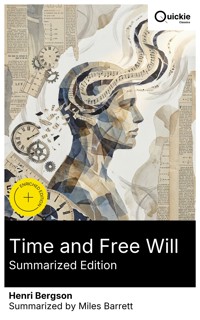
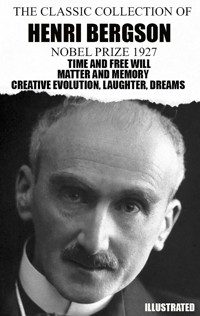
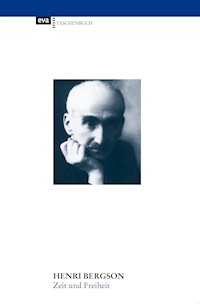
Time and Free Will argues that lived time (durée) is a qualitative flow, not the homogeneous, spatialized time of mechanics. Through analyses of intensity, the interpenetration of mental states, and the famous melody example, Bergson critiques psychophysics' arithmetic of the mind and the determinism it supports. In lucid, image-rich prose, the essay straddles psychology and metaphysics, opposing late nineteenth‑century positivism and associationism while inaugurating a distinct method of intuition. Henri Bergson (1859–1941), trained in mathematics at the École Normale Supérieure and shaped by Ravaisson and Boutroux, submitted this study as part of his 1889 doctoral theses. Dissatisfied with how calculus and physics spatialize time, and informed by close reading of psychophysics and British empiricism, he sought the immediate data of consciousness. These concerns anticipate his later accounts of memory and creative evolution, which would earn him the 1927 Nobel Prize. Recommended to readers probing freedom, agency, and temporality—from philosophers of mind and phenomenologists to psychologists wary of reductionism—this classic equips them with a precise vocabulary and vivid examples. Clear yet conceptually daring, it remains a compelling point of departure for rethinking what it means to live in time. Quickie Classics summarizes timeless works with precision, preserving the author's voice and keeping the prose clear, fast, and readable—distilled, never diluted. Enriched Edition extras: Introduction · Synopsis · Historical Context · Author Biography · Brief Analysis · 4 Reflection Q&As · Editorial Footnotes.
Das E-Book können Sie in Legimi-Apps oder einer beliebigen App lesen, die das folgende Format unterstützen:
Veröffentlichungsjahr: 2026
Ähnliche







Time and Free Will (Summarized Edition)
Table of Contents
Introduction
Between the measured ticks of clocks and the felt flow of consciousness, Bergson locates the possibility of freedom. Time and Free Will is an invitation to rethink what we mean by time, and how that meaning shapes our understanding of choice, responsibility, and the self. Henri Bergson proposes that a pervasive confusion—treating inner duration as if it were just another stretch of space marked by units—distorts both psychology and ethics. Without relying on technical jargon, he clarifies why experiences unfold with a continuity that numbers cannot capture. The result is a philosophical journey that begins in everyday awareness and ends by reframing human freedom.
A philosophical treatise first published in 1889 in French, this early book appeared in late-nineteenth-century France, amid expanding experimental psychology and mechanistic science. It belongs to the genre of rigorous, argumentative essay with examples drawn from common experience. Rather than a narrative, it presents a sustained analysis of consciousness and agency, developed with careful distinctions and patient exposition. Readers encounter an author writing in an era of confidence in measurement and causal explanation, yet attentive to the irreducibility of inner life. The publication context matters: it signals a response to prevailing intellectual habits that equated precision with quantification.
Time and Free Will unfolds as a clear, progressively layered argument addressed to thoughtful general readers as well as students of philosophy. Bergson begins from the felt continuity of inner life and shows how ordinary language and habits of measurement can mislead reflection. He moves through analyses of multiplicity, emotion, and deliberation, always returning to experiences anyone can recognize. The voice is confident but inviting, marked by concrete illustrations and careful conceptual separation. The style balances analytic precision with imaginative reach, producing a tone that is exploratory rather than dogmatic and that rewards slow, attentive reading without presupposing specialist training.
In its central chapters, the treatise distinguishes two senses of time: the homogeneous, divisible series used by science and the qualitative duration lived from within. Bergson contends that the former employs spatial metaphors that flatten the interpenetrating flow of consciousness into discrete, countable units. To mistake one for the other is to mistranslate feelings, desires, and thoughts into abstractions that never quite fit their originals. By recovering the continuity of duration, he aims to do justice to how experiences shade into one another, how states overlap, and how a life is more than a list of moments placed side by side.
On this basis, the book reevaluates freedom without appealing to mystery or denying causality. For Bergson, a free action is not a random interruption of nature but the unfolding expression of a person’s history and character as durationally composed. He criticizes models that reduce decision to mechanical addition of motives, arguing that deliberation has the texture of growth rather than of arithmetic. The analysis reframes responsibility as responsiveness to oneself over time, not as simple exemption from influence. Without polemics, the argument restores complexity to willing, suggesting that freedom is intelligible when we stop searching for it among isolated instants and impulses.
These ideas remain pressing in a culture saturated with metrics, schedules, and digital dashboards that map life into fragments. Bergson’s distinction helps clarify why experiences of time under attention economy pressures—multitasking, constant notifications, data-driven goals—can feel at odds with creativity, care, or rest. It also offers nuance to contemporary debates in psychology and neuroscience about agency, complementing empirical findings with an account of first-person continuity. Artists and designers can find resources here for thinking about rhythm, transition, and immersion. For readers navigating complex responsibilities, the book models how to honor lived temporality without rejecting the practical uses of measurement.
Approaching Time and Free Will profitably means granting its central term—duration—a patient hearing, letting examples accumulate until a new picture of inner life becomes plausible. The book does not offer quick formulas; it invites a shift in sensibility that can illuminate everything from planning a day to interpreting a life. Written in a lucid yet richly suggestive style, it stands as a landmark of modern thought without requiring allegiance to any school. Its enduring importance lies in the way it rescues freedom from caricature and time from reduction, giving contemporary readers conceptual tools to live more attentively and responsibly.
Synopsis
Henri Bergson’s Time and Free Will presents an inquiry into the “immediate data” of consciousness, arguing that inner experience resists the quantitative habits of science and common sense. Written as a sustained philosophical essay, it begins by defining its task: to describe lived mental states without translating them into numbers, spatial images, or mechanical schemas. Bergson contends that many classic problems in psychology and metaphysics arise from confusing what is qualitative and flowing with what is homogeneous and divisible. The book sets out to disentangle these orders, tracing how the misapplication of measurement distorts our ideas of sensation, succession, and choice, and preparing the way for a rethinking of freedom.
The opening movement challenges the prevailing psychophysical view that sensations possess measurable “intensities.” Bergson claims that when we say a feeling is stronger or weaker, we often smuggle in external references—stimuli, bodily reactions, or behavioral thresholds—rather than capturing the felt change itself. He focuses on the inner profile of experience, where differences appear as modifications of the whole state rather than units added or subtracted. This critique does not deny practical measurement of causes or effects; it denies that such measurements directly mirror consciousness. The distinction frames his broader aim: to protect the specificity of the mental from categories adapted to material extension.
Developing this, Bergson argues that intensity is not a quantity located along a single scale but a qualitative nuance, a transformation within a living context. What looks like comparison by magnitude is instead a judgment about difference in kind within a constellation of sensations, memories, and attitudes. Psychophysical laws, in his view, measure external conditions or bodily correlates while mistaking their results for the inner fact. By re-centering attention on what is immediately given, he seeks to dissolve puzzles generated by forcing psychic life into numerical gradations, and he redefines “more” and “less” as signs of altered configuration rather than increments within a homogeneous container.
The book then pivots to the notion of multiplicity, distinguishing two forms. Quantitative multiplicity is composed of discrete units distributed in a homogeneous medium suited to counting—paradigmatically, space. Qualitative multiplicity, by contrast, characterizes consciousness as a continuity whose moments interpenetrate without sharp boundaries. On this account, inner states do not lie side by side but shade into one another, so that their succession is a genuine flowing rather than a series of positions. This contrast illuminates how treating mental life as a set of juxtaposed elements already presupposes spatialization, and how doing so misrepresents the lived sense of passage and growth.
From this distinction emerges Bergson’s central concept of duration, the time proper to consciousness. Duration is an indivisible, heterogeneous continuity in which past states persist and enter the present as a living influence. It cannot be captured by dividing time into identical instants, because such division constructs a spatialized time analogous to a line of points. While the homogeneous time of clocks is indispensable for action and science, Bergson insists that it abstracts from the very movement that constitutes inner life. Recognizing the difference helps explain why certain philosophical antinomies arise when we equate the measured succession of units with the experienced flow of becoming.
Bergson also examines how language and habitual thought reinforce spatial habits. Words and symbols carve continuous processes into stable objects for ease of communication and practical coordination. Number and measurement, invaluable for dealing with external things, are extended by analogy to the mind, where they lose grip on what they seek to express. The essay calls for a method attentive to the immediate—an intuition of qualitative change that does not substitute schema for experience. Against psychological theories that build the self from associated elements, Bergson stresses how memory and expectation knit states into an ongoing whole, without reducing this unity to aggregation.
With this groundwork, the book addresses the classic debate on free will. Determinism, as portrayed here, often depends on viewing motives and states as discrete forces whose resultant fixes the act. Indeterminism, in reaction, may picture choice as a capricious interruption. Bergson reframes the problem by returning to duration: an action ripens within the continuity of the self, drawing on a history that is lived rather than stored as separate items. The decisive moment is not the sum of juxtaposed motives but the expression of a developing personality, articulated in time. Consequently, prediction by enumeration misses the dynamic synthesis at play.




